

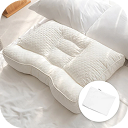
Why did you wake up today feeling like your neck was locked in a vice? You probably blame a long day at your desk or a stressful commute. Most often, the real culprit is the flat, unsupportive pillow you've been trusting for eight hours every night. It's exhausting to cycle through "deals" that lose their shape and go flat before the season even changes.
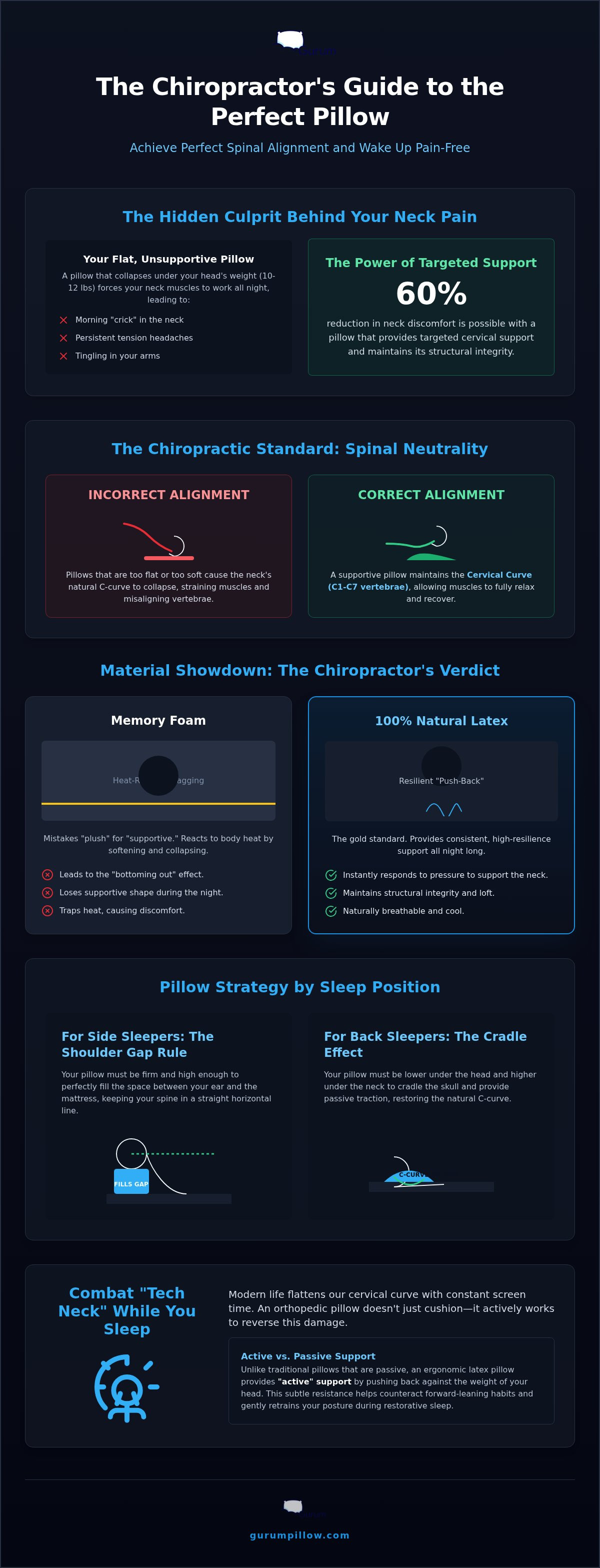
You aren't alone in feeling frustrated by a morning "crick" or persistent tension headaches. We understand the physical and emotional toll that comes with a lack of restorative rest. You want to know what kind of pillow do chiropractors recommend so you can finally stop guessing and start healing. This guide delivers the specific features, materials, and ergonomic shapes that experts trust to achieve perfect spinal alignment. Research shows that targeted cervical support can reduce neck discomfort by up to 60 percent, but only if your pillow maintains its structural integrity.
We'll explore the science of cervical support and the crucial difference between "soft" and truly "supportive" materials. You'll also learn why 100 percent natural latex is the secret to a long-lasting investment in your sleep health. It's time to wake up feeling refreshed, cool, and completely pain-free.
Key Takeaways
- Understand why spinal neutrality is the foundation of waking up pain-free and how your pillow protects the natural C-curve of your neck.
- Discover what kind of pillow do chiropractors recommend by comparing the sagging of memory foam against the resilient push-back of natural latex.
- Learn the Shoulder Gap rule for side sleepers and how to maintain a neutral loft if you prefer sleeping on your back.
- See why 100 percent natural latex is the gold standard for maintaining structural integrity and preventing Tech Neck symptoms.
- Find out how an ergonomic design created by a chronic pain sufferer can offer a permanent solution to your morning stiffness.
The Chiropractic Standard: What Defines a Recommended Pillow?
You've likely spent a small fortune on pillows that promise the world but deliver a stiff neck by sunrise. It's a common cycle of disappointment. When you ask what kind of pillow do chiropractors recommend, they don't point toward the softest cloud in the store. Instead, they look for structural integrity. A truly effective pillow acts as a functional tool for your skeleton, not just a soft place to rest your head. Its primary mission is to support your cervical lordosis, which is the natural C-shaped curve of your neck. Without this support, your muscles stay "on" all night, struggling to hold your head in place while you try to rest.
Many people mistake "plush" for "supportive," but a pillow that collapses under the weight of your skull is the enemy of a healthy spine. Your head weighs about 10 to 12 pounds. If your pillow doesn't offer enough resistance to push back against that weight, your neck vertebrae will drift out of alignment. This misalignment creates tension that radiates from the base of your skull down to your shoulder blades. Professional recommendations focus on pillows that maintain their loft and shape from the moment you lie down until the moment your alarm goes off.
The Core Principles of Orthopedic Support
Consistency is the hallmark of a professional-grade sleep surface. Your pillow must feel the same at 2:00 AM as it did when you first tucked in at 10:00 PM. If a material reacts to your body heat by softening or sagging, it's failing you. This is why material density is so critical. High-resilience materials provide the "push-back" necessary to keep your spine in a straight line. An Orthopedic pillow is specifically engineered to fill the anatomical "gap" between your mattress and your neck. By filling this void, the pillow allows your neck muscles to fully disengage and recover from the day's strain.
Why Your Current Pillow Might Be Failing Your Spine
The most common failure is the "bottoming out" effect. This happens when your head sinks completely through the fill until you're essentially resting on the mattress itself. When this occurs, your spine loses its neutral position. Spinal neutrality is the state where vertebrae are stacked without torque or strain. If you aren't in this state, you'll likely experience the classic signs of misalignment: morning headaches, tingling in your arms, or that nagging "crick" in your neck. These aren't just signs of a bad night's sleep; they're your body's way of telling you that your current support system has collapsed. Understanding what kind of pillow do chiropractors recommend is the first step toward ending that physical frustration for good.
Restoring the Cervical Curve: The Science of Neck Alignment
Anatomy isn't just for textbooks; it's the blueprint for your recovery. Your neck consists of seven small vertebrae, labeled C1 through C7, which form a delicate forward curve known as the cervical lordosis. During the day, gravity and "Tech Neck" (forward head posture) put immense pressure on these bones. At night, your pillow must act as a corrective tool. When patients ask what kind of pillow do chiropractors recommend, the answer always involves restoring this natural curve. If your pillow is too high or too flat, these vertebrae are forced into a straight line or, worse, a reversed curve. This condition, often called "Military Neck," leads to chronic nerve compression and muscle fatigue.
For back sleepers, achieving the "Cradle Effect" is vital. This means your head should actually sit slightly lower than your neck. A pillow that is contoured to be higher under the neck and lower under the skull provides passive traction. This gentle pressure encourages the C1 through C7 vertebrae to settle into their natural alignment. As noted by Harvard Health on pillow choice, the right support can prevent the morning stiffness that stems from hours of poor positioning. By supporting the neck's arch, you allow the surrounding ligaments to finally go slack and heal.
Combating Forward Head Posture (Tech Neck)
Modern life has us constantly looking down at screens, which flattens the cervical curve over time. Your pillow should work to reverse this damage while you sleep. Unlike traditional pillows that simply provide a soft surface, an orthopedic design offers "active" support. This means the material pushes back against the weight of your neck rather than letting it sink. This subtle resistance helps counteract the forward-leaning habits of your day. If you've noticed your posture slipping, using a Premium Latex Pillow can help reinforce the healthy alignment your chiropractor works to achieve during your visits.
The Role of Loft (Height) in Spinal Health
Loft is not a one-size-fits-all measurement. The ideal height of your pillow depends on your shoulder width and the firmness of your mattress. If you have broad shoulders, a low-loft pillow will leave your neck hanging, causing lateral strain. Many people try to solve this with "adjustable" pillows filled with loose, shredded materials. However, loose fill often shifts during the night, leading to inconsistent support that leaves you misaligned by 3:00 AM. For a deeper look at how height affects your body, check out our Cervical Pillow Guide: How Ergonomic Support Heals Neck Pain at Night. Consistency is king when it comes to spinal health.
Latex vs. Memory Foam: The Chiropractor's Verdict
Choosing between memory foam and latex is where most people get stuck. You've likely felt the cozy, "melting" sensation of memory foam and assumed it was the peak of comfort. While memory foam is excellent for initial pressure relief, it often struggles to provide the long-term structural integrity your spine requires. When you look at what kind of pillow do chiropractors recommend, the focus shifts from a "soft feel" to "reliable resistance." Natural latex provides an instantaneous push-back that maintains its height regardless of your body temperature or the time of night.
Breathability isn't just about staying cool; it's about spinal stability. When a material traps heat, it forces you to toss and turn to find a cooler spot. Every time you shift, you risk losing your neutral alignment. Chiropractors prefer materials that promote a deep, still sleep by regulating temperature. Durability also plays a major role in your health. A high-quality natural latex pillow typically maintains its supportive properties for 5 to 10 years. In contrast, synthetic foam often begins to degrade and sag within just 2 to 3 years, leaving your neck vulnerable to strain.
The Temperature-Support Paradox
Memory foam is viscoelastic, meaning its firmness is dictated by heat. As your body warms the pillow, the material softens and allows your head to sink deeper. This creates a "sinking" feeling that can actually trap your neck in a fixed, often misaligned position. Latex features a unique open-cell structure. It provides constant support that doesn't rely on your body heat to conform to your shape. If you find yourself waking up to "fluff" your pillow at 3:00 AM, it's a clear sign your support has failed. You aren't just a "bad sleeper"; you're likely using a material that can't handle the physical demands of an eight-hour rest.
Hypoallergenic and Health Benefits
There is a hidden link between your respiratory health and your spinal health. If you're congested due to dust mites or "off-gassing" from synthetic chemicals, you're more likely to breathe through your mouth and toss restlessly. This movement disrupts your cervical alignment. 100 percent natural latex is inherently resistant to dust mites and mold, creating a cleaner sleep environment. Choosing a natural material also means avoiding the volatile organic compounds (VOCs) found in many cheap, synthetic foams. For a deeper dive into these differences, read our article on Latex vs. Memory Foam: Why Natural Support Wins. Investing in the right material is the first step toward a pain-free morning.
Choosing Your Pillow Based on Sleep Position
Your preferred sleep position is the most important variable when determining what kind of pillow do chiropractors recommend. A pillow that feels like a dream for a back sleeper can be a nightmare for someone on their side. The goal is always the same: keep your ear, shoulder, and hip in a straight line. If you feel like you're fighting your pillow all night, your alignment is the casualty. Most people choose a pillow based on how it feels in the store for ten seconds, but your spine needs a solution that works for eight hours.
Combination sleepers, who move throughout the night, face a unique challenge. They need a material that is responsive enough to adapt to movement without losing its shape. This is where natural latex shines. It provides an immediate "push-back" that follows you as you shift from your back to your side. This prevents the momentary lapses in support that lead to waking up with a "crick" in your neck. If you're ready to stop the guessing game, you can find the Premium Latex Pillow that adapts to your specific needs.
The Side Sleeper's Alignment Checklist
Side sleepers must account for the "shoulder gap." This is the physical space between your ear and the edge of your mattress. To find your ideal loft, you can measure the distance from the tip of your shoulder to your neck. If your pillow is too thin, your head drops toward the mattress. If it's too thick, your neck is forced upward. Both scenarios cause "lateral flexion," which is a side-bending of the spine that pinches nerves and strains ligaments. For a deeper look at this measurement, check out our Best Pillow for Side Sleepers: The 2026 Guide to Spinal Alignment.
Back Sleepers and the Cervical Extension
Back sleepers need a pillow that supports the "lordotic curve" without lifting the head too high. If your pillow is too thick, your chin will tuck toward your chest, which flattens the natural curve of your neck. You can perform a simple "Mirror Test" at home. Have someone take a photo of you from the side while you're lying down. Your nose should be vertically aligned with your sternum. This ensures your vertebrae are stacked naturally without torque or strain.
Stomach sleeping is almost universally discouraged by chiropractic professionals. It forces your neck into a 90-degree rotation for hours, which puts massive stress on the upper cervical spine. If you're a stomach sleeper, try transitioning to your side by using a second pillow tucked against your chest. This "body pillow" technique provides the sensory feeling of stomach sleeping while protecting your neck from long-term damage. Transitioning takes time, but your spine will thank you for the relief.
Why Gurum Premium Latex is the Professional Choice
We've explored the science behind spinal neutrality and the specific needs of different sleep positions. Now, the challenge is finding a product that actually meets those rigorous anatomical standards. Most retail options are designed for shelf appeal, not for the long-term health of your skeleton. The Gurum Premium Latex Pillow was engineered by Ji H. Won specifically to solve the chronic cervical pain that traditional pillows ignore. It isn't just another sleep accessory; it's a professional-grade tool designed for your home. When you ask what kind of pillow do chiropractors recommend, they point to designs that respect the delicate mechanics of the human neck.
Using 100 percent natural latex provides the exact resilience chiropractors look for in a sleep surface. Unlike synthetic blends that lose their "bounce" within months, this material offers a consistent push-back that keeps your C1 through C7 vertebrae aligned all night. Our breathable support system features an open-cell structure that ensures you stay cool, while the anti-allergy protection keeps your respiratory health in check. We believe your sleep environment should be as clean as it is supportive, which is why we've focused on materials that are naturally resistant to dust mites and mold.
The Gurum Difference: Resilience That Lasts
One of the biggest frustrations with standard pillows is the "bottoming out" effect. This happens when the fill shifts or collapses, leaving your head uncomfortably close to the mattress. When you invest in our Premium Latex Pillow, you're securing over 2,500 nights of consistent, high-density support. It provides a unique sensory experience. It's soft enough to feel luxurious, yet firm enough to protect your health. You won't wake up at 3:00 AM to find your head resting on a flat, lifeless cushion. This is what kind of pillow do chiropractors recommend for those who are tired of the "disposable pillow" cycle.
Waking Up Pain-Free: Real Results
Proper alignment does more than just stop neck pain; it reduces the frequency of necessary chiropractic adjustments. When your spine is supported correctly for eight hours, your body stops fighting itself. There is a profound psychological relief that comes with knowing your sleep is finally "working" for you instead of causing more damage. You deserve to wake up feeling refreshed, mobile, and ready for the day. If you're ready to experience this transformation and end the cycle of morning stiffness, you can Shop the Premium Latex Pillow today and feel the difference that true ergonomic design makes.
Take the First Step Toward Restorative Rest
You don't have to accept morning stiffness as a permanent part of your life. By prioritizing spinal neutrality and choosing high-resilience materials like natural latex, you can finally restore your cervical curve. We've seen how the right loft and consistent support prevent the "bottoming out" that ruins your sleep quality. Understanding what kind of pillow do chiropractors recommend is about more than comfort; it's about making a long-term investment in your physical health.
Ready to transform your mornings? Experience Chiropractor-Level Support with the Gurum Premium Latex Pillow. Our 100 percent natural, non-toxic latex was designed specifically for chronic neck pain relief. We also provide free shipping across the USA to help you start your recovery without delay. Your journey to waking up refreshed and pain-free starts tonight. You've struggled with discomfort long enough; it's time to give your neck the professional-grade support it deserves.
Frequently Asked Questions
Can a chiropractic pillow really fix chronic neck pain?
A specialized pillow can significantly alleviate symptoms by correcting the underlying cause of mechanical strain. While "fix" is a strong word, a pillow designed for alignment reduces pressure on the cervical discs and allows muscles to fully relax. By maintaining the natural curve of your neck, you stop the cycle of nightly micro-trauma. It's a foundational step in any long-term pain management plan.
How do I know if my pillow is too high or too low?
Check your nose-to-sternum alignment in a mirror or have someone take a side-profile photo. If your chin tilts toward your chest, the pillow is too high. If your head tilts backward, it's too low. Your neck should feel neutral and relaxed without any "pulling" sensation. This balance is exactly what kind of pillow do chiropractors recommend to ensure your vertebrae stay stacked naturally.
Why do chiropractors recommend latex over memory foam?
Chiropractors prefer latex because it offers immediate "push-back" and doesn't sag when it gets warm. Memory foam is viscoelastic, meaning it softens with body heat and often loses its supportive loft mid-night. Natural latex maintains its structural integrity for years. It provides a consistent, breathable surface that keeps your spine aligned without the sinking feeling often associated with synthetic foams or cheaper materials.
Is it better to sleep without a pillow for spinal alignment?
Sleeping without a pillow is rarely recommended unless you sleep strictly on your back on a very specific surface. For side sleepers, the "shoulder gap" must be filled to prevent the neck from collapsing toward the mattress. Without a pillow, your cervical spine lacks the necessary support to maintain its natural lordotic curve. Most people find that zero support leads to increased muscle tension and morning stiffness.
How long does it take to get used to a new orthopedic pillow?
It typically takes about 7 to 14 nights for your body to adjust to a new alignment. If you've spent years on a flat, unsupportive pillow, your neck muscles need time to relearn their natural position. You might feel slight "corrective" soreness during the first few days. This is normal as your vertebrae shift back into a healthy, neutral state after long periods of misalignment.
What is the best pillow for someone with 'Military Neck'?
A contoured, high-resilience latex pillow is the gold standard for addressing a flattened cervical curve. You need a design that provides passive traction by supporting the neck while allowing the head to sit slightly lower. This specific shape encourages the restoration of the natural C-curve over time. It's exactly what kind of pillow do chiropractors recommend for patients struggling with loss of lordosis or modern "Tech Neck" symptoms.
Why should I avoid sleeping on my stomach according to chiropractors?
Stomach sleeping forces your head into a full 90-degree rotation for hours at a time. This position creates massive torque on the upper cervical vertebrae and pinches the nerves in your neck. It almost guarantees you'll wake up with stiffness or a headache. Chiropractors urge patients to transition to side or back sleeping to protect the long-term health of their spinal joints and nervous system.
How often should I replace my chiropractic pillow?
You should replace most pillows every 1 to 2 years, but a high-quality natural latex pillow can last up to 10 years. The key is monitoring the "rebound" of the material. If the pillow stays flat after you press down or feels "mushy" rather than firm, it's time for a change. Consistent support is non-negotiable for spinal health, so don't wait for visible holes to upgrade.