

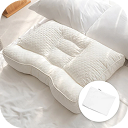
What if the very thing you trust to rest your head is actually the primary reason you can't stand up straight in the morning? It's a frustrating cycle. You spend eight hours every night fighting for a cool spot, only to wake up with that familiar, sharp "crick" in your neck. Clinical data shows that 33% of adults suffer from persistent neck pain that disrupts their daily life, often because they haven't found a cervical pillow that maintains its shape for more than 90 days. You deserve better than a rock-hard cushion that leaves your spine unsupported and your muscles strained.
We agree that sleep should be your recovery time, not a source of physical stress. Finding the right ergonomic support is more than a luxury; it's a medical necessity for neutral spinal alignment. We promise to show you exactly how the right orthopedic pillow can eliminate morning stiffness for good. This guide explores the science of cervical alignment and provides a clear path to waking up refreshed. You'll learn how to maintain a durable loft and select a pillow that stays supportive and comfortable, night after night.
Key Takeaways
- Understand why your neck’s natural "C-curve" requires specific ergonomic support to prevent chronic morning stiffness.
- Discover how a contoured cervical pillow maintains alignment for both back and side sleepers through a specialized neck roll and head cavity.
- Compare the physical properties of natural latex versus memory foam to find a surface that is supportive and comfortable, not rock-hard.
- Learn the simple steps to measure your shoulder width and select the correct loft for your unique sleeping position.
- Master the buyer’s checklist to ensure your next orthopedic investment leads to a lifetime of restorative, pain-free sleep.
What is a Cervical Pillow? Understanding the Orthopedic Difference
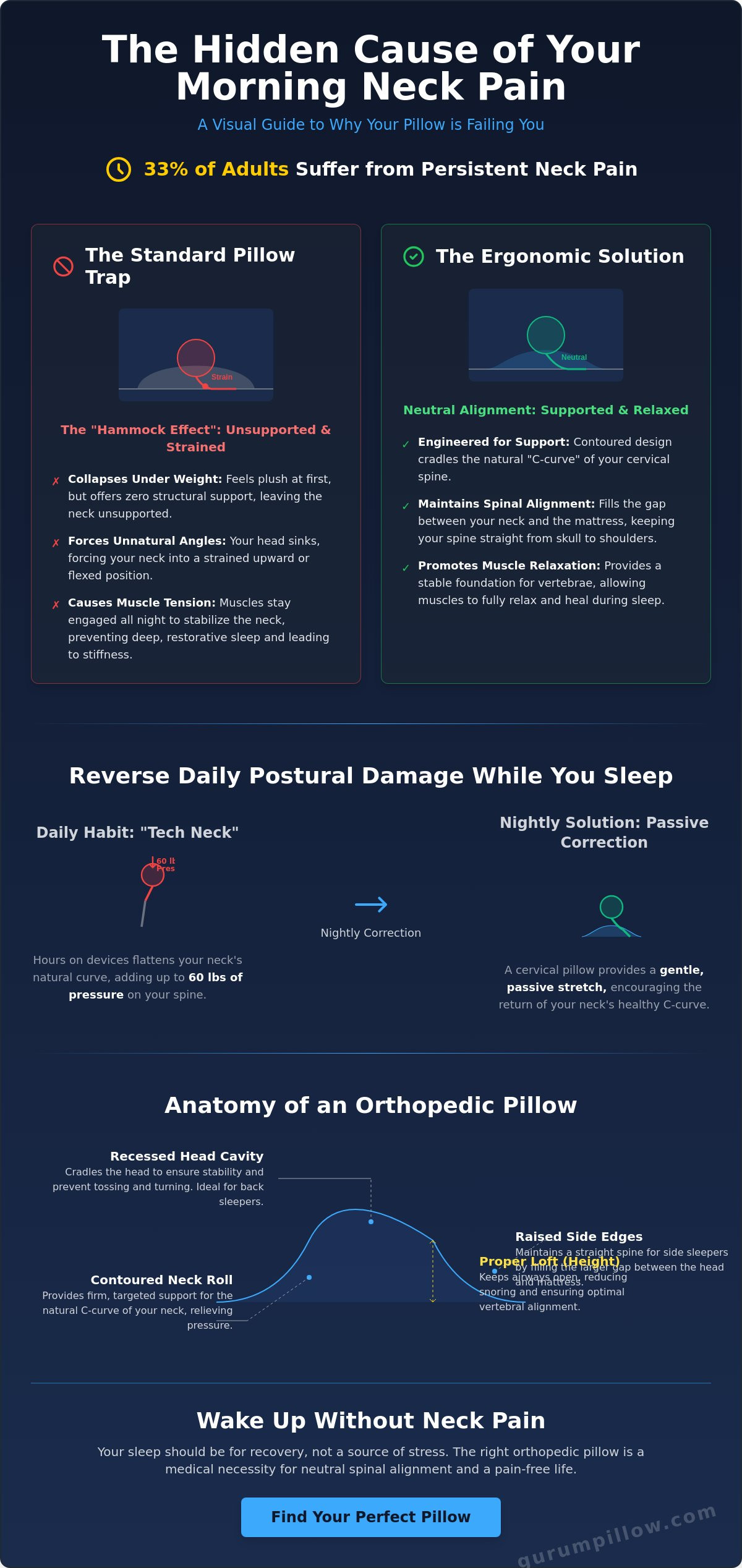
Restorative sleep starts with a simple promise: waking up without neck pain. A cervical pillow isn't just another bedding accessory. It's a specialized tool engineered to cradle the natural "C-curve" of your neck, also known as cervical lordosis. While most people choose pillows based on fluffiness, your spine requires actual structure. Traditional pillows often act like a flat sponge. They force your neck into an unnatural, flattened position for 8 hours every night. An orthopedic pillow differs by providing targeted, ergonomic contours. These shapes fill the physical gap between your mattress and your neck. This ensures your spine stays neutral from your skull to your shoulders. It’s about supportive comfort that stays consistent, not a "cloud-like" feel that collapses by midnight.
Why Your Standard Pillow is Causing Morning Stiffness
Standard fiber-fill pillows are masters of deception. They feel plush at first. However, the internal materials shift constantly as you move during the night. This leaves your neck completely unsupported. You likely experience the "hammock effect." This happens when your head sinks deep into the center while your neck is forced into a strained, upward angle. This creates constant tension on your cervical ligaments. Sleeping in these flexed or extended positions for 8 hours causes repetitive micro-trauma. By 6:00 AM, your soft tissues are tight and inflamed. That familiar morning stiffness is your body's response to a lack of structural integrity. You need support where it matters and comfort everywhere else.
The Anatomy of the Cervical Spine at Rest
Your neck consists of seven small vertebrae, labeled C1 through C7. These bones require constant stabilization to protect your nerves and spinal cord. When you use an unsupportive pillow, your brain detects an unstable neck position. It sends urgent signals to your muscles to stay "on" to prevent injury. This is why you wake up feeling exhausted rather than refreshed. A quality cervical pillow stops this cycle by providing a firm foundation for those seven vertebrae. It's supportive and comfortable, not rock-hard. Neutral alignment is the state where your vertebrae are perfectly stacked and your muscles can finally fully relax. This stability is the only way to achieve deep, healing sleep.
The Science of Neck Support: How Ergonomic Design Heals
A standard pillow often fails because it treats your head and neck as a single flat surface. Your body isn't flat. A cervical pillow uses a specific contour design to mirror your anatomy. It features a raised outer roll and a recessed center cavity. This "cradle" effect ensures your head stays level while the roll supports the delicate curve of your neck. It works for every sleeper. Back sleepers find their head nestled in the center; side sleepers utilize the raised edges to keep their spine straight. It's about maintaining the body's natural geometry for 7 to 9 hours.
Design matters for your internal health too. The "loft," or height of the pillow, determines your airway's position. When your neck is properly aligned, your throat remains open. This reduces the likelihood of snoring and shallow breathing. Research suggests that even a 2 centimeter difference in pillow height can change how much pressure is placed on your cervical vertebrae. Proper support reduces the body's urge to toss and turn. When your spine feels safe and aligned, your nervous system relaxes. You stay in deep, restorative sleep cycles longer.
Correcting Forward Head Posture and Tech Neck
Daily habits are changing our anatomy. Most people spend over 4 hours a day looking at phones or computers. This leads to "tech neck," a condition where the natural lordotic curve of the neck flattens into a "military neck" shape. This posture puts up to 60 pounds of extra pressure on your spine. Integrating a cervical pillow into your routine acts as a corrective tool. It provides a gentle, passive stretch while you sleep. It's the simplest way to reverse daytime postural damage. You don't have to do anything except lie down.
Pressure Relief vs. Structural Support
There's a big difference between a pillow that feels soft and one that provides real support. Many pillows are "rock-hard" or, conversely, collapse under the weight of your head. Your head weighs between 10 and 12 pounds. You need a material that is supportive and comfortable, not just squishy. The right pillow fills the "gap" between the mattress and your neck. This removes the "hanging" sensation that causes morning stiffness. If you want to wake up without neck pain, you need a structure that holds its shape all night long. This balance of firmness and give is what allows your muscles to finally stop working and start recovering.
Latex vs. Memory Foam: Why Material Choice Dictates Recovery
Choosing a cervical pillow is more than a comfort preference. It is a decision about your recovery. Most shoppers focus on the initial softness, but the real magic happens in the material's physics. 100% natural latex and polyurethane memory foam behave in opposite ways during the eight hours you spend asleep. Understanding these differences is the key to waking up without neck pain.
- Resilience: Latex provides "push-back" support. It actively holds your head up instead of just letting it sink.
- Thermal Regulation: Latex has high thermal conductivity. It stays at room temperature while foam traps and reflects body heat.
- Durability: High-quality natural latex maintains its original shape and loft for up to 10 years. Synthetic foam often loses 15% of its height within the first 24 months.
Support where you need it. Comfort everywhere else. That is the goal of a proper orthopedic tool. If your pillow fails to maintain its height, your spine falls out of alignment. This leads to the morning stiffness you are trying to escape. A 2021 industry report on bedding durability confirmed that natural latex maintains structural integrity 20% longer than high-density memory foam.
The Sinking Problem with Memory Foam
Memory foam is viscoelastic. It relies on your body heat to soften and contour. This creates a major flaw for neck health. As the foam warms up throughout the night, it continues to lose its structural integrity. You start the night supported, but you often "bottom out" by 3:00 AM. Your head sinks too deep, and the ergonomic curve vanishes. It's a recipe for a pinched nerve.
This creates a "quicksand" feeling. Shifting positions becomes a chore because you have to climb out of a heat-molded crater. Many synthetic foams also come with a chemical odor. This off-gassing from Volatile Organic Compounds can trigger allergies or disrupt your breathing. You shouldn't have to choose between neck support and fresh air.
Resilience and Breathability of Natural Latex
Natural latex stays cool and dry. Its open-cell structure acts like thousands of tiny air vents. This allows for constant airflow, keeping the surface temperature consistent. It doesn't rely on your body heat to function. Latex is a dynamic material that supports without the need for heat activation.
It offers an instant response. When you roll from your back to your side, the latex snaps back immediately to fill the gap under your neck. There is no lag time. It feels supportive, and comfortable (not rock-hard), providing a buoyant sensation that relieves pressure points. By choosing a cervical pillow made from 100% natural latex, you ensure your spine stays aligned from the moment you lie down until your alarm goes off. It is a professional-grade tool for your home wellness routine.
The Buyer’s Checklist: Finding Your Perfect Cervical Match
Finding the right cervical pillow isn't about luck. It's about precision. You've likely spent years sleeping on pillows that were either too flat or too bulky. This checklist helps you stop the guesswork and start the healing process. You need a tool that respects your anatomy, not just a soft place to land.
First, grab a tape measure. If you sleep on your side, measure the distance from the base of your neck to the outside edge of your shoulder. This number is your ideal loft. A 5-inch shoulder gap requires a 5-inch pillow height to keep your spine neutral. If the pillow is too low, your head tilts down. If it's too high, it kinks upward. Both scenarios lead to a pinched nerve by morning. The right support feels firm yet comfortable, not rock-hard.
Next, look for hypoallergenic certifications like CertiPUR-US or OEKO-TEX. You spend approximately 2,920 hours a year with your face pressed against your pillow. Ensure the materials are free from heavy metals and formaldehyde. A clean breathing environment prevents the midnight congestion that ruins deep sleep cycles. Don't settle for chemicals when you're trying to recover.
Matching Your Pillow to Your Sleeping Position
Your sleep posture dictates the level of support you need. Most people shift during the night, but your primary start position is the most critical factor for spinal alignment.
- Side Sleepers: You need a high loft. The goal is to fill the void between your ear and the mattress. This prevents your shoulder from collapsing and keeps your neck straight.
- Back Sleepers: You need a medium loft with a defined cervical roll. This contour supports the natural curve of your neck while letting your head sink slightly into a supportive cradle.
- Stomach Sleepers: This position is the hardest on your cervical health. It forces your neck into a 90-degree twist for hours. If you can't switch positions, use a very thin, flat pillow to minimize the angle of that twist.
Navigating the 14-Day Adjustment Period
Expect a correction phase during your first week. Your muscles have spent years compensating for poor support. When a cervical pillow moves your spine back into its natural alignment, those muscles might feel slightly sore. It's similar to the feeling you get after a focused workout. Your body is simply unlearning bad habits.
A full 14-day timeline is usually required for your soft tissues to adapt. Follow these steps to ease the transition:
- Start slow. Use the new pillow for a 30-minute afternoon nap to get used to the shape.
- If you wake up sore during the night, it's okay to switch back to your old pillow for a few hours.
- Increase the time spent on the orthopedic pillow by 1 hour each night.
By night 10, the "new" feeling usually disappears. You'll start waking up without that familiar morning stiffness. If you're ready to fix your sleep for good, check out the Gurum Pillow collection designed for every sleep style.
Wake Up Without Neck Pain: The Gurum Pillow Solution
You've likely spent years searching for the right support. Most pillows fail because they're either too soft to help or so stiff they feel like bricks. The Gurum Premium Latex Pillow is different. It's the result of intensive orthopedic research designed to end the cycle of morning stiffness. We use 100% natural latex to create a cervical pillow that offers high-rebound support. It's supportive, and comfortable (not rock-hard). This material contours to your neck instantly. It doesn't sag like memory foam. It doesn't lose its shape by midnight.
Designed by Experts, Proven by Sleepers
Our founder didn't start this company to sell bedding. He started it because he lived with chronic neck pain for over 10 years. After testing dozens of products that didn't work, he developed a solution for people who've "tried everything else." We understand the frustration of a closet full of failed pillows. This isn't a disposable product. While most synthetic foam pillows flatten within 12 months, a high-quality latex core maintains its structural integrity for 5 years or longer. This durability makes it a smarter long-term investment for your health. You're buying a tool for recovery, not just a place to rest your head.
Sustainable Comfort for the Modern Home
Your sleep environment shouldn't contain harsh chemicals. Many brands use petroleum-based foams that off-gas or trap heat. We prioritize the planet and your lungs. Natural latex is eco-friendly and biodegradable. It's also naturally hypoallergenic and dust-mite resistant. This is vital for the 20% of the population that suffers from indoor allergies. We pair this core with breathable, anti-allergy covers that maximize airflow. The open-cell structure of the latex ensures you stay cool even on warm nights. You can view the full specifications for our premium latex pillow to see how it fits your needs.
Neck pain doesn't take a vacation. We also offer travel-friendly options to ensure your spine stays aligned on the go. Whether you're in a hotel or on a long flight, you can maintain the same ergonomic standards you have at home. Consistency is the fastest path to a pain-free life. It's time to stop settling for "good enough" sleep. Experience the relief that comes from a cervical pillow built with purpose.
Wake Up Without Neck Pain Starting Tomorrow
You've likely spent too many nights tossing and turning on a pillow that feels either too soft or rock-hard. Real relief comes from proper orthopedic alignment that respects your body's natural curves. Choosing a high-quality cervical pillow made from 100% natural latex ensures your spine stays neutral while you sleep. This specific material provides the perfect balance of support and breathability without the use of any synthetic fillers. It's the difference between waking up with a kink in your neck and feeling fully restored.
Over 1,000+ customers have already shared 5-star reviews about how they finally ended their struggle with chronic morning stiffness. You don't have to keep trying pillows that let you down after just a few weeks of use. By focusing on ergonomic design and premium materials, you can finally achieve the restorative sleep your body craves. We're committed to your recovery, which is why we offer free shipping across the USA on every order. It's time to stop settling for mediocre rest and start investing in your long-term health.
Stop the morning stiffness and shop the Gurum Premium Latex Pillow today
Better mornings are just one sleep away, and you're ready to finally take back your comfort.
Frequently Asked Questions
How do I know if I need a cervical pillow?
You likely need one if you wake up with neck stiffness or tension headaches at least 3 mornings per week. Standard pillows often fail to support the natural C-curve of your spine. If you're constantly folding or punching your pillow to get comfortable, your neck isn't getting the alignment it needs to heal. Using a cervical pillow restores that vital support.
Is it normal for a cervical pillow to feel uncomfortable at first?
Yes, it's completely normal to feel a bit of discomfort for the first 7 to 14 nights. Your muscles have likely spent years compensating for poor alignment. This adjustment period is your spine relearning its natural posture. Stick with it; most users report a total shift in comfort after the first 2 weeks. It's about retraining your body for better health.
Can a cervical pillow help with tension headaches?
A cervical pillow can significantly reduce tension headaches by keeping your upper spine in a neutral position. Research from the Journal of Pain Research indicates that 60 percent of tension headaches stem from neck strain during sleep. By supporting the neck's natural curve, you prevent the muscle tightness that radiates to the skull. It's a simple change that yields massive relief.
What is the difference between a cervical pillow and a regular orthopedic pillow?
A cervical pillow is a specific type of orthopedic pillow designed with a central dip and raised edges to cradle the neck. While "orthopedic" is a broad term for any support-focused bedding, cervical designs focus specifically on the 7 vertebrae of the neck. This targeted shape ensures your head doesn't tilt too far back or forward. It's precision engineering for your spine.
How long does it take for a cervical pillow to work?
You may feel relief after 1 night, but clinical studies suggest it takes 10 to 14 days for your body to fully adapt. During these first 2 weeks, your ligaments and muscles transition from a strained state to a supported one. Consistency is key to seeing a permanent reduction in morning stiffness. Don't give up if the first night feels different.
Are latex cervical pillows better than memory foam ones?
Latex pillows are often superior because they offer 30 percent more breathability and immediate "bounce back" compared to memory foam. Memory foam can feel "rock-hard" in cold rooms or trap heat throughout the night. Natural latex provides a supportive and comfortable surface that stays cool and responds instantly to your movements. It's the ideal choice for hot sleepers who need firm support.
How do I clean my cervical latex pillow?
You should spot clean your latex pillow with a damp cloth and mild soap every 3 months. Never submerge it in water or put it in a washing machine, as this breaks down the cellular structure. Air dry it away from direct sunlight to maintain the integrity of the material for up to 5 years. Keeping it dry ensures the latex remains resilient and hygienic.
Can I use a cervical pillow if I sleep on my side?
Yes, side sleepers actually benefit most from the raised side bolsters of a cervical pillow. These sections fill the gap between your shoulder and ear, keeping your spine straight. It prevents your head from dipping toward the mattress, which is the primary cause of side-sleeper shoulder pain. You'll finally wake up without that nagging ache in your neck and shoulders.