

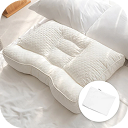
The material promised to cradle your spine is often the very thing causing your morning stiffness. Many sleepers invest in memory foam expecting relief, only to find themselves waking up with a "military neck" tension that lingers all day. You're likely tired of that "sunk-in" feeling that makes it impossible to roll over without a struggle. It's frustrating to search for alternatives to memory foam pillows when every option seems to promise the same synthetic, heat-trapping results. You deserve a sleep surface that reacts to your weight, not just your body heat.
We understand the exhaustion that comes from chronic discomfort and the disappointment of pillows that flatten out by midnight. This guide will help you find a high-performance alternative that offers anatomically correct cervical support and natural breathability. You'll discover why materials like natural latex can reduce neck discomfort by as much as 60 percent according to research in the Journal of Physical Therapy Science. We'll explore the best options for 2026, focusing on GOTS and GOLS certified materials that eliminate chemical off-gassing while keeping you cool. It's time to trade the "stuck" feeling for restorative, pain-free rest.
Key Takeaways
- Understand why memory foam’s tendency to melt under body heat creates a "sinking" effect that compromises your cervical alignment.
- Explore the top-rated alternatives to memory foam pillows, including natural latex and buckwheat, for superior airflow and structural integrity.
- Discover how the "push-back" support of natural materials provides the anatomical lift necessary to eliminate morning neck tension.
- Learn how to match your specific sleep position with the ideal loft and density to maintain a restorative, neutral spine.
- Find out why 100% natural latex is the premier choice for sleepers who prioritize thermal neutrality and chemical-free comfort.
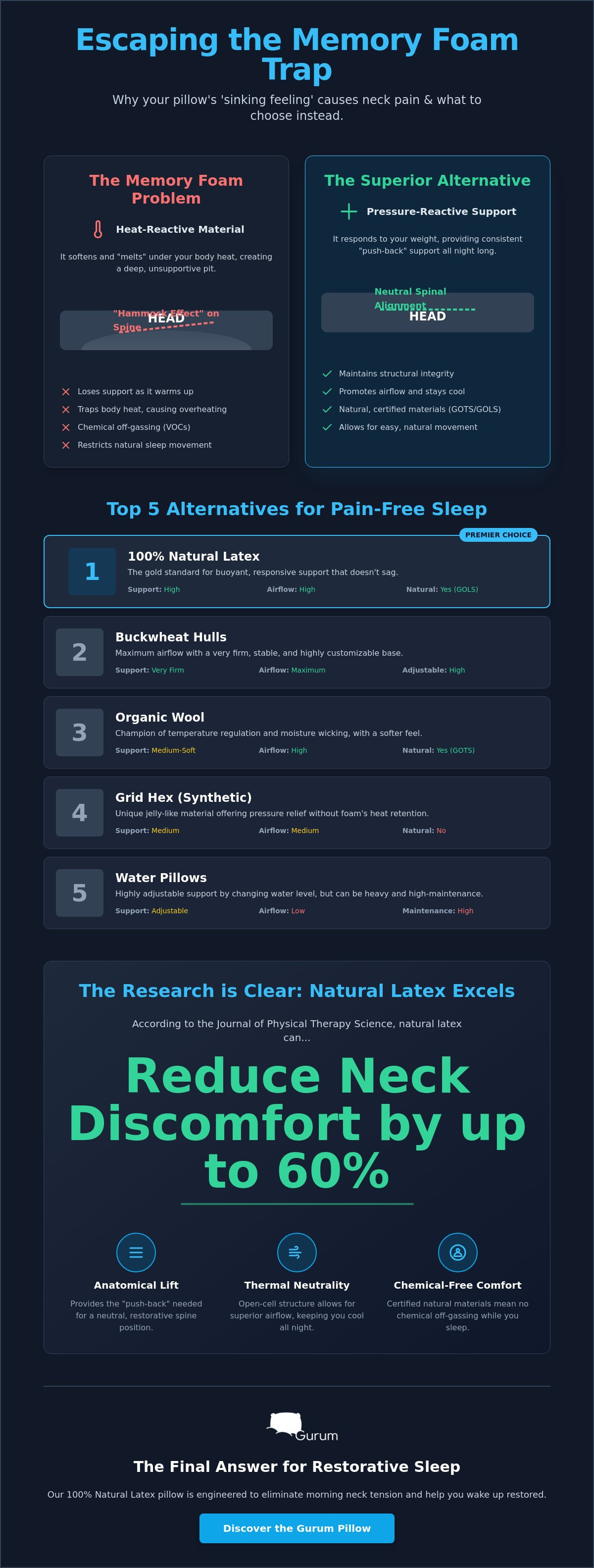
The Memory Foam Trap: Why Your Pillow is Sinking (and Hurting Your Neck)
Memory foam was marketed as a sleep revolution. It promised a cloud-like experience that would end restless nights. Instead, many sleepers wake up with a neck that feels like it's been held in a vice. The problem isn't your sleep position; it's the chemistry of the material itself. Memory foam is viscoelastic. This means it's designed to change its state based on temperature. As you sleep, your body heat softens the foam. It doesn't just support you; it melts away from you. By the time you reach deep sleep, the support you felt at the start of the night has literally vanished.
Most memory foam is made from synthetic polyurethane. This material is prohibited by the Global Organic Textile Standard (GOTS) because of its chemical composition. Beyond the physical sinkage, there's the hidden reality of chemical off-gassing. That "new pillow smell" is actually a cocktail of volatile organic compounds (VOCs) being released into your breathing zone. This is why more people are researching pillow materials and types that offer a cleaner, more stable environment. If you're looking for alternatives to memory foam pillows, you're likely seeking a material that respects both your anatomy and your air quality.
Heat vs. Pressure Reactivity
The fundamental flaw of memory foam is that it's heat-reactive. It softens specifically where your head is warmest. This creates a deep, unsupportive pit. By 3 AM, your head has sunk lower than it was at 10 PM. This shift forces your neck into an unnatural angle for hours. High-performance alternatives to memory foam pillows use pressure-reactive materials instead. These options respond to the weight of your head, not your body temperature. They maintain their loft and structural integrity regardless of how warm the room gets. You won't wake up feeling "stuck" in a synthetic crater or struggling to roll over.
The Impact on Spinal Alignment
When your pillow melts, your spine loses its neutral position. This creates what experts call the "hammock effect" on the cervical spine. Your head drops too low, causing your neck muscles to stretch and strain all night to compensate. This constant tension is a primary driver of morning headaches and that stiff "military neck" feeling. Side sleepers suffer the most from this compression. You need a consistent height to fill the gap between your ear and your shoulder. When foam collapses, your shoulder takes the weight and your neck kinks. True relief requires a material that provides a consistent "push-back" to keep your airway open and your nerves uncompressed.
Slow-recovery foam is often sold as a luxury feature, but it's actually a hindrance to natural movement. Humans naturally move 40 to 50 times every night to maintain circulation. When you're trapped in a heat-molded hole, your body has to work harder to turn over. This micro-exertion breaks your deep sleep cycles. You wake up feeling exhausted because your body spent the night fighting its own pillow.
Top 5 Alternatives to Memory Foam for Pain-Free Sleep
Breaking the cycle of chronic neck pain starts with moving beyond synthetic foam. While memory foam traps you in a heat-molded pit, high-performance materials prioritize structural integrity and airflow. You need a surface that respects your anatomy rather than fighting it. Finding the right alternatives to memory foam pillows means looking for materials that offer consistent lift without the "melting" sensation we discussed earlier. Here are the leading contenders for restorative sleep in 2026.
- 100% Natural Latex: This is the gold standard for sleepers who want a "buoyant" feel. It provides immediate, responsive support that doesn't sag as the night progresses.
- Buckwheat Hulls: These offer maximum airflow and a very firm, stable base. You can add or remove hulls to customize your loft exactly to your shoulder width.
- Organic Wool: Wool is a champion of temperature regulation. It wicks moisture away effectively, though it typically offers a flatter profile that may not suit everyone.
- Grid Hex (Synthetic): This jelly-like material provides a unique feel for those who want pressure relief without the heat retention of foam, though it lacks the natural benefits of organic options.
- Water Pillows: These allow for high adjustability by changing the water level. However, they are heavy, high-maintenance, and can be prone to leaks.
If you're ready to experience the difference a responsive surface makes, our Premium Latex Pillow provides the anatomical lift your neck has been missing.
Natural Latex: The High-Response Leader
Natural latex is the premier choice for those who feel "stuck" in traditional foam. Unlike memory foam, which has a slow-recovery "sink," latex is buoyant. It pushes back gently against your weight. This creates a sensation of floating rather than drowning in your bedding. The open-cell structure is a functional masterpiece. It allows air to circulate constantly, preventing the heat buildup that triggers midnight tossing and turning. Additionally, 100% natural latex is naturally dust-mite resistant and antimicrobial. This makes it a cleaner, healthier choice for those with environmental sensitivities.
Buckwheat and Wool: The Traditional Contenders
Buckwheat and wool offer distinct benefits but come with trade-offs. Buckwheat hulls allow for a completely custom loft. You can mold the pillow into the perfect shape for your neck. However, the hulls make a distinct "crunchy" noise when you move. This can be distracting for light sleepers. Organic wool is fantastic for staying cool and dry. It handles moisture better than almost any other material. The downside is its lack of ergonomic shaping. Wool tends to compress over time and doesn't provide the specific contouring properties found in a Premium Latex Pillow. While these traditional materials are better than foam, they often lack the precise cervical support required to fully eliminate morning tension.
Latex vs. The Rest: Finding Your Perfect Support Level
Choosing between different alternatives to memory foam pillows often feels like a gamble. You've likely spent years trying to find a surface that doesn't collapse by 2 AM. While many materials claim to offer relief, few provide the active "push-back" necessary for spinal health. Memory foam is a passive material; it waits for your heat to tell it how to react. In contrast, natural latex is an active material. It provides an immediate anatomical lift that keeps your head and neck aligned from the moment you lie down until you wake up.
This difference in response isn't just about comfort. It's about longevity. High-quality natural latex is up to four times more durable than traditional foam. Research from 2026 shows that while polyester or foam pillows lose their integrity within 6 months to 2 years, latex maintains its shape for 5 to 10 years. This makes it a sustainable investment for your health and the planet. Unlike petroleum-based synthetics that end up in landfills, natural latex is biodegradable and free from the polyurethane prohibited by GOTS standards.
The "Lift" Factor for Neck Pain
Effective cervical pillow designs rely on a material's ability to hold its shape under pressure. Latex excels here because it creates a "floating" sensation. It distributes weight evenly across the surface, which significantly reduces pressure on your ears and jaw. This is vital for sleepers who wake up with facial tenderness or ear pain. Dynamic support is the ability of a material to adjust instantly to movement. When you turn, the latex recovers its shape immediately. You're never left waiting for the pillow to "re-mold" to your new position.
Breathability Without the Gimmicks
The bedding industry is full of "cooling gel" myths. These gels are often just a temporary fix for the inherent heat-trapping nature of synthetic foam. They might feel cool for ten minutes, but they eventually reach your body temperature and stop working. Premium natural latex pillows don't need these additives. They use pincore ventilation—thousands of tiny holes created during the manufacturing process—to allow heat to escape. This physical structure, paired with the material's natural thermal neutrality, ensures you stay cool all night. You aren't just buying a pillow; you're investing in a material that works with your body's natural temperature regulation cycles.
By moving away from petroleum-based alternatives to memory foam pillows, you're choosing a cleaner sleep environment. You'll breathe easier knowing your pillow isn't off-gassing chemicals while you rest. It's a simple change that delivers profound results for your physical recovery and your overall peace of mind.
Selection Guide: Matching Your Sleep Position to the Right Material
Your sleep position is the blueprint for your physical recovery. While we've established why memory foam fails technically, your specific posture determines which alternatives to memory foam pillows will actually end your morning pain. A side sleeper's needs are fundamentally different from someone who rests on their back. If you've been using a "one-size-fits-all" approach, you're likely waking up with the "military neck" tension we aim to resolve. Your pillow should be a tool for alignment, not just a place to rest your head.
Ergonomic Needs for Side Sleepers
Side sleepers face the greatest structural challenge: filling the deep void between the ear and the mattress. When you use memory foam, the concentrated heat from your shoulder causes the material to collapse exactly where you need support. This drop forces your neck to bend sideways, straining the cervical muscles and pinching nerves. The best pillow for side sleepers must offer high-loft and high-density support that refuses to sag. You can find your perfect height by measuring the distance from the tip of your shoulder to the side of your neck. A 100% natural latex pillow maintains this measurement all night, ensuring your spine stays as straight as a plumb line.
Cervical Support for Back Sleepers
For those who sleep on their backs, the goal is anatomical neutrality. Your chin should remain level with your chest, not tilted toward the ceiling or jammed into your collarbone. Flat cotton or down pillows often allow the head to tilt back too far, which compresses the discs in your neck. A best latex pillow for neck pain provides a contoured cradle that supports the natural curve of your spine. It fills the small gap under your neck while allowing the back of your head to rest at the correct height. This precise alignment prevents the tension headaches that often ruin your morning focus.
Stomach sleepers should be especially cautious with synthetic foam. Memory foam's "sink" can create a suffocation risk or force the neck into a dangerous 90-degree over-extension. If you prefer this position, look for ultra-thin alternatives to memory foam pillows made from breathable materials like wool or low-loft latex. These provide a soft barrier without compromising your airway or spinal integrity. They offer the comfort you crave without the structural risks of polyurethane.
Finally, consider the "Active Sleeper" test. Do you wake up with your sheets tangled or your pillow on the floor? If you toss and turn, your body is searching for a comfortable position it can't find in a slow-recovery foam pit. You need a high-response material that adapts to your movement instantly. If you're tired of the midnight struggle, you can explore our collection of responsive latex pillows to find your perfect anatomical match.
The Gurum Pillow: Why Our 100% Natural Latex is the Final Answer
Finding the right alternatives to memory foam pillows shouldn't be a cycle of trial and error. You've likely already spent too many nights adjusting your posture, only to wake up with the same familiar ache. At Gurum, we've moved past the "melting" plastics and synthetic fillers that fail your spine. Our approach centers on one perfected solution: the Gurum Premium Latex Pillow. It’s a tool designed for those who refuse to settle for subpar rest and chemical off-gassing.
While many brands use "blended" latex to cut costs, our formula is 100% natural. This purity ensures the material remains buoyant and responsive for years, not months. For those who travel frequently, the Gurum Travel Latex Pillow brings this same ergonomic integrity to every hotel bed. You no longer have to risk your neck health on unpredictable, worn-out pillows while away from home. We're committed to providing chemical-free, hypoallergenic sleep solutions for households across the United States.
Engineered for the Cervical Spine
The Gurum Premium Latex Pillow isn't just another bedding accessory. It's an engineered device for anatomical precision. This specific density and shape were born from founder Ji H. Won’s personal struggle with chronic neck pain. After failing to find relief in traditional foam, he developed this specialized formula to provide the exact "push-back" support the human neck requires. We want this relief to be accessible to everyone, which is why we offer free shipping across the United States for our entire collection.
Clean Sleep, Every Night
True restorative rest requires more than just support; it requires a clean environment. Our tree-tapped latex is naturally hypoallergenic. It’s a safe haven for those with environmental sensitivities. To enhance this protection, we’ve designed our Anti-Allergy Pillow Covers as the perfect companion for your new pillow. They provide a breathable barrier that keeps your sleep surface pristine. You don't have to worry about the hidden irritants found in synthetic alternatives to memory foam pillows. You can finally rest in a space that supports your health as much as it supports your spine.
Experience the relief of a Premium Latex Pillow today.
Wake Up Without the Weight of Yesterday
The journey to pain-free sleep starts with acknowledging that your current pillow might be working against you. You've seen how memory foam's reliance on heat leads to a sagging spine and trapped warmth. By exploring high-performance alternatives to memory foam pillows, you're choosing a material that respects your anatomy. Natural latex doesn't just cushion your head; it provides the active lift needed to keep your cervical spine in neutral alignment all night long. It's a shift from merely sleeping to truly recovering.
Our 100% Natural Latex formula was designed by a neck pain sufferer specifically for neck pain sufferers. We understand the frustration of waking up stiff, and we've engineered a solution that maintains its integrity for years. Whether you're a side sleeper or a back sleeper, you deserve the confidence that comes with professional-grade support. With free shipping within the United States, your path to a refreshed morning is simpler than ever. Switch to the lift and support of a Gurum Premium Latex Pillow. You're one night away from the restorative rest you've been searching for.
Frequently Asked Questions
Are latex pillows better than memory foam for neck pain?
Latex is often superior for neck pain because it provides an immediate anatomical lift. While memory foam softens and sags as it absorbs body heat, natural latex maintains its structural integrity throughout the night. This prevents the "hammock effect" that leads to morning stiffness and tension headaches. It's a more reliable tool for keeping your cervical spine in a neutral position.
Do natural latex pillows have a smell like memory foam does?
Natural latex does not produce the chemical off-gassing associated with synthetic polyurethane foam. Memory foam often releases volatile organic compounds (VOCs) that can cause respiratory irritation or headaches. 100% natural latex may have a faint, sweet scent of natural rubber when first opened, but it's free from the harsh, synthetic odors found in traditional foam products.
How long does a natural latex pillow last compared to foam?
High-quality natural latex is significantly more durable, typically lasting between 5 and 10 years. In contrast, traditional memory foam or polyester pillows often lose their support and shape within 6 months to 2 years. This longevity makes latex one of the most sustainable alternatives to memory foam pillows for long-term spinal health and environmental impact.
Can I wash a latex pillow if it gets dirty?
You shouldn't put a solid latex pillow in a washing machine or dryer. The agitation and high heat can damage the natural cell structure of the material. Instead, spot clean any stains with a mild detergent and warm water. Always allow the pillow to air dry completely in a shaded area, as direct sunlight can cause natural latex to become brittle.
Is a buckwheat pillow too loud for light sleepers?
Buckwheat pillows make a distinct "crunching" sound as the hulls shift under your head. For light sleepers who are sensitive to noise, this auditory feedback can be distracting during the night. If you need firm support without the rustling sound, a responsive natural latex pillow is a much quieter alternative that provides similar stability without the noise.
What is the best pillow for someone who hates the "sinking" feeling of foam?
Natural latex is the premier choice for sleepers who want to feel "on top" of their pillow rather than "in" it. It offers a buoyant, high-response surface that adjusts instantly to your movements. You won't feel trapped in a heat-molded pit. This makes it much easier to roll over and maintain circulation without waking up from the effort.
Are there any memory foam alternatives that stay cool all night?
Natural latex and buckwheat hulls are the top alternatives to memory foam pillows for thermal neutrality. Latex features an open-cell structure and pincore ventilation holes that allow heat to escape constantly. Unlike foam, these materials don't rely on temporary cooling gels. They are inherently breathable and maintain a steady, comfortable temperature from the moment you lie down.
Is a wool pillow firm enough for side sleepers with broad shoulders?
Wool pillows usually lack the necessary loft and firmness for side sleepers with broad shoulders. While wool is excellent for moisture-wicking and temperature regulation, it tends to compress into a flatter profile over time. For proper shoulder clearance and spinal alignment, a high-density, high-loft latex pillow is generally more effective at preventing your head from tilting toward the mattress.