

You might think the softest pillow is the cure for your morning neck stiffness, but that "cloud-like" feel could actually be the reason you wake up with a headache. It's exhausting to spend another night punching a synthetic pillow back into shape, only to have it lose its loft before midnight. When you're caught between talalay vs dunlop latex pillows, it's easy to feel overwhelmed by technical specs while your neck just wants relief. You deserve a surface that lifts your head rather than letting it sink into a heat-trapping hole.
We understand the frustration of chronic cervical pain because we've lived it. The choice between these two materials isn't about which one is "better" on paper. It's about matching the foam’s responsiveness to your specific anatomy. This guide will help you understand the technical and ergonomic differences so you can choose the pillow that finally fixes your sleep. We'll explore how density and breathability impact your alignment. You'll finally find a solution that maintains its shape for years to come.
Key Takeaways
- Understand how the unique manufacturing of talalay vs dunlop latex pillows determines whether your neck feels braced or cushioned throughout the night.
- Identify why Dunlop's denser, resilient structure is often the better choice for those struggling with chronic cervical tension.
- Learn why Talalay’s airy, uniform cell structure provides instant pressure relief for sensitive sleepers who prefer a weightless sensation.
- Find out how to match your specific sleep position to the right material to ensure your spine stays in perfect alignment until morning.
- Discover the importance of using 100% natural, molded latex to prevent the "sinking" feeling common in traditional synthetic foam alternatives.
Dunlop vs. Talalay: Why the Manufacturing Process Matters for Your Neck
The journey from a tropical forest to your bedroom begins with the milky sap of the Hevea brasiliensis tree. This raw material is a living substance, and how it is processed determines whether you wake up refreshed or reaching for the ibuprofen. Both materials are technically defined as vulcanized natural rubber foam, yet they offer vastly different experiences for your cervical spine. The core difference lies in the physics of the pour and the temperature of the bake.
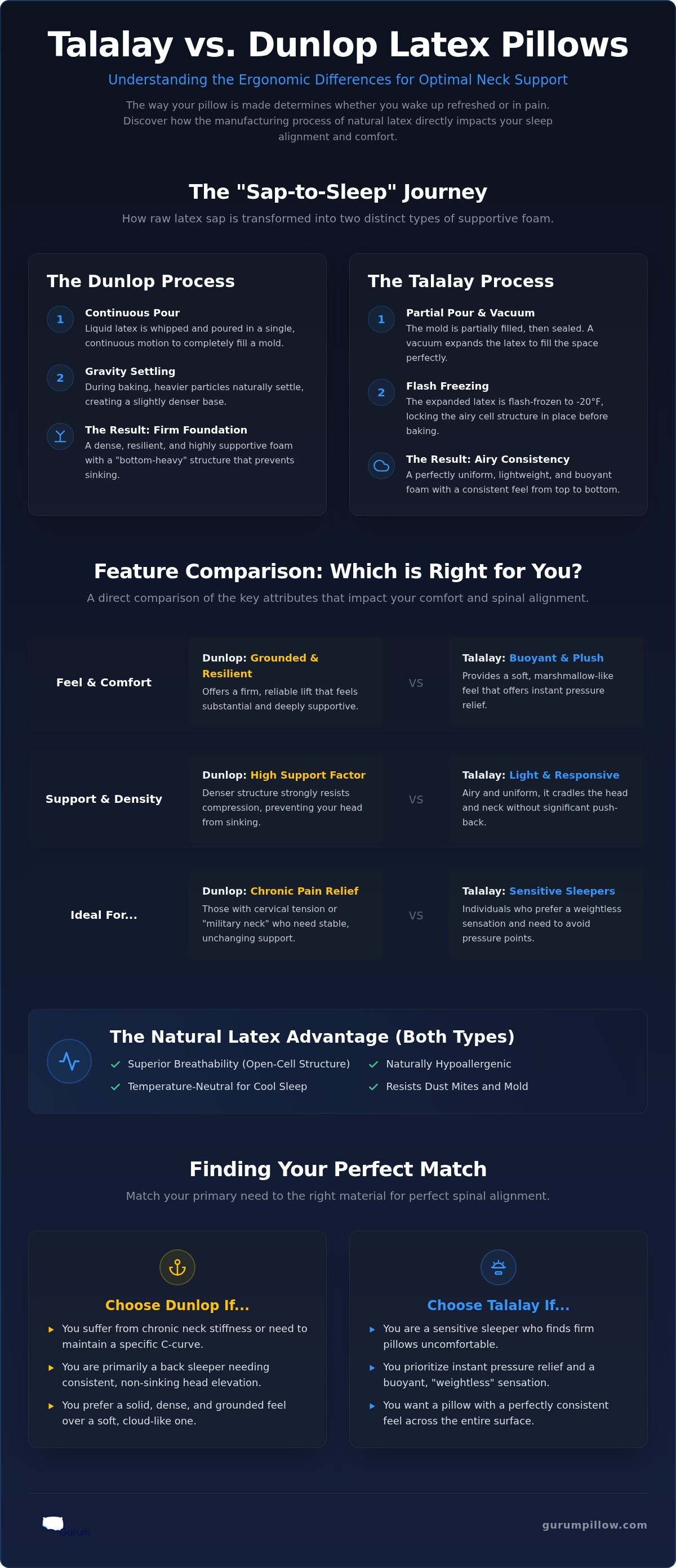
Dunlop latex is the traditional, time-tested method. Think of it as a whipped cake batter that is poured into a mold and baked until firm. Because it is a single, continuous pour, the heavier particles settle slightly toward the bottom during the process. This creates a denser, more substantial structure. When comparing talalay vs dunlop latex pillows, the Dunlop variety feels more grounded. It provides a reliable foundation that doesn't "bottom out" halfway through the night.
Talalay latex involves a more complex, modern sequence. The mold is only partially filled before a vacuum stretches the liquid latex to fill every corner. It is then flash-frozen at -20°F to lock the cell structure in place before being baked. This flash-freezing prevents any sediment from settling, resulting in a perfectly uniform, airy feel. This specific Dunlop or Talalay process is what gives the foam its characteristic bounce and consistent texture from top to bottom.
The "Sap-to-Sleep" Journey
Choosing between these two is about matching the material’s "lift" to your personal anatomy. Dunlop offers a firm, resilient lift that is ideal for those who need significant support to keep their spine aligned. Talalay provides a buoyant, marshmallow-like lift that caters to sleepers who want pressure relief without the sinking feeling of synthetic alternatives. Both remain 100% natural, but their internal physics dictate the density and "push-back" your neck receives.
Breathability and Pinhole Design
Heat retention is a common enemy of deep sleep. Unlike synthetic memory foam, which is a dense, heat-trapping plastic, natural latex features an open-cell structure. Both manufacturing processes incorporate a pinhole design, where metal rods in the mold create vertical channels for airflow. This ensures your pillow breathes like a living lung throughout the night. You won't find yourself flipping to the "cool side" because the entire material is inherently temperature-neutral and hypoallergenic.
The Dunlop Process: Deep Support for Chronic Neck Pain
Dunlop latex is often described as the "workhorse" of the natural bedding world. While some manufacturers treat its density as a secondary trait, we see it as a mechanical necessity for anyone battling chronic morning stiffness. When comparing talalay vs dunlop latex pillows, the Dunlop version stands out for its high "support factor." This is a technical measure of how much a material resists compression. Because Dunlop is denser, it provides a firm, reliable lift that keeps your cervical spine in a neutral position throughout the night.
One unique characteristic of this method is the slight settling of sediment during the baking process. This creates a "bottom-heavy" structure. While some see this as a lack of uniformity, it actually provides a stable foundation that prevents the pillow from shifting or flattening under the weight of your head. This stability is crucial for ending the "sink-and-stiffen" cycle. Many synthetic pillows allow your head to tilt backward as the foam compresses; this strains the delicate muscles of the throat and neck. A Dunlop core ensures that the material that supports your neck remains firm until the sun comes up.
Stabilizing the Cervical Spine
If you have been diagnosed with "military neck" or a loss of the natural C-curve, you need a material that mimics the resistance of human tissue. Dunlop’s density does exactly this. Unlike shredded latex or down, a molded Dunlop core is a single, solid unit. It cannot clump, shift, or leave you with a flat spot at 3 AM. This structural integrity is a primary reason why our Cervical Pillow Guide emphasizes molded designs for long-term alignment. By maintaining a consistent loft, you reduce the mechanical stress on your vertebrae.
Who Should Choose Dunlop?
This material is the gold standard for back sleepers who need their head held at a specific, unchanging height. It is also a lifesaver for side sleepers with broad shoulders. These individuals often find that softer pillows collapse, causing the neck to kink toward the mattress. Dunlop offers the highest support factor available in natural foam; it pushes back just enough to keep you level. If you are looking for a pillow that maintains its structural integrity for years, a molded Premium Latex Pillow using the Dunlop process is the most durable choice you can make.
The Talalay Process: Plush Comfort and Airy Responsiveness
If the Dunlop process is like baking a dense, hearty loaf of bread, the Talalay method is more akin to crafting a delicate souffle. While we previously explored the grounded stability of Dunlop, the Talalay process prioritizes a lighter, more buoyant sensation. The Sleep Foundation explains the difference between Talalay and Dunlop latex by highlighting how this vacuum-sealed and flash-frozen sequence creates a lighter, more consistent foam. This high-tech approach removes any chance of sediment settling; it ensures every square inch of the pillow feels identical.
When you're deciding between talalay vs dunlop latex pillows, the immediate difference you'll notice is the "marshmallow-like" feel. This is achieved during the vacuum stage, where the latex is stretched to perfectly fill the mold. Flash-freezing then locks those air bubbles in place before the vulcanization process begins. The result is a perfectly uniform foam with a bouncy, energetic response. It doesn't just hold your head; it seems to float it. This airy responsiveness is a primary reason why many sleepers find Talalay to be the peak of luxury in natural bedding.
The Science of "Bouncy" Comfort
The secret to Talalay’s unique feel is its high point elasticity. This means the material compresses exactly where you apply pressure without pulling on the surrounding areas. It creates a weightless sensation that feels like your head is being "cradled" rather than "held." Because the material responds instantly to movement, there’s no lag time when you switch positions. You won't feel like you're fighting against the foam to get comfortable. It’s a dynamic kind of support that caters to the body’s micro-movements during the night.
Who Should Choose Talalay?
Side sleepers often struggle with traditional pillows that feel too hard against their ears or jawline. Talalay is the ideal solution for these sensitive pressure points. Even when measured at the same Indentation Load Deflection (ILD), Talalay is almost always perceived as softer and more "cloud-like" than its Dunlop counterpart. It’s also the superior choice for "active sleepers" who move frequently. The instant rebound ensures the pillow is always ready to support your next position. However, if you require a rigid brace for severe cervical instability, keep in mind that Talalay's plush nature offers less "push-back" than the denser Dunlop molded core.
Comparing the Two: Which One Actually Heals Morning Stiffness?
Morning stiffness is rarely a mystery. It is the physical evidence of a neck that spent eight hours fighting for a neutral position. When we weigh talalay vs dunlop latex pillows, we are really weighing two different philosophies of orthopedic care. Dunlop is the structural engineer; it uses density to prevent the cervical spine from collapsing. Talalay is the massage therapist; it uses airy responsiveness to eliminate pressure points that cause you to toss and turn. Both are vastly superior to memory foam, which often traps heat and loses its shape halfway through the night.
The "Alignment Test" is the most critical factor for long-term health. If your head tilts too far back or too far forward, the muscles in your neck never truly relax. They remain in a state of micro-tension. A molded Dunlop core provides the rigid support needed to maintain the natural C-curve of the neck. Conversely, Talalay is exceptional at cushioning the sensitive areas of the face and jaw. If you wake up with ear pain or facial pressure, the softer Talalay process is often the better remedy. One is not "better" than the other. They simply solve different anatomical problems.
Side-by-Side: Performance Metrics
Choosing the right material requires a clear understanding of your primary sleep goal. While both materials are superior to synthetic foams, they excel in different categories:
- Support: Dunlop wins. Its bottom-heavy density provides a non-collapsing foundation for heavy heads.
- Pressure Relief: Talalay wins. Its uniform cell structure cradles the head without pushing back too hard.
- Breathability: Both are excellent, but Talalay’s flash-frozen structure offers slightly more airflow.
- Durability: Dunlop has the edge. Its density makes it nearly impossible to flatten, even after a decade of use.
Your sleep position dictates which metric matters most. Side sleepers often find that a softer surface prevents shoulder collapse, which is why we created our Best Pillow for Side Sleepers guide to help you navigate these nuances. Back sleepers, on the other hand, almost always require the firm lift of a Dunlop core to prevent their chin from tucking toward their chest.
The Investment Value
It's tempting to view a pillow as a disposable item. However, when you break down the cost over a 10-year lifespan, natural latex is remarkably affordable. Talalay is typically more expensive because the manufacturing process is twice as energy-intensive and requires specialized vacuum equipment. Dunlop is more cost-effective but offers a level of resilience that memory foam cannot match. Choosing the Best Latex Pillow for Neck Pain isn't about finding the cheapest option; it's about investing in a material that won't lose its loft in six months. If you are ready to end the cycle of waking up in pain, you can explore our Premium Latex Pillow collection to find your perfect match.
Finding Your Perfect Match: The Gurum Pillow Approach
Ji H. Won didn't start Gurum to join the bedding industry. He started it because he was desperate. Years of chronic tension and debilitating morning headaches led him through a graveyard of failed pillows. He realized that the common debate over talalay vs dunlop latex pillows often misses the most critical point: the material must be 100% natural and molded for specific anatomical lift. Synthetic blends and shredded fillers simply cannot provide the consistent support needed to heal a strained cervical spine. They are temporary fixes for a permanent problem.
Our Premium Latex Pillow is the direct result of that personal struggle. We prioritize a molded design because it offers a level of ergonomic precision that mass-produced alternatives lack. While shredded latex might feel soft at first, it shifts and clumps during the night. This leaves your neck unsupported while you are in your deepest sleep. A molded core ensures that the height of your support stays exactly where it needs to be. It provides a "living" resistance that lifts your head rather than letting it sink into a hole.
Why Our 100% Natural Choice Wins
We chose 100% natural latex for more than just its physical lift. Choosing natural materials means eliminating the volatile organic compounds (VOCs) and chemical off-gassing common in synthetic memory foams. You shouldn't have to breathe in toxic smells while your body tries to recover. Our specific density targets the cervical spine to provide immediate relief for those struggling with "military neck" or persistent tension headaches. We have seen real success stories from sleepers who finally found relief after switching to a material that maintains its structural integrity until morning.
Waking Up Refreshed
There is a profound psychological relief that comes with knowing your pillow won’t flatten by 3 AM. When your body trusts its support system, your nervous system can finally downregulate. This leads to deeper REM cycles and more restorative rest. You are no longer waking up to fluff a pillow or adjust your position. You are simply sleeping. If you have spent years searching for the answer to your chronic neck pain, it is time to stop settling for market solutions that have already disappointed you. Experience the relief of a Premium Latex Pillow today and rediscover what it feels like to wake up truly refreshed.
Take the Final Step Toward Pain-Free Sleep
Choosing the right support material is the final step in ending the cycle of morning stiffness and tension headaches. Whether you require the grounded, non-collapsing lift of Dunlop or the airy, pressure-relieving buoyancy of Talalay, the goal remains the same: a neutral spine. The technical nuances of talalay vs dunlop latex pillows are secondary to your individual anatomical needs. You deserve a specialized tool that respects the natural C-curve of your neck rather than a mass-produced foam block that loses its loft by midnight.
Ji H. Won founded Gurum to solve the chronic pain he lived with for years. Our Premium Latex Pillow uses 100% natural, breathable materials with a pinhole design to keep you cool and supported throughout every REM cycle. We've eliminated the synthetic chemicals and clumping fillers that fail most sleepers. With free shipping within the USA, your journey to better rest is closer than you think. You've spent enough nights fighting your pillow; it's time to experience a surface that lifts you up.
Wake up pain-free with the Gurum Premium Latex Pillow
Frequently Asked Questions
Is Talalay latex better than Dunlop for neck pain?
Neither material is objectively superior, as the choice between talalay vs dunlop latex pillows depends on the specific source of your discomfort. Dunlop offers a denser, more resilient lift that is ideal for stabilizing the cervical spine and correcting poor alignment. Talalay provides a softer, bouncy sensation that excels at relieving pressure points around the ears and jaw. If your pain stems from a lack of structural support, Dunlop is the more effective orthopedic tool.
Does a natural latex pillow have a chemical smell?
100% natural latex doesn't have the harsh chemical off-gassing smell associated with synthetic memory foams. You might notice a faint, sweet, or rubbery scent similar to a vanilla bean when you first open the package. This is a natural characteristic of the botanical sap and usually dissipates within a few days. Because it's free from volatile organic compounds (VOCs), you can breathe easily knowing your sleep environment is clean and safe.
Which latex is more durable, Dunlop or Talalay?
Dunlop latex is generally considered the more durable of the two due to its denser, more substantial structure. While both materials far outlast traditional down or synthetic alternatives, the traditional Dunlop process creates a resilient foam that is highly resistant to sagging or flattening over time. Talalay is still incredibly durable, but its lighter, airy cell structure can be slightly more delicate if handled roughly during the cleaning process.
Can I wash my natural latex pillow?
You should never put a natural latex pillow in a washing machine or dryer, as the agitation and high heat will destroy the cellular structure. Instead, spot clean any stains with a mild detergent and a damp cloth. To keep your pillow fresh, use a high-quality protector like our Anti-Allergy Pillow Cover. This prevents moisture and oils from reaching the core, ensuring the material remains hygienic and supportive for its entire lifespan.
Is Talalay latex always more expensive than Dunlop?
Talalay latex is almost always more expensive than Dunlop because the manufacturing process is significantly more complex and energy-intensive. The Talalay method requires specialized vacuum chambers and flash-freezing equipment, which essentially doubles the production time. While the price point is higher, many sleepers find the investment worth it for the unique, weightless sensation and superior pressure relief that only the Talalay process can provide for sensitive sleepers.
How do I know if my latex pillow is 100% natural or a blend?
The easiest way to verify the purity of your pillow is to look for specific certifications like GOLS (Global Organic Latex Standard). A 100% natural pillow won't contain synthetic SBR blends. When researching talalay vs dunlop latex pillows, check the product description for "100% natural" rather than just "natural latex," which can sometimes be a marketing term for a blend. Purity ensures better breathability and a much longer lifespan for your investment.
What is the best latex pillow for side sleepers with shoulder pain?
Side sleepers with shoulder pain often benefit most from Talalay latex because its high point elasticity prevents the shoulder from being compressed too harshly. The material contours to your curves without bottoming out, which helps maintain a neutral spine. However, if you have broad shoulders, a high-loft, molded Dunlop pillow might be necessary. It provides the height required to keep your neck from kinking toward the mattress during the night.
How long should I expect my latex pillow to last?
You can expect a high-quality natural latex pillow to last between 5 and 10 years with proper care. Unlike memory foam, which often loses its rebound after two or three years, latex is a highly resilient material that maintains its support factor for a decade. This longevity makes it one of the most cost-effective investments for your health, as you won't need to replace it nearly as often as synthetic alternatives.