

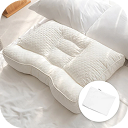
Your pillow is not just a soft place to rest your head; it is a critical medical tool for spinal alignment. You have likely spent hundreds of dollars on a neck pain pillow only to wake up with rock-hard tension and a lingering headache. It's exhausting to feel like you're failing at sleep, especially when the global orthopedic pillow market reached a staggering $4.2 billion in 2025. We understand that frustration because we've been there too.
Finding support that actually works in 2026 requires looking past marketing buzzwords and focusing on the science of ergonomics. You can end the cycle of morning stiffness and interrupted sleep. This guide provides the essential checklist to restore your spinal health and find a durable, breathable solution that lasts. We'll explore the vital criteria for cervical alignment and explain why high-performance latex is now the preferred choice over the memory foam designs that dominated 42.1% of the market last year. It's time to wake up feeling refreshed and ready for your day.
Key Takeaways
- Identify the hidden signs of "pillow failure," including the common habit of tucking your arm under your head for extra height.
- Compare the "sink vs. float" dynamics of materials to see why memory foam often traps you in painful, misaligned positions.
- Use your shoulder width as a primary metric to choose a neck pain pillow with the perfect loft for your unique frame.
- Master position-specific adjustments to fill the gap behind your neck and prevent morning stiffness, whether you sleep on your side or back.
- Discover why 100% natural latex is the breathable, orthopedic standard for support that's comfortable without being rock-hard.
Is Your Pillow the Problem? The Morning Stiffness Checklist
Waking up should feel like a fresh start. Instead, you're greeted by a dull ache in your neck and a jaw that feels like it's been clenched for hours. If you're constantly readjusting in the middle of the night, your pillow isn't a place of rest; it's a source of stress. A true Orthopedic pillow isn't just a cushion. It's a precision-engineered tool designed to keep your spine aligned. Many people mistake "soft" for "supportive," but a pillow that's too plush allows the head to drop, straining the delicate ligaments in your neck. This sustained misalignment is why a growing percentage of the global population experiences chronic morning tension.
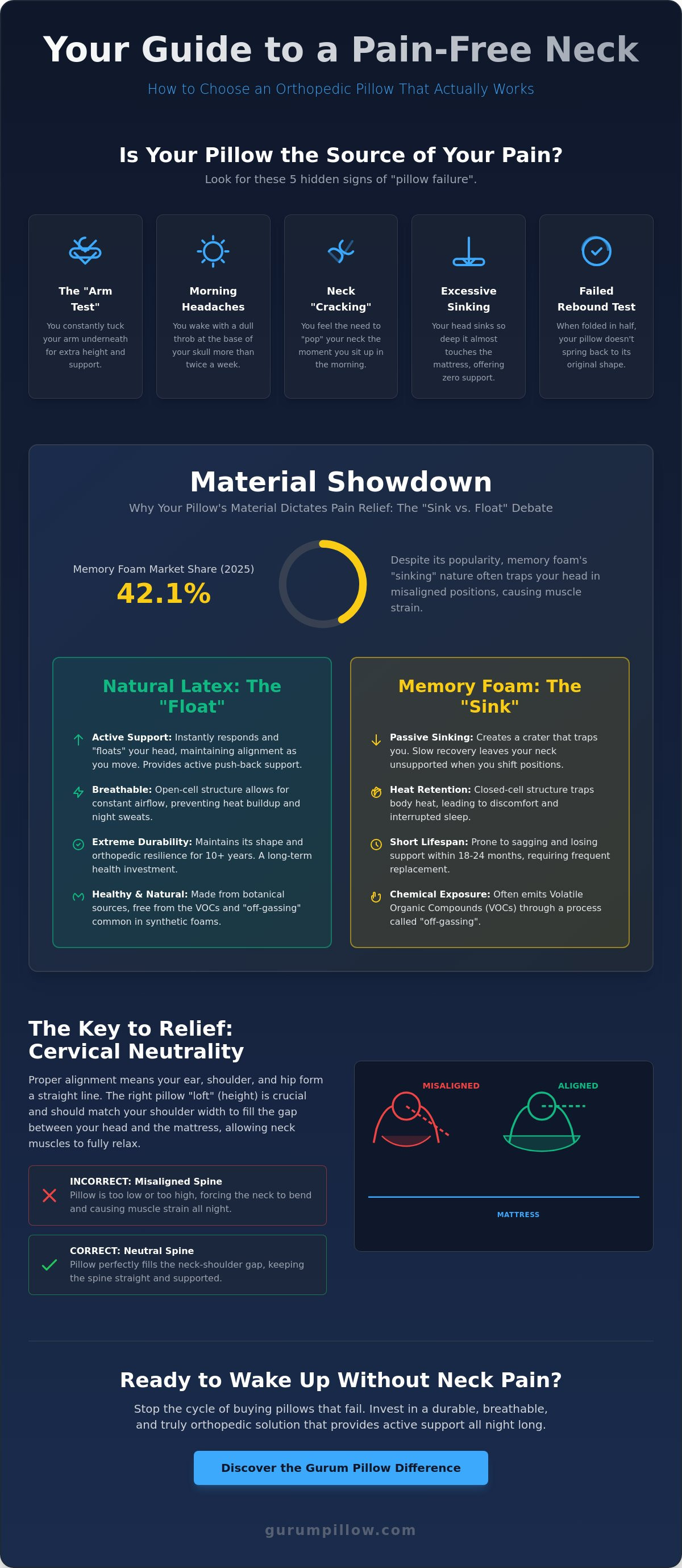
Look at your current pillow. Is it yellowed or flat? These aren't just cosmetic issues. Yellowing indicates a breakdown of material due to moisture and oils, while flattening means the loft has failed. Try the "Arm Test" tonight. If you find yourself sliding your arm under the pillow to get more height, your pillow has failed its only job. You're manually creating the support that your neck pain pillow should provide on its own. Your pillow should float your head, not swallow it.
The 5-Point Self-Diagnostic Checklist
- Ear-to-Shoulder Alignment: Lie on your side in front of a mirror or have a partner check you. Your ear, shoulder, and hip should form a perfectly straight line.
- Headache Frequency: Track how often you wake up with a dull throb at the base of your skull. If it happens more than twice a week, your pillow is likely the culprit.
- The Rebound Test: Fold your pillow in half. If it doesn't immediately spring back to its original shape, the internal structure is dead.
- Sink-Depth: If your head sinks until it almost touches the mattress, you have zero orthopedic support.
- Morning "Cracks": If you feel the need to "pop" your neck the moment you sit up, your muscles have been overstretched all night.
Understanding Cervical Neutrality
Cervical neutrality is the straight-line alignment of the ear, shoulder, and hip. Your neck has a natural "C-curve" that requires active, resilient support rather than simple cushioning. When this curve isn't maintained, your muscles stay "on" all night to prevent your head from drooping. This leads to nerve compression and chronic muscle strain. A high-quality neck pain pillow fills the gap behind your neck, allowing your muscles to finally switch off and recover. Without this active support, you aren't actually sleeping; you're just straining in the dark.
Latex vs. Memory Foam: Why Material Choice Dictates Pain Relief
When you're hunting for a neck pain pillow, the material determines whether you wake up refreshed or trapped in a crater of your own making. The "Sink vs. Float" debate is the most critical factor in orthopedic recovery. Memory foam, which accounted for 42.1% of the market share in 2025, is designed to "sink." While this feels cozy for a few minutes, it often traps your head in a single, misaligned position. If you try to roll over, the foam takes several seconds to reshape itself. During that delay, your neck loses all support, leading to the micro-strains that cause morning stiffness.
Natural latex offers a completely different experience. It "floats" your head by providing active push-back support. This material choice isn't just about comfort; it's about long-term durability and health. Consider these key differences:
- Thermal Regulation: Memory foam is a closed-cell structure that traps body heat, often leading to night sweats. Latex features an open-cell structure that allows constant airflow.
- Durability: Standard foam pillows often sag within 18 to 24 months. High-quality latex maintains its orthopedic shape and resilience for 10 years or more.
- Chemical Exposure: Many synthetic foams emit Volatile Organic Compounds (VOCs), often called "off-gassing." 100% natural latex is a botanical product, making it a cleaner choice for your respiratory health.
The Problem with Memory Foam for Neck Pain
The "slow-recovery" feature of memory foam is actually its biggest flaw for sleepers with chronic pain. When you move, the support is gone until the foam reacts to your new body heat. This creates a "rock-hard" sensation in cooler bedrooms, as the material requires heat to soften. If your room is 65 degrees, your pillow might feel like a brick until you've been lying on it for twenty minutes. You can learn more about these specific material trade-offs in our guide on Latex Foam Pillow vs. Memory Foam: Which Material Wins in 2026?
The Dynamic Response of Natural Latex
Natural latex provides a "Goldilocks" level of firmness. It's supportive and comfortable without being rock-hard. This material provides "push-back" support, meaning it actively lifts your head to maintain cervical neutrality regardless of how much you move. It's also inherently hypoallergenic and resistant to dust mites, which is vital for anyone who wakes up with a stuffy nose. If you're tired of pillows that go flat after a few months, switching to a premium latex pillow offers a consistent, reliable sleep surface that protects your spine for years to come.
The Structural Checklist: Loft, Firmness, and Contour
Geometry is just as important as material when selecting a neck pain pillow. If the shape is wrong, even the highest quality materials can't save your spine from a night of strain. Most traditional pillows are designed for aesthetics; they look full and fluffy on a made bed. However, your anatomy isn't a flat surface. Your head, neck, and shoulders require different elevations to remain in a neutral position. A structural checklist ensures your pillow fits your body like a custom tool rather than a generic cushion.
We often confuse "softness" with "comfort," but in orthopedic health, these are very different things. A pillow that feels like a cloud usually lacks the structural integrity to hold your head's weight, which is about 10 to 12 pounds. Orthopedic support requires a specific firmness that maintains its height throughout the night. Additionally, look for a design that incorporates a "cervical roll." This is the raised section that sits directly under your neck. It fills the natural void created by the C-curve of your spine, allowing your muscles to finally stop working and start recovering.
Finding Your Ideal Pillow Loft
The "loft" refers to the compressed height of the pillow. Your primary metric for this is your shoulder width. To find your ideal fit, measure the distance from the base of your neck to the outer tip of your shoulder bone. If you're a side sleeper, your loft must match this distance exactly to prevent your shoulder from collapsing inward. For back sleepers, the loft requirement is much lower. A pillow that's too high for a back sleeper pushes the chin toward the chest, which can restrict airways and strain the upper cervical vertebrae. Your neck pain pillow should keep your nose aligned with the center of your chest.
The Importance of Shape Retention
A pillow that needs "fluffing" is failing to provide consistent orthopedic support. If you have to beat your pillow back into shape at 3:00 AM, the internal structure has already collapsed, leaving your neck vulnerable for hours. This is why 100% natural latex is the only material that guarantees shape retention; it returns to its original form instantly every time you move. You can dive deeper into the technical reasons behind this in The Complete Guide to Natural Latex Pillows: Science, Support, and Better Sleep. Consistent height is the foundation of a pain-free morning.
Position-Specific Guidance: Adapting to Your Sleep Style
Your sleep position is the final piece of the orthopedic puzzle. Even the most advanced neck pain pillow won't help if it's fighting against your natural posture. Most generic guides offer a "one size fits all" approach. They ignore the reality that your body's needs change the moment you shift from your back to your side. We know how frustrating it is to buy a highly rated pillow only to find it's too high or too low for your specific frame. True relief comes from understanding how to bridge the gap between your mattress and your spine based on how you actually sleep.
The biggest challenge for many is the "Active Sleeper" dilemma. Research indicates that the average person moves between 10 and 40 times per night. If your pillow features a "slow-recovery" foam, you're essentially sleeping in a crater that sags as you move. This leaves your neck unsupported during the transition. You need a material that responds instantly to every shift. This dynamic support ensures you can wake up without neck pain, regardless of how many times you change positions during the night.
Side Sleeper Alignment Strategies
Side sleeping is the most popular position, but it's also the most likely to cause "scapular winging" or painful neck crinks. You must pass the "Ear-Shoulder-Hip" straight line test. If your pillow is too soft, your head tilts toward the mattress, stretching the muscles on the opposite side of your neck for eight hours straight. A firm, resilient latex core prevents this tilt. It provides the necessary lift to keep your spine neutral from your skull down to your lower back. For a deeper look at the mechanics of this, read our guide on the Cervical Support Pillow: The Science of Waking Up Without Neck Pain.
Back Sleeper Support Essentials
Back sleepers require a pillow that cradles the occipital bone at the base of the skull. A flat surface is your enemy. It allows the head to roll or the neck to flatten, which destroys your natural Lordotic Curve. You need a slight contour that fills the void behind your neck without pushing your chin toward your chest. This specific elevation keeps your airways open and your cervical vertebrae aligned. If you're tired of waking up with tension headaches, finding a neck pain pillow that supports this curve is non-negotiable.
Stomach sleeping is the hardest position to correct. It forces your neck into a 90-degree twist for hours, which is the primary cause of chronic morning stiffness. If you can't switch positions, you need the thinnest possible support to minimize that rotation. However, for most, the best solution is transitioning to side or back sleeping with a supportive latex pillow that makes those healthier positions feel natural and comfortable.
Wake Up Without Neck Pain: The Gurum Pillow Difference
Ji H. Won didn't start Gurum Pillow to join a crowded market. He started it because he was tired of living with the "pillow graveyard" in his closet. Like you, he suffered from chronic neck pain that turned every morning into a struggle. He realized that the industry was obsessed with "softness" at the expense of spinal health. This personal mission is why we do things differently. We don't just sell a place to rest your head; we provide a precision-engineered tool for recovery. Every neck pain pillow we produce is a reflection of that commitment to ending the cycle of morning stiffness.
We've made a conscious choice to avoid memory foam and synthetic blends entirely. While foam dominated 42.1% of the market last year, it often fails those with orthopedic needs. Our 100% natural latex is a botanical material that offers a level of resilience foam simply can't match. It doesn't sag, it doesn't trap heat, and it doesn't emit the chemical odors associated with synthetic products. We believe your sleep environment should be as clean as it is supportive. That's why we also offer specialized anti-allergy pillow covers to protect you from dust mites and irritants. To make this professional-grade relief accessible, we provide free shipping in the USA on every order.
Engineered for Orthopedic Relief
The Premium Latex Pillow is designed with a specific density that targets the cervical spine. We've perfected a "supportive, not rock-hard" philosophy. Many people fear that an orthopedic neck pain pillow will feel like a brick, but we've found the "Goldilocks" balance. The material cradles your head's 10-pound weight while providing active push-back support to keep your neck aligned. This ensures your muscles can finally switch off and enter a state of deep repair. Shop the Premium Latex Pillow and end your morning stiffness today.
Your Travel Solution for Neck Health
Consistency is the foundation of spinal health. You shouldn't have to sacrifice your progress just because you're away from home. Most hotel pillows are either dangerously soft or completely flat, leading to "vacation neck" that ruins your trip. Our Travel Latex Pillow provides the same high-performance support as our flagship model in a compact, portable size. It ensures you maintain your alignment across the United States, whether you're in a hotel or on a long flight. For a deeper look at why this material is the gold standard for 2026, check out our guide on the Best Latex Pillow for Neck Pain: The 2026 Guide to Pain-Free Sleep. Your health deserves a routine that never takes a day off.
Take Control of Your Spinal Health Today
Your path to restorative sleep begins with a single, informed choice. You now understand that a neck pain pillow isn't a luxury; it's a medical necessity for maintaining cervical neutrality. By prioritizing 100% natural latex over the heat-trapping sagging of memory foam, you're investing in a decade of consistent support. It's time to stop settling for pillows that require constant fluffing and start using a tool that actually works. Remember to match your pillow loft to your shoulder width to prevent those agonizing morning crinks.
Our mission at Gurum Pillow is deeply personal. Ji H. Won designed these products to solve his own chronic struggle with spinal tension. We've replaced the rock-hard feel of traditional orthopedic tools with a breathable, supportive, and comfortable alternative that lifts your head effortlessly. With free shipping across the United States, professional-grade relief is closer than ever. You don't have to accept morning stiffness as a permanent part of your life.
Wake Up Without Neck Pain. Shop Gurum Premium Latex Pillows Now. You deserve to start every morning feeling refreshed and ready for your day. Rest is waiting for you.
Frequently Asked Questions
Is a firm or soft pillow better for neck pain?
A medium-firm pillow is the gold standard for orthopedic health. A pillow that's too soft allows your head to sink into an unnatural angle; this stretches your ligaments and causes morning stiffness. Conversely, a rock-hard surface creates pressure points that can lead to headaches. You need a material that provides active push-back support to keep your cervical spine in a neutral position all night long.
How do I know if my pillow is too high for my neck?
You can tell your pillow is too high if your chin is pushed toward your chest while lying on your back. For side sleepers, a pillow that's too high forces your neck to tilt upward; this breaks the straight line from your ear to your hip. If you wake up with a "crink" or find yourself constantly adjusting your head, your loft is likely misaligned with your shoulder width.
Can memory foam pillows actually make neck pain worse?
Yes, memory foam can worsen neck pain because its "slow-recovery" design traps you in a single position. When you shift during the night, the material takes several seconds to reshape itself. This creates a temporary gap in support that strains your muscles. Additionally, memory foam's 42.1% market share hides the fact that it often sags after 18 months, losing its ability to provide a reliable neck pain pillow experience.
How long does it take to adjust to a new orthopedic pillow?
It typically takes between 7 and 14 days for your muscles to adapt to a new orthopedic surface. Your neck has likely spent years compensating for poor alignment on traditional cushions. During this "break-in" period, you might feel slight discomfort as your spine returns to its natural C-curve. Consistency is the key to long-term relief; don't give up after just one or two nights.
What is the best pillow for someone with "military neck" or a flat cervical curve?
A contoured pillow with a dedicated cervical roll is the best choice for a flat cervical curve. This design provides active support to the "void" behind your neck; it encourages the spine to maintain its healthy Lordotic Curve. Standard flat pillows allow the neck to flatten further against the mattress. This leads to nerve compression and chronic muscle fatigue that persists throughout your day.
How often should I replace my neck pain pillow?
You should replace a standard foam or down pillow every 18 to 24 months. These materials lose their resilience and loft quickly; this leaves your head unsupported. However, 100% natural latex is significantly more durable. A high-quality latex neck pain pillow can maintain its original shape and orthopedic integrity for 10 years or more, making it a much more sustainable investment for your health.
Does 100% natural latex have a chemical smell like memory foam?
No, 100% natural latex doesn't have the harsh chemical "off-gassing" smell common in memory foam. Synthetic foams are often made with petroleum-based chemicals that emit Volatile Organic Compounds (VOCs). Natural latex is a botanical product harvested from rubber trees. While it may have a faint, sweet scent initially, it's hypoallergenic and free from the toxic odors that can interrupt your sleep.
Can a pillow help with tension headaches caused by neck stiffness?
Yes, a supportive pillow can significantly reduce tension headaches by preventing strain at the base of your skull. When your head isn't aligned, the suboccipital muscles stay "on" to protect your spine. This constant contraction leads to referred pain that feels like a tight band around your head. Proper alignment allows these muscles to finally relax, ending the cycle of morning headaches.