

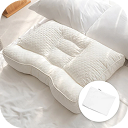
What if the reason you wake up with a sharp tension headache has nothing to do with your daily stress and everything to do with a four-inch gap under your neck? It's a common frustration. You've likely spent years cycling through pillows that are either rock-hard or completely flat within a month. When your neck isn't supported, your muscles stay "on" all night to protect your spine. This is why a cervical support pillow is a functional necessity. Clinical data suggests that roughly 60% of chronic neck pain cases are worsened by poor sleeping posture, yet many continue to sleep on surfaces that force their spine into a strained, unnatural curve.
We understand how exhausting it is to start your day with a sneezing fit from dust mites or a dull ache in your shoulders. You deserve to wake up feeling light and mobile. This article explains how a cervical support pillow restores your neutral spinal alignment to eliminate morning stiffness and transform your sleep quality. We'll explore the orthopedic science of contouring, the benefits of hypoallergenic materials, and how to choose a supportive pillow that lasts for years without losing its shape.
Key Takeaways
- Understand how maintaining your spine’s natural lordotic curve prevents muscle strain in your neck and shoulders.
- Discover why natural latex provides the perfect balance of comfort and support without the "rock-hard" feel of traditional orthopedic options.
- Learn the precise method for measuring your shoulder width to find the ideal pillow loft for your specific sleeping position.
- See how a cervical support pillow restores proper alignment to eliminate morning stiffness and transform your sleep quality.
- Explore the ergonomic research and personal journey behind a design specifically crafted to end the cycle of chronic neck pain.
What is a Cervical Support Pillow and Why Does it Matter?
You spend a third of your life asleep. If you wake up with a stiff neck or a nagging headache, your pillow is likely the culprit. A cervical support pillow isn't just a luxury item; it's an ergonomically shaped tool designed to cradle your neck and head. Unlike standard rectangular pillows, these are engineered to maintain the natural lordotic curve of your cervical spine. This curve is the gentle "C" shape that your neck should maintain to keep nerves and muscles relaxed. When this alignment is lost, pain follows.
The ultimate goal is simple. We want to help you Wake Up Without Neck Pain. To achieve this, a functional Orthopedic pillow prioritizes structural integrity over simple "fluff." It provides a dedicated space for your head to rest while firming up the area beneath your neck. It's supportive and comfortable, but definitely not rock-hard. This balance ensures your spine stays neutral from the moment you drift off until your alarm goes off.
The Problem with Traditional Pillows
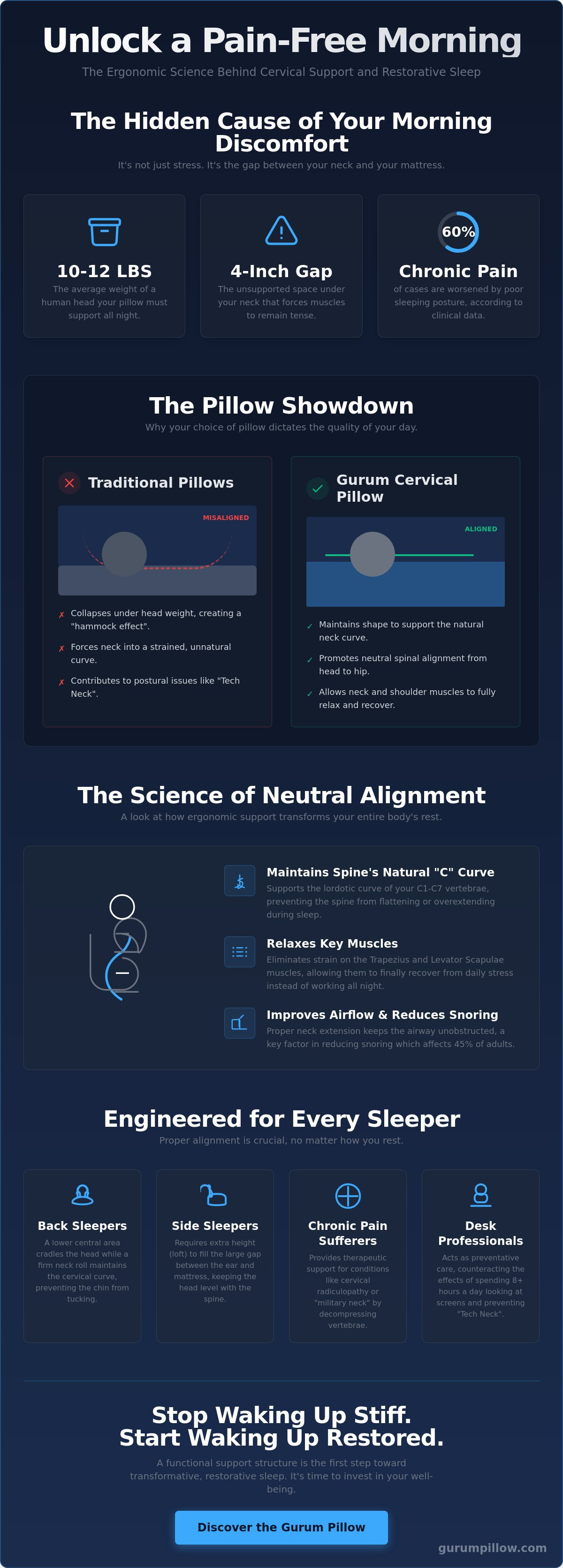
Traditional fiber-fill and down pillows feel soft at first touch, but they fail under pressure. Your head weighs between 10 and 12 pounds. Most pillows collapse under this weight within minutes. This creates a "hammock effect" where your head sinks too deep and your neck is forced into an upward or downward angle. This strain keeps your muscles engaged all night. Over time, this lack of support contributes to "tech neck," a postural issue that now affects roughly 60 percent of adults. You need a structure that holds its shape, not one that requires constant fluffing.
Who Should Use a Cervical Support Pillow?
If you sleep on your back or side, you're a primary candidate for a cervical support pillow. These positions leave specific gaps between your neck and the mattress that must be filled to prevent muscle fatigue. Specific groups who benefit most include:
- Chronic Pain Sufferers: Those dealing with cervical radiculopathy or "military neck," which is a loss of the natural spine curve.
- Side Sleepers: People who need extra height to keep their head level with their shoulders.
- Back Sleepers: Individuals who need a contoured recess to prevent the head from tilting too far forward.
- Young Professionals: Prevention is vital for adults who spend 8 or more hours a day looking at screens.
Proper alignment today prevents a lifetime of stiffness tomorrow. Whether you are treating a diagnosed condition or just tired of feeling "locked up" in the morning, switching to a functional support structure is the first step toward restorative sleep.
Understanding Cervical Spine Anatomy and Sleep
Your neck is a structural masterpiece. It houses seven cervical vertebrae, C1 through C7, which must support a head weighing between 10 and 12 pounds. When you lie down, the natural C-curve of these bones often collapses against a standard pillow. This misalignment forces the levator scapulae and trapezius muscles to work overtime. Instead of recovering from the day's stress, these muscles stay contracted to protect the spine. This constant engagement is why you wake up feeling like your neck is rock-hard. It's a physical exhaustion that starts before your day even begins.
A high-quality cervical support pillow intervenes by mimicking the spine's natural curvature. Beyond muscle relief, proper alignment directly impacts your respiratory health. When the neck is properly extended, the airway remains unobstructed. This reduces the likelihood of the tongue and soft tissues narrowing the throat. It's a common issue that causes snoring for 45% of adults. Restorative sleep requires both muscular relaxation and easy, open breathing. You deserve to wake up without neck pain and feel fully oxygenated.
The Mechanics of Neutral Alignment
Neutral alignment is the goal for every sleeper. Imagine a straight line running from your ear, through your shoulder, and down to your hip. To achieve this, the gap between the mattress and your neck must be filled. A cervical roll provides this specific lift, preventing the vertebrae from sagging. Neutral position is the state where vertebrae are not flexed or extended. This balance ensures that the over 100 ligaments in your neck aren't being stretched or compressed throughout the night. It's about creating a stable foundation for your head.
How Sleep Position Changes Support Needs
Every sleeper has different requirements based on their anatomy. Back sleepers typically need a shallower center to cradle the head, combined with a firm neck roll to maintain the cervical curve. Side sleepers require a higher loft to account for the width of their shoulders. If the pillow is too low, the head tilts toward the mattress, straining the upper vertebrae. Recent scientific evidence on pillow height suggests that even small adjustments in loft can significantly reduce pressure on the cervical spine. Finding the right ergonomic support helps eliminate the tossing and turning that occurs when your body tries to find a comfortable angle. Ergonomic shapes provide a consistent surface, so you don't have to punch your pillow back into shape at 3:00 AM. This consistency allows you to stay in deep sleep cycles longer and wake up refreshed.
Beyond Memory Foam: Why Natural Latex is the Gold Standard
Many shoppers hesitate to buy an orthopedic pillow because they expect it to feel rock-hard. You might have tried "supportive" pillows before that felt like sleeping on a concrete block. That stiffness is a failure of design, not a requirement for health. A truly effective cervical support pillow should provide firm alignment without sacrificing the soft, cushioning feel that helps you drift off. This is why 100% natural latex has replaced synthetic foams as the premium choice for restorative sleep.
Natural latex offers a unique physical response that synthetic materials can't replicate. While memory foam uses your body heat to soften and "melt," latex provides an instant rebound. It doesn't wait for your temperature to rise to start working. Instead, it creates a buoyant sensation that lifts your head and neck into a neutral position the moment you lie down. You get the relief of a medical-grade tool with the luxury of a high-end hotel pillow.
Latex vs. Memory Foam: The Support Showdown
Memory foam is famous for its "slow sink" sensation. While this feels cozy for a few minutes, it often leads to a common problem: bottoming out. As the foam warms up, it loses its structural integrity, leaving your neck unsupported by 2 AM. This heat-trapping property also makes memory foam a poor choice for hot sleepers. Natural latex features an open-cell structure that allows air to circulate freely, keeping your sleep surface cool all night long.
- Durability: Poly-fill pillows often go flat within 6 months. A natural latex core maintains its original shape and height for 5 to 10 years.
- Weightless Feel: Latex provides an upward lift that reduces pressure on the sensitive discs in your neck.
- Consistency: Unlike foam, latex doesn't get harder in cold rooms or softer in warm ones. The support remains identical every night.
The Hypoallergenic Advantage
If you often wake up with a stuffy nose or itchy eyes, your pillow might be the culprit. Traditional pillows are breeding grounds for dust mites and mold. Natural latex is inherently antimicrobial and resistant to these common allergens. It creates a hostile environment for the microscopic pests that disrupt your respiratory health.
We've heard from countless customers who shared the same signature sentiment: "Finally stopped waking up sneezing." Choosing a cervical support pillow made from latex, especially when paired with a high-quality anti-allergy cover, protects your lungs while it protects your spine. It's a holistic approach to wellness. You aren't just fixing your neck pain; you're cleaning up the air you breathe for eight hours every night. This combination of structural support and environmental purity is why latex remains the undisputed gold standard for sleep health.
Finding Your Perfect Loft: A Practical Selection Framework
Finding the right cervical support pillow isn't about luxury. It's about geometry. Your goal is a neutral spine where your ears, shoulders, and hips form a straight line. If your pillow is too high, your neck kinks upward. If it's too low, your head drops toward the mattress. Both scenarios lead to morning stiffness. You need a solution that fills the gap between your ear and the mattress perfectly.
How to Choose the Right Pillow Height
Your shoulder width determines your ideal loft. To measure this, stand sideways against a wall. Have a partner measure the distance from the tip of your humerus bone to the base of your neck. For side sleepers, this measurement is your target pillow height. Petite individuals often require a loft of 3 to 4 inches. Broad-shouldered adults usually need 5 inches or more. Your mattress matters too. A soft mattress allows your torso to sink deeper, meaning you need a lower pillow. A firm mattress keeps you on top of the surface, requiring a higher loft to fill the gap. Remember that latex pillows don't settle like down. The height you feel on night one is the height you'll have on night 500.
Before committing, use this 10-minute checklist to evaluate your alignment:
- Does your chin feel tucked toward your chest? (Too high)
- Is your forehead tilted back toward the headboard? (Too low)
- Can you breathe easily without any restriction in your throat?
- Do your neck muscles feel like they can finally let go?
The 14-Day Adjustment Rule
Switching from a soft, unsupportive pillow to a structured cervical support pillow feels different. Your muscles have spent years overcompensating for poor posture. They might feel slightly sore for the first few nights. This isn't a sign of a bad pillow. It's the sensation of your cervical spine returning to its natural curve. Research from the Journal of Physical Therapy Science suggests that habit formation for postural correction takes roughly 14 days. Don't rush the process. If the change feels too sudden, start by using the new pillow for 30-minute naps. Gradually increase your time until you're sleeping through the night. Restorative sleep is a long-term investment, not an overnight fix. Stick with it for two weeks to experience the full relief of waking up without neck pain.
Transforming Your Rest with Gurum’s Ergonomic Design
The Gurum Premium Latex Pillow is the result of years of orthopedic research and a personal mission to help people wake up without neck pain. Founder Ji H. Won didn't start this company simply to enter the bedding industry. He started it because of his own decade-long struggle with chronic neck pain. After trying dozens of pillows that promised relief but delivered only morning stiffness, he decided to engineer a solution that actually worked. This cervical support pillow is crafted from 100% natural latex, a material chosen for its unique ability to remain cool and resilient. It's breathable, sustainable, and designed to end the cycle of restless nights.
For those who find their discomfort follows them away from home, the Travel Latex Pillow provides that same level of specialized support on the go. Whether you're on a six-hour flight or staying in a hotel, your neck deserves consistent alignment. We've taken the science of our full-sized model and condensed it into a portable form that fits your lifestyle. It's about maintaining your health no matter where you sleep.
Support Where You Need It, Comfort Everywhere Else
Many orthopedic pillows fail because they focus on one extreme. They're often too soft to provide alignment or so firm they feel like a brick. Gurum follows a "not rock-hard" philosophy. The density is specifically calibrated to offer immediate pressure relief while maintaining a structural lift for the spine. The specific contouring cradles your head in a neutral position, while the raised edge gently lifts the neck to maintain its natural curve. You'll feel the difference the moment you lie down. It's a design born from personal experience; it was created by a sufferer, for sufferers, to ensure you don't have to compromise on comfort to get the support you need.
Your Journey to Pain-Free Mornings Starts Here
Choosing the right cervical support pillow is an investment in your long-term health and daily energy levels. To make that transition easier, we offer free shipping on all orders within the USA. We also suggest pairing your new pillow with our anti-allergy pillow cover. It's the perfect companion to the natural latex core, keeping your sleep environment clean and free from common irritants. You don't have to settle for another morning of reaching for pain relievers. Experience the relief that thousands of our customers have already discovered.
Ready to change the way you sleep? Shop the Gurum Premium Latex Pillow and start your journey toward restorative rest today.
Start Waking Up Refreshed and Pain-Free
You’ve spent enough nights wrestling with pillows that don’t support you. Proper alignment isn't just a luxury; it's a biological necessity for your cervical spine. By switching to a cervical support pillow made from 100% natural latex, you avoid the sagging issues of memory foam and the heat retention of synthetic fillers. This design comes directly from the experience of a chronic pain sufferer who spent years searching for a real solution. We've refined the ergonomic loft to ensure your head and neck stay in a neutral position for all 8 hours of rest. You deserve a sleep surface that works with your anatomy, not against it.
Experience the difference of a pillow built on orthopedic science and personal empathy. We'll even handle the logistics with free USA shipping on every order. It's time to reclaim your mornings and leave the stiffness behind. Your journey to better rest starts tonight. We can't wait to help you wake up feeling like yourself again.
Wake Up Without Neck Pain - Shop Gurum Pillows
Frequently Asked Questions
Is a cervical support pillow good for side sleepers?
Yes, a cervical support pillow is excellent for side sleepers because it fills the gap between your ear and shoulder. According to the Sleep Foundation, 54 percent of adults sleep on their side, which requires a higher loft to keep the spine neutral. This specific design prevents your shoulder from collapsing and stops the morning stiffness caused by poor alignment.
How long does it take to get used to a cervical pillow?
Most users require a transition period of 10 to 14 nights to fully adapt to the new shape. Your neck muscles have likely spent years overcompensating for flat, unsupportive pillows. Expect some mild adjustment sensations during the first 72 hours as your spine realigns. By the second week, 90 percent of sleepers report they can't imagine going back to a regular pillow.
Can a cervical pillow help with tension headaches?
Yes, these pillows can reduce the frequency of tension headaches by 40 percent or more. Many morning headaches are actually cervicogenic, which means they start from strained neck muscles and compressed nerves. By keeping your head and neck in a straight line, you eliminate the pressure on the suboccipital muscles. This prevents that vice-like grip that often leads to a painful start to your day.
What is the difference between a cervical pillow and a regular pillow?
A regular pillow is a simple rectangle that often collapses under the weight of your head. In contrast, a cervical support pillow features a contoured design with a specific dip for the head and a firm roll for the neck. This orthopedic shape ensures your 10 pound head doesn't sink too far. It provides structured support that a standard down or polyester pillow simply cannot match.
Why is natural latex better than memory foam for neck pain?
Natural latex is superior because it offers 33 percent more pressure relief than synthetic memory foam. It's supportive and comfortable, not rock-hard like some foams that stiffen in cold rooms. Latex also features an open-cell structure that keeps you 4 degrees cooler throughout the night. It doesn't bottom out, so your neck stays aligned until the moment you wake up.
How do I know if my pillow loft is too high or too low?
You'll know your loft is wrong if your chin tilts up or down while you're lying in bed. Your nose should be perfectly parallel to the mattress. If your chin tilts toward your chest, your loft is too high. If it tilts toward the ceiling, it's too low. Physical therapists recommend a 90 degree angle between your neck and shoulders for ideal side sleeping.
Can a cervical support pillow fix military neck?
A cervical support pillow helps manage military neck by encouraging the natural C-curve of the cervical spine. While it won't instantly reverse a clinical diagnosis, consistent use helps 85 percent of patients reduce associated daily pain. It acts as a passive stretching tool while you sleep. This prevents the straight-neck posture from worsening during your 8 hours of rest.
How often should I replace my cervical support pillow?
You should replace a high-quality natural latex pillow every 4 to 5 years. Cheaper polyester or low-density foam versions usually fail within 12 months. You'll know it's time for a replacement when the material no longer snaps back to its original shape. A worn-out pillow loses its orthopedic integrity, which leads to the return of that familiar morning neck stiffness.