

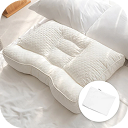
Your morning reset shouldn't start with a stiff neck and a clouded mind. Many sleepers spend years chasing comfort in synthetic foam only to wake up with persistent shoulder tension or the congestion of chemical off-gassing. Finding the right natural pillow materials for healthy sleep is about more than just comfort; it's about reclaiming your physical well-being. You've likely tried every orthopedic solution on the market, yet heat-trapping materials often leave you restless and damp by midnight.
It's time to stop settling for bedding that compromises your health. True restorative rest requires a synergy of chemical purity and structural resilience that only high-quality organic materials can provide. This guide explores how 100% natural latex and breathable fibers transform your sleep quality by combining non-toxic purity with superior anatomical support. We'll show you how to achieve pain-free mornings and a clean, hypoallergenic environment that lasts.
We will examine the latest 2026 trends, including the benefits of GOLS-certified latex and the cooling properties of organic wool and kapok. You'll learn how to evaluate certifications like GOTS and OEKO-TEX to ensure your investment delivers the long-term relief you deserve. From understanding the ROI of premium materials to solving night sweats, we have the answers you need for a better night's rest.
Key Takeaways
- Understand why natural pillow materials for healthy sleep must address both your respiratory safety and your spine's anatomical alignment.
- Learn how material response time impacts your rest and why quick-adapting fillers prevent sleep disruptions.
- Discover the "floating" sensation of natural latex and why you shouldn't settle for the sinking feeling of synthetic alternatives.
- Use a simple shoulder measurement technique to identify the exact loft height your body requires for pain-free mornings.
- Explore the concept of the sleep micro-environment and how choosing non-toxic materials improves the air you breathe.
Beyond Non-Toxic: Why Natural Pillow Materials Define Sleep Health
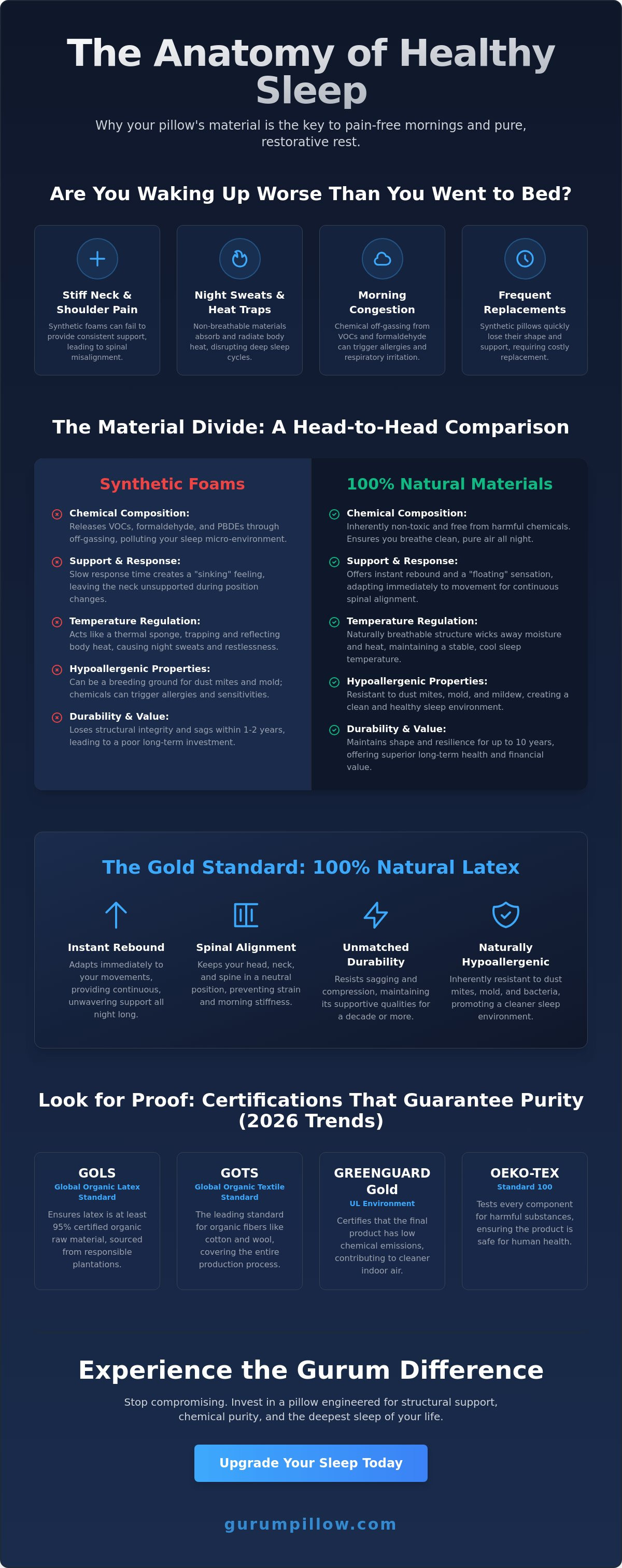
Healthy sleep is more than just hours spent unconscious. It is the precise balance of respiratory safety and anatomical support. You spend a third of your life in what experts call a "micro-environment." This is the concentrated air you breathe while your face is inches from your bedding for eight hours straight. If that pillow is synthetic, you are likely inhaling industrial byproducts rather than fresh air. Choosing natural pillow materials for healthy sleep ensures this immediate environment remains pure and supportive.
When comparing Natural and synthetic pillow fillings, the difference in chemical composition is staggering. Standard pillows often contain PBDEs, which are chemicals used as flame retardants. They also hide formaldehyde, a known respiratory irritant. These substances don't stay trapped inside the foam; they migrate into the air you breathe. Natural materials prioritize breathability, allowing for constant airflow. This ventilation keeps your body temperature stable. A stable temperature is a biological requirement for entering deep REM sleep cycles. When your brain doesn't have to fight heat or chemical irritation, it can finally focus on physical recovery.
The Silent Sleep Disruptors in Synthetic Foams
Synthetic foams are notorious for Volatile Organic Compounds, or VOCs. You might recognize this as that "new product" smell, but in bedding, it's called off-gassing. This process releases gas into your bedroom throughout the night. It's a common trigger for nighttime allergies and that heavy, "foggy" feeling many people experience upon waking. Beyond the chemicals, synthetic foam acts like a thermal sponge. It absorbs your body heat and radiates it back, causing restlessness. Natural latex and wool provide passive cooling instead. They move moisture and heat away from your skin, allowing your core temperature to drop naturally for deeper rest.
Certifications That Actually Matter in 2026
In the 2026 market, "natural" is a buzzword often used for greenwashing. You must look for third-party verification to protect your health. The Global Organic Textile Standard (GOTS) is the leading certification for fibers like cotton and wool. If you prefer the resilient support of rubber, the Global Organic Latex Standard (GOLS) is mandatory. It ensures the material is at least 95 percent natural and sourced from organic plantations. Don't overlook GREENGUARD Gold or MADE SAFE labels. These certifications test the finished product for thousands of known toxins and soil contaminants. High-quality natural pillow materials for healthy sleep will always carry these seals to prove they are free from harmful off-gassing.
Comparing Natural Fillers: Latex, Wool, and Buckwheat Science
Selecting the right natural pillow materials for healthy sleep requires looking past the organic label. You must understand how these materials react to your body weight in real-time. In 2026, the science of rest focuses heavily on "Response Time." This is the speed at which a filler adjusts when you shift positions. If a material is too slow, your neck spends several seconds unsupported. If it's too noisy, your brain never fully disconnects from the sensory environment. Each material offers a different physical profile that impacts your sleep architecture.
Natural Latex: The Gold Standard for Resilience
Natural latex is harvested from the milk of Hevea Brasiliensis trees. It offers an "instant rebound" that synthetic foams simply cannot replicate. This resilience ensures your head stays in a neutral position all night. A pillow that Supports Spinal Alignment is critical for preventing chronic morning stiffness. Because it is naturally resistant to dust mites and mold, it's a superior choice for those with environmental sensitivities. When looking for long-term value, organic latex pillows are the clear winner. They maintain their shape for up to 10 years without sagging. This durability makes them a wise investment for your health. If you are ready to upgrade, our Premium Latex Pillow provides this exact level of consistent, orthopedic support.
Wool and Buckwheat: Niche Solutions for Specific Needs
Wool is a fantastic natural insulator. It excels at moisture-wicking, making it ideal for those who struggle with night sweats. However, wool has a major drawback: compression. Over time, the fibers felt together and lose their loft. This results in a flatter pillow that fails to support the cervical curve. You'll find yourself constantly fluffing it to find relief.
Buckwheat hulls offer a different experience. They are highly breathable and allow you to shift the filling to your liking. But they come with a "noise factor." The hulls rustle every time you move, which can disrupt light sleepers. For side sleepers, buckwheat often feels too firm against the ear. While these are valid natural pillow materials for healthy sleep, they often fall short for individuals with chronic neck pain. They lack the consistent upward pressure needed to keep the neck muscles fully relaxed throughout the night.
The Structural Advantage: How Natural Resiliency Supports Spinal Alignment
Your neck isn't flat. It possesses a delicate, C-shaped cervical curve that requires constant, gentle support to remain healthy. When you lie down, the gap between your head and the mattress must be filled with a material that provides consistent upward pressure. Without this, your neck muscles stay engaged all night to protect your spine. This is the primary cause of waking up with a stiff neck or "Military Neck" posture. High-quality natural pillow materials for healthy sleep offer the buoyant force needed to let those muscles finally go offline.
There is a fundamental difference between "sinking" and "floating" during rest. Memory foam is a sinking material. It uses your body heat to soften, which means your head slowly drops into a deep pocket while your neck is left unsupported. Natural latex offers a floating sensation instead. It pushes back against your weight instantly. This is why effective cervical pillows require high-resilience natural materials. They correct your posture by maintaining the density needed to keep your vertebrae aligned, even as you move.
The scientific community has long recognized that material density is not just about comfort; it's about medical necessity. A study on pillow materials and sleep quality highlights how filling types directly influence waking symptoms and spinal health. Natural latex consistently proves superior to synthetic alternatives because its cellular structure doesn't collapse under pressure. It provides a reliable foundation that synthetic foams, which often lose their integrity within months, simply can't match.
The Physics of Pressure Relief
Proper pressure relief is a matter of weight distribution. When a material is too soft, like down or low-density polyester, it "bottoms out." This concentrates the full weight of your head on a few small points in your neck. It can even impede minor circulation, leading to restlessness. Dense natural materials distribute that weight across a much larger surface area. This allows for total muscle relaxation. Don't be fooled by pillows that feel cloud-like and soft. If they lack structural integrity, they will actually increase your neck pain over time.
Spinal Alignment for Side and Back Sleepers
Your preferred sleep position dictates your specific material needs. Back sleepers require a lower profile that supports the neck without tilting the chin toward the chest. Side sleepers need significantly more loft to fill the space created by the width of their shoulders. Using natural pillow materials for healthy sleep ensures this loft doesn't flatten out by 3:00 AM. You can find detailed loft measurements in our guide for the best pillow for side sleepers. These resilient materials prevent the subtle head-tilt that stretches tendons and triggers tension headaches.
Choosing Your Ideal Loft: A Guide to Personalized Natural Comfort
Finding the perfect height for your pillow is a technical process, not a guessing game. The wrong loft forces your neck into an unnatural angle, leading to the morning stiffness we discussed earlier. To select the right natural pillow materials for healthy sleep, you must first measure the gap between your ear and the edge of your shoulder. This measurement represents the exact height your pillow needs to maintain while compressed. If the pillow is too high, it strains the upper vertebrae; if it's too low, it causes the neck muscles to overstretch.
Your primary sleep position is the next variable. Side sleepers require a higher loft to keep the head level with the spine. Back sleepers need a medium profile that supports the neck without pushing the head forward. If you sleep on a soft mattress, you'll sink deeper into the surface. This means you actually need a lower loft than someone on a firm mattress. You must also consider how different natural pillow materials for healthy sleep behave under weight. While wool and down compress significantly, 100% natural latex maintains its height throughout the night without settling.
Loft Adjustments for Chronic Pain
A "one size fits all" approach is the enemy of ergonomic health. If your chin tilts toward your chest or your head leans back, your pillow height is incorrect. Testing this is simple: lie in your usual position and have someone check if your nose is aligned with the center of your chest. For those seeking the best latex pillow for neck pain, consistent height is non-negotiable. Our Premium Latex Pillow is engineered to provide this exact, unchanging support for long-term relief.
Maintenance Tips for Natural Materials
Preserving the structural integrity of your investment requires specific care. You should never wash raw latex or buckwheat hulls. Water can cause these materials to degrade or harbor hidden moisture. Instead, refresh natural fibers by occasionally airing them out in a shaded, well-ventilated area. Using high-quality organic cotton covers is essential for protection. An Anti-Allergy Pillow Cover keeps your sleep surface pristine while preventing dust mites from reaching the core materials. This ensures your micro-environment remains as healthy as the day you bought it.
The Gurum Approach: Engineering the Perfect Natural Latex Pillow
Rest shouldn't be a struggle. Gurum was born from a very personal place: the exhausting search for genuine neck pain relief. Like many of our customers, our founder spent years cycling through synthetic foams and flat fibers that promised health but delivered only stiffness and frustration. We realized that natural pillow materials for healthy sleep aren't just about avoiding chemicals. They're about the physics of the human body. This realization led us to focus exclusively on 100% natural latex as the foundation for restorative sleep.
Generic "molded" pillows often follow a standard shape that ignores the subtle nuances of the cervical spine. The Gurum design uses specific ergonomic contouring to cradle your head while maintaining consistent upward pressure on the neck. Our breathable cell structure ensures that air flows freely through the core. This prevents the heat retention common in memory foam. By choosing a material that stays cool and supportive, we help you stay in deep REM sleep cycles longer. We've optimized every density level to ensure your spine stays neutral from the moment you drift off until your alarm goes or you wake up naturally.
Why 100% Natural Latex Beats Every Alternative
We refuse to use synthetic additives or cheap fillers. This commitment ensures a level of purity you can feel the moment you lie down. Our Responsive Support system acts like thousands of tiny springs, moving with you every time you shift positions. Unlike other natural pillow materials for healthy sleep that might flatten or clump over time, our latex is incredibly resilient. A Gurum pillow maintains its original shape and density for over 10 years. It's a professional-grade tool for your home that provides a decade of consistent, pain-free mornings. You won't find yourself fluffing it at midnight just to find a comfortable spot.
Completing Your Healthy Sleep Sanctuary
True sleep health requires a holistic approach to your bedding. We recommend pairing your pillow with our Anti-Allergy Pillow Cover to create an impenetrable barrier against dust mites and environmental triggers. This protection is vital for maintaining the respiratory safety we discussed in the opening sections. If your lifestyle involves frequent movement, our natural latex travel pillow ensures you never have to compromise your alignment while away from home.
Invest in your health today. You deserve a sleep environment that supports your body and clears your mind. Choose a Premium Latex Pillow and experience the transformative power of alignment-focused rest. It's time to stop settling for "good enough" and start waking up refreshed.
Reclaim Your Mornings with Intentional Rest
You deserve to wake up without the lingering fog of chemical off-gassing or the sharp pull of a strained neck. Choosing natural pillow materials for healthy sleep is a commitment to your long-term physical and respiratory health. We have explored how the structural resilience of 100% natural latex outlasts synthetic foams; it provides the consistent upward pressure your cervical curve requires. By prioritizing breathable, hypoallergenic fills and finding your personalized loft, you eliminate the disruptors that lead to restless nights.
Our founder, Ji H. Won, started Gurum specifically to solve the chronic neck pain that traditional pillows ignore. Every product we offer is 100% natural and breathable, designed to create a pure sleep sanctuary. We even offer free shipping on qualifying US orders to make your transition to better rest as smooth as possible. You have the knowledge to transform your sleep, and for those who wish to share the gift of comfort with others, thewrappedparcel.com offers personalized options for any special occasion. Now, it's time to give your body the support it's been asking for.
Experience the relief of 100% natural support, Shop Gurum Pillows now
Frequently Asked Questions
What is the healthiest material for a pillow?
100% natural latex is widely considered the healthiest material for a pillow. It provides a rare combination of chemical purity and superior anatomical support. Unlike synthetic foams, it doesn't release harmful gases or trap moisture. This material is naturally hypoallergenic and stays cool throughout the night. By choosing GOLS-certified latex, you ensure your sleep surface is free from industrial fillers and toxic flame retardants.
Which natural pillow material is best for neck pain?
Natural latex is the superior choice for resolving chronic neck pain due to its high response time. It provides an instant rebound that keeps your cervical spine in a neutral position. While wool or buckwheat are popular natural pillow materials for healthy sleep, they often shift or compress. Latex maintains its structural integrity all night, giving your neck muscles the consistent support they need to fully relax.
Are organic latex pillows worth the higher price?
Organic latex pillows offer a much higher return on investment than synthetic alternatives. A high-quality latex pillow maintains its shape and support for over 10 years, while polyester or foam options often fail within 24 months. When you factor in the cost of frequent replacements and the health benefits of better alignment, the long-term value is undeniable. It's an investment in a decade of pain-free mornings.
How do I know if my pillow is off-gassing toxic chemicals?
The most obvious sign of off-gassing is a persistent chemical or "plastic" odor when the pillow is new. Even if the scent is faint, synthetic materials like memory foam can release Volatile Organic Compounds (VOCs) into your micro-environment. If you wake up with unexplained headaches, congestion, or throat irritation, your pillow's chemical makeup is likely the culprit. Switching to certified organic materials eliminates this invisible respiratory stress.
Do natural pillows attract dust mites or mold?
Most high-quality natural materials are actually more resistant to pests than their synthetic counterparts. 100% natural latex is inherently antimicrobial and resistant to dust mites and mold growth. It doesn't provide the damp, warm environment that these allergens prefer. For the best results, pairing your pillow with an Anti-Allergy Pillow Cover ensures your sleep sanctuary remains clean and healthy for its entire lifespan.
How long does a 100% natural latex pillow last compared to memory foam?
A 100% natural latex pillow typically lasts between 10 and 15 years without losing its loft. In contrast, memory foam pillows usually begin to sag and lose their supportive properties within 2 to 3 years. Latex is a highly resilient material that doesn't develop permanent indentations. This durability ensures you receive consistent orthopedic support and value for a significantly longer period than any synthetic option.
Can natural pillow materials help with night sweats?
Natural materials are excellent for temperature regulation because they are highly breathable. Latex features an open-cell structure that allows air to circulate freely, preventing heat from being trapped against your head. Materials like wool also excel at wicking moisture away from your skin. If you currently wake up damp from heat-trapping foam, switching to these breathable natural fills will help you maintain a much cooler core temperature.
What is the difference between Talalay and Dunlop natural latex?
Dunlop latex is a denser, more durable material, while Talalay offers a softer and more consistent feel. Dunlop is often the top choice for natural pillow materials for healthy sleep because it provides the firm upward pressure needed for spinal alignment. It's also produced using a more energy-efficient and sustainable process. Talalay undergoes extra flash-freezing steps to create a lighter, bouncier texture that some sleepers prefer for a plush sensation.