


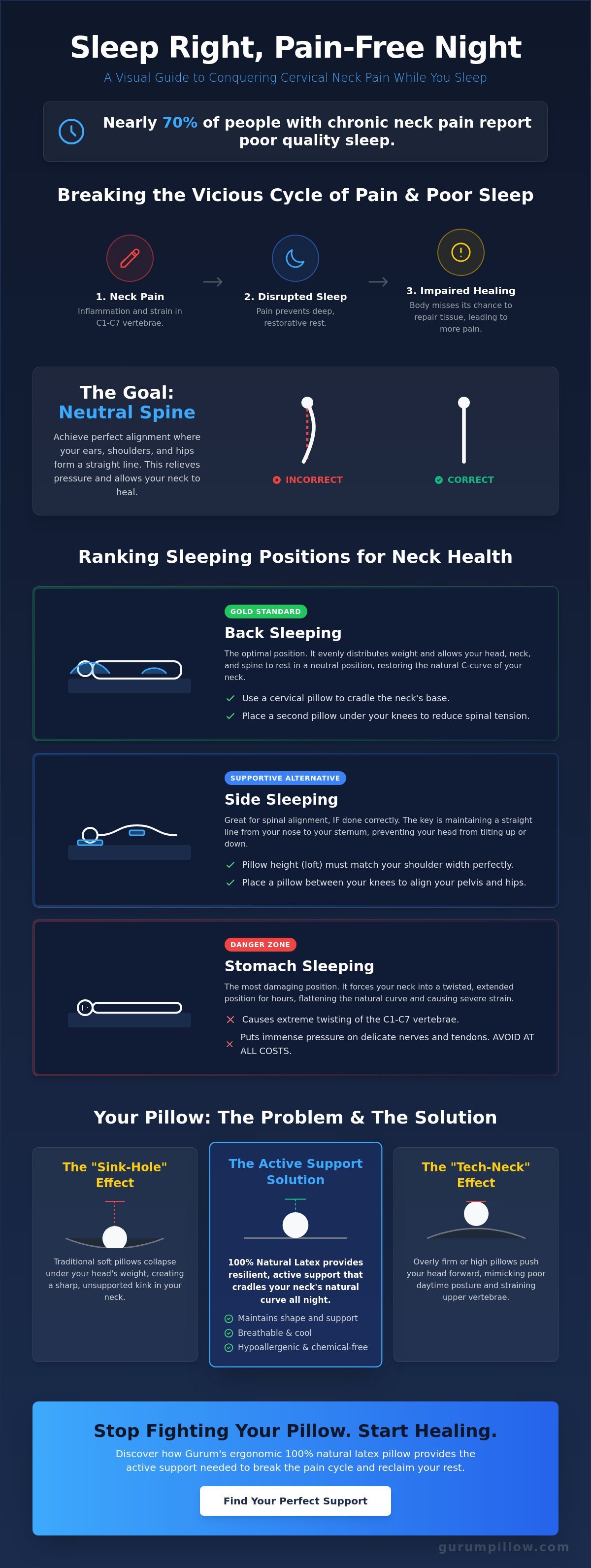
Did you know that nearly 70% of people with chronic neck pain report poor quality sleep? It is a frustrating cycle where the pain prevents rest, and the lack of rest prevents your body from healing. Learning how to sleep with cervical neck pain isn't just about closing your eyes; it's about engineering your environment for recovery. You've likely spent your nights tossing and turning, searching for a supportive spot or trying to fold your pillow into a shape that actually cradles your spine. You're tired of waking up with stiff shoulders. You're over the sharp, radiating pain that travels down your arm.
We understand the exhaustion of chronic discomfort. This guide provides the exact positions and pillow setups needed to silence cervical pain and finally wake up feeling restored. We will explore the anatomical why behind your stiffness and provide a simple, repeatable bedtime routine. You'll learn how to maintain neutral spinal alignment using resilient support that restores your natural curve. It's time to stop fighting your pillow and start waking up without a headache.
Key Takeaways
- Identify the anatomical triggers within the C1-C7 vertebrae that cause nighttime inflammation and learn how to neutralize them.
- Rank common sleeping positions to find the gold standard for weight distribution and cervical pressure relief.
- Understand the difference between "active support" and the "sink-hole" effect of traditional materials that trap your neck in poor alignment.
- Establish a 30-minute decompression routine to master how to sleep with cervical neck pain and stop the cycle of morning stiffness.
- Discover why resilient, 100% natural latex provides the breathable and chemical-free foundation your body needs to heal while you rest.
Understanding Cervical Neck Pain and the Sleep Disruption Cycle
Cervical neck pain is more than just a literal pain in the neck. It is a complex physiological response often rooted in inflammation or nerve compression within the C1 through C7 vertebrae. These seven small bones support the full weight of your head, making them incredibly susceptible to strain. When you are Understanding Cervical Neck Pain, you begin to see why your discomfort feels so much worse the moment your head hits the pillow. During the day, your muscles work overtime to stabilize your spine. At night, those muscles finally relax. If your sleep surface doesn't provide active support, gravity takes over and pulls your neck into unnatural angles.
This creates a vicious cycle. Deep sleep is the primary window for tissue repair and the release of growth hormones. When pain wakes you up every two hours, your body misses its chance to heal the very inflammation causing the trouble. Mastering how to sleep with cervical neck pain starts with breaking this loop. You must move from passive resting to active recovery by maintaining your cervical lordosis. This is the natural C-shaped curve of your neck. Many people today suffer from "military neck," where this curve has flattened due to looking at screens. Without a pillow that mirrors this curve, your ligaments stay under constant tension all night long.
The Role of Spinal Alignment in Pain Management
True relief happens when you achieve a neutral spine. This means your ears, shoulders, and hips are perfectly aligned in a straight line. When your neck is misaligned, it puts immense pressure on delicate tendons. This mechanical stress often manifests as more than just localized soreness. It is the primary cause of those throbbing tension headaches that greet you at 6:00 AM. If you feel a "pulling" sensation in your upper back, your alignment is likely failing you.
Why Your Current Pillow Might Be the Culprit
Many traditional pillows offer a false sense of comfort. You might love a soft, fluffy pillow, but these often lead to "bottoming out." This happens when the material collapses under the weight of your head, creating a sharp "kink" in your neck. Conversely, pillows with too much loft push your head forward, mimicking the exact "tech neck" posture you are trying to escape. Understanding how to sleep with cervical neck pain requires looking at your gear. If your pillow loses its shape mid-way through the night, your spine is left unprotected for hours. You need a material that remains resilient from the moment you drift off until your alarm goes off.
The Best Sleeping Positions for Cervical Pressure Relief
Your sleeping posture determines whether your neck heals or suffers overnight. Research suggests that back and side positions are easiest on the neck compared to other habits. If you're struggling with how to sleep with cervical neck pain, you must rank your comfort based on spinal alignment rather than just habit. Here is the hierarchy of rest for cervical health:
- The Gold Standard: Back sleeping (supine).
- The Supportive Alternative: Side sleeping.
- The Danger Zone: Stomach sleeping.
Back Sleeping: Restoring the Natural Curve
Sleeping on your back is the best way to distribute your body weight evenly. It allows your head, neck, and spine to rest in a neutral position without added pressure points. To do this correctly, you need a pillow that provides rounded cervical support to cradle the base of your neck. Your head should rest in a slight indentation. This prevents your chin from tilting down toward your chest, which can strain the upper vertebrae. For even better results, place a secondary pillow under your knees. This simple move flattens the lower back and reduces overall spinal tension.
Side Sleeping: Maintaining the Neutral Line
Most people are side sleepers by nature. This position is excellent for your spine as long as you maintain a straight line from your nose to your sternum. The secret lies in your pillow's loft, or height. Your pillow must match your shoulder width to fill the gap between your ear and the mattress perfectly. If your head tilts toward the mattress, your pillow is too thin. If it tilts toward the ceiling, it's too thick. Keep a pillow between your knees to prevent your pelvis from rotating. Using a resilient ergonomic latex pillow ensures this support doesn't collapse during the night, keeping your neck stable until morning.
Modifying Your Position for Radiculopathy
If you experience sharp, radiating pain down your arm, you might have a pinched nerve. This condition requires specific tweaks to open the neural foramen, the small openings where nerves exit the spine. During acute flare-ups, a small neck roll can provide targeted relief. Some find that sleeping slightly upright with a wedge pillow reduces the pressure on the cervical discs. This can be a lifesaver when lying flat feels impossible. Understanding how to sleep with cervical neck pain during these episodes is about finding the specific angle that takes the "bite" out of the nerve.
Whatever you do, avoid stomach sleeping. This position forces your neck into a rotated state for hours. It compresses nerves and strains muscles on one side while overstretching the other. It's the fastest way to wake up with a stiff neck that lasts all day.
Beyond Softness: Why Material Choice Dictates Neck Health
Most people equate comfort with softness. This is a dangerous mistake. When you are learning how to sleep with cervical neck pain, you must distinguish between passive cushioning and active support. Materials like memory foam offer passive support. They react to your body heat and melt away. While this feels cozy for five minutes, it eventually creates a sink-hole effect. Your head sinks too deep. Your neck loses its alignment. The foam sags as it warms up, leaving your spine unprotected for the rest of the night.
Understanding the causes of neck pain reveals that mechanical stress is a primary driver of discomfort. If your pillow material collapses, those mechanical stresses intensify. You need a material that maintains its structural integrity throughout the entire sleep cycle. Durability is a medical necessity, not just a luxury. If your support system fails at 3:00 AM, your body cannot complete the tissue repair needed to reduce inflammation.
The Latex Advantage for Cervical Support
Latex is a high-resiliency material. It doesn't just give under weight; it pushes back. This active response maintains your cervical curve regardless of how much you move. It provides a consistent loft that doesn't deflate. Choosing the best latex pillow for neck pain also means investing in breathability. Natural latex has an open-cell structure. It stays cool. It doesn't trap the heat that causes traditional foams to fail. It's also naturally hypoallergenic. This prevents the nighttime congestion that leads to tossing and turning.
The Problem with Feathers and Down
Feather pillows are the masters of conforming, but they are terrible at supporting. They feel luxurious because they wrap around your head. However, they lack the structural integrity to hold your vertebrae in place. You've likely spent nights constantly fluffing your pillow to get that support back. Every time you move, the feathers shift. Your neck eventually hits the mattress. This creates a sharp angle in your cervical spine. These collapsed pillows are a direct contributor to chronic strain.
Durability matters. If your pillow loses its shape after three months, your recovery stops. You need a material that remains stable for years. This is how to sleep with cervical neck pain without worrying about your gear failing you mid-night. Resilient support is the only way to ensure your neck stays in a neutral position from dusk until dawn.
A 5-Step Bedtime Routine for a Pain-Free Morning
Most people dive straight into bed and hope for the best. This reactive approach is why you wake up with a "locked" neck. If you want to master how to sleep with cervical neck pain, you must implement a 30-minute "Cervical Decompression" window before lights out. This period allows your nervous system to downshift and your muscles to release the tension they've held since morning. By preparing your body, you ensure that your orthopedic support can do its job effectively rather than fighting against tight, guarded muscles.
Thermal Therapy and Muscle Preparation
Thermal therapy is your first line of defense. For chronic stiffness, moist heat is superior to dry heat. It penetrates deeper into the scalene and trapezius muscles. Apply a warm towel or a specialized heating pad to the base of your skull for 15 to 20 minutes. This increases blood flow and resets the muscle spindles. If you are dealing with acute inflammation (a new injury), use ice instead. Relaxed muscles respond much better to a cervical pillow, allowing your spine to settle into its natural curve without resistance.
Safe Micro-Stretches for Cervical Relief
Aggressive pulling or "cracking" your neck right before bed will backfire. It triggers a stretch reflex that causes muscles to tighten further. Stick to gentle range-of-motion micro-stretches. Start with the "Chin Tuck." Gently draw your head straight back as if making a double chin. This engages the deep neck flexors that support your spine. Follow this with slow ear-to-shoulder tilts. Stop the moment you feel a light pull. Avoid "neck circles" at all costs. These circular motions can grind the cervical joints and worsen nerve compression.
Setting the Scene: Environment and Ergonomics
Your sleep environment must support your physical recovery. Keep your room temperature cool. A lower core body temperature encourages deeper, non-restless sleep. You must also enforce a strict "No-Phone" rule. Looking down at a screen in bed creates "tech-neck" strain that undoes all your preparation. Ensure your mattress provides a firm base. A sagging mattress will cause your hips to sink, which eventually pulls your neck out of alignment regardless of your pillow quality.
The final step is the "Pillow Check." Before you drift off, ensure your support is tucked firmly against the tops of your shoulders. There should be no gap between your neck and the pillow. If you're ready to upgrade your nightly recovery, explore our premium latex support options to find your perfect fit. Following this structured routine is how to sleep with cervical neck pain while actually giving your body the chance to heal.
Reclaiming Your Rest with Gurum’s Ergonomic Latex Support
You have mastered the positions and the prep work. Now you need the correct tool to execute them. Understanding how to sleep with cervical neck pain is impossible if your pillow collapses under the weight of your head by midnight. The Gurum Premium Latex Pillow is an engineered solution to the mechanical failures of traditional bedding. It doesn't just cushion your head; it actively restores your natural cervical curve. Unlike traditional materials that trap heat or lose their loft, our 100% natural latex provides a consistent, breathable foundation that stays resilient for years.
This isn't a product born in a corporate boardroom. Our founder, Ji H. Won, designed this ergonomic shape after a personal struggle with chronic neck pain and the disappointment of existing market solutions. The result is a specific curvature that offers a "floating" sensation. This buoyancy reduces the pressure on your C1-C7 vertebrae, allowing your muscles to fully disengage. You stop fighting for a comfortable spot and start drifting into the deep, restorative sleep your body requires for tissue repair.
Designed by Experience, Backed by Science
We believe that durability is a medical necessity. While memory foam or down pillows might feel "soft" initially, they inevitably sag, leading to the very misalignment that triggers morning headaches. Our Premium Latex Pillow maintains its structural integrity for years, not months. It is 100% natural, meaning you don't have to worry about chemical off-gassing or synthetic odors. For sensitive sleepers, our Anti-Allergy Pillow Cover provides an extra layer of protection, ensuring that nighttime congestion doesn't disrupt your recovery.
Finding Your Perfect Fit
Every body is different, and your support should reflect that. If you are a dedicated side sleeper, you might require a specific height to keep your spine neutral. You can explore our best pillow for side sleepers guide to find the ideal loft for your shoulder width. For those who find themselves frequently on the road, our Travel Latex Pillow ensures that you never have to compromise your cervical health in a hotel bed.
Reclaiming your rest is about more than just one good night. It is about a repeatable, pain-free experience every single morning. By combining the right routine with professional-grade latex support, you finally solve the puzzle of how to sleep with cervical neck pain. It is time to wake up refreshed, silent the sharp radiating pains, and start your day without the weight of physical exhaustion. You deserve a pillow that works as hard as you do to protect your health.
Wake Up Restored and Ready to Move
Restorative sleep shouldn't be a luxury. By mastering how to sleep with cervical neck pain through proper spinal alignment and a dedicated decompression routine, you can finally break the cycle of morning stiffness. Remember that your choice of material is the foundation of your recovery. Moving away from sagging foams and toward resilient, active support ensures your C-shaped curve remains protected throughout the night. You've learned the positions and the prep work. Now it's time to let your gear do the heavy lifting.
The Gurum Premium Latex Pillow offers 100% natural latex construction and precise ergonomic support for cervical alignment. It's designed to provide the buoyancy you need without the chemical off-gassing of traditional alternatives. Plus, with free shipping on qualifying US orders, your journey toward a pain-free morning is closer than ever. Experience Pain-Free Sleep with the Gurum Premium Latex Pillow and reclaim the rest you deserve. You don't have to settle for another night of tossing and turning. Tomorrow's energy begins with tonight's support.
Frequently Asked Questions
Is it better to sleep with a high or low pillow for neck pain?
The ideal height depends entirely on your sleeping position. Back sleepers generally require a low to medium loft of 3 to 5 inches to support the natural curve of the neck without pushing the head forward. Side sleepers need a higher loft, typically 4 to 6 inches, to fill the space between the ear and the shoulder. The goal is always neutral alignment rather than a specific height.
How can I tell if my pillow is causing my cervical pain?
If your pain is most intense when you wake up but fades within an hour of being upright, your pillow is likely failing you. Look for signs of "bottoming out," where the material collapses and leaves your head touching the mattress. If you find yourself constantly folding or bunching your pillow to find a comfortable spot, it's time to switch to a more resilient support system.
Can I sleep without a pillow if I have neck pain?
Sleeping without a pillow is generally discouraged for those with cervical issues. Without support, your head tilts at an unnatural angle, putting immense strain on the C1-C7 vertebrae and the surrounding ligaments. While some people think this "resets" the spine, it actually forces the neck muscles to stay engaged all night to protect the joints. A low-profile, active support is always a safer choice.
What is the fastest way to relieve a stiff neck from sleeping wrong?
Apply moist heat for 15 to 20 minutes to relax the trapezius and scalene muscles. Once the area is warm, perform gentle "chin tucks" to engage the deep neck flexors. Avoid the temptation to aggressively "crack" or pull your neck. These micro-movements help reset the muscle spindles and reduce the guarding response that causes the stiffness.
How long does it take to get used to a cervical latex pillow?
Most people require 7 to 14 nights to fully adjust to a new cervical support. Your muscles have likely adapted to poor alignment over many years. As the latex pushes back to restore your natural curve, you might feel a different type of pressure. This is a normal part of the corrective process as your spine returns to a neutral, healthy state.
Should I use a hard or soft pillow for cervical radiculopathy?
You need a medium-firm pillow that provides active buoyancy. Soft pillows are often the worst choice for radiculopathy because they allow the neck to "kink," which further compresses the pinched nerve. You need a material that lifts the head enough to open the neural foramen. High-resiliency latex offers this necessary lift without the punishing hardness of some orthopedic foam products.
Can a bad pillow cause dizziness or headaches?
Yes, poor alignment is a frequent trigger for cervicogenic headaches and bouts of dizziness. When your neck is strained, it impacts the nerves and blood flow at the base of the skull. Learning how to sleep with cervical neck pain by using proper support can significantly reduce these secondary symptoms. Removing the mechanical stress from your upper vertebrae is often the "missing link" in solving chronic morning headaches.