


Did you know that global neck pain cases are projected to surge by 32.5% by 2050, affecting nearly 269 million people? You likely already feel the reality of these numbers in your own life. You wake up with a stiff neck that lingers through your morning coffee, or perhaps a migraine triggered by a restless night. It's exhausting to deal with pillows that go flat by 3 AM, leaving you tossing and turning in search of support. We understand the frustration of feeling like your body is failing you before the day even begins.
The truth is that your nightly alignment dictates your daily comfort. This article explores exactly how sleep posture affects neck health and offers the science-backed steps to achieve a neutral spine. You'll discover how to choose the perfect position for your specific body type and learn why structural resilience is the key to waking up refreshed. We'll preview the best ergonomic practices and the materials that provide long-term support for your cervical health so you can finally find the relief you deserve.
Key Takeaways
- Understand why your muscles struggle to recover when your cervical curve isn't properly supported.
- Discover the scientific link between how sleep posture affects neck health and the elimination of morning tension.
- Identify the ideal loft for back and side sleeping to keep your head, neck, and spine in perfect alignment.
- Learn why resilient materials like natural latex prevent the midnight "pillow collapse" that triggers chronic pain.
- Find a long-term solution for "military neck" by choosing support that matches your body's anatomical needs.
The Hidden Link Between Your Sleep Posture and Chronic Neck Pain
Sleep posture is more than just how you lie down; it's the dynamic alignment of your head, neck, and spine during rest. When this alignment breaks, your body pays the price. Understanding how sleep posture can affect neck and back pain is the first step toward waking up without that familiar, heavy ache. Your neck health is the foundation of your entire spinal integrity. If the foundation is crooked, the rest of the structure will eventually lean, leading to a cascade of physical discomfort.
Your muscles are designed to recover during rest. However, poor posture forces them into a state of constant vigilance. Instead of recharging, they work overtime to stabilize an unsupported head. This creates "micro-strains." These tiny injuries accumulate over an eight-hour period, leading to the inflammation you feel the moment you open your eyes. It's a silent cycle of stress that prevents true restorative sleep.
Why Your Muscles Don't 'Turn Off' At Night
Stabilization is a 24/7 job for your scalene and upper trapezius muscles. If your pillow is too flat or too high, these muscles stay contracted to protect your spinal cord. A common mistake is tucking your hands under your head or placing a palm on your forehead. This awkward arm placement pulls on the neck's connective tissue, triggering immediate tension. Nocturnal muscle activity is a primary cause of morning stiffness. We've found that many people don't realize their own "comfortable" habits are actually keeping their muscles in a state of high alert.
The Long-Term Consequences of Postural Neglect
Ignoring these signals leads to more than just a bad morning. Over time, poor alignment can result in significant structural changes. This is exactly how sleep posture affects neck health over years of neglect. Chronic strain can lead to several long-term issues:
- Military Neck: The clinical loss of your natural cervical curve, which places immense pressure on the spine.
- Tension Migraines: Headaches that start at the base of the skull and radiate forward due to muscle fatigue.
- Degenerative Wear: Accelerated wear and tear on spinal discs because of uneven weight distribution.
You might find it harder to check your blind spot while driving or notice a reduced range of motion during exercise. These aren't just signs of aging; they're often the result of repeated postural neglect. By addressing the way you rest tonight, you protect the mobility you need for tomorrow.
The Anatomy of Alignment: Achieving a Neutral Spine
Achieving a neutral spine is the "Goldilocks" zone of restorative rest. It's the state where your cervical curve is perfectly supported, keeping your ears, shoulders, and hips in a relatively straight line. When we talk about how sleep posture affects neck health, we're really talking about geometry. If your head is pushed too far forward or allowed to drop too far back, you've exited the neutral zone. Your pillow should act as a structural bridge, filling the gap between your head and the mattress to maintain this delicate balance.
Many traditional pillows fail because they prioritize softness over structure. A pillow that feels like a cloud at bedtime often becomes a pancake by midnight. True alignment must be maintained throughout the entire night, not just for the first twenty minutes. If your support collapses, your spine twists, and the healing process stops. Finding a resilient support solution ensures that your alignment stays consistent from dusk until dawn.
The Three Curves of Your Spine
Your spine isn't a straight rod. It's a series of sophisticated curves: the cervical (neck), thoracic (mid-back), and lumbar (lower back). The most critical part for neck health is the cervical lordosis. This is the natural C-shape curve of your neck. Flattening this curve during sleep causes immediate muscular distress as your body tries to "correct" the lack of support. Harvard Medical School notes that choosing the easiest sleeping positions on the neck often involves protecting this specific C-shape to prevent morning stiffness.
Self-Check: Is Your Alignment Failing?
You don't need a doctor to tell you if your setup is working. You can perform a quick 3-point checklist while lying in your usual position. This simple audit helps you visualize how sleep posture affects neck health in real-time. If you find yourself failing these checks, it's time to reconsider your sleep surface.
- Check 1: The Chin Tilt. Is your chin tilted down toward your chest? If so, your pillow is likely too high, straining the back of your neck and restricting your airway.
- Check 2: The Forehead Drop. Is your head tilted backward with your chin pointing at the ceiling? This means your pillow is too low, leaving your throat muscles stretched and your spine unsupported.
- Check 3: The Gap Test. Reach back and try to slide your hand under the curve of your neck. Is there a visible gap or empty space? Your pillow should fill this void completely to cradle the cervical spine.
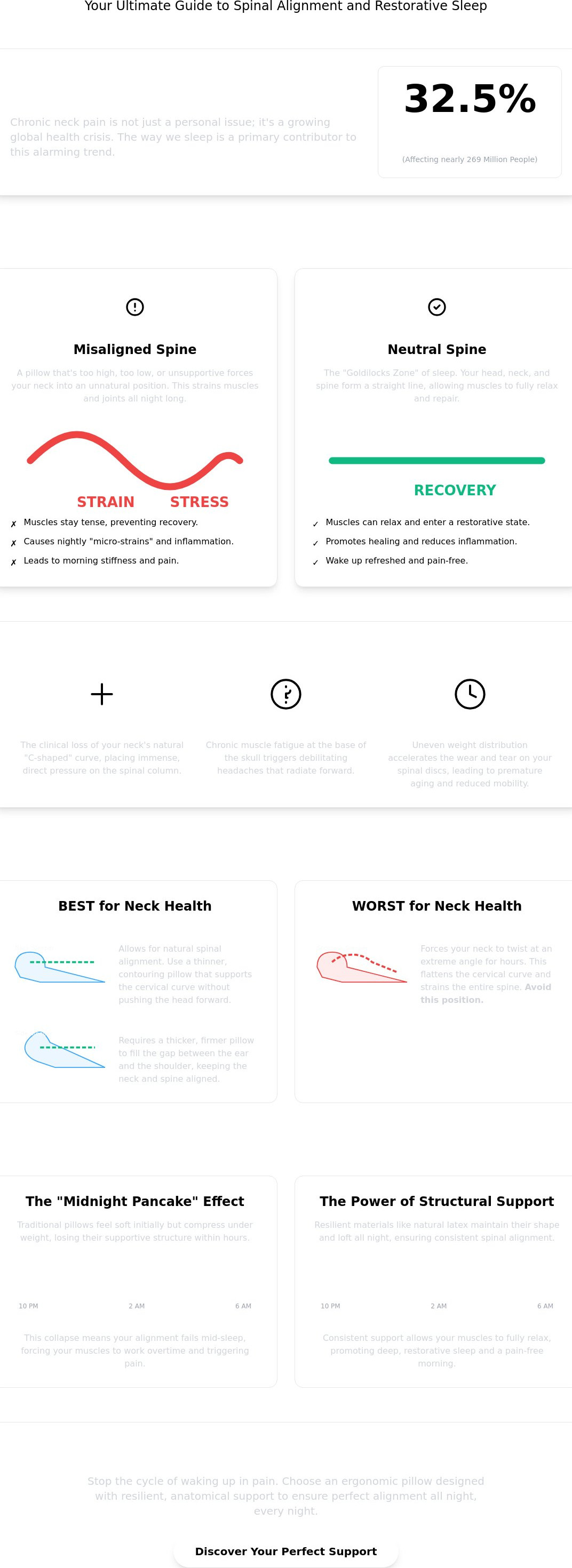
Evaluating the Best (and Worst) Sleeping Positions for Your Neck
Your favorite way to drift off is often a hard habit to break. However, understanding how sleep posture affects neck health requires a critical look at your nightly geometry. Some positions allow your body to heal, while others keep your nervous system on edge. While we previously discussed the anatomy of a neutral spine, applying that science depends entirely on your orientation in bed. Your choice determines whether your muscles spend the night recovering or struggling to maintain balance.
Most people aren't stationary sleepers. We move, shift, and adjust. This reality makes versatile support mandatory. If your pillow can't handle the transition from your back to your side, your alignment will fail the moment you move. We've found that the most successful sleepers are those who choose materials that adapt to these shifts without losing their structural integrity.
The Back Sleeper's Blueprint
Back sleeping, or the supine position, is the gold standard for weight distribution. It allows the mattress to fully support the heavy thoracic spine, which takes the pressure off your smaller cervical vertebrae. To keep your cervical lordosis intact, you need a medium-loft support. It should cradle the base of your skull without pushing your chin toward your chest. Pro tip: place a small pillow under your knees. This simple adjustment flattens your lower back and reduces the overall tension on your entire spinal column.
Side Sleeping Without the Shoulder Pain
Side sleeping is the most common choice, but it presents a unique challenge: the "shoulder-to-neck" gap. This distance varies significantly based on your frame. If your pillow is too soft, your head will tilt down toward the mattress, overstretching the top side of your neck. You need a firmer material that won't bottom out under the weight of your head. Achieving this balance is essential for preventing nerve compression. For a deeper dive into this specific setup, read our guide on the Best pillow for side sleepers.
Why You Should Break the Stomach Sleeping Habit
We consider stomach sleeping the "danger zone" for neck health. To breathe in this position, you're forced to turn your head nearly 90 degrees for hours at a time. This sustained rotation creates intense strain on your facet joints and ligaments. It's essentially the same as staring over your shoulder for an entire eight-hour workday. This is a major factor in how sleep posture affects neck health over time, often leading to chronic stiffness. If you're struggling to stop, try using a long body pillow. It provides the sensory feeling of pressure on your stomach while keeping you safely on your side.
Beyond Position: How Material Integrity Dictates Your Nightly Posture
Positioning yourself correctly is only the first step toward a pain-free morning. If your pillow material doesn't have the structural integrity to hold that position, your effort is wasted. This is the missing link in understanding how sleep posture affects neck health. You need a surface that offers both immediate comfort and long-term resilience. The secret lies in the "rebound rate." This is the speed at which a material returns to its original shape. For those who move in their sleep, a high rebound rate is mandatory to prevent alignment gaps during transitions.
Many people think they have to choose between a pillow that feels like a rock or one that feels like a cloud. This is a false choice. True ergonomic support requires a balance. You need enough "give" for your head to feel cradled, but enough "push-back" to keep your neck from kinking. When your material fails this balance, your muscles never get the chance to relax. They stay engaged all night, trying to compensate for the lack of a stable foundation.
The Failure of Memory Foam and Feathers
Memory foam is often marketed as the ultimate solution, but it has a significant flaw: the "sink-hole" effect. It adapts to your body heat; this sounds cozy until you realize that as the foam warms up, it loses its ability to provide lift. You end up trapped in a dip, struggling to turn over. Feather pillows are equally problematic for your spine. The filling is prone to "migration," meaning the feathers shift to the edges of the pillow while you sleep. This leaves your neck completely unsupported against the mattress by 3 AM. Hygiene is another factor to consider. Old pillows are breeding grounds for dust mites, which can irritate your respiratory system and keep you from reaching the deep sleep cycles necessary for muscle repair.
Why Natural Latex is the Posture Specialist
Natural latex is the true posture specialist because of its unique physical properties. Unlike foam, it offers an "instant response" that pushes back to support the weight of your head. It doesn't rely on heat to conform, so it provides the same level of support the moment you lie down as it does eight hours later. Natural latex maintains its loft for years, ensuring your posture remains consistent and your cervical spine stays protected night after night.
Because of its open-cell structure, latex is also incredibly breathable. This helps you maintain a neutral temperature, preventing the tossing and turning caused by overheating. If you're ready to stop the cycle of morning pain, finding the Best latex pillow for neck pain is a transformative step for your wellness routine. You deserve a pillow that works as hard as you do to maintain your health.
Don't let a collapsing pillow ruin your alignment. Upgrade to a resilient support solution today.
Reclaiming Your Rest: The Gurum Pillow Approach to Ergonomic Support
Reclaiming your rest starts with a commitment to better alignment. We've explored the intricate ways how sleep posture affects neck health, from the mechanics of micro-strains to the failure of traditional materials. The Gurum Premium Latex Pillow was engineered to solve these specific frustrations. It isn't just another bedding accessory; it's a professional-grade tool designed for the home. By using 100% natural latex, we provide a foundation that respects your anatomy. This material offers the consistent, resilient support needed to combat "military neck" and the chronic pain that stems from postural neglect.
Durability is the cornerstone of our design philosophy. Most pillows go flat or become lumpy, forcing your neck into awkward angles as the night progresses. Our latex core is different. It doesn't collapse under pressure or lose its lift over time. You can expect the same level of postural support on day 1,000 as you experienced on day 1. This consistency is vital for long-term spinal health. It allows your muscles to fully enter a state of recovery, knowing their foundation won't shift or sink while you sleep.
We also recognize that physical comfort involves more than just support. Sensitive sleepers often struggle with environmental triggers that disrupt their rest. Our pillows are naturally hypoallergenic and breathable. The open-cell structure of the latex allows for constant airflow, preventing the heat buildup that leads to tossing and turning. When you pair this with our Anti-Allergy Pillow Cover, you create a sleep environment that is as clean as it is supportive.
Engineered for the Cervical Curve
The Gurum shape is a direct response to the natural C-shape of your spine. It specifically cradles the neck, filling the "Goldilocks" zone we discussed earlier, while allowing the back of the head to rest at a natural level. This prevents the chin-to-chest tilt that strains the upper trapezius. For a deeper look at why this specific geometry is so effective, check out our Cervical pillow guide. It explains how targeted support can actively heal neck pain while you sleep.
Waking Up Without the 'Morning Ache'
Imagine a morning where you don't have to reach for your neck in pain. The transformation from waking up stiff to waking up refreshed is life-changing. It changes how you approach your workday, your workouts, and your family time. Our commitment to wellness and spinal health is reflected in every contour of our product. You've spent enough nights struggling with pillows that don't care about your posture. It's time to choose a solution that understands how sleep posture affects neck health and provides the relief you've been searching for. Experience the difference of a Premium Latex Pillow and start your journey toward pain-free rest tonight.
Take Control of Your Morning Mobility
We've explored the dynamic relationship between your body's mechanics and the structural resilience of your pillow. You now understand that waking up without tension isn't a matter of luck; it's a matter of alignment. By protecting your cervical curve and choosing materials that don't collapse, you stop the cycle of micro-strains that lead to chronic stiffness. This deeper understanding of how sleep posture affects neck health empowers you to make better choices for your long-term wellness.
You don't have to settle for another night of tossing and turning. Our 100% Natural Latex pillows were specifically designed by a chronic neck pain sufferer who understood your struggle firsthand. We believe that restorative rest should be accessible, which is why we offer free shipping on qualifying US orders. It's time to invest in a solution that actually supports your body's recovery process.
Start waking up pain-free with the Gurum Premium Latex Pillow. You deserve to wake up feeling refreshed and ready to take on the day. Your journey to pain-free rest begins with the very next night.
Frequently Asked Questions
What is the best sleeping position for someone with neck pain?
Back sleeping is widely considered the most effective position for reducing tension. It allows your mattress and pillow to distribute your weight evenly across your spine. If you prefer your side, ensure your pillow is high enough to keep your head from tilting toward the mattress. Both positions help maintain the cervical curve, which is essential for long-term health and prevents the muscles from working overtime while you rest.
Can a pillow really fix my neck posture?
A high-quality pillow serves as a vital structural bridge that maintains your cervical curve. While it can't replace medical care, it provides the necessary foundation for a neutral spine. By filling the gap between your head and the mattress, a resilient pillow prevents the micro-strains that occur when your neck is left unsupported. This is a critical factor in how sleep posture affects neck health and morning comfort levels.
How do I know if my pillow is too high or too low?
Perform a simple visual check in the mirror or have a partner look at your alignment. If your chin is pushed toward your chest, your pillow is too high and straining your upper back. If your head tilts backward toward the mattress, your pillow is too low. In a perfect setup, your ears should align with your shoulders, creating a straight line that mirrors your natural standing posture.
Is it better to sleep without a pillow for neck health?
Sleeping without a pillow is rarely recommended because it leaves the cervical spine completely unsupported. Without a bridge to fill the space between your neck and the bed, your muscles must stay engaged to protect your spinal cord. This leads to the "morning ache" many people struggle to overcome. A low-profile, resilient support is usually a much safer choice for maintaining the natural C-shape of your neck.
How often should I replace my pillow to maintain proper neck support?
You should replace traditional polyester or feather pillows every 6 to 12 months as they lose their structural lift. However, premium materials like natural latex are much more durable. A latex pillow can provide consistent support for up to 5 years without going flat. Investing in long-lasting materials ensures that your nightly alignment remains stable, protecting you from the gradual postural decline caused by collapsing foam or feathers.
Why does my neck hurt more when I sleep on my stomach?
Stomach sleeping forces your head into a sustained 90-degree rotation for hours. This puts immense pressure on your facet joints and overstretches the ligaments on one side of your neck. This position is a primary example of how sleep posture affects neck health negatively. It prevents the muscles from relaxing and can lead to chronic tension headaches. Switching to your side with a body pillow is a much healthier alternative.
What is the difference between a standard pillow and a cervical pillow?
Standard pillows are typically uniform in height and often collapse under the weight of your head. A cervical pillow, like the Gurum Premium Latex Pillow, is specifically engineered with contours to cradle the neck. It focuses on supporting the cervical lordosis while allowing the head to rest at a lower, more natural level. This specialized design ensures your spine stays neutral, whereas a standard pillow often leaves the neck floating and unsupported.
How long does it take to adjust to a new ergonomic sleep posture?
It typically takes about 10 to 14 days for your body to fully adapt to a new ergonomic setup. Your muscles have "memory" and may feel slightly different as they unlearn years of poor alignment habits. Don't be discouraged if the first night feels unusual. Stick with the new position consistently, and you'll soon notice the physical relief that comes with waking up without the usual stiffness and tension.