


Most people assume that a pillow is meant to be replaced every single year, but your bedding shouldn't have an expiration date that leaves you in pain. You know the frustration of a pillow that starts off perfect but flattens into a pancake within months. It's exhausting to wake up with neck stiffness or spend half the night fluffing a worn-out cushion just to find a moment of spinal alignment. If you're tired of wasting money on cheap materials that lose their shape, you're likely wondering how long do natural latex pillows last before they lose their supportive edge.
The truth is that natural latex isn't just another sleep material; it's a long-term investment in your physical health. While traditional options fail quickly, a high-quality latex core can provide consistent, orthopedic support for up to a decade. This guide reveals why natural latex remains the longest-lasting material in the industry and how to ensure your sleep environment stays hypoallergenic and resilient. We'll look at the specific factors that influence durability, from GOLS certifications to proper care, so your Premium Latex Pillow provides the same restorative rest on night 2,000 as it did on night one.
Key Takeaways
- Understand why natural latex outperforms synthetic alternatives, offering up to 10 years of comfort while polyester pillows often fail in under 12 months.
- Discover the specific environmental and care factors that determine how long do natural latex pillows last in a real-world bedroom setting.
- Identify the five physical warning signs, such as lingering morning neck stiffness, that indicate your pillow has lost its orthopedic integrity.
- Learn the essential maintenance "golden rules," including why you must protect your pillow from UV oxidation to prevent it from becoming brittle.
- Explore how the engineering behind the Premium Latex Pillow ensures consistent spinal alignment for a decade of restorative, pain-free sleep.
How Long Do Natural Latex Pillows Last? (The 2026 Lifespan Standard)
You shouldn't have to replace your pillow every single year. It’s a waste of your hard-earned money and a primary cause of chronic neck stiffness. Most sleepers start searching for how long do natural latex pillows last because they’re tired of the "polyester pancake" effect. They want a solution that doesn't sag after six months of use. In 2026, the gold standard for a high-quality natural latex pillow is a lifespan of 5 to 10 years. We define a pillow’s true "lifespan" as the period during which the material retains at least 95% of its original loft and orthopedic support.
Compare this to the alternatives filling up our landfills. A standard polyester pillow usually loses its integrity within 6 to 12 months. Even high-end memory foam often begins to experience "support decay" after just 18 to 36 months. Natural latex is different. It is a resilient, botanical material that resists the mechanical fatigue that kills other pillows. When you invest in 100% natural latex, you are choosing a material that maintains its structural precision for a decade, ensuring your spine stays aligned night after night.
Natural vs. Synthetic Latex: The Longevity Gap
The secret to a 10-year pillow lies in its molecular origin. Synthetic latex is a petroleum-based product designed to mimic the feel of rubber, but it lacks the same internal strength. Because it’s a chemical compound, it undergoes oxidative degradation much faster than its natural counterpart. This is why cheap blends eventually turn yellow, become brittle, and start crumbling inside the cover. 100% natural latex, like the core of our Premium Latex Pillow, is harvested from the Hevea brasiliensis tree. Its organic cell walls are significantly more elastic. The Science of Foam Latex details how this unique cellular structure provides an "instant rebound" that synthetic materials simply cannot replicate. Whether processed via the Dunlop or Talalay method, purity is the single biggest predictor of how long your support will last.
Why 2026 Standards Prioritize Material Purity
Modern sleep science in 2026 has shifted toward a "purity equals performance" mindset. Recent testing shows that VOC-free, organic latex maintains its cell elasticity longer than materials treated with harsh chemical flame retardants or fillers. These chemicals can actually accelerate the breakdown of the foam's internal lattice. Beyond your own comfort, there is a significant environmental argument for durability. Choosing one 10-year natural latex pillow prevents approximately ten polyester pillows from entering a landfill. When you look at the cost-per-night breakdown, a premium natural latex pillow is actually the most economical choice. You're paying for a decade of restorative rest rather than a temporary fix. It’s about buying better, not buying more.
The Science of Support: Why Latex Resists Flattening
Durability is often misunderstood as a pillow simply staying in one piece. For those struggling with chronic pain, true durability is about orthopedic precision. You've likely experienced "Support Decay." This is the slow, invisible loss of neck alignment that happens as materials fatigue. While many standard pillow replacement guidelines suggest swapping your bedding every few years due to hygiene, natural latex is unique because its physical support doesn't collapse. It maintains its "shore hardness," or specific level of firmness, even after thousands of compression cycles. This is why the question of how long do natural latex pillows last is so vital for your health. It isn't just about saving money; it's about ensuring your spine is cradled correctly for years, not weeks.
The secret lies in the "instant rebound" property of natural rubber. When you move, the latex immediately snaps back to its original shape. It doesn't leave a lingering crater. Natural latex is composed of a rubber-based cell structure that acts like millions of microscopic springs. In contrast, memory foam uses a chemical-based cell structure that relies on your body heat to soften and mold. Over time, those chemical bonds weaken. They lose their ability to "reset," leading to permanent valleys that leave your neck strained and unsupported.
Open-Cell Structure and Breathability
Heat and moisture are the primary killers of traditional bedding. When you sweat, that moisture gets trapped in dense foams, causing them to soften and degrade prematurely. Natural latex features an inherently open-cell structure. This allows for constant airflow, which regulates temperature and keeps the material cool. By preventing heat-induced softening, the latex stays firm and resilient. It doesn't matter if it's a humid summer night or a cold winter evening. The material remains stable. This breathability is a major factor in how long do natural latex pillows last, as it prevents the structural rot common in synthetic alternatives.
Latex vs. Memory Foam: The Compression Test
Memory foam relies on heat to mold, which eventually leads to permanent "indentations." Once those indentations form, your "support" is gone. Latex provides a consistent physical push-back that keeps your head elevated and your airways open. This creates the best latex pillow for neck pain because the "sag factor" is virtually non-existent. While memory foam eventually bottoms out, our Premium Latex Pillow maintains its loft, ensuring you never wake up with that familiar, localized throbbing at the base of your skull. It’s a level of reliable engineering that chemical foams simply can't match.
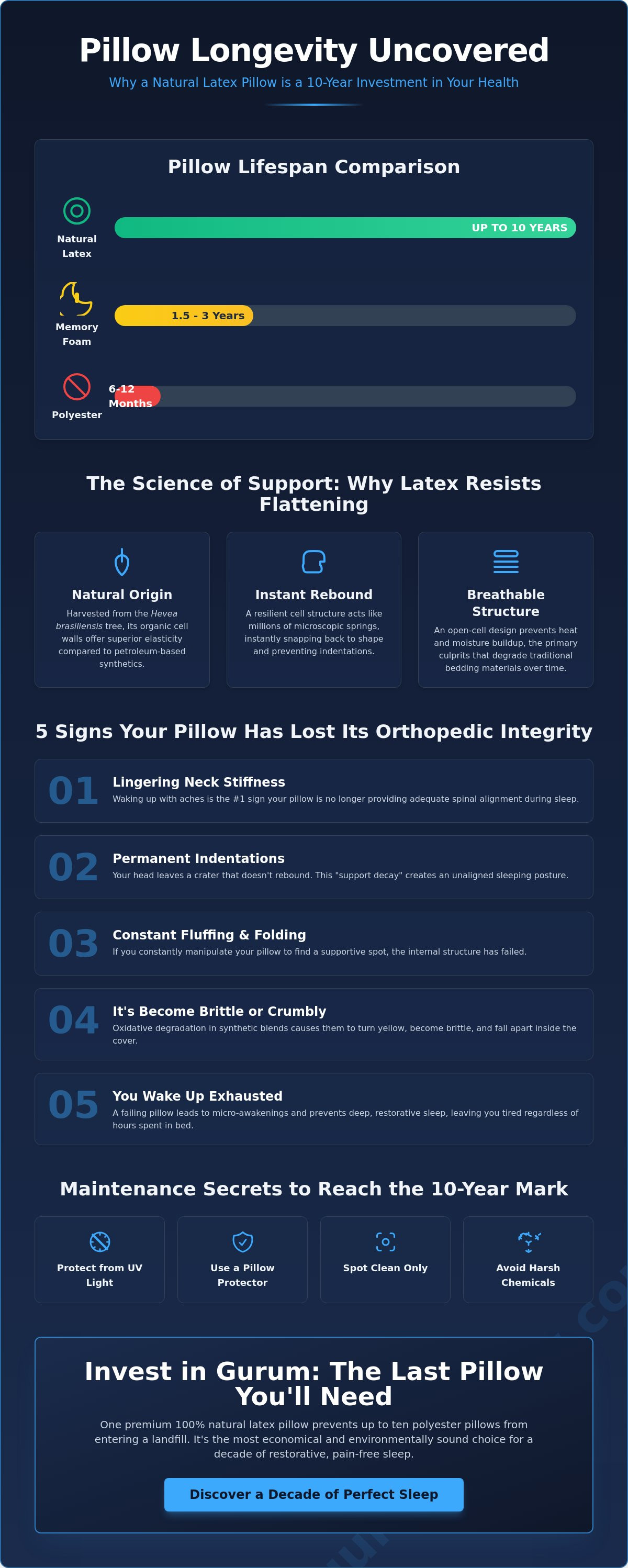
5 Signs Your Pillow Has Lost Its Orthopedic Integrity
Physical survival is not the same as orthopedic success. Your pillow might still look like a pillow, but that doesn't mean it's doing its job. When you're evaluating how long do natural latex pillows last, you have to look beyond whether the material has physically disintegrated. You need to measure its ability to maintain the delicate curve of your cervical spine. If your pillow has lost its structural "push-back," your neck muscles are forced to work overtime all night just to keep your head level. This leads to that familiar, deep-seated ache that greets you at sunrise.
Don't wait for your pillow to crumble before replacing it. Watch for these five definitive warning signs:
- Temporary Morning Stiffness: You wake up with a "locked" neck that magically disappears after about an hour of being upright. This is a clear indicator that your pillow is bottoming out during the night.
- The Center Trough: If you see a visible indentation or "valley" where your head rests, the latex has suffered mechanical fatigue. Even a high-quality core eventually reaches its limit.
- Lagging Rebound: Press your hand into the center. If the material takes more than a split second to return to its original height, the internal cell walls have weakened.
- Sudden Allergies: Natural latex is inherently resistant to dust mites, but after years of use, microscopic debris can eventually accumulate. If you're waking up with puffy eyes or a stuffy nose, the hygiene barrier is compromised.
- The Latex Fold Test: Unlike a down pillow, which you want to stay folded, a healthy latex pillow should be impossible to fold in half. If you can fold it and it doesn't immediately and violently spring back open, the elasticity is gone.
Beyond the Surface: Internal Structural Failure
Internal failure often starts long before you see external damage. If you notice small particles like sand or "pilling" inside your pillow cover, the latex is beginning to oxidize and break down. This structural decay often results in a loss of loft. While it might seem minor, a loss of even half an inch in height can completely ruin your spinal alignment. You can verify your current setup against our check-list for neck pain pillows to see if your alignment is still protected. While we know the general durability of latex pillows is superior to foam, no material is immortal.
The Hygiene Factor: When to Replace for Health
Even if the support feels adequate, you should consider the 5-year hygiene rule. Natural latex is antimicrobial, which significantly extends the "safe" usage period compared to synthetic foams. However, your skin oils and sweat eventually migrate through the material. Using high-quality anti-allergy pillow covers can act as a sacrificial barrier, protecting the core from this buildup. If you haven't used a protective cover, you may need to replace your pillow sooner to maintain a truly hypoallergenic sleep environment. How long do natural latex pillows last depends heavily on how well you've shielded the core from the elements of your own sleep habits.
Maintenance Secrets to Reach the 10-Year Mark
A decade of perfect sleep isn't a miracle. It's the result of simple, intentional care. While we’ve established that the material is incredibly durable, how long do natural latex pillows last in your specific bedroom depends on your maintenance routine. Natural latex is a botanical product. It requires a different approach than the synthetic foams you might be used to. If you treat it with respect, it will reward you with consistent orthopedic support for years to come. Neglect it, and you’ll find yourself shopping for a replacement much sooner than necessary.
The absolute golden rule of latex care is simple: Never submerge the core in water. While you can wash most covers, soaking the latex itself is a recipe for disaster. Latex is highly porous. If water gets trapped deep inside the cellular structure, it's nearly impossible to dry completely. This creates a hidden breeding ground for internal mold that will ruin the pillow’s integrity from the inside out. For the eco-conscious sleeper, spot cleaning with a damp cloth and mild soap is all you need to handle the occasional spill.
UV protection is your second line of defense. Direct sunlight is the primary enemy of natural rubber. It triggers a process called rapid oxidation. This chemical reaction breaks the elastic bonds within the latex, making the material brittle and prone to crumbling. Never "air out" your pillow on a sunny balcony without a protective cover. Keep it shaded, keep it dry, and the material will remain as supple as the day you bought it.
Protecting the Core: The Role of Covers
A double-cover system is essential for reaching that 10-year milestone. Use a breathable, high-quality inner protector to shield the latex from skin oils and sweat. This prevents organic compounds from seeping into the core and causing premature softening. When you wash your bedding, remove the outer pillowcase but leave the inner protector intact as much as possible. This minimizes friction on the latex surface. If you use specialized cervical pillow shapes, ensure your covers aren't too tight. Excessive tension on the corners can cause unnecessary wear on the foam’s edges over time.
Airflow and Environment Management
You don't need to rotate your latex pillow to ensure "uniform wear." Unlike memory foam, which develops localized soft spots, natural latex maintains its density across the entire surface. However, managing bedroom humidity is vital. High moisture levels in the air can encourage microscopic mold growth, even on antimicrobial surfaces. Keep your room well-ventilated to assist the pillow's natural open-cell airflow. Finally, stop fluffing your pillow. Traditional pillows need fluffing to redistribute clumped filling, but latex is a solid, engineered core. Aggressively shaking or punching the pillow can actually damage the delicate cell walls. Trust the material to do its job.
Ready to upgrade your protection? Invest in our Anti-Allergy Pillow Cover to keep your sleep environment pristine for the next decade.
Investing in Gurum: The Last Neck Support Pillow You’ll Need
Buying a pillow shouldn't be a recurring chore. It should be a definitive solution. We've explored how long do natural latex pillows last and the science behind their resilience, but not all latex is created equal. At Gurum, we don't just sell bedding. We provide a decade-long commitment to your cervical health. Our founder, Ji H. Won, spent years battling chronic neck pain caused by pillows that promised support but delivered disappointment. She realized that designing for pain relief requires designing for extreme durability. This mission led to our "No-Flatten" Guarantee. It's our promise that your orthopedic alignment won't vanish after a few months of use.
This focus on persistent precision is why Gurum is the preferred choice for side sleepers across the USA. Side sleeping puts the most pressure on a pillow's loft. Without high-grade materials, that loft collapses, leaving your neck in a strained, downward tilt. We've engineered our core to resist this mechanical fatigue, ensuring your head stays perfectly level for years. You deserve a sleep environment that doesn't require constant adjustment or middle-of-the-night fluffing.
Engineered for Ergonomic Longevity
The secret to our longevity is the specific Indentation Load Deflection (ILD) we've chosen. We've balanced sensory softness with a density that refuses to "bottom out" under the weight of a human head. This same high-grade core is utilized in our natural latex travel pillow. Your neck deserves consistent support whether you're at home or in a hotel. Our customers often report that even after 3 years of nightly use, their pillows feel exactly like they did on night one. This is the difference between a mass-market product and an anatomically focused tool.
Making the Switch to Gurum
Cheap pillows have a "break-down" period. They start losing their shape almost immediately. Gurum pillows have a brief "break-in" period. It might take a few nights for your muscles to adjust to proper alignment, but once they do, that support stays constant. We want to make this transformation accessible. We offer free shipping across the United States to remove the barrier to premium sleep. You've spent enough time and money on temporary fixes that left you waking up in pain. It's time to invest in a solution that respects your body and your budget. How long do natural latex pillows last when they're engineered by experts? With Gurum, the answer is a full decade of restorative rest. Upgrade to a Gurum Pillow today and finally wake up refreshed.
Claim Your Decade of Restorative Sleep
You've seen the data. You understand the science. Now, it's time to act. Choosing a pillow shouldn't be a gamble that leaves you in pain every six months. By understanding how long do natural latex pillows last, you've discovered that true orthopedic support can actually endure for a full decade. Natural latex isn't just a material; it's a botanical solution to the structural decay that ruins most synthetic bedding.
A pillow is only as good as its core. While memory foam loses its rebound and polyester flattens, our 100% natural latex core maintains its height and elasticity night after night. It was designed by a chronic pain sufferer who knows exactly what it's like to wake up with a locked neck. You don't have to settle for "good enough" rest anymore. With free shipping across the United States, your journey to a pain-free morning is simplified. Don't let another night of poor alignment drain your energy.
End the cycle of flattening pillows—Get your Gurum Premium Latex Pillow now
You deserve a sleep environment that supports you as much as you support everyone else. Sleep well and wake up refreshed.
Frequently Asked Questions
Can I wash a natural latex pillow in the washing machine?
No, you should never wash a natural latex pillow in a washing machine. The heavy agitation and high-speed spinning can physically tear the delicate cellular structure. If the core becomes fully submerged, it's nearly impossible to dry, which often leads to internal mold growth. Stick to washing your outer covers and spot cleaning the latex with a damp cloth.
Do natural latex pillows get lumpy over time?
No, natural latex pillows do not get lumpy over time. Unlike pillows filled with polyester fiber or down, which clump together and require constant fluffing, a solid latex core maintains a perfectly uniform density. This structural consistency is a major reason why many people ask how long do natural latex pillows last when seeking permanent relief from neck pain.
How do I know if my latex pillow is 100% natural or a blend?
You can identify 100% natural latex by checking for GOLS (Global Organic Latex Standard) certification on the product tag. Genuine natural latex has a matte, slightly irregular surface and a mild rubber scent. Synthetic blends often have a shinier, more uniform look and may emit a chemical odor. Always prioritize certified organic materials to ensure you're getting the full durability benefits of botanical rubber.
Is it normal for a latex pillow to have a slight smell when new?
Yes, it is normal for a new natural latex pillow to have a mild, sweet scent similar to vanilla or rubber. This is a natural characteristic of the material and is not the result of toxic off-gassing. If the scent bothers you, simply leave the pillow in a shaded, breezy area for a day or two to let it air out before use.
Why is my latex pillow turning yellow or crumbling?
Yellowing and crumbling are definitive signs of oxidation, often caused by exposure to direct sunlight. UV rays break down the elastic bonds in natural rubber, eventually making it brittle. If your pillow is crumbling into small, sand-like particles, it has lost its orthopedic integrity. It’s time to replace it to ensure your neck remains properly supported during the night.
How often should I change the pillowcase on a latex pillow?
You should change your pillowcase at least once every week to maintain a clean sleep environment. Regularly washing your case and Anti-Allergy Pillow Cover prevents body oils and moisture from seeping into the latex core. Protecting the material from these organic compounds is the best way to extend how long do natural latex pillows last while keeping them hypoallergenic.
Does the 10-year lifespan apply to travel-sized latex pillows too?
Yes, the 10-year lifespan standard applies to our Travel Latex Pillow just as it does to our Premium version. We use the same high-grade, 100% natural latex core for both products. Even though it's smaller, the material’s resistance to flattening and support decay remains the same, provided you follow the standard care and UV protection guidelines during your trips.
Can a latex pillow help with dust mite allergies for the long term?
Yes, natural latex is an excellent long-term solution for dust mite allergies because it is inherently antimicrobial. The material is naturally resistant to the buildup of common allergens, unlike traditional pillows that trap dust and skin cells. By using a protective cover and keeping the core dry, you can maintain a sneeze-free, hypoallergenic sleep environment for many years.