

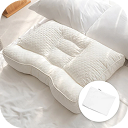
You've spent real money on pillow after pillow, and yet you still wake up reaching for your neck. Sound familiar? If you're searching for the best pillow for neck support, you've likely already tried the thick memory foam block that traps heat all night, or the budget pillow that flattens within an hour of lying down. You know what a good night's sleep is supposed to feel like. You're just not getting it.
Here's the truth most pillow brands won't tell you: passive materials that simply sink under the weight of your head can't maintain the cervical alignment your spine actually needs. Your neck requires dynamic resistance, something that gently pushes back, holds its loft, and keeps your vertebrae in a neutral position from the moment you fall asleep to the moment your alarm goes off.
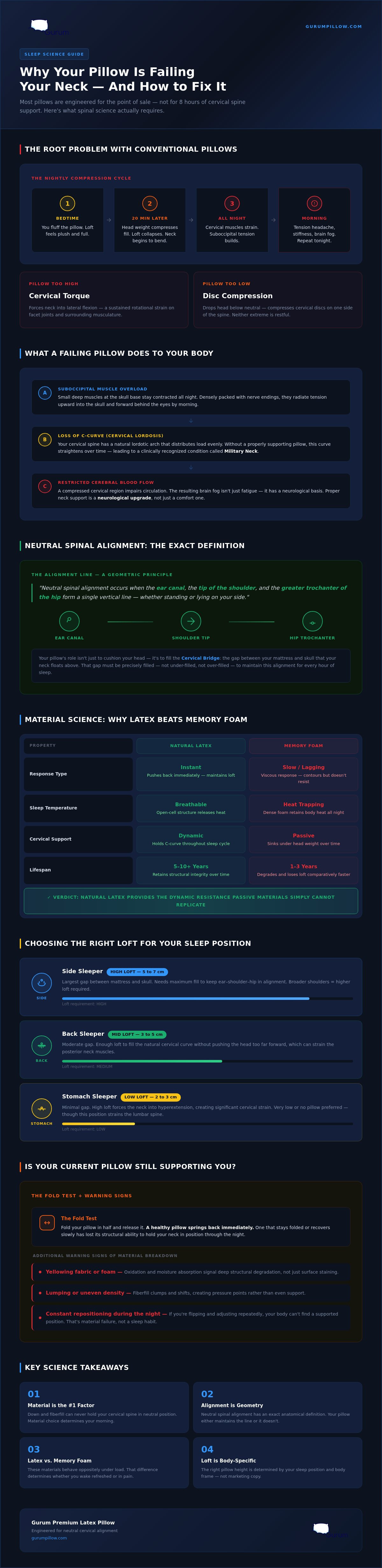
This guide cuts through the noise. You'll learn exactly what spinal alignment means in practical terms, why material choice is the single biggest factor separating a pain-free morning from another tension headache, and how to match pillow loft to your specific body frame. By the end, you'll know precisely what to look for and why it matters.
Key Takeaways
- Your pillow's material is the single biggest factor in neck pain relief — and finding the best pillow for neck support starts with understanding why passive materials like down and fiberfill can never hold your cervical spine in a neutral position.
- Neutral spinal alignment isn't a vague wellness concept — it has a precise anatomical definition, and this guide explains exactly what it means for your nightly sleep position.
- Latex and memory foam behave in fundamentally opposite ways under the weight of your head, and that difference determines whether you wake up refreshed or reach for your neck every morning.
- The right pillow loft isn't one-size-fits-all — your sleeping position and body frame dictate the specific height your cervical spine needs to stay supported through the night.
- Not all "ergonomic" pillows are engineered equally — you'll learn what separates a pillow built around genuine spinal science from one that simply uses the right marketing language.
Understanding Why Your Current Pillow Fails Your Neck
That pillow you've been sleeping on? It was probably never built to support your neck in the first place. Most conventional pillows are designed around one thing: the feeling of softness at the point of sale. What happens to your cervical spine over the next eight hours is an afterthought.
Down clusters and polyester fiberfill share a fundamental flaw. They compress under the weight of your head and stay compressed. You might fluff your pillow before bed, but within twenty minutes of lying down, that loft is gone. What's left is a thin, uneven layer of material that offers zero structural resistance. Your head sinks. Your neck bends. And your cervical muscles spend the rest of the night working overtime to compensate.
That's the fluffing cycle. It's exhausting, and it's pointless.
Pillow height is equally critical. A pillow that's too high forces your neck into lateral flexion, creating what clinicians call cervical torque: a sustained rotational strain on the facet joints and surrounding musculature. A pillow that's too low drops your head below neutral, compressing the discs on one side of your cervical spine. Neither position is restful. Both cause pain.
The Anatomy of a Tension Headache
At the base of your skull sits a group of small, deep muscles called the suboccipital muscles. They're responsible for fine head movement and are densely packed with nerve endings. When your pillow fails to support the correct loft for your sleeping position, these muscles stay contracted through the night. By morning, that chronic tension radiates upward into the skull and forward behind the eyes, producing the classic tension headache that no amount of coffee seems to fix.
The stiffness you feel when you first sit up isn't just muscular. It's a signal that your cervical spine spent hours without its natural C-curve, the gentle lordotic arch that distributes load evenly across your vertebrae. Lose that curve consistently, and you're on a direct path toward a condition called Military Neck, a clinically recognized straightening or reversal of the cervical curve caused by sustained poor posture, including poor sleep posture. It's more common than most people realize, and a flat or collapsing pillow is a significant contributing factor.
The brain fog that follows a bad night isn't just fatigue. Restricted blood flow through a compressed cervical region affects cognitive clarity. Finding the best pillow for neck support isn't a comfort upgrade; it's a neurological one.
Signs Your Pillow Has Lost Its Integrity
Your pillow will tell you it's failing if you know what to look for. Try the Fold Test: fold your pillow in half and release it. A pillow with structural integrity springs back immediately. One that stays folded, or recovers slowly, has lost its ability to hold your neck in position through the night.
Other signs of material breakdown include:
- Yellowing fabric or foam: Oxidation and moisture absorption indicate deep structural degradation, not just surface staining.
- Lumping or uneven density: Fiberfill clumps and shifts, creating pressure points rather than even support.
- Constant repositioning during the night: If you're flipping and adjusting your pillow repeatedly, your body is telling you it can't find a supported position. That's material failure, not a sleep habit.
"Soft" feels luxurious in the store. But softness without resistance means your cervical spine is unsupported for every single hour of your sleep cycle. That's the quiet damage most pillow brands never talk about.
The Anatomy of Support: Defining Neutral Spinal Alignment
Neutral spinal alignment has a precise anatomical definition: it occurs when the ear canal, the tip of the shoulder, and the greater trochanter of the hip form a single vertical line, whether you're standing or lying on your side. That's not a wellness concept. That's geometry. And your pillow either maintains that line through the night or it doesn't.
Think of the space between your mattress and your skull as a bridge gap. Your neck doesn't rest on the mattress. It floats above it, unsupported unless something fills that void. That's the role of what spinal therapists sometimes call the Cervical Bridge: the pillow's job isn't just to cushion your head. It's to fill the precise gap between the mattress surface and the base of your skull, maintaining the natural C-curve of your cervical spine while you sleep.
A well-engineered support pillow functions as a passive physical therapy tool. It holds your neck in the position a physiotherapist would manually place it in during a session. The difference is that it does this for eight hours straight, without fatigue, without shifting, and without losing its structure the moment you roll over.
That last point matters more than most people realize. You change positions an average of dozens of times each night. A pillow that holds perfect loft while you're lying still but collapses the moment you shift isn't truly supporting you. The best pillow for neck support must adapt to your movements dynamically, recovering its height and resistance instantly, so your cervical spine never falls out of alignment mid-sleep.
Support vs. Pressure Relief: You Need Both
These two qualities are often confused. Support is structural: it carries the weight of your head, which typically falls between 10 and 12 pounds. That load requires a high-density material with genuine compressive resistance. Pressure relief is different. It's about distributing that load evenly across the contact surface, preventing localized compression on nerves and skin. A pillow that only supports creates hard pressure points. One that only relieves pressure collapses under the load. You need both working simultaneously. When they're balanced correctly, the result is what ergonomic specialists describe as the floating sensation: your head feels weightless because the load is perfectly distributed, and your muscles finally release the chronic tension they've been holding.
Restoring the Cervical Curve
There's a meaningful difference between cradling the head and propping it up. Propping pushes the head forward, increasing the angle at the base of the skull and compressing the posterior cervical joints. Cradling, by contrast, supports the head from below while simultaneously filling the lordotic curve of the neck, keeping the vertebrae in their natural stacked position.
A cervical pillow engineered around this principle doesn't just stop pain. It actively works to restore the natural lordotic curve that poor sleep posture erodes over time. That's the difference between a pillow that markets itself as "orthopedic" and one that's actually built around spinal mechanics.
If you're ready to experience that difference, exploring a premium latex ergonomic pillow designed specifically around cervical alignment is a practical next step.
Latex vs. Memory Foam: Why Material Science Matters
Your pillow's material isn't a preference. It's a mechanical decision. And the difference between latex and memory foam isn't measured in comfort ratings or price points. It's measured in how each material behaves under the sustained, shifting weight of your head across eight hours of sleep.
Memory foam is viscoelastic. That means it responds to both pressure and heat, softening as it warms and stiffening when it cools. The result is a material that never behaves the same way twice. On a cold winter night, it resists. On a warm summer evening, it surrenders. Neither version is actually supporting your cervical spine. It's just reacting to temperature.
Natural latex is different at the molecular level. It's elastic, not viscoelastic. It compresses under load and immediately rebounds. Temperature doesn't change its behavior. It simply works, consistently, every night, regardless of the season.
The Memory Foam "Sinking" Trap
Here's what memory foam marketing never shows you. Because the material softens progressively under heat, your head, the heaviest part of the contact area, sinks deeper than your neck. The result is what ergonomic specialists call the hammock effect: your head drops below the level of your shoulders, pulling your cervical spine into a downward curve rather than holding it neutral. You're not being cradled. You're being swallowed.
There's also the off-gassing issue. Synthetic memory foam is manufactured using a range of chemical compounds, and many products release volatile organic compounds (VOCs) during the first weeks of use. For anyone sensitive to chemical exposure, that's not a minor footnote. It's a nightly inhalation concern.
Longevity is the gap no competitor wants to discuss honestly. Memory foam typically begins losing its compressive resistance within six to twelve months of regular use. The surface may look intact, but the internal cell structure has broken down. You're sleeping on a ghost of the support you started with.
100% Natural Latex: The Orthopedic Powerhouse
Natural latex is harvested from the Hevea brasiliensis tree, a renewable source that requires no synthetic chemical processing to produce a material with genuinely superior mechanical properties. Its open-cell structure allows continuous airflow through the pillow, which means heat dissipates rather than accumulating beneath your head.
The recovery is instantaneous. Roll over, and latex follows you. It doesn't need a moment to "remember" your new position. That dynamic response is precisely why latex pillows for neck pain are the preferred recommendation among physical therapists. The material delivers consistent resistance throughout the night without the temperature dependency that makes memory foam unreliable.
Durability compounds the advantage. A quality natural latex pillow maintains its structural integrity for years without sagging or developing the uneven density that creates pressure points. That's not a marketing claim. It's a function of elastic polymer physics.
Natural latex is also inherently resistant to dust mites and mold. No chemical treatment required. The material's cellular structure and natural proteins create an inhospitable environment for the allergens that synthetic pillows accumulate over time. For anyone who wakes with congestion or irritated airways, that distinction matters enormously.
If you're searching for the best pillow for neck support and you've been disappointed by memory foam, the gap isn't in your expectations. It's in the material. Exploring a best latex pillow built around genuine spinal mechanics is the most direct path to a different morning.
Choosing the Right Loft for Your Sleeping Position
Loft is the single most personal variable in pillow selection. Get it wrong by even an inch, and your cervical spine spends the night fighting a losing battle against gravity. Get it right, and your muscles finally stop working while you sleep.
The simplest way to find your ideal loft is to measure your Shoulder-to-Ear distance: stand straight, relax your shoulders, and measure the gap from the top of your shoulder to the base of your ear. That measurement is the minimum height your pillow needs to maintain when compressed under the weight of your head. It's not a rough estimate. It's the number your pillow has to hit, consistently, every night.
The Side Sleeper's Dilemma
Side sleeping creates the largest shoulder-to-neck gap of any sleep position. Your shoulder presses into the mattress while your head floats above it, and the only thing standing between neutral alignment and lateral cervical collapse is your pillow's loft and firmness. Plushness won't save you here. A soft pillow compresses under the weight of your head and lets it drop toward the mattress, creating exactly the kind of lateral flexion that strains the facet joints on one side of your neck.
What you need is firmness with contouring. A side sleeper pillow built from high-density latex holds its loft under sustained compression, so your ear stays level with your shoulder from the moment you close your eyes to the moment your alarm goes off. The Ear-to-Shoulder alignment check is your verification tool: if someone viewed you from the front while you slept on your side, your ear should sit directly above your shoulder, not dropped toward it or elevated above it.
Back Sleeping and the Cervical Bridge
Back sleepers need less loft than side sleepers, but precision matters just as much. The target is a neutral gaze: lying flat, your nose should point directly at the ceiling, not angled toward your chest or tilted toward the wall. If your chin is tucking toward your sternum, your pillow is too high. If your head is dropping back and your throat feels stretched, it's too low.
A contoured latex pillow solves this elegantly. The raised edge supports the cervical curve while the lower central section cradles the skull, nesting it without pushing the head forward. That's the Cervical Bridge principle applied in practice.
One mistake back sleepers make repeatedly: stacking two pillows. The second pillow drives the head into forward flexion, loading the posterior cervical joints and accelerating the very posture problems you're trying to correct. One well-engineered pillow, at the right loft, does more than two flat ones ever will.
Stomach sleepers face the harshest reality. That position forces the neck into sustained rotation, compressing the joints on one side for hours at a time. The recommendation is a very low loft pillow or no pillow at all under the head. A thin pillow under the abdomen can reduce lumbar strain in the interim, but transitioning away from stomach sleeping is the only genuine long-term solution.
If you're ready to match your sleeping position to a pillow engineered around these exact principles, explore Gurum's premium latex pillow and find the loft that finally fits your anatomy.
The Gurum Premium Latex Pillow: Engineered for Alignment
Every pillow principle covered in this guide, cervical bridging, dynamic loft recovery, pressure distribution without collapse, points toward a single material conclusion: 100% natural latex. Gurum's Premium Latex Pillow is built around exactly that. No synthetic fillers. No blended foams that compromise the elastic properties latex is known for. Just the real material, engineered around the spinal mechanics that determine whether you wake up refreshed or reach for your neck.
The ergonomic design targets a specific clinical problem: the progressive loss of the cervical lordotic curve that leads to Military Neck and chronic tension. Where generic "orthopedic" pillows borrow the language of spinal science, Gurum's pillow is shaped around it. The contour fills the cervical gap for back sleepers. The loft holds firm for side sleepers. The latex rebounds instantly when you shift positions, so alignment isn't something you achieve once before bed. It's something the pillow maintains for you, all night.
Breathability is built in, not added on. Natural latex's open-cell structure allows continuous airflow without the chemical cooling gels that synthetic competitors apply as a surface treatment. Those gels dissipate within the first hour. Natural latex simply doesn't trap heat in the first place.
Durability is where the long-term value becomes undeniable. Unlike memory foam, which begins losing compressive resistance within months, a quality natural latex pillow holds its structural integrity for years. You're not replacing it annually. You're investing once in a pillow that actually does its job the same on night 500 as it did on night one.
The Gurum Difference: From Pain to Performance
Gurum wasn't founded around a market opportunity. It was founded around a personal one. Ji H. Won designed this pillow after struggling with chronic neck pain himself, which is precisely why the product reflects a practitioner's priorities rather than a retailer's. That origin story matters. It's the difference between a pillow designed to sell and a pillow designed to solve. Free shipping across the USA means that solution is genuinely accessible, without a premium freight cost erasing the value of the investment.
Your Path to a Pain-Free Morning
Pairing the Premium Latex Pillow with Gurum's Anti-Allergy Pillow Cover completes the system. The cover adds a protective barrier against dust mites and moisture, extending the pillow's lifespan and keeping the sleep environment clean for anyone with sensitivities.
Expect a short adjustment period of around seven days. Your cervical muscles have been compensating for poor support for months, possibly years. A pillow that actually holds your neck in neutral alignment will feel unfamiliar at first. That's not a sign something is wrong. It's a sign something is finally right. The tension releases gradually as your muscles stop bracing and start resting.
If you've worked through this guide and recognized your own sleep problems in every section, you already know what the next step is. Finding the best pillow for neck support stops being a search the moment you find a pillow engineered to solve the exact problem you've been living with. Experience the relief of a Premium Latex Pillow today.
Your Best Sleep Starts With the Right Foundation
Every morning you wake up reaching for your neck is a morning your pillow failed you. The science is clear: passive materials collapse, temperature-sensitive foams shift their behavior, and generic loft heights ignore your anatomy entirely. Finding the best pillow for neck support isn't about spending more. It's about choosing a material that actually holds its promise through the night.
100% natural latex does what memory foam can't: it rebounds instantly, breathes continuously, and maintains its structure for years without sagging. Designed by ergonomic specialists and built around genuine spinal mechanics, Gurum's Premium Latex Pillow treats your cervical spine as the priority it deserves to be.
Your neck has been compensating long enough. It's time to let it rest.
Shop the Premium Latex Pillow for Ultimate Neck Support today, with free US shipping included. A pain-free morning is closer than you think.
Frequently Asked Questions
What is the best pillow for neck support and side sleepers?
For side sleepers, the best pillow for neck support is one that combines high loft with firm, consistent resistance. Your shoulder creates a significant gap between the mattress and your head, and only a pillow that holds its height under sustained compression can bridge that space. A 100% natural latex pillow is the strongest option because it doesn't flatten under load the way fiberfill or memory foam does.
The practical test is simple: after a full night of sleep, your pillow should look nearly identical to how it did before you lay down. If it's visibly compressed in the morning, it failed you during the night. Latex rebounds instantly with each position change, keeping your ear level with your shoulder throughout.
Can the wrong pillow cause neck pain and headaches?
Yes, directly and predictably. A pillow that's too soft, too flat, or the wrong height forces your cervical muscles to compensate for the lack of structural support. Those muscles don't get to rest. They stay contracted through the night, and by morning that sustained tension radiates into the skull, producing the classic tension headache that feels worse before your first cup of coffee.
The suboccipital muscles at the base of your skull are particularly vulnerable. They're dense with nerve endings, and chronic overnight contraction is one of the most common and overlooked causes of recurring morning headaches. Fixing your pillow often resolves headaches that painkillers only temporarily mask.
How do I know if my pillow loft is too high or too low?
Too high: your chin tilts toward your chest when lying on your back, or your neck feels a pulling sensation on the lower side when you're on your side. Too low: your head drops toward the mattress, your throat feels stretched, and you wake with stiffness along the back of your neck. Both positions strain the cervical joints, just in opposite directions.
A reliable starting point is your shoulder-to-ear measurement taken while standing. That distance represents the minimum compressed height your pillow needs to maintain. Side sleepers generally need more loft than back sleepers, and body frame matters: broader shoulders require higher loft to maintain neutral alignment.
Is a firm or soft pillow better for neck support?
Firmness wins for structural support, but the real answer is that you need firmness with contouring. A pillow that's simply hard creates pressure points without distributing load evenly. One that's simply soft collapses under the weight of your head. The ideal pillow resists compression while simultaneously conforming to the natural curve of your neck.
Natural latex achieves this balance better than most materials. It's firm enough to hold your head at the correct height but elastic enough to cradle the cervical curve rather than just propping the skull up. That distinction matters: propping pushes the head forward, while genuine cradling keeps the vertebrae in their natural stacked position.
How long does a natural latex pillow last compared to memory foam?
A quality natural latex pillow maintains its structural integrity for several years without sagging or developing uneven density. Memory foam typically begins losing its compressive resistance within six to twelve months of regular use. The surface may look unchanged, but the internal cell structure breaks down, and you're gradually sleeping on less and less support without realizing it.
That durability gap changes the value calculation significantly. Replacing a memory foam pillow annually costs more over time than investing once in a natural latex pillow that holds its performance consistently. The support you get on night one is the support you get years later.
What is 'military neck' and can a pillow help fix it?
Military neck is a clinically recognized condition where the natural C-shaped lordotic curve of the cervical spine straightens or reverses. Instead of the gentle inward arch your neck is supposed to have, the vertebrae stack in a flat or forward-curved line. It's caused by sustained poor posture, and poor sleep posture is a significant contributing factor that most people never address.
A pillow can't reverse advanced military neck on its own, but it can stop the nightly damage that accelerates the condition. A correctly lofted latex pillow holds the cervical spine in its natural curve for eight hours every night, which is the same position a physiotherapist would manually place it in during treatment. Consistent nightly support actively works to restore the lordotic curve over time rather than eroding it further.
Do orthopedic pillows actually work for chronic neck stiffness?
Some do. Many don't. The word "orthopedic" has no regulated definition in the pillow industry, so it's used freely as a marketing term regardless of whether the product is actually engineered around spinal mechanics. The distinction comes down to material and design: does the pillow hold its loft dynamically through the night, and is its contour shaped around the actual geometry of cervical alignment?
A genuinely engineered cervical pillow reduces morning stiffness by keeping the neck in a neutral position that allows muscles to fully relax rather than brace. Expect a short adjustment period of around a week as muscles that have been compensating for poor support finally start to release. Stiffness that persists beyond that adjustment window is worth discussing with a physiotherapist.
How do I clean a natural latex pillow to maintain its support?
Never machine wash or tumble dry a natural latex pillow. The agitation and heat break down the elastic polymer structure, causing the material to crack, tear, or lose its rebound properties permanently. Spot cleaning with a mild soap solution and a damp cloth is the correct method for surface stains. Allow it to air dry completely before replacing the cover.
For ongoing maintenance, use a quality pillow cover, like an anti-allergy cover, to create a protective barrier against moisture, dust mites, and skin oils. That barrier is what extends the pillow's lifespan significantly. Air the pillow out periodically in a shaded, well-ventilated space to keep the open-cell structure fresh, but keep it away from direct sunlight, which degrades natural latex over time.