

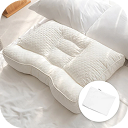
Buying the firmest pillow on the shelf won't stop your neck from aching by 3 AM. You've probably tried every "extra-firm" option available, only to find your head sinking through the fluff until it hits the mattress. It's exhausting to wake up with that stiff, "military neck" feeling after a night spent wrestling with a flat pillow. If you're searching for the best pillow for heavy head support, you've likely realized that most standard options simply can't handle the pressure.
We understand the frustration of constant fluffing and the trapped heat that often comes with high-density materials. You deserve a sleep surface that maintains its height and keeps your spine aligned without sagging. In this 2026 spinal guide, we'll show you why material resilience matters far more than simple firmness. You'll learn how to find a pillow that offers immediate, consistent push-back while remaining breathable and cool. We're going to explore the specific ergonomic designs that finally put an end to morning stiffness and help you stay asleep all night long.
Key Takeaways
- Learn why material resilience is the secret to finding a pillow for heavy head support that won't collapse by midnight.
- Understand the "Memory Foam Trap" and why natural latex provides the active push-back necessary for anatomical health.
- Master the "Shoulder-Width Rule" to calculate your perfect loft and prevent waking up with a stiff neck.
- Discover how 100% natural latex maintains its structural integrity over time, eliminating the need for constant fluffing.
- Explore how engineered ergonomic support can transform your sleep from a struggle into restorative rest.
Why Most Pillows "Bottom Out" Under Heavy Head Pressure
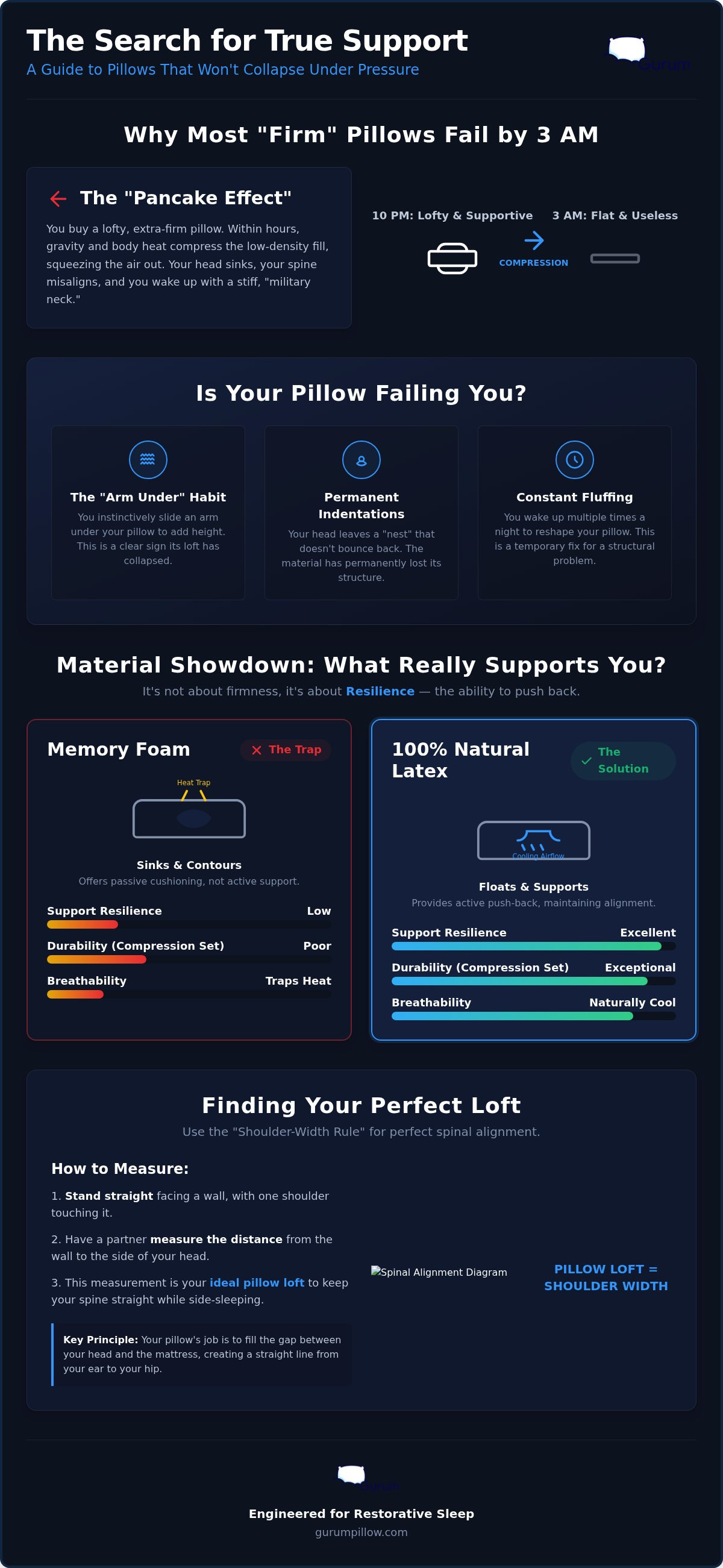
Many people wake up at 3 AM feeling like their head is resting directly on the mattress. This is the "Pancake Effect." It's not just annoying; it's a structural failure. You buy a pillow that feels lofty in the store, but within ten minutes of lying down, the air is squeezed out. For those seeking a pillow for heavy head support, this collapse is the root cause of chronic morning stiffness. When a pillow bottoms out, it ceases to be a tool for rest and becomes a source of physical stress.
Gravity exerts constant downward pressure on your cervical spine. If your head isn't properly cradled, your neck muscles stay "on" all night to compensate for the lack of support. This mechanical stress leads to tension headaches and that dreaded "military neck" feeling. Your body shouldn't have to work while you sleep. Without immediate, consistent push-back from your pillow, your spine loses its natural curve, straining the delicate ligaments in your neck.
Don't be fooled by "extra-firm" polyester or down-alternative fills. These are often just more of the same low-density fibers stuffed into a tighter casing. Fluffing them is a temporary fix for a permanent structural problem. While history shows humans have used different types of pillows for centuries, many modern synthetic options simply lack the density to withstand the weight of a larger frame. They offer the illusion of support that disappears the moment you actually close your eyes.
The Science of Compression Sets
Compression set is a technical term for when a material loses its ability to return to its original thickness. Low-density foams and synthetic fills have high compression sets. They fail faster under heavy loads. Body heat also plays a role. As you sleep, your warmth softens synthetic materials, causing them to sag further as the night progresses. You need a material that ignores temperature and focuses on structural integrity to maintain its shape until morning.
Signs Your Pillow is Failing Your Frame
Is your pillow actually working? Look for these red flags that your current setup is inadequate:
- The "Arm Under the Pillow" habit: If you're constantly sliding your arm underneath to add height, your pillow's loft is failing.
- Chin Tucking: Waking up with your chin pressed toward your chest or your head tilted too far back indicates a misalignment.
- Permanent Indentations: If you see a "nest" where your head sits that doesn't bounce back, the material has reached its limit.
When searching for a pillow for heavy head support, look for materials that offer active resistance rather than passive cushioning. If you find yourself wrestling with your bedding every night, it's a sign that the material has reached its compression limit.
Anatomy of Support: Loft, Density, and Material Resilience
Many shoppers make the mistake of choosing a pillow based on height alone. Loft refers to the thickness of the pillow, but height doesn't guarantee a quality pillow for heavy head support. You've likely bought a "tall" pillow that felt substantial at first, only to have it flatten into a thin pancake by morning. True support comes from the combination of density and resilience, not just the initial loft.
Density is a measure of weight. Heavier materials generally offer more reliable support over time because they contain more structural matter to resist compression. When a pillow has high density, it doesn't just feel heavy in your hands; it acts as a durable foundation for your cervical spine. This structural integrity ensures that your neck muscles can finally relax during REM sleep, rather than staying engaged to prevent your head from rolling off a sagging surface.
Why Resilience is the Secret to Pain-Free Sleep
Resilience is the "push-back" factor. While memory foam is famous for "sinking" and contouring, it often lacks the active resistance needed for a heavier frame. Natural latex, on the other hand, makes you feel like you're "floating" on the surface. Resilience is the material’s ability to provide upward force against weight. This active support distributes weight across a larger area, preventing pressure points from forming. A systematic review on pillow designs highlights how specific materials, particularly those with higher resilience, are more effective at reducing chronic neck pain.
The Role of Spinal Alignment
Proper alignment means a straight line from your ear through your shoulder to your hip. If your pillow lacks resilience, your head will drop below this line, creating a "cervical dip." This dip puts mechanical stress on your vertebrae and can lead to nerve impingement. Choosing a pillow for heavy head support that maintains its shape prevents this misalignment. You can learn more about how these mechanics heal pain in our cervical pillow guide. If you're ready to stop the sink and start floating, a premium latex pillow might be the solution your neck has been begging for.
Latex vs. Memory Foam: Which Material Actually Supports Your Weight?
Most people assume memory foam is the gold standard for comfort. It feels soft and expensive in the store. However, for anyone requiring a pillow for heavy head support, memory foam often becomes a trap. This material is visco-elastic. It's designed to soften and "melt" when it encounters body heat. While this creates a nice contour, it eventually leads to a total collapse under sustained pressure. By the middle of the night, the foam has warmed up, lost its structural integrity, and left your neck unsupported.
Natural latex operates on a completely different principle. It provides "Active Support." Instead of waiting for your body heat to mold the material, latex uses its natural elasticity to push back. It maintains its structure regardless of the temperature in your room. This means the support you feel at 10 PM is exactly the same support you'll feel at 6 AM. It doesn't sag. It doesn't soften. It simply holds its ground.
Durability is another major factor. High-density synthetic foams often begin to degrade within 1 to 2 years. They lose their "memory" and stop bouncing back. In contrast, 100% natural latex is incredibly resilient, often maintaining its shape and support for 5 to 10 years. Choosing the right material isn't just about comfort for tonight. It's about ensuring you don't have to go pillow shopping again next year because your current one has given up.
The Downside of Memory Foam for Heavier Sleepers
If you've ever felt "stuck" in your pillow, you've experienced the downside of foam. It takes time for memory foam to reshape itself when you move. For heavier sleepers, this creates a literal hole that is difficult to climb out of, leading to restless tossing and turning. This trapped heat doesn't just soften the foam; it can also lead to night sweats. Many synthetic foams also carry a distinct chemical odor, known as off-gassing, which can be irritating for those with environmental sensitivities.
Natural Latex: The High-Pressure Specialist
Latex doesn't wait for you. It responds the millisecond you shift your weight, ensuring your spine never spends a second out of alignment. This instant response time is vital for maintaining a pillow for heavy head support throughout the night. Its open-cell structure acts like a natural ventilation system. Air circulates freely through the material, keeping it cool and preventing the moisture buildup that often ruins traditional pillows. For a deeper look at these differences, read our full latex vs. memory foam comparison to see why natural materials win every time.
How to Choose Your Ideal Loft and Firmness Level
You've found the right material. Now you need the right dimensions. Even the best pillow for heavy head support will fail if the loft doesn't match your physical frame. Loft refers to the compressed height of the pillow while you're lying on it. If you have broad shoulders, a standard "one-size-fits-all" pillow is often two inches too short. This creates a gap that forces your neck into an unnatural tilt, leading to the very stiffness you're trying to avoid.
Sleep position dictates your specific needs. Side sleepers require the most loft to fill the deep curve between the ear and the shoulder. Back sleepers need a medium loft that cradles the neck without pushing the chin toward the chest. If you're constantly switching positions, you need a high-resilience material that adapts instantly. You can test your alignment at home with a 15-minute check. Lie down and have someone look at your profile. If your ear, shoulder, and hip don't form a straight line, your pillow is the wrong size.
Measuring Your Personal Loft Requirement
Don't guess your size. Use the Shoulder-Width Rule to get an accurate measurement. Stand with your side against a wall and measure the distance from the wall to the base of your neck. This number is your ideal loft.
- Low Loft (2-3 inches): Best for stomach sleepers or those with very narrow frames.
- Medium Loft (4-5 inches): The standard for back sleepers and average frames.
- High Loft (5+ inches): Essential for side sleepers with broad shoulders.
Addressing the "Too Hard" Objection
Many people avoid supportive pillows because they fear they'll feel like a brick. It's important to distinguish between firm support and surface comfort. You don't need a hard pillow; you need a resilient one. A pillow for heavy head support can have a soft, plush cover while maintaining a high-density core that keeps you buoyant. This combination gives you the "cloud-like" feel you want with the medical-grade support you need. For more position-specific advice, check out our best pillow for side sleepers guide. Ready to find your match? Explore our Premium Latex Pillow collection for the ultimate in adjustable comfort.
Why Gurum Premium Latex is the Ultimate Heavy Head Solution
The search for a pillow for heavy head support often ends in a graveyard of flattened foam and discarded polyester. We designed the Premium Latex Pillow to break this cycle of disappointment. It's a precision-engineered tool for spinal health. Unlike synthetic alternatives that soften with use, our 100% natural latex provides a consistent "shelf" for your neck. This ergonomic curve ensures your head stays buoyant while your cervical spine remains in a neutral, stress-free position.
You won't find synthetic fillers or chemical additives here. These fillers are usually what cause a pillow to degrade and lose its shape. By using 100% natural latex, we ensure the material maintains its "push-back" nature for years. The open-cell structure of the latex works in tandem with our Anti-Allergy Pillow Cover. This combination moves heat away from your body, preventing the temperature-related softening that ruins memory foam. You stay cool, supported, and perfectly aligned from the moment you lie down until your alarm goes off.
A Solution Born from Real Pain
Our founder, Ji H. Won, didn't set out to just sell another bedding product. He suffered from chronic neck pain and struggled to find a pillow for heavy head support that didn't bottom out by midnight. This personal struggle led to the development of a specific ergonomic design that prioritizes anatomical health over simple softness. He focused on 100% natural materials because they offer the best balance of durability and comfort. Gurum pillows are designed to maintain 99% of their loft over years of use, providing a reliable foundation for your restorative rest.
Investment in Restorative Sleep
Think about your cost-per-sleep. Buying one high-quality latex pillow is significantly cheaper than replacing five cheap foam ones that fail within months. It's an investment in your daily energy and long-term spinal health. We make the transition to better sleep easy by offering free shipping across the USA. We're committed to your satisfaction because we know the relief that comes with finally finding the right support. Rest should be a time of recovery, not a source of physical stress. Experience the support of the Gurum Premium Latex Pillow today.
Secure Your Path to Restorative Sleep
Stop settling for pillows that flatten before midnight. You've learned that true support comes from density and material resilience, not just initial loft. By prioritizing 100% natural latex, you ensure your spine stays aligned and your neck muscles finally get the chance to relax. It's the difference between sinking into a hole and floating on a supportive surface. You don't have to spend another night wrestling with your bedding or waking up with a stiff neck.
Finding the right pillow for heavy head support is an investment in your daily wellness. Our Premium Latex Pillow is designed by ergonomic experts to solve the bottoming-out problem for good. It won't go flat, it won't trap heat, and it stays resilient through years of use. Shop the Premium Latex Pillow for Unbeatable Support and enjoy free shipping within the USA. You deserve to wake up feeling refreshed and completely pain-free every single morning.
Frequently Asked Questions
Why does my pillow always go flat in the middle of the night?
Your pillow goes flat because low-density fills like polyester or down lack structural resilience. These materials compress under weight and heat, losing their air pockets as the night progresses. This is why a pillow feels great at 10 PM but like a pancake by 3 AM. Switching to a high-density material like natural latex provides the consistent push-back needed to stay buoyant until morning.
Is a firm pillow better for a heavy head?
Firmness is often confused with support, but they aren't the same. A hard pillow can create pressure points, while a resilient pillow for heavy head support provides upward force to keep your spine neutral. You don't need a "hard" surface; you need a material with high density and quick response times. This ensures your head stays "floating" rather than sinking into a collapsed core.
What is the best pillow material for someone with broad shoulders?
Natural latex is the best material for broad shoulders because it offers high loft without the risk of sagging. Memory foam often softens too much under body heat, causing your head to tilt. Latex maintains its shape and height regardless of temperature. It provides the stable foundation necessary to fill the wide gap between your ear and the mattress, keeping your neck perfectly straight.
How high should a pillow be for a side sleeper with a large frame?
Side sleepers with large frames usually need a high loft of at least 5 inches. The goal is to keep your head level with your spine. You can find your ideal height by measuring from the base of your neck to the edge of your shoulder while standing against a wall. A high-loft pillow ensures your head doesn't drop, which prevents nerve compression and morning shoulder pain.
Can a pillow cause neck pain if it is too soft?
A pillow that is too soft fails to stabilize your cervical spine, leading to significant neck pain. When your head sinks too deep, your neck muscles must work all night to prevent injury. This constant engagement causes muscle fatigue and stiffness. A supportive pillow should act as a cradle, holding your head in a neutral position so your muscles can finally enter a state of recovery.
How long does a natural latex pillow last compared to memory foam?
Natural latex pillows are incredibly durable, often lasting 5 to 10 years without losing their shape. In contrast, memory foam and synthetic fills typically degrade within 1 to 2 years. Heavier weight loads accelerate this breakdown in low-density materials. Choosing a 100% natural latex option is a long-term solution that eliminates the frustration of your pillow "giving up" and going flat after just a few months of use.
What is "loft" and why does it matter for heavy head support?
Loft is the thickness of your pillow, and it is the key to maintaining a neutral spine. For a pillow for heavy head support, you must consider the "active loft," which is how high the pillow stays under pressure. If the material lacks resilience, a high-lofted pillow will still bottom out. You need a combination of high loft and high density to ensure the pillow doesn't collapse under the weight of your head.
Does a heavy head require a special type of cervical support?
A heavy head benefits from specialized cervical support, such as an ergonomic curve or a built-in neck "shelf." Standard pillows often allow the head to tilt too far back or forward, which strains the vertebrae. A cervical design cradles the skull while providing firm support directly under the neck. This specific geometry keeps the airway open and the spine aligned, reducing tossing and turning throughout the night.