


Is your pillow working against you? You might think a tall, fluffy pillow is the ultimate luxury, but for many, it's the primary cause of chronic neck stiffness. When your head is pushed too far forward, your cervical spine loses its natural curve. Your muscles never truly relax. They spend eight hours in a state of constant tension. This anatomical strain is why identifying the signs your pillow is too high is critical, especially since 30% of people report neck pain from using the wrong pillow.
We understand the frustration of tossing and turning to find a comfortable position. It's exhausting to wake up feeling more drained than when you went to bed. You deserve a sleep environment that respects your anatomy. In this guide, we'll help you identify if your pillow loft is causing neck pain and explain the science of the "sweet spot" for your spine. We'll show you how to find a height that balances your shoulder width with your mattress firmness, ensuring your support doesn't flatten or shift overnight. You can finally trade those morning tension headaches for the restorative, pain-free rest you've been searching for.
Key Takeaways
- Recognize the physical signs your pillow is too high, including the "chin-to-chest" sensation and radiating tension headaches.
- Understand the "10-12 pound problem" and how improper loft creates damaging leverage on your cervical spine.
- Uncover the "False Height" trap of memory foam and why material compression ratios are critical for maintaining all-night support.
- Master simple at-home diagnostic tools like the Wall Test to visualize your alignment and find your ideal pillow height.
- Learn how transitioning to a specifically engineered latex pillow can restore your natural curve and eliminate chronic morning stiffness.
Common Physical Signs Your Pillow Is Too High
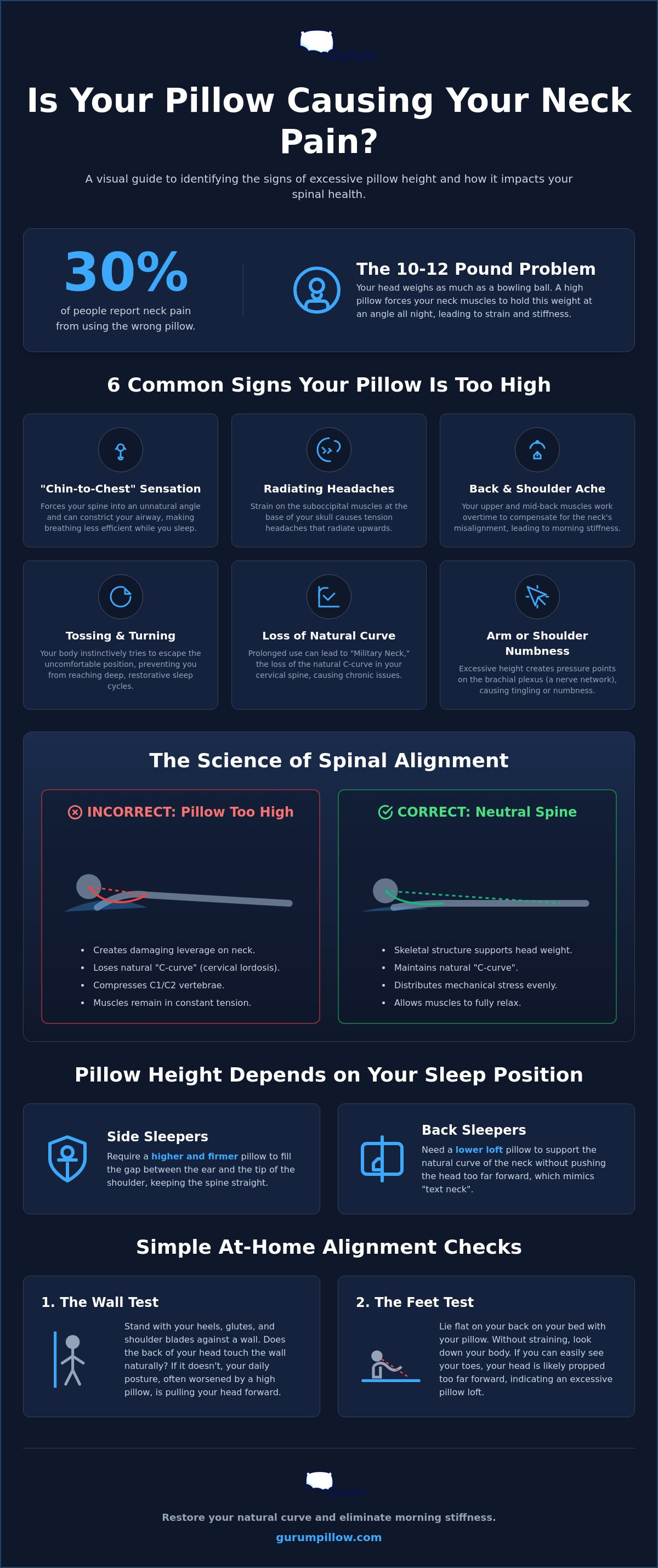
You wake up, and instead of feeling refreshed, your neck feels like it’s been in a vice. It’s a common frustration. One of the most telling signs your pillow is too high is how your body reacts the moment you lie down. If you feel your chin tilting toward your chest, you’re already in trouble. This position slightly constricts your airway. It makes breathing less efficient; your body should be resting, not struggling for oxygen. This "chin-to-chest" sensation is a red flag that your cervical spine is being forced into an aggressive, unnatural angle.
Then there are the headaches. These aren't just stress related. They radiate from the base of your skull. This pain is caused by suboccipital muscle strain. When your head is propped too high, these tiny muscles work overtime to stabilize your skull. This tension doesn't stay in the neck. The strain travels. Your upper back and scapular region begin to ache because they are compensating for the misalignment. Your mid-back tries to pull your spine back into a neutral position, but it’s a losing battle that ends in morning stiffness.
You might also find yourself tossing and turning throughout the night. This is your body’s survival mechanism. It’s trying to escape an unnatural forward-tilt. Understanding The Science of Sleep helps us realize that deep, restorative stages require physical stillness. If you're constantly adjusting, you're never reaching those deep cycles. Identifying the signs your pillow is too high is the first step toward reclaiming your energy and protecting your long-term health.
The Visual Markers of Poor Alignment
Check your position with the "Feet Test." Lie flat on your back. If you can easily see your toes without effort, your head is propped too far forward. Look at the ear-to-shoulder gap. Your neck should rest parallel to the mattress. If it cranes upward, the loft is excessive. Many people also have a "hand-under-pillow" habit. You might think you're adding support, but it's often a subconscious attempt to fix a height that feels unstable or awkward during the night.
Immediate Muscular Feedback
Prolonged use of a high pillow can lead to "Military Neck" symptoms. This is the loss of the natural C-curve in your cervical spine. You might also feel numbness in your shoulders or arms. This happens when excessive height creates pressure points on the brachial plexus, the network of nerves in your shoulder. Cervical strain is the primary result of excessive loft.
The Science of Spinal Alignment: Why Pillow Loft Matters
Your head weighs between 10 and 12 pounds. That’s roughly the weight of a medium bowling ball. When your spine is neutral, your skeletal structure supports this weight effortlessly. However, when your pillow is too high, it creates a mechanical leverage problem. Your head is pushed forward, forcing the muscles in your neck to "hold" that weight at an angle for eight hours. This constant engagement is one of the most common signs your pillow is too high, leading directly to that familiar morning stiffness.
Maintaining a neutral spine is the goal of every healthy sleep environment. This means keeping your ears, shoulders, and hips in a straight line regardless of your position. When this alignment breaks, you lose your natural cervical lordosis. This is the inward curve of the neck designed to distribute mechanical stress and protect your nerves. Without this curve, the pressure shifts to your discs and your upper vertebrae. Specifically, the Atlas and Axis vertebrae (the C1 and C2) become compressed. These two bones are responsible for the majority of your head's rotation. If they're jammed all night, you won't just wake up tired; you'll wake up with a neck that refuses to turn.
Side Sleeping vs. Back Sleeping Heights
Your ideal loft depends entirely on your position. Side sleepers require a higher loft to bridge the gap between the ear and the shoulder tip. If the pillow is too low, the head drops; if it's too high, the neck cranes upward. For a deeper dive into this balance, see our Best Pillow for Side Sleepers: The 2026 Guide to Spinal Alignment. Conversely, back sleepers face a different risk. A high pillow mimics "text neck" posture. It’s the same strain you feel when staring down at a phone, but sustained for an entire sleep cycle. It’s a recipe for long-term postural damage.
Long-term Effects of Ignoring Height Issues
Ignoring these signs your pillow is too high can lead to permanent changes in your physiology. Your sternocleidomastoid muscles, the large muscles at the front of your neck, can actually shorten over time due to constant forward flexion. This makes it harder to maintain good posture even while you're awake. More seriously, constant forward bending increases the risk of herniated discs. Beyond the physical, poor alignment disrupts your sleep architecture. When your body is in pain, it struggles to stay in deep REM sleep. You might think you're resting, but your brain is stuck in a shallow, unrefreshing state. Choosing a properly engineered support tool is a vital investment in your long-term mobility and mental clarity.
Why Static Loft is a Myth: Memory Foam vs. Latex
Loft isn't a static number. It's a dynamic relationship between weight, heat, and material resistance. Many shoppers make the mistake of buying based on how a pillow looks on a shelf. They see a thick, plush profile and assume it provides the necessary support. However, one of the hidden signs your pillow is too high is actually how it behaves thirty minutes after you fall asleep. If a material lacks the structural integrity to hold its shape, your "perfect" height is just an illusion. You might start the night with your head propped up, only to wake up with your neck collapsed because the material failed to maintain its loft.
The problem lies in compression ratios. Different materials react to the 10 pound weight of a human head in vastly different ways. Memory foam, while popular, is notoriously inconsistent. It's designed to soften with heat. As you lie there, your body temperature transfers into the foam, causing it to lose its initial resistance. This creates a "sinking" effect. The pillow that felt supportive at 10:00 PM has often lost two inches of effective height by midnight. This loss of support forces your neck muscles to re-engage to stabilize your spine, leading to that familiar morning stiffness.
The Memory Foam "Sink" Phenomenon
Viscoelastic properties are what give memory foam its signature feel, but they're also its greatest weakness regarding spinal alignment. When you first lie down, the high loft might feel like it's providing great support. But as you sink, you risk the "bottoming out" effect. This is when your head eventually pushes through the material until it's nearly touching the mattress. It’s a bait-and-switch for your anatomy. You go from a pillow that's too high to one that's effectively too low, causing your spine to zigzag throughout the night.
Natural Latex: The Gold Standard for Height Consistency
Natural latex is fundamentally different because it provides instantaneous push-back. It doesn't rely on heat to conform to your shape. Instead, it offers a consistent "uplift" that stays the same from the moment you lie down until your alarm goes off. This resilience is why many experts recommend it as the best latex pillow for neck pain. It doesn't develop permanent dips or "thin out" over months of use. By choosing a material with a high compression ratio, you ensure that the signs your pillow is too high don't turn into a nightly struggle with disappearing support. It’s about finding a height that stays put.
The 3-Step Test to Find Your Perfect Pillow Height
Stop guessing and start measuring. If you’ve identified the signs your pillow is too high, the next step is finding your anatomical "sweet spot." This isn't about following a generic chart. It’s about understanding how your unique frame interacts with your mattress. One of the fastest ways to check your alignment is the "Breathing Test." Lie down and take a deep belly breath. If your chin is tilted down, your airway is slightly restricted, making the breath feel forced. When your neck is neutral, your windpipe opens. Breathing becomes effortless. This immediate feedback is your body’s way of signaling safety and relaxation.
Alignment is a relationship, not a fixed number. Your shoulder width and your mattress firmness are the two biggest variables in this equation. A pillow that works on a firm guest bed will likely feel too high on a plush, memory foam mattress. You need a testing method that accounts for these dynamic factors before you commit to a new sleep setup.
Step 1: The Standing Alignment Check
The Wall Test is the gold standard for home diagnostics. It simulates your sleeping position without the variables of mattress sink. Stand against a flat wall in your preferred sleep posture. If you’re a back sleeper, keep your shoulder blades and buttocks touching the wall. For side sleepers, stand sideways. Have a partner measure the distance between your ear and the wall without you tilting your head or chin. This gap represents your ideal compressed pillow height. It is the exact amount of space your pillow needs to fill to keep your spine straight.
Step 2: Assessing Your Mattress Sink
Now, factor in your mattress. A soft mattress allows your shoulders and hips to sink deeper, which effectively brings the mattress closer to your head. This means you need less loft. Conversely, a firm mattress keeps you on the surface, requiring a higher pillow to bridge the gap. The shoulder-to-mattress ratio determines how much remaining space your pillow must fill to maintain a horizontal spine. If you ignore this ratio, even a high-quality pillow will fail to provide the support you need.
Step 3: The Trial and Error Phase
Your muscles have memory. Even when you find the perfect height, your body may need 3 to 5 nights to adjust. During this window, look for warning signs like sharp, new pains rather than just mild adjustment soreness. If the signs your pillow is too high persist, you may need to reconsider your material choice. For a deeper look at how specialized shapes can help, read our Cervical Pillow Guide: How Ergonomic Support Heals Neck Pain at Night. Ready to stop the morning ache? Upgrade your sleep with a Premium Latex Pillow designed for anatomical precision.
Restoring Your Natural Curve with the Gurum Premium Latex Pillow
If you’ve spent weeks spotting the signs your pillow is too high, it’s time to move toward a permanent fix. We didn't just build another bedding accessory. We engineered a professional-grade sleep tool. The Premium Latex Pillow is designed to hit the anatomical "sweet spot" where your head is supported but your neck isn't strained. Unlike the high-loft options that force your chin toward your chest, this pillow maintains a consistent height from the moment you lie down until your alarm goes off. It respects the natural C-curve of your cervical spine, allowing your muscles to finally enter a state of total relaxation.
This isn't a "one size fits all" promise. It's a commitment to anatomical health. By using 100% natural latex, we’ve created a surface that provides "uplift" rather than just a soft place to land. This material density is critical. It ensures your head doesn't bottom out, which is a common failure in traditional pillows. You get the dual benefit of sensory comfort and functional utility. It’s a durable investment in your well-being. This pillow won't flatten out or lose its structural integrity after three months of use. It remains a reliable partner in your recovery, night after night.
Why 100% Natural Latex is the Answer
We know the frustration of the "chemical" smells that often come with high-loft foam. Our Premium Latex Pillow has no off-gassing. It’s a cleaner, healthier choice for your environment. Because latex is naturally dust-mite resistant and hypoallergenic, you’re protecting your respiratory health while you fix your posture. The specific ergonomic shape is intentional. It’s designed to cradle the base of your skull. It provides the precise amount of support needed to keep your ears and shoulders aligned, even if you shift positions during the night.
Waking Up Refreshed
Think about your current morning routine. Does it start with neck rolls and stretching? Do you reach for ibuprofen before you’ve even started your coffee? It doesn't have to be that way. When you eliminate the signs your pillow is too high, you reclaim your mornings. There’s a profound emotional relief in finally finding "the one" pillow that actually works. You can stop the cycle of disappointment and wake up feeling refreshed, mobile, and ready for the day. You deserve to experience the physical and emotional freedom of a truly restorative night. Experience the relief of the Gurum Premium Latex Pillow today.
Reclaim Your Morning Vitality
Recognizing the physical signs your pillow is too high is the first step toward ending the cycle of chronic morning stiffness. We've explored how improper loft creates mechanical leverage that strains your cervical spine and why material resilience matters just as much as height. While traditional foam often fails by sinking too deep or trapping heat, a stable support system keeps your spine neutral from the moment you lie down until you wake up. By using the Wall Test and adjusting for your mattress firmness, you can finally find the anatomical "sweet spot" your body needs for restorative sleep.
You don't have to accept neck pain as a permanent part of your life. The Gurum Premium Latex Pillow was ergonomically designed by Ji H. Won specifically to solve these issues using 100% natural latex. It's a professional-grade tool for your home that promises a transformative rest experience. Plus, we offer free shipping within the United States to make your recovery even easier. End the morning neck pain—Shop the Gurum Premium Latex Pillow. We’re here to help you wake up feeling refreshed, mobile, and ready for your day.
Frequently Asked Questions
Is a high pillow better for side sleepers?
Side sleepers generally require a higher loft than back or stomach sleepers to fill the gap between the ear and the shoulder tip. However, "high" is relative to your frame. If the pillow is tall enough to crane your neck upward, it causes the same misalignment as any other position. The goal is always a horizontal spine that stays parallel to the mattress.
Can a pillow that is too high cause snoring or sleep apnea?
Yes, a pillow with excessive loft can contribute to snoring by obstructing your airway. When your chin is pushed toward your chest, it narrows the throat and makes breathing less efficient. While a pillow change isn't a cure for clinical sleep apnea, maintaining an open, neutral airway is a critical component of healthy sleep hygiene.
How many inches high should a pillow be for a back sleeper?
Back sleepers typically find their "sweet spot" with a medium loft between 3 and 5 inches thick. This range keeps the head level with the spine without forcing the chin downward. Since there are no official government standards for loft, these measurements are industry guidelines. Your specific needs will depend on your shoulder width and mattress firmness.
Why does my neck hurt more with a fluffy pillow?
Fluffy pillows often provide "false height" that lacks the structural integrity to support your cervical spine. They look tall on the bed but compress instantly under the weight of your 10 pound head. This creates an unstable surface where your muscles never truly relax. Identifying the signs your pillow is too high often starts with realizing that fluff is not the same as support.
Will my body adjust to a pillow that is too high?
Your muscles may temporarily compensate for a high pillow, but your skeletal structure will not adjust to poor alignment. Sustained forward flexion leads to chronic issues like shortened neck muscles or disc compression. While you might stop noticing the immediate discomfort after a few nights, the underlying anatomical strain continues to damage your long-term spinal health and REM quality.
What is the best pillow material for maintaining height?
Natural latex is the most reliable material for maintaining consistent height throughout the night. Unlike memory foam, which softens and sinks as it absorbs body heat, latex provides instantaneous push-back. It doesn't develop permanent dips or "thin out" during your sleep cycle. This resilience makes it a professional-grade choice for those who need stable, all-night cervical support without the sink.
How do I know if my pillow is too high or if my mattress is the problem?
Use the Wall Test to isolate the pillow's height from the mattress's influence. If your alignment feels perfect against the wall but painful in bed, your mattress is likely the culprit. A sagging mattress makes any pillow feel taller because your shoulders sink too deep. Understanding the signs your pillow is too high requires looking at your bed and pillow as a single, connected system.
Can a high pillow cause shoulder pain?
Yes, a pillow with excessive loft can cause shoulder pain by creating pressure points on the brachial plexus nerves. When your head is pushed at an awkward angle, your shoulder is forced to bear more weight or stay in a cramped, forward position. This often leads to numbness, tingling, or "pins and needles" sensations in your arms and hands when you wake up.