


What if the cloud-like softness you were promised is the very thing stealing your restorative sleep? You wake up at 3:00 AM with a dull ache in your neck. Your luxury pillow has collapsed into a thin, lifeless pancake. You spend the next few minutes punching and fluffing the fill, desperate to reclaim the loft you need for comfort. You aren't alone in wondering why do down pillows go flat so quickly, especially when they were marketed as a premium solution for your sleep health.
The truth is that down pillows rely on trapped air for their height. When that air is displaced by the weight of your head, the anatomical support simply vanishes. We understand the frustration of wasting money on bedding that doesn't last six months. This article explains the science behind this inevitable decline and shows you how to transition to a support system that never fails your neck. We will explore the structural limits of feathers and why natural latex provides the consistent cervical alignment (without the rigid feel of traditional foam) you need to wake up refreshed and pain-free every morning.
Key Takeaways
- Discover the structural science behind why do down pillows go flat and why their reliance on air displacement makes them a poor choice for long-term neck health.
- Identify the three silent enemies, moisture, body oils, and sweat, that cause delicate down clusters to clump and lose their resilience over time.
- Learn how a flattened pillow forces your cervical spine out of alignment, leading to the chronic stiffness and morning fatigue you're currently experiencing.
- Compare the high maintenance of traditional fills with the self-fluffing properties of natural latex, which maintains its height and support for years.
- Explore why a high-density ergonomic core made from 100% natural latex provides the consistent, middle-of-the-night support that down simply can't match.
The Mechanics of Loft: Why Down Pillows Lose Their Shape
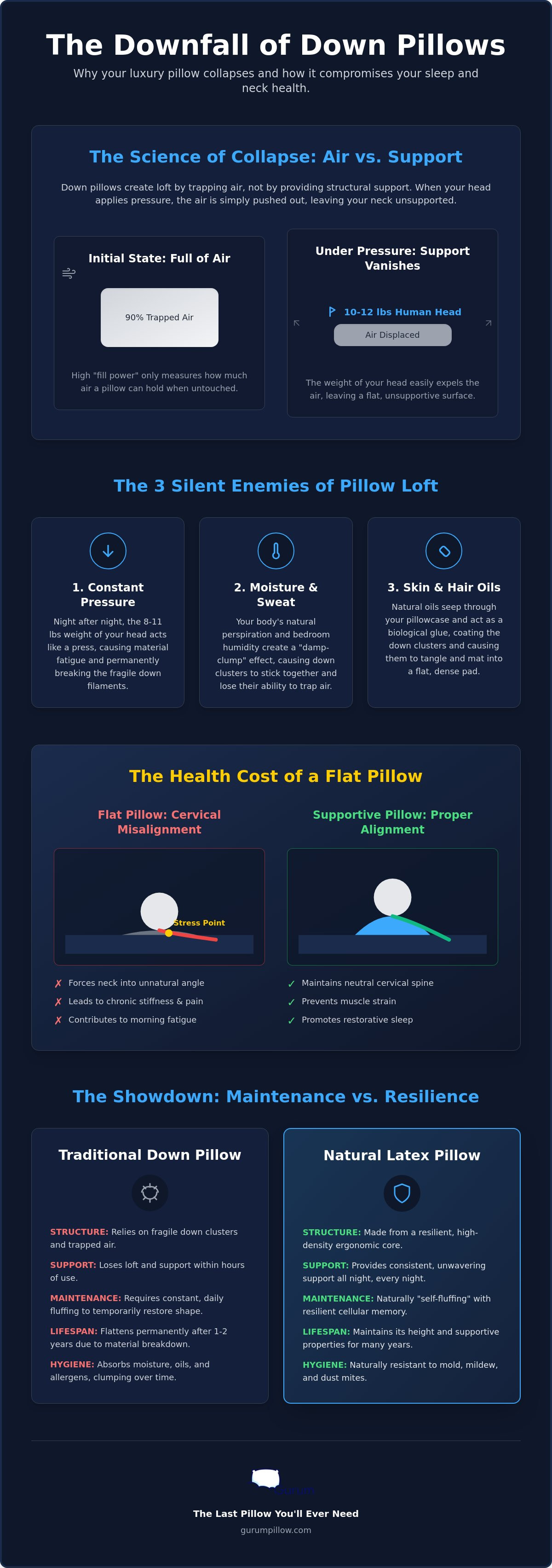
Down pillows are often sold as the peak of bedroom luxury. They look magnificent on a showroom bed, piled high and inviting. But once you bring them home, the reality sets in. You find yourself asking why do down pillows go flat after just a few hours of use. The answer lies in the very nature of the material itself. Loft is the temporary volume created by air trapped within down clusters. Because these clusters are 90% air, they have no internal skeleton to fight back against the weight of your head. When you lie down, that air is simply pushed out. You are left with a thin layer of material and zero support for your neck.
Most manufacturers talk about "fill power" to convince you of a pillow's quality. This number measures the volume a single ounce of down can occupy. While a high fill power looks impressive, it doesn't measure structural resistance. It only measures how much air the down can hold when no one is touching it. Your head weighs between ten and twelve pounds. Without a solid core, even the most expensive down will eventually yield to that pressure. It is a structural failure, not a maintenance one. You can't fluff your way out of a physics problem.
Down Clusters vs. Feather Quills
Down is the soft, fluffy undercoating found beneath the exterior feathers of ducks and geese. It consists of thousands of tiny, three-dimensional filaments. The intricate structure of down feathers is designed for insulation, not for load-bearing support. Many "down" pillows actually contain a high percentage of feathers to save on costs. Feathers have quills, which are flat and rigid. While they provide more initial bulk, they eventually poke through the fabric or snap under pressure. This mix of soft down and sharp feathers leads to clumping. Once the clusters begin to tangle and stick together, the pillow loses its ability to hold air entirely.
The Compression Cycle
Every night you sleep, you participate in a destructive compression cycle. As you rest your head, you force air out of the clusters. In the beginning, a quick shake in the morning brings the air back. However, these delicate filaments are fragile. Over time, they experience material fatigue. They lose their "spring" and their ability to bounce back to their original shape. This is why do down pillows go flat permanently after a year or two of use. Unlike natural latex, which has a resilient cellular memory, down filaments eventually stay crushed. You end up with a pillow that feels like a sack of flour rather than a supportive sleep tool.
The Three Enemies: What Specifically Flattens Your Pillow
Understanding why do down pillows go flat requires looking at what happens on a microscopic level every single night. It isn't just the passage of time. Your pillow is under constant attack from environmental and biological factors. While the air displacement we discussed earlier causes immediate flattening, these three enemies create the permanent, clumpy collapse that no amount of fluffing can fix.
The first enemy is simple mechanical pressure. A human head weighs between 8 and 11 pounds. Every night, that weight acts like a slow-motion hydraulic press on delicate down filaments. Over hundreds of hours, these microscopic structures eventually snap. Once the filaments break, they lose their ability to trap air. This is the point of no return for your comfort. You are no longer sleeping on a cloud; you are sleeping on a collection of broken fibers.
Humidity and Perspiration
Moisture is the silent killer of loft. Even if you don't feel like you're sweating, your body releases water vapor throughout the night. This moisture penetrates the pillow ticking and settles into the down clusters. It creates a "damp-clump" effect where the filaments stick together rather than fanning out to trap air. This is why a pillow that felt great in the store feels lifeless after a few months in a real bedroom.
Bedroom humidity makes this worse. High moisture levels in the air can cause down to lose its fluff even when the pillow isn't in use. This damp environment also invites microscopic mold and mildew. These organisms add weight to the light filaments, dragging them down and making the pillow feel heavy and dense. While synthetic down alternatives are often marketed as a durable solution, they often flatten even faster. Their polyester fibers lack the natural, though fragile, hinge of real down.
The Impact of Skin and Hair Oils
Your skin and hair produce natural oils every hour. These oils act as a biological glue. They seep through even high-thread-count pillowcases and coat the down clusters. Once coated in oil, the 3D structure of the down collapses. The filaments become slick and slide past each other instead of interlocking to provide support. They can no longer hold the air that creates the loft you need for spinal alignment.
You can see this degradation in the form of yellowing on the pillow surface. That yellow stain isn't just a cosmetic issue. It's a visual indicator that the internal materials have chemically and physically broken down. Even the most expensive luxury covers cannot stop all oil transfer over time. To avoid this cycle of hygiene and structural failure, many sleepers are switching to a Premium Latex Pillow that naturally resists moisture and oil absorption while maintaining its height.
The Health Cost: How Flat Pillows Ruin Your Neck
A flat pillow isn't just a minor annoyance. It is a direct threat to your cervical health. When your pillow loses its loft, your head inevitably tilts backward or sags into the mattress. This misalignment creates a cascade of physical issues that follow you long after you wake up. Your cervical spine requires a specific, consistent height to remain in a neutral position. Neutral alignment means your ears, shoulders, and hips are in a straight line. Without this balance, your neck muscles never truly rest. They spend the entire night in a state of micro-tension, trying to compensate for the missing support. This is exactly how ergonomic support heals neck pain at night; it removes the burden from your muscles and places it on a stable surface.
Many people wonder why do down pillows go flat even when they start the night feeling firm and full. The answer is the duration of the 8-hour sleep cycle. A down pillow might support you for the first twenty minutes, but as the air is displaced by the weight of your head, that support vanishes. This transition often happens while you are in deep sleep. You don't realize the pillow has failed until you wake up with a stiff neck, a numb arm, or a nagging tension headache.
Spinal Alignment and the Sleep Cycle
Chronic neck pain is often the result of this "sagging" effect. When the head is not properly supported, the vertebrae in your neck are compressed or overextended. This constant strain is a leading cause of morning tension headaches. You might find yourself waking up several times to adjust your position. This disruption prevents you from staying in the REM (Rapid Eye Movement) stage of sleep. REM is critical for cognitive function and emotional regulation. A failing pillow doesn't just hurt your neck. It drains your mental energy for the following day.
Why "Fluffing" is a Temporary Fix
We've all been there. You wake up at 3:00 AM and start punching your pillow to get the loft back. This "pillow fighting" is a sign of a failed support system. Fluffing only redistributes the remaining air and filaments. It does not add any real structural integrity to the material. It's a temporary cosmetic fix for a deep structural flaw. This inconsistent support is why do down pillows go flat repeatedly throughout the night. Instead of restorative rest, your brain is stuck in a loop of monitoring and correcting your posture. True relief requires a material that holds its shape without your intervention.
Maintenance vs. Resilience: Down vs. Natural Latex
Owning a down pillow feels like a part-time job. Every morning, you have to shake, punch, and fluff the material just to make it look presentable. This labor is necessary because down has no internal memory. Once the air is gone, the support is gone. If you are tired of wondering why do down pillows go flat despite your best efforts, it is time to look at the structural resilience of natural latex. While down requires manual intervention, natural latex is essentially "self-fluffing." Its microscopic cell structure acts like millions of tiny springs that return to their original height the moment you move. This provides the consistent elevation required for a Best Latex Pillow for Neck Pain: The 2026 Guide to Pain-Free Sleep.
The difference in breathability is just as dramatic. As down compresses throughout the night, the clusters pack together tightly. This creates a dense barrier that traps your body heat, leading to a "hot" sleep surface. Natural latex uses an open-cell structure. It allows air to flow through the pillow even when it is under pressure. You don't have to flip to the "cool side" of the pillow because the entire material stays at a comfortable temperature. It is a solution designed for both thermal comfort and anatomical health.
The "Toss and Turn" Factor
Down creates a "crater" effect. As you settle in, the material shifts to the sides, leaving your head in a low point with no support underneath. If you turn over in your sleep, you have to manually rearrange the fill to find comfort again. This is why do down pillows go flat for side sleepers so quickly; the weight is concentrated in one spot, forcing the fill away from the neck. Latex provides instant recovery. It moves with you, filling the gap between your ear and shoulder the second you change positions. You stay supported without ever fully waking up to fix your bedding.
Durability and Value Over Time
The financial cost of down is often hidden. Because the filaments break down and clump due to moisture and oils, most down pillows need replacing every 1 to 2 years. They are a recurring expense that never quite solves your sleep issues. High-quality natural latex is a different investment entirely. It is documented to maintain 99% of its shape and height for years. It is the most sustainable and long-lasting sleep material available today. You also save hours of labor. There is no need for complex washing routines with tennis balls or daily fluffing rituals. To experience this effortless support for yourself, explore our Premium Latex Pillow and stop fighting with your bedding every night.
The Gurum Solution: Why Our Latex Never Goes Flat
We've spent years listening to the frustrations of sleepers who feel betrayed by their bedding. You shouldn't have to fight your pillow for the support you deserve. Gurum Pillow was created as a direct answer to this struggle. Designed by Ji H. Won, our products focus on solving the exact problem of middle-of-the-night flattening. While you now understand why do down pillows go flat, it's time to experience a material that resists the cycle of collapse. Our Premium Latex Pillow uses 100% natural latex with a high-density ergonomic core. It maintains its structural integrity from the moment you lie down until the sun comes up.
Unlike down, which is 90% air and easily displaced, our latex is a solid yet responsive material. It doesn't rely on trapped air for its height. It relies on a resilient cellular structure that bounces back instantly. This means you get consistent cervical support that never sags. Our material is also naturally hypoallergenic and antimicrobial. It resists the accumulation of body oils and moisture that typically kill the loft of traditional fills. You are left with a cleaner, cooler, and more reliable sleep surface that lasts for years instead of months.
Ergonomic Design for Spinal Health
Traditional pillows use loose fill that shifts to the sides under pressure. This leaves your neck vulnerable. Our molded shape is engineered to cradle the cervical spine, providing a stable foundation that loose fill ever could. For those living with chronic neck pain, the Premium Latex Pillow offers a transformative experience. It holds your head in neutral alignment without the need for constant adjustment. This breathability doesn't depend on air pockets that collapse; it comes from the open-cell nature of the latex itself, ensuring you stay cool while your spine stays straight.
Waking Up Refreshed
The greatest luxury isn't a soft pillow; it's a full night of uninterrupted sleep. There is a profound difference in waking up with the same level of support you fell asleep with. We regularly hear from former "down-fluffers" who finally found relief after switching to Gurum Pillow. They no longer wake up at 3:00 AM to punch their pillows back into shape. By removing the physical stress of a failing pillow, we help you reach the deep REM stages of sleep your body needs to recover. Ready to stop fluffing? Shop the Premium Latex Pillow and discover the relief of a support system that never fails.
Take Control of Your Restorative Sleep
You now understand the structural reality of why do down pillows go flat. It isn't your fault, and more "fluffing" won't fix a material that is 90% air. We've seen how moisture and pressure inevitably break down delicate filaments, leaving your neck unsupported. You've learned that consistent cervical alignment is the only path to waking up without pain. You don't have to settle for a pillow that collapses when you need it most. True rest requires a material that maintains its integrity all night long.
Don't let another night of "pillow fighting" drain your physical and mental energy. Our solution combines 100% Natural Latex with precise Ergonomic Neck Support to ensure your pillow stays as tall at 6:00 AM as it was at bedtime. It's a one-time investment in your daily wellness. You can also enjoy Free US Shipping on Qualifying Orders when you choose a sleep partner designed to last for years rather than months. It is time to stop compromising on your health.
Upgrade to the Premium Latex Pillow—Support That Never Fails
You deserve to wake up refreshed and ready for the day. Let's make chronic neck discomfort a thing of the past and finally get the restorative sleep you've been searching for.
Frequently Asked Questions
How often should I replace a down pillow?
Most sleep experts recommend replacing a down pillow every 1 to 3 years. You'll know it is time for a change when the pillow no longer returns to its original shape after a vigorous fluffing or if you notice permanent clumping. Because down is an organic material, it eventually loses its structural integrity due to the constant pressure of your head and the absorption of body oils over hundreds of nights.
Can you fix a down pillow that has gone flat?
You can temporarily restore a down pillow's loft by placing it in a dryer on low heat with clean tennis balls. This process forces air back into the clusters and breaks up minor clumps. However, this does not fix the underlying issue of broken filaments. If you find yourself asking why do down pillows go flat every single night, the material has likely reached its physical limit and requires a more resilient replacement.
Is a flat pillow bad for your neck?
Yes, a flat pillow is a primary cause of cervical spine misalignment. When your pillow sags, your neck is forced into an unnatural angle, straining the muscles and ligaments throughout the night. This leads to morning stiffness, tension headaches, and chronic discomfort. Consistent support is essential for maintaining a neutral position where your ears and shoulders stay aligned during every stage of sleep.
Why does my down pillow smell after it gets flat?
The odor is usually caused by the accumulation of moisture, bacteria, and body oils trapped within the compressed down clusters. As the material flattens and loses breathability, it becomes a breeding ground for microscopic organisms. This is particularly common in humid environments. The organic nature of down means it can develop a musty scent once the internal filaments begin to degrade and trap perspiration.
Does washing a down pillow help it stay fluffy?
Washing can help remove the oils that weigh down the filaments, but it is a high-risk maintenance task. If the down is not dried completely, it will clump permanently and may develop mold inside the ticking. While a clean pillow might feel fluffier for a short time, the washing process itself can be abrasive. It often accelerates the breaking of delicate clusters, leading to a faster structural collapse over time.
What is the best alternative to a down pillow that won't go flat?
A Premium Latex Pillow is the most effective alternative for those seeking permanent loft and support. Unlike loose fills, 100% natural latex has a solid, resilient cell structure that functions like millions of microscopic springs. It provides a soft, responsive feel but returns to its original height instantly. It naturally resists the moisture and oils that cause traditional pillows to fail, offering years of consistent cervical support.
How do I know if my pillow is too flat for side sleeping?
Perform the "ear-to-shoulder" test while lying on your side in your normal sleeping position. Your head should be perfectly level with your spine, with the pillow filling the entire gap between your ear and the mattress. If your head tilts downward toward the bed, the pillow is too flat. Side sleepers require a higher, more stable loft to prevent shoulder compression, which is why do down pillows go flat so noticeably for this specific sleep style.