

By 2050, an estimated 269 million people worldwide will struggle with chronic neck pain. That's a staggering increase from the 203 million cases reported in 2020, and many of those individuals are currently waking up with "military neck" or persistent stiffness. You've likely spent countless nights tossing and turning, trying to find a comfortable spot on a pillow that loses its shape in a matter of weeks. It's frustrating to invest in your sleep only to wake up feeling more tired than when you went to bed.
You're probably wondering, what is an orthopedic pillow, and can it actually fix the way you feel every morning? We understand the exhaustion that comes from chronic physical discomfort and the disappointment of products that don't deliver. In this 2026 guide, you'll discover the science behind orthopedic pillows and how the right structural support can eliminate chronic neck pain for good. We'll explain the vital difference between mere softness and true cervical support. You'll also learn how to identify a durable, hypoallergenic sleep solution that helps you wake up refreshed and headache-free.
Key Takeaways
- Learn exactly what is an orthopedic pillow and why its engineering focuses on correcting body positioning rather than just providing a soft surface.
- Understand the science of cervical lordosis and how to maintain the natural "C-curve" of your neck to prevent gravity-induced strain.
- Discover why the buoyant force of natural latex offers superior spinal support compared to the sinking sensation of traditional memory foam.
- Identify the specific pillow loft you need based on your sleep position to effectively bridge the gap between your shoulder and the mattress.
- Find out how to transition from chronic morning stiffness to restorative rest by choosing a solution designed for long-term structural integrity.
Defining the Orthopedic Pillow: More Than Just a Marketing Label
Walking through a bedding aisle can feel overwhelming. Every product claims to be the secret to better sleep, but the term "orthopedic" is often tossed around as a vague marketing buzzword. It's time to clear the confusion. A standard Pillow is designed for basic comfort, whereas an orthopedic version is a functional tool engineered for anatomical correction. So, what is an orthopedic pillow in the context of your health? It's a support system specifically designed to correct your body positioning while you're in bed. Unlike a standard cushion, its primary goal is maintaining the natural curve of your cervical spine, ensuring your head, neck, and shoulders stay in a neutral alignment all night long.
It works by physically filling the gap between your head and the mattress. When this space isn't properly supported, gravity pulls your neck into awkward angles. This leads to the "military neck" or morning stiffness many of us know too well. An orthopedic pillow prioritizes structural integrity over "cloud-like" fluffiness. It doesn't just collapse under the weight of your head; it pushes back with enough force to keep your vertebrae aligned. It's the difference between sleeping on a surface that feels soft for five minutes and one that supports you for eight hours.
The Functional Purpose of Orthopedic Support
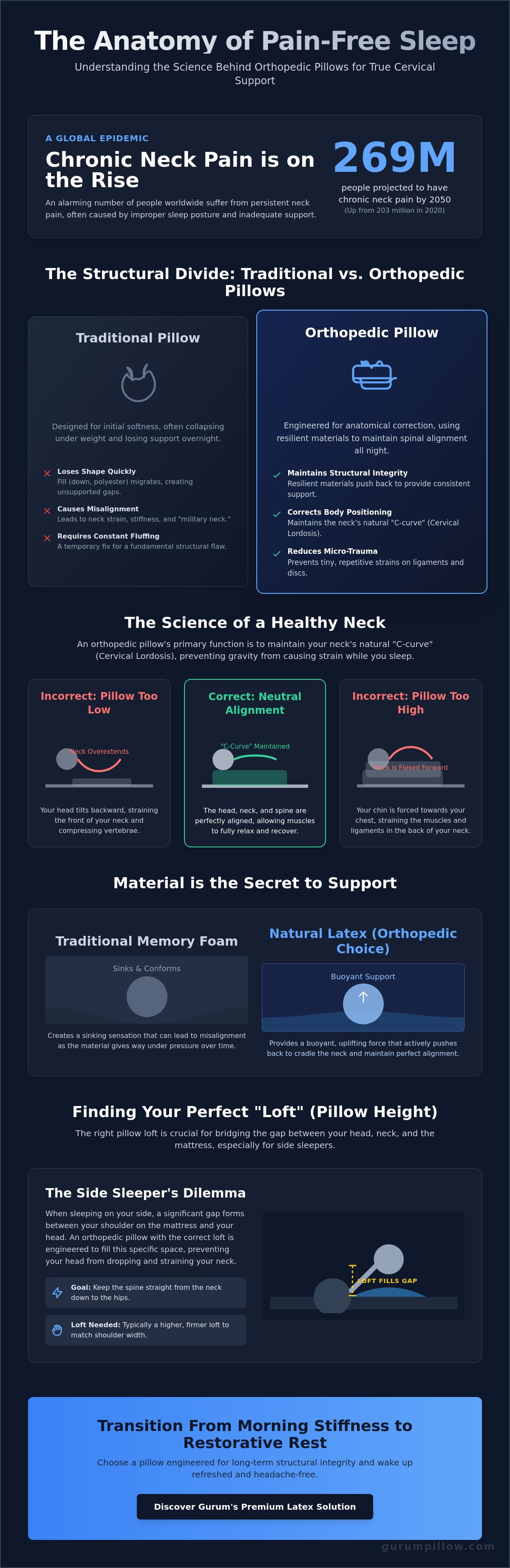
When you fall asleep, your muscles enter a relaxed, unconscious state. They can no longer actively protect your spine or hold your head in place. This is when your pillow has to do the heavy lifting. Orthopedic support provides a stable cradle that prevents your neck from twisting or dipping. By holding the neck in its natural "C-curve," these pillows relieve pressure points in the shoulders and upper thoracic region. This constant, steady support reduces "micro-trauma." These are the tiny, repetitive strains on your ligaments and discs caused by improper neck angles during long sleep cycles. Over time, preventing these small injuries leads to a massive reduction in chronic daily pain.
Orthopedic vs. Traditional Pillows: The Structural Divide
Traditional pillows are usually designed for aesthetics and initial "hand-feel" softness. They're filled with down, feathers, or polyester scraps that feel luxurious when you first lay down. However, these materials are notorious for shifting. Within an hour, the fill migrates to the sides, leaving your neck unsupported against the mattress. This inevitable collapse is why you wake up reaching for your neck in pain. Orthopedic pillows are built differently. They use resilient materials that maintain their shape regardless of how much you move. They focus on long-term spinal health rather than the fleeting sensation of sinking into a cloud. If your current pillow requires constant fluffing to feel "right," it isn't providing the orthopedic support your body needs to truly recover.
The Science of Cervical Alignment: How Orthopedic Pillows Actually Work
To truly understand what is an orthopedic pillow, we have to look beneath the surface at your own anatomy. Your neck isn't a straight line. It's a delicate sequence of seven small vertebrae curved into a shape known as cervical lordosis. This natural "C-curve" acts as a vital shock absorber for your head. When you lie down, gravity becomes your neck's primary antagonist. Without a structured support system, your head either sinks too far or is propped at an unnatural angle. This forces your neck muscles into a state of "muscle guarding." They stay flexed all night to protect your spinal cord, which is why you wake up feeling like you've been lifting weights in your sleep.
The solution lies in the "loft," or the specific height of the pillow. Loft isn't just about preference; it's about physics. If your pillow is too low, your neck overextends. If it's too high, your chin is forced toward your chest. Both scenarios strain the ligaments and are the leading causes of chronic tension headaches. Finding a Premium Latex Pillow with the correct loft ensures your muscles can finally go slack. When the pillow fills the gap between your head and the mattress perfectly, your body stops fighting gravity and starts recovering.
Anatomy of a Pain-Free Night
Your cervical spine supports roughly 10 to 12 pounds of head weight every day. Proper orthopedic support prevents "forward head posture," a common culprit behind the stiff, straightened "military neck" seen in many office workers. By maintaining the natural arch, you also keep your airways open. This alignment can significantly reduce mild snoring and improve oxygen intake during the night. It's not just about ending pain; it's about providing your body with the most efficient environment for deep rest.
The Neutral Spine Concept
A neutral spine is the "gold standard" for sleep health. This means achieving a straight line from your ear to your hip.
- Side Sleepers: The pillow must bridge the entire gap from the ear to the shoulder to keep the head level.
- Back Sleepers: The contour should cradle the neck arch without tilting the head forward or back.
Latex vs. Memory Foam: Why Material is the 'Secret Sauce' of Orthopedic Support
Most people focus on the wave-like shape of a support product. However, the true efficacy of orthopedic support depends on the material's ability to "push back" against your head's weight. When asking what is an orthopedic pillow, you must look beyond the contour and examine the core. Memory foam is a dominant material in the 2026 market, but it has a fundamental flaw; it relies on heat to soften and "cradle" your neck. While this feels cozy initially, it often lacks the buoyant force required for true spinal alignment. As your body temperature rises, the foam becomes softer. This causes your head to sink deeper, pulling your spine out of its neutral position over the course of the night.
Natural latex offers a completely different experience. It is pressure-reactive rather than heat-reactive. It provides an instant, springy response to every micro-movement you make. This ensures that your cervical curve is supported from the moment you lie down until you wake up. Understanding what is an orthopedic pillow requires recognizing that support is a dynamic process, not a static shape. Additionally, a hot pillow is a major disruptor of deep rest. Many synthetic foams trap heat, leading to night sweats that ruin the orthopedic benefits of your sleep. Latex is naturally breathable. It allows for constant airflow that keeps you cool and comfortable.
The Case for 100% Natural Latex
Durability is a cornerstone of orthopedic health. Synthetic foams often develop permanent "dips" or "valleys" after just a few months of use. Once a pillow loses its shape, its orthopedic value disappears. 100% natural latex maintains its structural integrity for years. It doesn't sag. It is also inherently hypoallergenic and dust-mite resistant, which is essential for cleaner breathing and uninterrupted sleep. The primary sensation of latex is one of buoyancy. It feels like it's lifting your head rather than swallowing it. This provides a sense of weightless support that foam simply cannot match.
Common Pitfalls of Cheap Orthopedic Foams
Many mass-market orthopedic pillows use low-grade polyurethane foam. These often come with a strong "new pillow smell." This is actually chemical off-gassing, which can irritate your respiratory system and lower your sleep quality. These materials also create a "stuck" feeling. Because memory foam takes time to reshape itself, shifting positions becomes a chore. This movement often wakes you up. It prevents you from reaching the deep, restorative sleep stages your body needs to heal. Choosing a resilient material like latex ensures you can move freely without losing your alignment.
How to Choose Your Ideal Orthopedic Pillow Based on Sleep Position
Choosing the right fit isn't about trial and error; it's about matching the pillow to your specific sleeping posture. When people ask what is an orthopedic pillow, they often forget that the answer depends entirely on their dominant sleep position. A pillow that works for a back sleeper will likely cause agony for someone on their side. Your goal is to keep your head level and your cervical spine neutral regardless of how you lie. We understand how frustrating it is to keep buying pillows that don't solve the problem, which is why matching the height to your frame is vital.
Side sleepers generally need the highest loft. Your pillow must bridge the entire gap from your shoulder tip to your ear. Without this height, your head collapses toward the mattress, stretching the muscles on one side of your neck while compressing the other. This imbalance is a primary source of morning stiffness and "military neck." Back sleepers, on the other hand, require a medium loft. The pillow should cradle the back of your head while providing a firm ridge of support directly under the neck's arch. If it's too high, it pushes your chin toward your chest, which can restrict your breathing and cause tension.
Stomach sleepers face the most significant challenge for spinal health. To prevent excessive cervical rotation, which is the act of twisting your neck 90 degrees to the side, you need a very low loft. In many cases, stomach sleepers benefit most from a thin, resilient support that barely lifts the head at all. You can test your current setup at home using the "Shoulder Test." Stand against a wall in your preferred sleep position and have someone check if your nose is aligned with the center of your chest. If your head tilts toward the wall or away from it, your pillow height is working against your health.
Measuring Your Personal Loft Requirement
To find your ideal fit, measure the distance from the base of your neck to the outside edge of your shoulder. This measurement represents the maximum loft you should consider for side sleeping. Understanding what is an orthopedic pillow involves knowing that loft is the compressed height of the pillow under the head's weight. You must also consider your mattress firmness. If you sleep on a soft mattress, your torso sinks deeper into the bed, meaning you'll need a lower pillow loft to maintain alignment than someone on a firm surface.
The Adjustment Period: What to Expect
Switching to a cervical pillow is a transition for your body. Your muscles have likely spent years "guarding" against poor posture. During the first 3 to 5 nights, your neck might feel "different" or even slightly sore as it learns to relax into a new, healthier position. This is a normal part of the transition from softness-seeking to support-seeking sleep habits. Be patient with yourself as your body unlearns old patterns. Ready to reclaim your rest? Explore our Premium Latex Pillow for the consistent, expert-backed support your neck deserves.
Reclaiming Your Rest with Gurum’s Premium Latex Orthopedic Solution
You've spent too many mornings rubbing a stiff neck and reaching for pain relief. You've likely tried the generic store-bought options that promised comfort but went flat within a few short weeks. When you ask what is an orthopedic pillow, you aren't just looking for a dictionary definition. You're searching for a way to finally wake up without a headache. At Gurum, we've focused our entire mission on a single, perfected solution: 100% natural latex. Our pillows provide the consistent, resilient support your cervical spine requires to stay aligned throughout the night.
Our Premium Latex Pillow is designed by experts who understand the intricate anatomy of rest. We ignore the industry's obsession with cheap, temporary fillers. Instead, we prioritize the buoyant force needed to keep your head from sinking into an unhealthy position. This ensures your neck stays supported without the heat retention of synthetic foams. Because we believe your journey to better sleep should be effortless, we also offer free shipping across the USA. It's time to stop settling for "good enough" and start investing in your long-term musculoskeletal health.
Why Gurum Stands Apart
We made a conscious choice to avoid memory foam entirely. It's often filled with chemicals and loses its vital "push-back" as it warms up against your skin. Our latex is pure, sustainable, and engineered for longevity. It won't flatten or develop those frustrating dips that ruin your alignment after a few months. To create the ultimate clean sleep environment, you can pair your pillow with our anti-allergy pillow cover. This combination protects your respiratory health while your spine recovers. It's a professional-grade tool for the home that bridges the gap between medical necessity and lifestyle luxury.
Your Journey to Pain-Free Mornings
Imagine waking up and feeling refreshed immediately. No more tossing and turning to find a comfortable spot. No more "muscle guarding" that leaves you exhausted by noon. We know you might have been disappointed by previous market solutions. We've heard those stories from customers who felt like they were constantly wasting money on pillows that didn't work. That's why our approach is different. We focus on the science so you can focus on your life.
The transformation from waking up stiff to waking up energized is real. It starts with understanding what is an orthopedic pillow and choosing a material that doesn't compromise on support. You deserve a sleep solution that works as hard as you do to maintain your health. Experience the difference of a Premium Latex Pillow today.
Wake Up Refreshed and Pain-Free
Achieving a restorative night's sleep shouldn't feel like a luxury. You've learned that what is an orthopedic pillow goes beyond a simple marketing label; it's a precision-engineered tool designed to maintain your neck's natural "C-curve." By choosing the correct loft for your specific sleep position and prioritizing the buoyant support of 100% natural latex, you're giving your body the foundation it needs to heal. You don't have to accept morning stiffness as a permanent part of your daily routine.
Our Premium Latex Pillow is hypoallergenic, breathable, and designed to stay resilient for years without flattening. We're committed to your wellness, which is why we offer free US shipping to make your transition to better sleep as smooth as possible. Don't let another night of poor alignment and muscle guarding drain your energy. Shop the Premium Latex Pillow for Ultimate Neck Support and rediscover the joy of waking up without discomfort. You've struggled with poor sleep for long enough. You're just one night away from the rest you truly deserve.
Frequently Asked Questions
Is an orthopedic pillow good for all sleep positions?
Yes, orthopedic pillows are beneficial for side, back, and even some stomach sleepers. when considering what is an orthopedic pillow, the most important factor is how it adapts to your specific posture. Side sleepers require a higher loft to bridge the shoulder gap, while back sleepers need a contour that supports the neck arch. By matching the pillow's design to your sleep position, you maintain a neutral spine and prevent morning stiffness.
How long does it take to get used to an orthopedic pillow?
Most people require an adjustment period of 3 to 5 nights to feel fully comfortable. Your neck muscles have likely spent years overcompensating for poor alignment, leading to a state of constant tension. As you transition to a supportive surface, those muscles finally begin to relax. While it might feel different initially, this is a positive sign that your body is unlearning old, harmful habits and moving toward restorative rest.
Can an orthopedic pillow help with tension headaches?
Yes, proper cervical support is often the missing link in managing chronic tension headaches. These headaches frequently stem from strain in the upper neck and base of the skull. When your head isn't supported, your muscles stay flexed, which can trigger referred pain. By maintaining the natural C-curve of your neck, an orthopedic pillow reduces this constant muscle guarding. This leads to fewer morning headaches and a more refreshed feeling upon waking.
What is the best material for an orthopedic pillow?
100% natural latex is widely considered the gold standard for orthopedic support. Unlike memory foam, which softens with heat and causes your head to sink, latex provides a consistent, buoyant push-back. It's highly responsive to your micro-movements and maintains its shape for years. It's also naturally breathable and hypoallergenic. This makes it a superior choice for anyone seeking a durable, chemical-free sleep environment that prioritizes spinal health and long-term comfort.
Do orthopedic pillows actually work for chronic neck pain?
Yes, orthopedic pillows are specifically engineered to address the root causes of chronic neck pain. When asking what is an orthopedic pillow, it's important to focus on its ability to reduce micro-trauma caused by improper sleep angles. By holding the cervical spine in neutral alignment, it prevents the repetitive strain on discs and ligaments that occurs with traditional pillows. Many users report a significant reduction in stiffness and localized pain within the first week.
How often should I replace my orthopedic pillow?
You should typically replace a high-quality latex orthopedic pillow every 3 to 5 years. This is significantly longer than traditional polyester or memory foam options, which often lose their structural integrity within six months. You'll know it's time for a replacement if the material feels less resilient or if you start waking up with familiar neck stiffness. Investing in a durable material ensures your spine receives consistent support night after night without fail.
Can an orthopedic pillow help with snoring?
Proper alignment can indeed help reduce mild snoring by keeping your airways open. When your head is too low or tilted back at an awkward angle, the tissues in your throat can partially obstruct your breathing. An orthopedic pillow keeps your head and neck in a neutral position, which helps prevent this collapse. While it isn't a cure for clinical sleep apnea, it's a valuable tool for improving overall respiratory efficiency and comfort during rest.
Is a firm pillow better for neck pain than a soft one?
Support is more important than sheer firmness. A pillow that is too hard can create painful pressure points, while one that is too soft will fail to maintain your spinal alignment. The goal is a medium-firm feel that offers enough resistance to hold your head level without feeling like a block of wood. This balance ensures that your neck is cradled and your spine stays straight, allowing your muscles to fully relax and recover.