

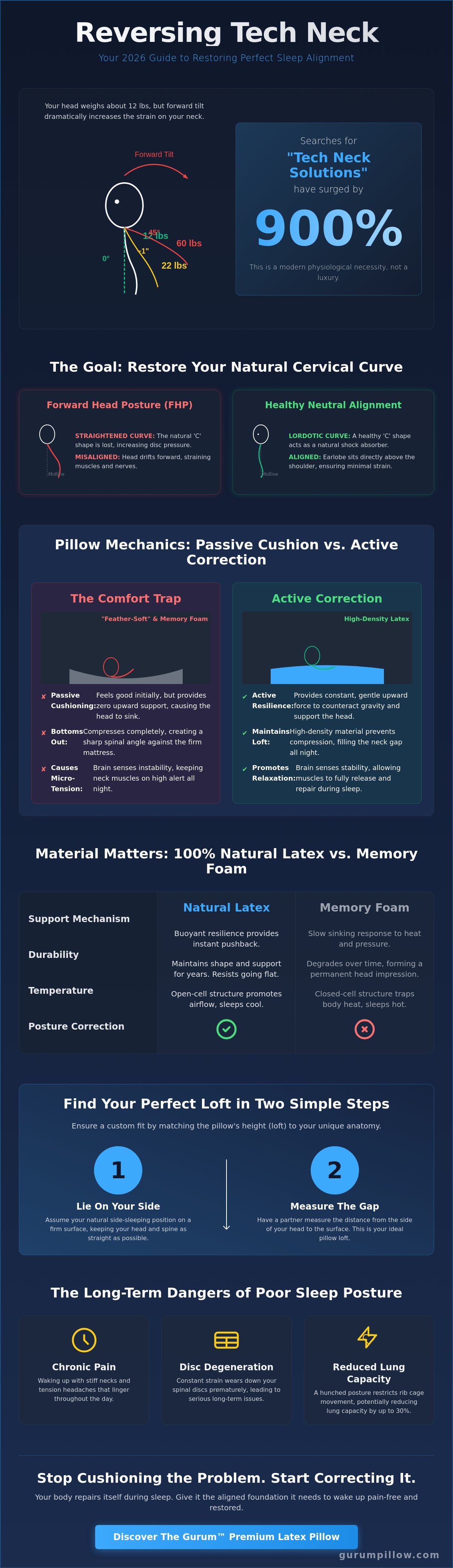
When you tilt your head 45 degrees to check a notification, your neck isn't just supporting 12 pounds of bone and muscle. It's actually carrying an effective weight of 60 pounds. This constant strain is why searches for tech neck solutions have surged by 900 percent recently. Finding the right pillow to prevent forward head posture is no longer a luxury; it's a physiological necessity for anyone living in a digital world.
You've likely spent years waking up with a stiff neck and a dull tension headache that lingers until noon. It feels like your head is simply too heavy for your shoulders to carry. We understand the frustration of buying pillows that go flat within a month, leaving you back at square one. You deserve a solution that doesn't just cushion your head but actively restores your alignment.
The right pillow material and structure can actually reverse forward head posture and restore your natural cervical curve while you sleep. In this 2026 guide, we'll show you how to choose a durable, high-density support system that stays resilient. We'll explore why specific materials like premium latex outperform traditional options to help you wake up feeling refreshed, tall, and entirely pain-free.
Key Takeaways
- Understand how every inch of forward tilt adds ten pounds of perceived weight to your neck and why constant upward support is required to reverse it.
- Learn why a 100% natural latex pillow to prevent forward head posture provides the buoyant resilience needed to maintain alignment, unlike memory foam which sinks as it warms.
- Discover the simple two-step method to calculate your ideal loft by measuring the gap between your neck and shoulder for a truly custom sleep experience.
- Identify the physical differences between passive cushioning and active correction to ensure your pillow choice supports your cervical curve all night long.
- Explore how high-density, filler-free materials prevent the common frustration of pillows going flat, ensuring your investment in posture correction remains effective for years.
Understanding Forward Head Posture and the "Tech Neck" Epidemic
Forward head posture (FHP) is more than just a slouch. It is the chronic anterior positioning of the cervical spine, where your head drifts in front of your body's vertical midline. Most people don't realize their head weighs about 12 pounds. For every single inch your head moves forward, it gains 10 pounds of perceived weight. If you are leaning three inches forward to read a screen, your neck muscles are struggling to hold up 42 pounds of pressure. Over 7 to 9 hours of sleep, using the wrong pillow to prevent forward head posture can lock this misalignment into place.
While many people use "Tech Neck" and "Military Neck" interchangeably, they describe different structural issues. Tech Neck is the habit of FHP. Military Neck, or cervical kyphosis, is the actual loss of the neck's natural curve. One leads to the other. Left untreated, this constant strain causes premature disc degeneration and even reduces your lung capacity by restricting the movement of your rib cage. You aren't just dealing with a sore neck; you're dealing with a neurological and respiratory burden.
The Anatomy of a Healthy Cervical Curve
Your neck should have a natural lordotic curve. This "C" shape acts as a shock absorber for your skull. During the REM cycle, your brain works to repair tissues and reinforce muscle memory. If your spine is misaligned during this critical window, your body "learns" to accept the slouch as its new normal. To achieve true health, you must maintain neutral alignment. Neutral alignment is defined as the earlobe sitting directly above the shoulder acromion.
Why Your Current Pillow Might Be Making It Worse
Most traditional pillows are designed for "comfort" rather than correction. High loft pillows are particularly dangerous. They prop the head up too high, forcing the chin toward the chest and flattening the cervical curve. Conversely, "feather-soft" pillows offer zero structural resistance. Your vertebrae simply sink into the material, providing no support for the 12-pound weight of your head. This lack of support leads to morning stiffness. When you wake up in pain, your brain remains in a "protective" state, causing you to hunch even more throughout the day. Choosing a specific pillow to prevent forward head posture is the first step in breaking this cycle of physical and psychological fatigue.
The Mechanics of Support: Why Resilience Matters for Posture
Passive cushioning is a comfort trap. It feels luxurious for five minutes, but it fails over eight hours. Your neck needs more than a soft landing. It needs active resilience. This is the constant, gentle upward force required to counteract the weight of your skull. Without this pushback, gravity wins. Your head sinks. Your cervical curve collapses. A high-quality pillow to prevent forward head posture acts as a structural partner, not just a place to rest your head. It provides the lift necessary to keep your vertebrae in their natural home.
Your brain is constantly monitoring your physical position through proprioception. If your pillow is too soft, your brain senses that your head is unstable. To prevent injury, your nervous system keeps your neck and shoulder muscles on high alert all night. You don't actually rest. You spend the night in a state of micro-tension. When you use a surface that offers consistent resistance, your brain finally receives the signal that it is safe to relax. This is why a medical overview of forward head posture often emphasizes the need for structural stability over simple softness.
Bottoming out is another common failure in traditional bedding. This happens when the material compresses so much that your head eventually rests on the firm mattress underneath. When you bottom out, the pillow loses its ability to fill the gap under your neck. This creates a sharp angle in the spine, worsening the very tech neck you're trying to fix. Resilience ensures the pillow maintains its loft from the moment you lie down until the moment you wake up. Investing in a Premium Latex Pillow ensures your neck receives this active support without the rigidity of traditional orthopedic foam.
Neutral Alignment vs. Comfort Traps
There is a massive difference between feeling soft and being supportive. A soft pillow might feel like a cloud, but it allows your head to tilt backward or forward into a strain zone. This tilt pinches nerves and strains ligaments. Neutral alignment means your spine stays straight and your airway remains open. If your pillow doesn't fight back against the weight of your head, your nervous system pays the price through chronic tension and morning headaches.
The Problem with "One Size Fits All" Orthopedics
Many people reach for rigid, pre-contoured foam pillows. These often fail because they assume everyone has the same neck length and shoulder width. If the contour doesn't hit your neck at the exact right spot, it can actually push your head further forward. The best pillow to prevent forward head posture is one that adapts to your unique shape while maintaining its structural integrity. This is why the cervical pillow is the gold standard for alignment. It offers a balance of customized contouring and unwavering support that synthetic materials simply can't match.
Latex vs. Memory Foam: Which Material Actually Fixes Posture?
Most people reach for memory foam because it feels forgiving in the store. However, for a pillow to prevent forward head posture, memory foam often creates a "comfort trap." It relies on your body heat to contour to your shape. This process is known as thermal softening. As your body temperature warms the material throughout the night, the foam loses its ability to push back. By the early hours of the morning, your head has sunk into a deep crater. Your neck loses the vital support it needs to stay in neutral alignment, leaving you to wake up with the same stiffness you had the day before.
100% natural latex offers a completely different experience. Instead of sinking, you feel a sense of buoyant lift. It's temperature-neutral. It stays cool and maintains its structural integrity from the moment you close your eyes until you wake up. While synthetic foams often degrade and go flat within 12 to 24 months, high-quality latex maintains its height for five years or more. This long-term durability is essential for consistent postural correction. You don't have to worry about your support system disappearing after a few months of use.
The Physics of Instant Response
Latex responds to your movements the millisecond they happen. When you shift positions, the material adjusts instantly to fill the gap under your neck. This prevents you from getting stuck in a poor posture. Many experts agree that latex foam pillows provide significantly higher uplift than synthetic alternatives. This responsive support ensures your cervical spine stays aligned even if you move frequently during the night. You won't find yourself fighting a "memory crater" just to turn over.
Chemical Off-gassing and Sleep Health
Petroleum-based foams often release volatile organic compounds (VOCs). These chemicals can irritate your respiratory system, causing you to toss and turn. Interrupted sleep leads to muscle tension and poor posture awareness. Natural latex is inherently hypoallergenic and VOC-free. Pairing this material with an Anti-Allergy Pillow Cover ensures a clean, breathable sleep environment. When you breathe clearly, your body stays relaxed. A relaxed body is much easier to keep in proper alignment than one struggling with environmental sensitivities.
How to Choose the Right Loft to Prevent Forward Head Posture
Finding the best pillow to prevent forward head posture is a matter of millimeters. It isn't enough to buy a "firm" or "soft" pillow. You need to measure your specific anatomical needs to ensure your spine stays neutral. Your goal is to fill the void between your mattress and your neck without tilting your head in either direction. Follow these five steps to find your perfect fit.
- Step 1: Identify your primary sleep position. Your body needs different levels of support whether you are on your back or your side.
- Step 2: Measure the "Gap." Use a ruler to measure the distance from the base of your ear to the outside of your shoulder. This is the height your pillow must maintain under load.
- Step 3: Account for mattress firmness. A soft mattress allows your shoulders to sink deeper. This reduces the loft height you actually need. If your mattress is firm, you'll need a higher loft to bridge the distance.
- Step 4: Test for the "Horizontal Gaze." Lie down on your potential pillow. Your nose should point directly at the ceiling. If you're looking toward your knees, the loft is too high. If you're looking behind you, it's too low.
- Step 5: Commit to the 14-day break-in. Your neck muscles have "learned" a poor posture. It takes about two weeks of consistent support for your body to accept a new, healthy alignment.
Don't settle for a generic height that doesn't respect your frame. You can buy a Premium Latex Pillow designed to provide the specific resilience required for these measurements.
The Side Sleeper’s Posture Checklist
Side sleepers face the greatest risk of spinal collapse. If your pillow is too thin, your head drops toward the mattress, overstretching the top side of your neck. This creates intense shoulder pressure and leads to chronic tension headaches. You need a higher loft that matches your shoulder width exactly. For more detailed measurement techniques, check out our guide on the best pillow for side sleepers. Proper loft ensures your neck remains a straight extension of your spine.
Back Sleepers and the Cervical Cradle
Back sleepers require a medium-firm feel that supports the "hollow" of the neck. The pillow should cradle the base of the skull without pushing the chin toward the chest. If the material is too soft, your head rolls to the side, causing you to wake up with a "crick" in your neck. While some prefer stomach sleeping, it is generally discouraged for correcting forward head posture. It forces the neck into a 90-degree rotation for hours, which is the opposite of neutral alignment. Focus on back or side sleeping to allow your cervical spine to recover.
The Gurum Solution: Premium Latex Support for Lasting Correction
The Gurum Premium Latex Pillow isn't a temporary fix. It is a precision-engineered tool designed to address the root causes of cervical strain. Most market alternatives rely on synthetic blends that lose their shape within weeks. We chose a different path. By utilizing 100% natural latex, we ensure your pillow to prevent forward head posture provides the same level of buoyant lift on day 1,000 as it did on day one. There are no fillers. There are no petroleum-based synthetics. It is just pure, resilient support that respects your anatomy.
Our design specifically respects the dual needs of side and back sleepers. We understand that your body requires different support levels depending on your position. This ergonomic versatility ensures that your spine stays in neutral alignment throughout the night. You won't wake up feeling like your head is too heavy for your neck. Instead, you'll experience the relief that comes when your muscles finally stop fighting for stability. Our durability guarantee means you are investing in support that lasts for years, not months.
Designed by Experience, Backed by Science
Ji H. Won created Gurum because of a personal struggle with chronic discomfort. After years of disappointment with standard orthopedic pillows, he sought a solution that combined anatomical science with sensory comfort. This journey led to a focus on 100% natural, breathable materials. A restorative sleep environment requires more than just support; it requires a cool, hypoallergenic surface. Discovering the best latex pillow for neck pain is often the turning point for those suffering from tech neck. It transforms sleep from a period of strain into a proactive session of postural correction.
Taking Your Support on the Road
Consistency is the most important factor in reversing forward head posture. Your progress shouldn't reset just because you are away from home. The Travel Latex Pillow offers the same high-density support as our full-sized version in a portable, convenient frame. It ensures you maintain your alignment in hotels, on planes, or at a friend's house. By keeping your cervical curve supported every single night, you accelerate the healing process. You can Shop the Gurum Collection to find the complete system needed for a pain-free life. It's time to stop settling for pillows that fail and start investing in a solution that lasts.
Reclaim Your Alignment and Wake Up Refreshed
Correcting tech neck requires more than just daytime stretches. It requires a sleep environment that actively restores your cervical curve while you rest. You now understand that active resilience is the only way to counteract the weight of your head. By choosing a material that doesn't bottom out or soften with heat, you give your nervous system the safety it needs to fully relax. Measuring your ideal loft ensures your spine stays neutral, preventing the morning stiffness that has held you back for far too long.
Investing in a professional-grade pillow to prevent forward head posture is the most effective way to break the cycle of chronic tension. Our 100% natural latex design was created by experts to solve chronic neck pain. With free US shipping on qualifying orders, there is no reason to spend another night in discomfort. It is time to wake up feeling tall, refreshed, and ready for the day.
Restore your neck’s natural curve with the Gurum Premium Latex Pillow
You don't have to live with the physical burden of poor posture. Better sleep and a healthier spine are within your reach starting tonight.
Frequently Asked Questions
Can a pillow really fix forward head posture?
A pillow alone won't erase years of slouching, but it is a critical tool for passive correction. While you sleep, the right support reinforces the natural lordotic curve of your neck. This prevents the cervical spine from remaining in a strained, anterior position for eight hours. It works by providing a stable foundation that allows your muscles to finally disengage from their protective tension and begin to heal.
Is a firm or soft pillow better for correcting tech neck?
Neither a "brick" nor a "cloud" is ideal for spinal health. You need a material with high resilience that offers a constant upward force against the weight of your head. A pillow that is too soft allows your neck to collapse into a strain zone. A pillow that is too firm can create painful pressure points. Resilient 100% natural latex provides the perfect balance of anatomical support and sensory comfort.
How long does it take to see results from a posture-correcting pillow?
Most people begin to feel a significant difference in morning stiffness within the first 14 days of consistent use. This period allows your muscle memory to reset and your nervous system to adapt to the new, healthy alignment. While the physical relief from tension headaches is often immediate, visible improvements in your standing posture take longer as your body unlearns the tech neck habit during the day.
What is the best pillow height (loft) for forward head posture?
The ideal loft depends entirely on your primary sleeping position and shoulder width. Side sleepers generally need a higher loft to bridge the gap between the ear and the mattress. Back sleepers require a medium loft that cradles the neck without pushing the chin forward. Using a specific pillow to prevent forward head posture ensures your head stays level with your spine regardless of your body type.
Why is natural latex better than memory foam for neck support?
Natural latex provides a buoyant lift that memory foam simply cannot replicate. Memory foam is a petroleum based product that softens as it absorbs body heat, causing you to sink and lose vital support mid night. Latex stays cool and maintains its height for years. It responds instantly to your movements, so you never wake up trapped in a "memory crater" that strains your cervical vertebrae.
Should I use a cervical roll in addition to my pillow?
You don't need a separate cervical roll if your pillow is ergonomically designed with a supportive core. A high quality latex pillow already provides the necessary lift for the hollow of your neck. Adding a roll to an already supportive pillow can actually overextend the spine and cause new issues. It's better to invest in one perfected solution that handles the alignment for you naturally.
Can children use these pillows to prevent future posture issues?
Yes, children can benefit from ergonomic support, especially since many get their first smartphone by age nine. Early intervention helps prevent the development of permanent structural changes in the developing cervical spine. Using a supportive pillow to prevent forward head posture early on can offset the mechanical strain caused by hours of daily tablet use, setting them up for a lifetime of better spinal health.
What happens if I continue to sleep on a pillow that offers no support?
Continuing to sleep without support leads to accelerated disc degeneration and chronic nerve compression. When your head isn't supported, your neck muscles stay "on" all night to protect the spine, leading to those familiar morning tension headaches. Over time, the loss of the natural cervical curve can even reduce your lung capacity and increase neural fatigue as your brain works harder to maintain balance.