

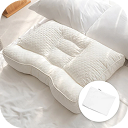
Your bulky travel pillow might be doing more damage to your spine than the cramped airplane seat itself. It's a frustrating reality many of us face. You pack a pillow hoping for rest, but you wake up with sharp neck pain and a sweaty, chemical scent lingering on your skin. We understand that exhaustion. You've likely tried every "ergonomic" shape on the market only to find they're too hot or lose their shape within an hour. Choosing a latex vs memory foam travel pillow is about more than just softness; it is about finding a material that responds to your body while you're stuck in a vertical position.
This guide will help you master the science of upright sleep so you can finally arrive at your destination feeling human. We'll explain why material density matters for spinal alignment and how to navigate the 2026 TSA regulations that have effectively banned many gel-filled cooling pillows from carry-on luggage. You'll get a clear comparison of latex, memory foam, and inflatable options to ensure your next flight is actually restorative. We are looking at durability, breathability, and the specific anatomical support required to keep you pain-free at 30,000 feet.
Key Takeaways
- Learn how to close the "Cervical Gap" to eliminate the sharp neck pain caused by standard airplane seats.
- Discover why a latex vs memory foam travel pillow makes the difference between a breathable rest and a stifling, slow-sink heat trap.
- Avoid the discomfort of chemical off-gassing and VOCs by choosing materials that prioritize your respiratory health in pressurized cabins.
- Master the physics of supporting 11 pounds of head weight in a vertical position to protect your spinal alignment.
- Match your unique sleeping style with a durable travel companion that won't lose its shape after a single trip.
The Travel Pillow Debate: Inflatable, Memory Foam, or Latex?
For years, the travel pillow was a desperate afterthought. It was a last-minute purchase made at an airport terminal gate because the alternative was sixteen hours of staring at a seatback. We've all been there. You grab the first plush U-shape you see, hoping for a miracle. But as we become more attuned to our anatomical health, the airport impulse buy is being replaced by material science. Travelers are finally asking the right questions about synthetic and natural fillers to avoid the post-flight neck brace. They want to arrive refreshed, not restricted by a sharp pinch in their trapezius muscles.
The primary conflict often boils down to a latex vs memory foam travel pillow, though inflatable options still linger in the market. Choosing the cheapest option often leads to mid-flight regret and unnecessary neck strain. There is a constant trade-off between packing volume and actual restorative rest. If a pillow saves space but leaves you with a migraine, it hasn't served its purpose. A truly effective travel companion must manage the 11 pounds of pressure your head exerts while you are stuck in a vertical position. Without the right material, your spine is left to fend for itself against the vibrations of the aircraft.
Inflatable Pillows: The Minimalist Choice
These are the go-to for travelers who prioritize "one-bag" efficiency. They fold down to the size of a deck of cards and add almost no weight to your carry-on. You can adjust the firmness by adding or releasing air, which sounds ideal in theory. However, air is a poor substitute for structural support. Inflatable chambers create surface tension that feels "bouncy" rather than cradling. They don't provide true pressure relief. Instead of supporting your neck, they act as a stiff barrier. This often keeps your head at an awkward, rigid angle throughout the flight.
Memory Foam: The Traditional Standard
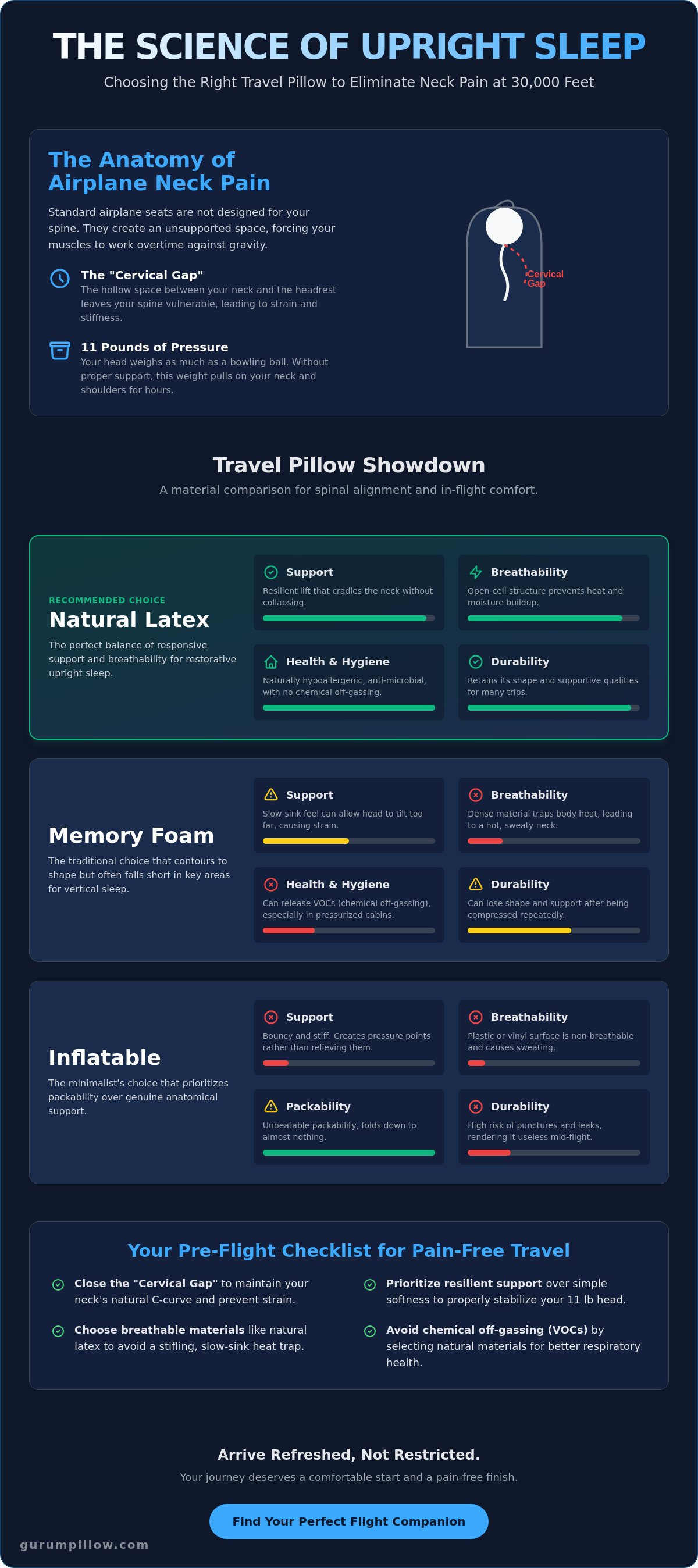
Many travelers gravitate toward the familiar feel of memory foam. It uses a "slow-sink" mechanism that responds to heat and weight to contour to your shape. While this works on a flat mattress, it behaves differently in a 90-degree upright position. In a pressurized cabin, memory foam can often feel too soft. It eventually loses the battle against gravity, allowing your head to tilt too far. Then there is the bulk. High-quality foam doesn't compress well. It takes up significant space, often hanging off luggage like a cumbersome trophy of poor planning. Many find it too hot, as the material tends to trap body heat against your neck for hours on end.
Anatomy of Upright Sleep: Why Support Matters at 30,000 Feet
Airplane seats are designed for space efficiency, not human anatomy. They often feature a protruding headrest that pushes your skull forward while leaving your neck dangling. This design creates the "Cervical Gap." It is the hollow, unsupported space between the back of your neck and the seat. When this gap is left empty, your neck muscles must work overtime to stabilize your head. Your head weighs roughly 11 lbs. That is about the same weight as a professional bowling ball. Holding that heavy weight upright for hours without proper assistance leads to extreme muscle fatigue and localized inflammation.
Softness is often the biggest trap in travel comfort. We equate "plush" with "good," but vertical sleep requires structural integrity rather than just a soft touch. In the debate of latex vs memory foam travel pillow, the way a material handles gravity is vital. Memory foam often yields too much under the constant pressure of a leaning head. It slowly sinks until your chin is resting on your chest. This collapse results in "military neck." It is that agonizing stiffness where your neck loses its natural flexibility upon landing. You need a material that provides a resilient lift to keep your airway open and your spine neutral.
Maintaining the Natural C-Curve
Your neck has a natural inward curve that must be preserved even in a cramped middle seat. A high-quality cervical pillow fills the void behind your neck to maintain spinal integrity. Inflatables are notoriously bad at this because they create "rebound" pressure. Since they are filled with air, they don't move with you; they push back against you. This creates a surface tension that strains delicate muscles. You need a pillow with consistent loft that stays the same height from takeoff to touchdown, regardless of cabin pressure changes.
Preventing the Bobblehead Effect
Most travelers focus on back cushioning, but lateral stability is actually more critical for long-haul rest. Your head naturally slumps side-to-side as your muscles relax during sleep. This "bobblehead" effect is a primary reason travelers wake up every twenty minutes. It prevents you from reaching the deep REM sleep necessary to avoid jet lag. Materials also react differently to airplane vibrations. Some synthetic foams can actually amplify the low-frequency hum of the engine, keeping your nervous system on high alert. Switching to a latex travel pillow allows your body to feel grounded and stable enough to finally let go and sleep.
Hygiene, Durability, and the Chemical Smell Factor
Travel is inherently messy. You are confined in a metal tube with hundreds of strangers; sharing recycled air and upholstery that rarely sees a deep clean. While we've discussed spinal alignment, the sensory experience of your pillow is just as vital for rest. Many travelers buy a new pillow only to find it emits a sharp, plastic-like odor the moment they settle into their seat. This is off-gassing. It's caused by Volatile Organic Compounds (VOCs) found in synthetic materials. In a pressurized cabin with limited ventilation, these smells become concentrated. It's not just an annoyance; for some, it triggers headaches or respiratory irritation mid-flight.
When comparing a latex vs memory foam travel pillow, the "chemical smell" factor is a major differentiator. Memory foam is a petroleum-based product. Even CertiPUR-US® certified foams, which have low VOC emissions (less than 0.5 parts per million), can still carry a distinct scent when first unboxed. Natural latex is a rubber-based foam that doesn't rely on the same complex chemical cocktails. It offers a cleaner, more neutral experience from the first minute of your journey. You don't want to spend an eight-hour flight with your nose inches away from a "new car" smell that won't quit.
Durability also plays a role in your long-term comfort. Inflatable pillows are prone to microscopic air leaks at the seams, often failing exactly when you need them most. Cheap foam pillows suffer from "compression sets." This means they lose their ability to bounce back after being stuffed into a carry-on. High-quality materials like natural latex can last 5 to 10 years without losing their structural integrity. They provide the same level of support on your fiftieth flight as they did on your first.
Breathability and Temperature Regulation
Memory foam is a closed-cell material. It works by trapping your body heat to soften the foam. By hour four of a long-haul flight, this often turns your pillow into a "neck heater." Natural latex features an open-cell structure that allows air to circulate freely. It naturally dissipates heat rather than storing it. Air-filled pillows offer zero thermal regulation; they simply take on the temperature of the cabin. If you tend to run hot while sleeping, the breathability of latex is a game-changer for your comfort.
Hypoallergenic Travel: Allergies on the Go
Airplane upholstery is a haven for dust mites and allergens. Your travel pillow needs to act as a protective barrier for your skin and lungs. Choosing anti-allergy pillow covers is essential for frequent flyers who want to avoid post-flight breakouts or congestion. Natural latex is inherently resistant to dust mites and mold, making it the superior choice for those with environmental sensitivities. It's a professional-grade tool for maintaining your personal hygiene in a public space.
The Natural Latex Alternative: Why Material Science Wins
Natural latex is the high-performance "third way" for travelers who are tired of compromising. It bridges the gap between the extreme portability of inflatables and the contouring of foam. When evaluating a latex vs memory foam travel pillow, the most striking difference is the response time. Latex provides an instant, buoyant lift. It doesn't wait for your body heat to activate or soften. It simply meets your head with a resilient force that air-filled chambers cannot match. This is material science at its most practical. It offers a "spring-back" sensation that keeps you suspended rather than swallowed.
Moving away from petroleum-based plastics and foams is also a choice for a healthier travel environment. Most traditional travel accessories rely on synthetic chemicals that degrade over time. Natural latex is harvested from rubber trees, making it a sustainable alternative that doesn't sacrifice performance. It provides a level of pressure relief that feels more like floating than sinking. While memory foam creates a heat-trapping cradle, latex remains neutral and supportive. It's the difference between sleeping on a material that works with your body and one that forces your body to adapt to it.
Ergonomic Integrity Under Pressure
Latex maintains its loft even after hours of heavy compression. This is vital when you're leaning your full head weight against a window or headrest. Your neck muscles can finally relax because they aren't fighting a collapsing material. This consistency is why many experts consider it the best latex pillow for neck pain, even in a scaled-down travel size. The material provides a reliable foundation that won't flatten out by the time you reach mid-Atlantic airspace. It keeps your cervical spine aligned without the "rebound" pressure common in air-filled pillows.
Weight vs. Support: The Fair Trade-off
Carrying an extra 8oz of weight might seem like a deterrent for minimalist packers. However, that small amount of mass is worth eight hours of restorative sleep. Smarter shaping and ergonomic design allow a Travel Latex Pillow to provide superior support without unnecessary bulk. It doesn't need to be massive to be effective; it just needs to be dense enough to handle the 11 lbs of pressure from your head. Latex also offers incredible longevity. It easily outlasts three generations of cheap inflatable pillows. It won't develop leaks, and it won't lose its shape after being stuffed into a carry-on for the hundredth time. It is a long-term investment in your physical well-being.
Choosing Your Perfect Flight Companion: The Buyer’s Checklist
Finding the right fit for your journey requires an honest look at your habits. Travel is personal. Your choice between a latex vs memory foam travel pillow should reflect your unique anatomy and your luggage style. Digital nomads moving every week need a material that can withstand constant compression without losing its "spring." Occasional travelers might prioritize a specific shape that mirrors their favorite bed pillow. Think about your storage. If you carry a small under-seat bag, your support needs to be compact but dense. If you use the overhead bin, you have more freedom to prioritize a full-lofted cervical design.
Most people don't realize their sleeping position changes when they're confined to a seat. You might be a side sleeper at home, but on a plane, you're forced onto your back. Look for a versatile design that fills the cervical gap regardless of how you tilt. We've found that the natural latex travel pillow remains the most reliable option for these shifting conditions. It offers a consistent level of lift that synthetic foams simply cannot maintain over a ten-hour flight. It provides the stability you need to stay asleep through turbulence and cabin announcements.
The 5-Point Travel Pillow Test
Before you commit to your next trip, put your pillow through this quick assessment. First, test the chin support. If the material allows your head to drop forward even slightly, you'll wake up with a strained neck. Second, check for washability. You should be able to strip the cover and clean the core after exposure to airplane germs. Third, evaluate consistency. A good pillow feels the same at 30,000 feet as it does in your living room. Finally, ensure it offers true breathability and is made from hypoallergenic materials to protect your skin during long-haul transit. If it fails even one of these points, your rest will suffer.
Preparing for Your Next Trip
Success starts before you leave for the airport. We recommend using your new ergonomic support at home for at least two nights. This "breaks in" the pillow and helps your muscles recognize the new alignment. When it's time to pack, don't just shove the pillow into a corner. Roll it tightly from one end to the other to save maximum carry-on space. This method protects the open-cell structure from being crushed unevenly. By the time you board, you'll be ready to settle in with confidence. Ready for pain-free travel? Discover the Gurum Travel Latex Pillow today.
Arrive Refreshed for Your Next Adventure
Restorative sleep shouldn't be a luxury reserved for the ground. The choice between a latex vs memory foam travel pillow is ultimately a decision to protect your anatomical health at 30,000 feet. You now understand that while synthetic foams trap heat and collapse under pressure, natural latex provides the resilient, buoyant lift needed to maintain your spine's integrity. It's time to leave behind the chemical odors of off-gassing and the frustrating "bobblehead" effect of unsupportive materials.
You deserve a travel companion that prioritizes your wellness. Our solutions are crafted from 100% Natural Latex and were designed by ergonomic expert Ji H. Won to ensure every journey is pain-free. We are committed to your comfort, which is why we offer free US shipping on qualifying orders. Experience restorative sleep at 30, 000 feet with Gurum Travel Latex Pillows. Don't let another flight steal your energy. Invest in the science of rest and wake up ready to embrace your destination with a clear mind and a relaxed body.
Frequently Asked Questions
Is a latex travel pillow better than memory foam for neck pain?
Yes, a latex travel pillow is generally superior for neck pain because it provides an instant, buoyant response. Unlike memory foam, which requires body heat to soften and often sinks too deep, latex maintains a consistent loft. This prevents your head from tilting into awkward angles that strain the cervical spine. It offers the resilient support needed to keep your neck muscles relaxed throughout a long flight.
Why does my memory foam travel pillow smell like chemicals on a plane?
The chemical smell is caused by Volatile Organic Compounds (VOCs) off-gassing from petroleum-based foam. In the confined space of a pressurized airplane cabin, these odors become concentrated and more noticeable. Choosing a latex vs memory foam travel pillow can solve this problem. Natural latex is rubber-based and doesn't rely on the same synthetic chemical cocktails that often trigger mid-flight headaches or respiratory irritation.
Are inflatable travel pillows actually worth it for long-haul flights?
Inflatable pillows are best suited for minimalist travelers who prioritize bag space over spinal health. While they are ultra-lightweight, they lack true pressure relief. The air chambers create a bouncy surface tension that often feels rigid against the neck. For a long-haul flight where deep rest is the goal, the structural integrity of a solid core material is a much better investment for your comfort.
How do I stop my head from falling forward while sleeping on a plane?
You can stop the head-drop wake-up call by choosing a pillow with a tapered front or a high-density core. A material with a high response rate, like natural latex, provides enough lift to keep your chin from resting on your chest. You should also ensure your pillow is secured snugly around your neck to provide a 360-degree foundation that supports the weight of your head.
Can I wash a foam travel pillow in a standard washing machine?
You should never put a solid foam or latex core in a standard washing machine. The agitation can tear the material, and the dense foam will trap water, which leads to mold growth. Instead, strip off the removable cover and wash it on a gentle cycle. For the core itself, spot clean with a damp cloth and mild soap, then allow it to air dry completely.
What is the best travel pillow for side sleepers in 2026?
For side sleepers, the best travel pillow is one that offers significant lateral stability and height. You need a material that fills the gap between your shoulder and your ear without collapsing over time. A natural latex option is ideal because its open-cell structure dissipates heat while providing the firm, buoyant lift necessary to keep your head from slumping against the window or the person next to you.
How do inflatable pillows behave with cabin pressure changes?
Inflatable pillows expand as cabin pressure drops during ascent. If you fill your pillow to maximum capacity on the ground, it may become uncomfortably hard or even pop as the plane reaches cruising altitude. It's best to inflate them only halfway before takeoff. This allows the air inside to expand naturally, ensuring you maintain a comfortable level of firmness without straining the seams of the pillow.
Can I take a full-sized pillow on a plane as a personal item?
Most major airlines allow you to carry a full-sized pillow as a personal item, but it often counts against your luggage allowance. Budget carriers are much stricter and may require you to fit the pillow inside your carry-on bag. To avoid extra fees, many travelers prefer a dedicated travel size that provides professional-grade support while taking up significantly less space than a standard bed pillow.