


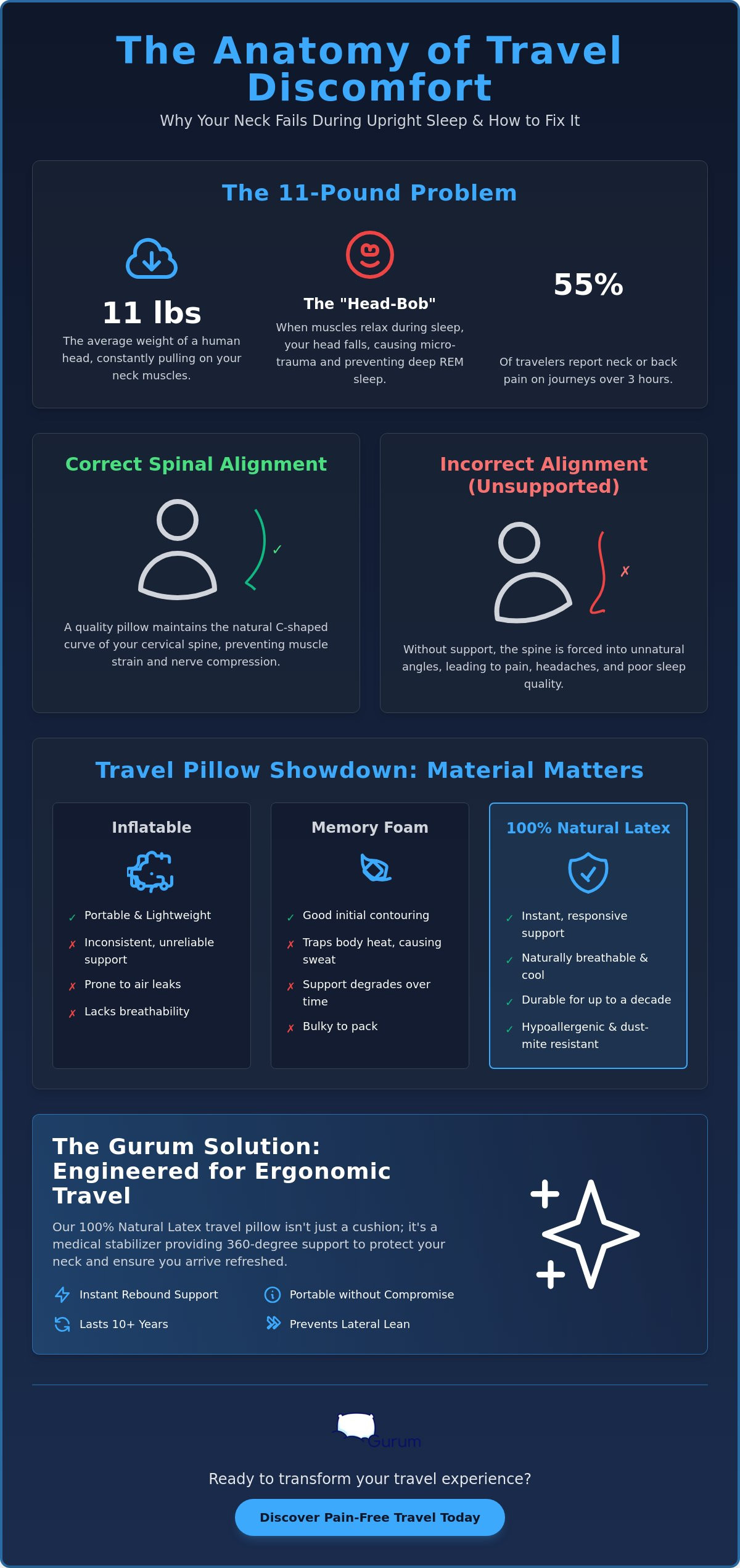
Your head weighs roughly 11 pounds. Yet, you likely expect a thin, upright airline seat to support it while you're hurtling through the sky. A travel pillow isn't just a luxury; it's a medical stabilizer for your cervical spine in an environment never designed for human sleep. Many travelers wonder, is a travel pillow necessary, or is it just another piece of bulky luggage taking up space? With over 55% of travelers reporting neck or back discomfort on journeys longer than three hours, the real question is why the support you've tried before probably failed you.
We've all been there. You wake up from a fitful nap with sharp, radiating neck pain and the lingering embarrassment of the "head-nod" that prevented deep sleep. It's frustrating to carry a bulky cushion that offers little more than a sweaty, foam-filled distraction. You deserve a solution that prioritizes your anatomical health without crowding your carry-on. This guide reveals why most travel pillows fail and how to choose the right support to prevent pain during your 2026 travels. We'll explore the science of spinal alignment and the specific materials that ensure you wake up feeling truly refreshed.
Key Takeaways
- Learn why your 11-pound head requires a medical stabilizer, not just a soft cushion, to maintain proper spinal alignment while seated.
- Discover the definitive answer to is a travel pillow necessary by understanding how gravity impacts your neck muscles during deep sleep.
- Compare why natural latex outperforms memory foam and inflatables by providing consistent support without trapping heat in cramped cabins.
- Master the simple two-step ergonomic technique to position your pillow and headrest for maximum comfort and side-lean support.
- Find out how the unique properties of 100% natural latex create a portable, durable solution that protects your neck for up to a decade.
Is a Travel Pillow Necessary or Just a Marketing Gimmick?
Many travelers dismiss the neck pillow as a "frumpy" accessory. They see it as a marketing gimmick designed to fill airport gift shops. But if you have ever spent a red-eye flight leaning against a cold window, you know the truth. The real question isn't just is a travel pillow necessary; it's whether your neck can survive the journey without one. Its true purpose isn't just to provide a soft surface. It's to stabilize your cervical spine. Without support, your 11-pound head puts immense strain on your neck muscles the moment you drift off. You might feel silly wearing a bulky cushion, but the physical relief of arriving pain-free far outweighs the temporary "silly" factor.
Don't fall for the "Airline Pillow" trap. Those tiny, paper-thin squares provided on long-haul flights offer zero anatomical support. They are often too soft to hold any weight and slide away the moment you shift position. If your journey lasts longer than three hours, your body requires more than a square of polyester. Most U-shaped travel pillows are designed specifically to cradle the neck while you sit upright. They fill the structural gap that standard airline seating leaves behind. For anyone on a flight or ride exceeding that three-hour mark, proper support is a health requirement, not a luxury.
The Cost of the 'Head-Bob'
When you fall asleep, your muscles lose their natural tone. Your head eventually snaps forward or to the side. This is the "head-bob." It causes repeated micro-trauma to the ligaments and tendons in your neck. This constant jolting prevents you from entering deep REM sleep, which is why you feel exhausted even after "napping" for hours. Sleep inertia is the state of impaired cognitive performance and grogginess that follows awakening from poor sleep; it's significantly worse when your rest is fragmented by bad posture.
Travel Pillows vs. Traditional Bed Pillows
Your favorite home pillow is designed for horizontal rest. It uses gravity to settle your head into a mattress. In an airplane seat, the physics change completely. You're dealing with vertical pressure and a constant "lateral lean." A bed pillow simply cannot solve the problem of your head tipping sideways or forward. You need 360-degree stabilization. This concept ensures that no matter which way your head tilts, there is a responsive surface waiting to catch it. This keeps your spine aligned and your airway open, allowing for the restorative rest you actually need.
The Anatomy of Upright Sleep: Why Your Neck Fails
Your head is essentially an 11-pound bowling ball. It sits balanced on seven small, delicate vertebrae. While you're awake, your muscles provide a constant, active support system. But the moment you drift off in a plane seat, that system shuts down. You lose muscle tone. Gravity becomes your primary architect. Without support, your head slumps. It pulls at the ligaments and tendons of your cervical spine. Many travelers ask, is a travel pillow necessary for short trips, but the anatomical strain begins within minutes of losing muscle tone. Your neck simply wasn't built to hold the weight of your head at these extreme, unsupported angles.
Maintaining spinal alignment is the key to waking up without a "traveler’s crick." The cervical spine has a natural C-shaped curve that must be preserved. When your head drops forward or tilts sharply to the side, you overstretch the Trapezius and Sternocleidomastoid muscles. These muscles quickly become fatigued and inflamed. To effectively support the neck, you must fill the structural void between your head and the seat. If you've ever felt a sharp, radiating pain in your shoulder after a nap, you've already experienced why your anatomy needs a stabilizer.
Protecting the Cervical Spine
Improper head positioning leads to more than just a stiff neck. It can cause nerve compression. This pressure often manifests as morning headaches or tingling in your arms. A quality support system bridges the gap between your neck and the headrest, keeping your spine neutral. For a deeper look at how this works, check out our cervical pillow guide. It explains how ergonomic support heals neck pain by preventing these structural misalignments during rest.
Breathing and Snoring in Flight
The "chin-on-chest" posture is a major travel pitfall. When your head slumps forward, it constricts your airway. This leads to snoring and, in some cases, mild apnea. You'll wake up feeling breathless or groggy because your blood oxygenation levels dropped during your nap. Chin support is the missing link in most designs. It keeps the jaw elevated and the airway open. This ensures you're actually getting oxygen while you sleep, making your rest far more restorative.
Side-sleepers face a unique struggle in narrow middle or aisle seats. Without a window to lean against, your head has nowhere to go but down. This creates an intense lateral lean that crushes the muscles on one side of your neck while overextending the other. Finding an ergonomic travel solution that offers 360-degree stabilization is the only way to protect yourself from this uneven strain. It's about more than comfort; it's about arriving at your destination ready to move without pain.
Latex vs. Memory Foam: Which Material Wins in 2026?
Choosing the right material is where most travelers get stuck. While memory foam holds roughly 48% of the market share, its popularity doesn't always equal performance. Memory foam is a "slow-response" material. It relies on your body heat to soften and contour. In a cramped, climate-controlled cabin, this creates a major flaw. The foam eventually "bottoms out," losing its ability to support your head. It also traps heat against your skin, leading to a restless, overheated nap. When deciding is a travel pillow necessary for your journey, the material choice determines whether you actually sleep or just carry extra weight.
Inflatable pillows are the other common alternative, making up about 29% of sales. They are portable, but they offer zero pressure relief. An inflatable cushion is essentially a balloon wrapped in thin fabric. It creates a "bouncy" instability that forces your neck muscles to work harder to stay balanced. This defeats the purpose of stabilization. Natural latex provides a superior middle ground. It offers an instant rebound that memory foam lacks. It pushes back against the weight of your head, maintaining that critical spinal alignment we discussed earlier.
Durability is another factor that sets materials apart. A memory foam pillow typically loses its structural integrity within two to four years. In contrast, a natural latex travel pillow can last between five and ten years. It won't flatten out after a few long-haul flights. The debate of Latex vs. Memory Foam often comes down to responsiveness. Latex is resilient and buoyant. It adapts to your movement instantly, ensuring your neck remains cradled even if you shift in your seat.
Temperature Regulation at 30,000 Feet
Natural latex features a unique open-cell structure. This allows air to circulate freely through the core of the pillow. Staying cool is essential for reaching deep REM sleep; a spike in skin temperature can trigger your body to wake up. Natural latex prevents the "sweaty neck" syndrome common with synthetic foams. It remains breathable and temperature-neutral, regardless of the cabin's humidity levels.
Hygiene and Travel Allergens
Airplane seats are often hotspots for germs and dust mites. Frequent flyers need materials that don't absorb environmental toxins. Natural latex is inherently antimicrobial and resistant to dust mites. This makes it a much safer choice for those with environmental sensitivities. Pairing your pillow with an anti-allergy cover ensures that you aren't bringing the plane's bacteria home with you. It's a professional-grade tool for maintaining your health while you travel.
How to Use a Travel Pillow for Maximum Ergonomic Benefit
Owning a high-quality support tool is only half the battle. To truly answer why is a travel pillow necessary, you must understand the mechanics of how to wear it. Even the best material fails if it's positioned incorrectly against your unique anatomy. Proper setup transforms a simple cushion into a medical-grade stabilizer. Follow these steps to ensure your next trip is actually restful.
- Step 1: Adjust the seat headrest. Most modern airline seats have adjustable "wings." Flatten these out or raise the headrest height first. This provides a stable, flat base for your pillow to rest against rather than pushing your head forward.
- Step 2: Position for your lean. Identify your natural sleeping posture. If you tend to tilt sideways, rotate the bulk of the pillow toward that shoulder. If you are a front-leaner, the support needs to sit directly under your jawline.
- Step 3: Secure the fastening. A loose pillow provides no stability. Use the built-in toggles or snaps to keep the support snug against your neck. This prevents the "gap" that leads to sudden, painful head drops.
- Step 4: Align the lower spine. Use a footrest or your personal bag to slightly elevate your knees. This simple shift flattens your lower back against the seat, which helps maintain the natural curve of your entire spine.
The 'Backwards' Technique
For many travelers, the standard U-shape orientation is the reason they can't sleep. If your head constantly falls forward, try flipping the pillow around. Positioning the opening at the back of your neck creates a firm "shelf" for your chin. This technique is a lifesaver for those with "military neck," a condition where the cervical spine has lost its natural curve. It keeps the airway open and prevents the chin-on-chest posture that causes snoring. Pair this with noise-canceling headphones to create a quiet, sensory-deprived cocoon for deeper rest.
Packing Your Support
Many travelers worry about luggage space, but natural latex is incredibly resilient. You can compress your support into a carry-on without fear of damaging the internal cell structure. It will rebound to its original shape the moment you unpack it. Avoid the common habit of clipping your pillow to the outside of your bag. Airport surfaces and overhead bins are often unsanitary; keeping your support inside your bag protects you from environmental allergens. Maintaining proper spinal alignment is just as important in a hotel as it is on a plane. Use your travel support to supplement soft hotel pillows that often lack the density required for neck health.
Ready to experience the difference that 100% natural latex makes for your neck? Discover our Travel Latex Pillow and arrive at your next destination feeling refreshed and pain-free.
The Gurum Solution: Why Our Travel Latex Pillow is Different
We've established that the answer to is a travel pillow necessary is a definitive yes. But the caveat is that the pillow must actually hold the weight of your head. Most travel accessories are built for the gift shop shelf, not for the human spine. Our Travel Latex Pillow is different. It's engineered to provide the structural integrity of a professional-grade tool in a portable format. It bridges the gap between the need for comfort and the necessity of anatomical health.
Unlike memory foam, which sinks and stays down under pressure, our 100% natural latex provides an immediate, buoyant "push-back." It cradles your neck while actively resisting the downward pull of gravity. This responsiveness is critical for maintaining spinal alignment during vertical sleep. You get the sensory satisfaction of a soft, breathable Tencel Modal cover paired with professional-grade anatomical support. It's the physical and emotional relief you've been searching for during those long, upright hours.
Designed by Experts, Proven by Sleepers
Our founder, Ji H. Won, started with a mission to solve chronic physical discomfort through better material science. He understood that a travel pillow shouldn't be a secondary thought. It should mirror the high-performance support of our best latex pillow used at home. Because natural latex is exceptionally durable, we offer a "no-flat" guarantee. While synthetic foams lose their shape and support after a few flights, our shredded latex remains resilient for five to ten years. It's a perfected solution that won't let you down mid-flight.
A Wellness Partner for Every Journey
Your travel gear is more than just luggage. It's a wellness partner. When you choose the right support, you aren't just buying a cushion; you're ensuring that you arrive at your destination ready to explore. If you have ever wondered is a travel pillow necessary for your wellness routine, the answer lies in how you feel when the cabin lights come up. You deserve to wake up refreshed rather than spending your first day in a new city recovering from a "traveler's crick."
We want to make transformative rest accessible for your next trip. This is why we provide free shipping within the USA on our premium pillows. Stop settling for subpar support and start prioritizing your spinal health. Experience the relief of the Gurum Travel Latex Pillow today.
Arrive Refreshed and Ready to Explore
Restorative sleep while traveling isn't a luxury; it's a physiological necessity. We've explored how your 11-pound head requires active stabilization to protect your cervical spine from the micro-trauma of the "head-bob." By choosing 100% natural latex over heat-trapping memory foam, you ensure a breathable, resilient support system that won't bottom out mid-flight. If you're still asking is a travel pillow necessary, consider the physical cost of arriving at your destination in pain. You shouldn't have to spend your first day of vacation recovering from your journey.
Our Travel Latex Pillow was designed by Ji H. Won to solve the specific frustrations of chronic pain sufferers. It is inherently breathable, hypoallergenic, and engineered to maintain its shape for years of adventure. You deserve a wellness partner that works as hard as you do to find comfort in the skies. Don't leave your spinal health to chance on your next long-haul flight.
Upgrade your next trip with the Gurum Travel Latex Pillow and experience the relief of truly restorative rest on the go. Your neck will thank you the moment you land.
Frequently Asked Questions
Is a travel pillow worth the luggage space for a 4-hour flight?
Yes, because anatomical strain begins long before you reach your destination. Even on a four-hour flight, your neck muscles can become fatigued from the constant micro-adjustments required to stay upright. When you consider whether is a travel pillow necessary for shorter trips, think about the physical cost of arriving with a stiff neck. A compressible latex pillow provides essential stabilization without crowding your carry-on bag.
Can a travel pillow actually prevent neck pain or just make it more comfortable?
A properly designed travel pillow is necessary to prevent physical trauma rather than just providing a soft surface. It functions as a medical stabilizer for your cervical spine during upright rest. By filling the structural gap between your neck and the seat, it prevents the overextension of the trapezius muscles. This support stops the sharp, radiating pain and morning headaches caused by poor travel posture.
Why do most people find U-shaped travel pillows uncomfortable?
Most traditional U-shaped pillows fail because they are made of cheap, low-density memory foam. This material often "bottoms out" under the weight of your head or traps uncomfortable heat against your skin. Many designs also lack the necessary height to support the jawline. Without this chin support, your head still drops forward, which creates the same strain you were trying to avoid in the first place.
What is the best material for a travel pillow if I have a sensitive neck?
For those with a sensitive neck, 100% natural latex is the superior choice. Unlike memory foam, latex is a high-response material that provides immediate buoyancy. It pushes back against the head's weight rather than sinking. It's also inherently antimicrobial and resistant to dust mites. This makes it ideal for frequent flyers who struggle with environmental sensitivities or skin irritation from synthetic foams.
How do I stop my head from falling forward when sleeping on a plane?
The most effective way to stop your head from falling forward is to use the "backwards" technique. Rotate your U-shaped pillow so the bulk of the support sits directly under your chin. This creates a firm shelf that keeps your jaw elevated and your airway open. You can also use adjustable toggles to secure the pillow tightly around your neck, ensuring it doesn't slide away while you sleep.
Are inflatable travel pillows as good as foam or latex ones?
Inflatable pillows are rarely as effective because they lack pressure relief. They are essentially balloons that create a "bouncy" instability, forcing your neck muscles to stay active to maintain balance. This prevents you from reaching the deep, restorative sleep cycles your body needs. Natural latex offers a much better balance of portability and professional-grade support. It provides the consistent density required to truly offload the weight of your head.
How do you wash a travel pillow to keep it hygienic?
Maintaining hygiene is easy if your pillow has a removable, washable cover. You should launder the cover after every trip to remove airplane germs and skin oils. While natural latex is antimicrobial and doesn't need deep cleaning, you can spot-clean the core with a damp cloth if needed. Always use an anti-allergy pillow cover to create an extra barrier against the dust mites found in airplane upholstery.
Can children use adult-sized travel pillows safely?
Children generally shouldn't use adult-sized pillows because the dimensions are too large for their shorter neck length. An oversized pillow can actually push a child's head into an unnatural, forward-leaning position. This increases the risk of airway constriction rather than providing support. It's best to look for smaller, child-specific ergonomic supports that align with their smaller frame. This ensures they stay safe and comfortable during long family journeys.