


Your pillow isn't failing because it's lost its fluff. It's failing because it doesn't fill the anatomical gap between your ear and your mattress. You've likely spent nights flipping or folding your pillow, searching for a support level that never stays put. Waking up with a tension headache or shoulder numbness isn't just a "bad night" of sleep. It's a sign that your cervical spine is struggling to stay aligned. Learning how to choose the right pillow loft is the first step toward reclaiming your rest and finding consistent, non-collapsing support that lasts all night.
We've developed a clear guide to help you calculate the perfect height for your unique body type and sleep position. You'll discover the precise science of spinal alignment and learn why proper cervical support can lead to a 60% reduction in neck discomfort. This article provides a simple formula to help you find the loft that supports your anatomy and your health. Whether you are resting at home or need to maintain that alignment while traveling, this approach ensures you wake up refreshed and pain-free every morning in 2026.
Key Takeaways
- Learn how to choose the right pillow loft by measuring the precise gap between your ear and the mattress to maintain neutral spinal alignment.
- Discover why your primary sleeping position and shoulder width are the most critical factors in determining your ideal pillow height.
- Master the "Mirror Test" to visually confirm your alignment and identify the physical red flags of a pillow that is too high or too low.
- Understand why natural latex provides a consistent, non-collapsing loft that prevents the middle-of-the-night sagging common in memory foam.
- Find out how the ergonomic "Golden Loft" of the Premium Latex Pillow cradles your head while providing fixed support for your cervical spine.
Understanding Pillow Loft and Why It Matters for Your Neck
Loft is the uncompressed height of your pillow when it's resting on the mattress. While many shoppers focus on "softness," loft is the technical measurement that determines your physical comfort. When you're Understanding Pillow Loft, you'll see it categorized as low, medium, or high. However, these labels are often misleading because they don't account for how the material reacts to the weight of your head. A pillow that looks tall on a store shelf might flatten to nothing the moment you lie down.
The industry often pushes a "one size fits all" approach to bedding. This is a myth. A broad-shouldered side sleeper requires a significantly different height than a petite back sleeper. If you use a pillow that isn't tailored to your specific frame, you're inviting cervical strain. This leads to morning stiffness, tension headaches, and a feeling of exhaustion before your day even begins. Learning how to choose the right pillow loft is about finding the exact measurement that fills the gap between your ear and the bed.
The Anatomy of a Perfect Night: Your Cervical Spine
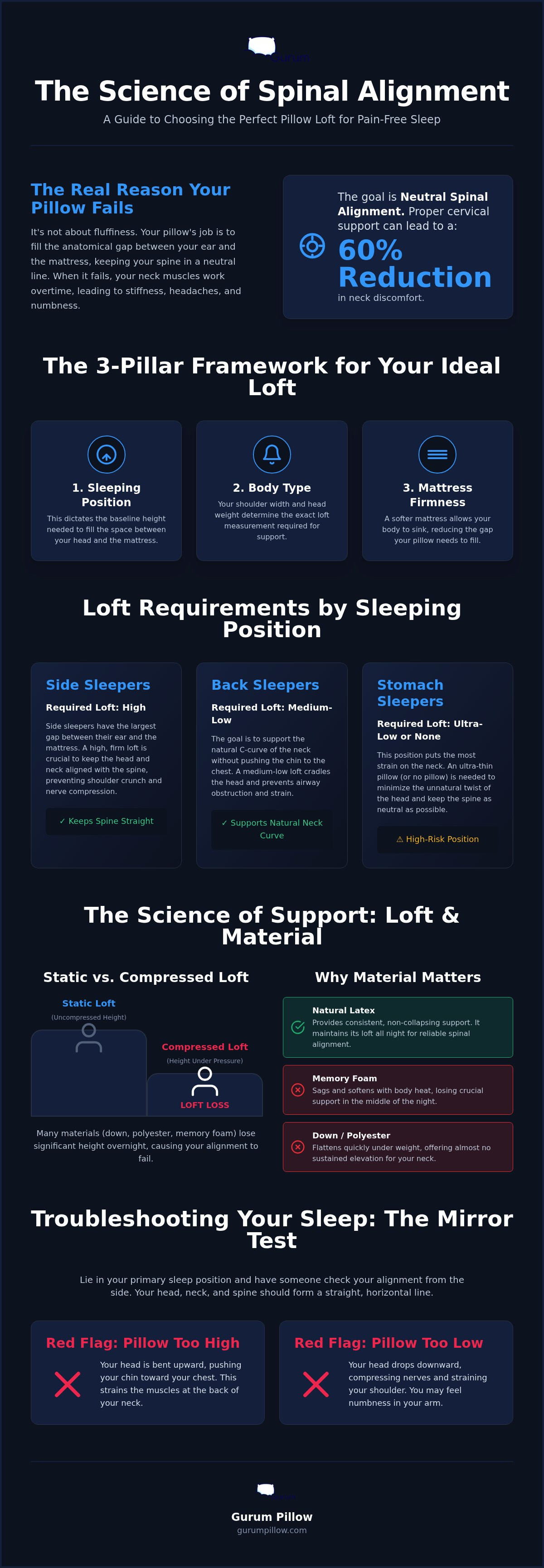
Your neck isn't a straight line. It has a natural C-curve known as lordosis. This curve is vital for distributing the weight of your head, which typically weighs between 10 and 12 pounds. Without proper loft, your neck muscles must work all night to hold that weight in place. According to a 2023 study in the Journal of Physical Therapy Science, appropriate cervical support can lead to a 60% reduction in neck discomfort. Proper cervical alignment ensures your vertebrae stay stacked naturally; this eliminates the uneven nerve pressure that causes radiating pain and numbness.
Static Loft vs. Compressed Loft
There is a massive difference between how a pillow looks and how it performs. Static loft is the height of the pillow at rest. Compressed loft is what remains after you apply weight. A 6-inch down pillow might look impressive, but it often compresses to less than an inch. This "loft loss" is the primary reason people wake up to fold or flip their pillows at 3 AM. Polyester and down alternatives simply cannot provide the sustained elevation your spine requires.
Choosing a material like natural latex provides responsive support. It maintains its height regardless of how many hours you sleep on it. It doesn't sag like memory foam or flatten like feathers. For a deeper look at how material choice influences your spinal health, see our guide on the best latex pillow for neck pain. Understanding how to choose the right pillow loft requires looking past the initial fluff and focusing on sustained, reliable height that protects your neck until morning.
The 3-Pillar Framework for Choosing Your Ideal Pillow Loft
Finding the perfect pillow height isn't a matter of luck. It's a calculation based on your unique anatomy. If you've spent years waking up with shoulder numbness or a stiff neck, your current pillow likely ignores your physical dimensions. We use a three-pillar framework to help you determine how to choose the right pillow loft with mathematical precision. By evaluating your sleep position, your body frame, and your mattress, you can finally end the cycle of restless nights.
Pillar 1: Sleeping Position Requirements
Your sleeping position dictates the baseline height your spine needs. Side sleepers require the highest loft. This is because they have the largest physical gap to fill between the ear and the mattress. Without enough height, the head droops toward the shoulder, causing nerve compression. Back sleepers need a medium-low loft. The goal here is to support the neck's natural curve without tilting the chin toward the chest. Stomach sleepers face the highest risk of neck rotation. They require an ultra-low loft, or even no pillow at all, to keep the spine from twisting at an unnatural angle throughout the night.
Pillar 2: Body Type and Shoulder Measurement
Your shoulder width is the most overlooked factor in sleep health. You can measure this at home by standing against a wall and measuring the distance from your ear to the outer edge of your shoulder. Broad-shouldered individuals often need an additional 1 to 2 inches of loft to compensate for this wider gap. Conversely, those with a more petite frame will find standard "high loft" pillows far too aggressive. Your head weight also matters. A heavier head will compress soft materials more quickly, which is why choosing a Premium Latex Pillow is vital for maintaining a consistent height that doesn't bottom out by morning.
Pillar 3: The Mattress Firmness Variable
Your mattress acts as the foundation for your pillow. If you sleep on a soft mattress, your torso and shoulders sink deeper into the bed. This reduces the distance between your head and the mattress surface, meaning you need a lower loft. On a firm mattress, your body stays on top of the surface. This creates a larger gap that requires a higher loft to maintain alignment. Specifically for memory foam mattresses, the sinkage factor is much higher due to heat-responsiveness, which often necessitates a thinner pillow than you would use on a traditional innerspring bed.
To find your target loft range, combine these pillars. A side sleeper with broad shoulders on a firm mattress will always sit at the highest end of the loft spectrum. A back sleeper with a petite frame on a soft mattress will need the lowest. Once you understand these variables, you can stop guessing and start sleeping with the support your body deserves.
Troubleshooting Your Sleep: Is Your Loft Too High or Too Low?
Most people only realize their pillow is failing them after the damage is done. Your body is a precise instrument. It sends clear signals when your spinal alignment is compromised. If you find yourself constantly punching your pillow into a different shape or waking up to reposition your head, you're fighting a loft issue. Understanding how to choose the right pillow loft involves listening to these physical red flags before they turn into chronic injuries.
The "Mirror Test" is the most effective way to visually confirm your alignment. Lie down in your primary sleeping position and have a partner look at your profile. Your nose should be in a straight line with the center of your sternum. If your head tilts toward the ceiling or sinks toward the mattress, your loft is incorrect. You can also do this alone by setting a phone timer and taking a side-profile photo. If you're still unsure, use folded towels to experiment. Stack them in half-inch increments to find the exact height that eliminates neck tension. This simple home test provides a blueprint for your next purchase.
Symptoms of a Pillow That Is Too High
When your pillow is too tall, it forces your chin toward your chest. This is an aggressive, unnatural posture that strains the suboccipital muscles at the base of your skull. You'll likely wake up with tension headaches that radiate from the back of your head toward your temples. This "chin-to-chest" position also narrows your airway, which can lead to restricted breathing or increased snoring. Many sleepers also report discomfort in the "buffalo hump" area, where the neck meets the upper back. This is a sign that your pillow is pushing your cervical vertebrae into a forward-flexed position all night.
Symptoms of a Pillow That Is Too Low
A pillow that is too low fails to bridge the gap between your head and the bed. This often results in a sharp neck "crick" or a burning sensation in the side of the neck. For side sleepers, a low loft is particularly damaging. Without enough height, your shoulder bears the full weight of your torso. This leads to "shoulder crushing" and the familiar pins-and-needles sensation of arm numbness. If you are experiencing these symptoms, our cervical pillow guide explains how targeted ergonomic support can heal this specific type of nighttime pain. How to choose the right pillow loft is ultimately a diagnostic process; once you identify the symptoms of misalignment, the solution becomes clear.
Why Material Matters: How Natural Latex Maintains Consistent Loft
A static height measurement means nothing if the material fails at 2 AM. When you're learning how to choose the right pillow loft, you must account for dynamic compression. Down and polyester pillows are notorious for "loft loss." They feel plush for the first ten minutes, but the fibers quickly clump and shift. This leaves your neck unsupported in a hollow valley, forcing you to wake up and shake the pillow back into shape. It's an exhausting cycle that prevents deep, restorative sleep.
Memory foam offers a different set of challenges. While it's marketed as high-support, memory foam is inherently heat-sensitive. As your body heat transfers to the material, the foam softens and sags. This leads to middle-of-the-night sagging where your head sinks lower than intended. This shift in height mid-sleep is a major cause of morning neck stiffness. Natural latex acts as the "Goldilocks" of loft retention because it remains temperature-neutral and maintains its structural integrity regardless of your body heat.
Latex vs. Memory Foam: The Support Battle
The core difference lies in the type of support provided. Memory foam offers sink-in support, which can feel restrictive and hot. Natural latex provides push-back support. It's a resilient material that immediately responds to your movements without losing its shape. Side sleepers benefit most from this resilience. It ensures the shoulder gap remains filled all night long. For a deeper look at the material science behind these differences, explore our latex vs memory foam comparison. Understanding these mechanics is a crucial part of how to choose the right pillow loft that actually works for your anatomy.
Durability: Why Latex Stays at the Right Height for Years
The molecular structure of 100% natural latex is designed for longevity. Unlike synthetic foams that break down and off-gas over time, natural latex is harvested from rubber trees and retains its elasticity for years. It's naturally resistant to flattening or clumping. While a standard polyester pillow often needs replacement after just 1 year, a high-quality latex pillow can maintain its original loft for 5 years or more. This makes it a professional-grade tool for your home wellness routine.
Breathability also plays a secondary role in sleep posture. When a pillow traps heat, you tend to toss and turn to find a cool spot. This movement often leads to awkward, unaligned positions. Latex is naturally porous, allowing constant airflow that keeps you still and aligned. If you're ready to end the frustration of collapsing pillows, you can shop the Premium Latex Pillow to secure a consistent loft that lasts.
Finding Your Perfect Match with Gurum Premium Latex Pillows
You now understand the mechanics of spinal health and the variables of shoulder width. The final step in how to choose the right pillow loft is selecting a tool that respects those measurements. We designed the Premium Latex Pillow to provide what we call the "Golden Loft." It's a height engineered to bridge the anatomical gap for side and back sleepers without the risk of mid-night collapse. By combining 100% natural latex with a precision-molded shape, we've created a sleep surface that cradles your head while providing firm, fixed support for your cervical spine.
Restorative rest shouldn't be limited to your bedroom. Our Travel Latex Pillow allows you to maintain your alignment while away from home. Hotel pillows are notoriously unpredictable, often featuring the very "loft loss" we've discussed in previous sections. Bringing your own ergonomic support ensures you don't return from a trip with a stiff neck or a tension headache. Every pillow we produce is hypoallergenic and breathable. It's the ideal choice for those with environmental sensitivities or those who simply sleep hot.
Engineered for Alignment: The Gurum Difference
Ji H. Won developed the Gurum range after struggling with chronic neck pain that traditional market solutions couldn't fix. We don't use generic foam. We use a specific density of natural latex to ensure the loft remains constant for the entire night. This density is the key to preventing the "sink-in" feeling that ruins spinal posture. To protect your investment, our Anti-Allergy Pillow Cover provides a breathable barrier against dust mites and allergens. It's a professional-grade addition that keeps your sleep environment as clean as it is supportive.
Your Journey to Pain-Free Sleep Starts Here
Choosing between our Premium and Travel sizes depends on your lifestyle, but both prioritize the same ergonomic principles. We believe that pain-free sleep is a necessity, not a luxury. That's why we offer free shipping and a commitment to helping you find the restorative rest you've been missing. Understanding how to choose the right pillow loft is the first step; the second is trusting a material that won't fail you at 3 AM. You don't have to settle for another morning of stiffness. Experience the perfect loft with the Gurum Premium Latex Pillow and discover how the right height transforms your health.
Reclaim Your Rest and Wake Up Pain-Free
You now have the technical blueprint for a better night of sleep. Understanding how to choose the right pillow loft is about more than just comfort; it's about protecting your cervical spine from chronic strain. By measuring your shoulder gap and testing your alignment with the Mirror Test, you can finally move past the frustration of morning stiffness and tension headaches. Your anatomy deserves a solution that doesn't collapse at midnight.
Our pillows are designed by ergonomic experts to solve the specific problems of loft loss and misalignment. We use 100% natural, hypoallergenic latex because it provides the consistent, resilient support your body requires. Every night should be a transformative experience that leaves you refreshed and ready for the day. With free shipping on all US orders, your path to restorative sleep is clearer than ever.
Find your perfect alignment with Gurum Premium Latex Pillows and start your journey toward a life without neck pain today. You deserve to wake up feeling your best every single morning.
Frequently Asked Questions
What is the standard height for a medium loft pillow?
A medium loft pillow typically measures between 3 and 5 inches in height. This range serves as a versatile middle ground for sleepers with average body frames. It's a common starting point when you're learning how to choose the right pillow loft for your specific needs. This height provides enough elevation to support the neck's natural curve without overextending the cervical spine during the night.
How do I know if my pillow loft is too high?
You'll know your pillow is too high if your chin is pushed toward your chest while you're lying on your back. This aggressive posture strains the suboccipital muscles and can restrict your breathing. Visually, your head will appear tilted upward rather than resting in a neutral line with your sternum. Waking up with tension headaches at the base of your skull is a definitive red flag.
Does mattress firmness affect what pillow loft I should choose?
Yes, mattress firmness is a critical variable in your alignment calculation. A soft mattress allows your body to sink deeper, which effectively reduces the gap between your ear and the bed. In this case, you need a lower loft to avoid pushing your head too high. Conversely, a firm mattress keeps you on the surface and requires a taller pillow to fill the wider space.
What is the best pillow loft for side sleepers with neck pain?
Side sleepers typically require a high loft of 5 inches or more to fill the broad gap created by their shoulders. When you're managing neck pain, this height must be consistent and non-collapsing. A 2023 study in the Journal of Physical Therapy Science suggests that proper cervical support can reduce discomfort by 60%. Choosing a resilient material like natural latex is vital for maintaining this height.
Can a pillow that is too low cause shoulder pain?
A pillow that is too low is a leading cause of shoulder pain and arm numbness for side sleepers. Without enough loft, your shoulder must bear the full weight of your torso, leading to painful shoulder crushing. This compresses nerves and restricts blood flow, causing that familiar pins and needles sensation. Finding a pillow that bridges the shoulder to ear gap is essential to offload this pressure.
How often should I replace my pillow to maintain the correct loft?
Replacement frequency depends entirely on the material's structural integrity. Polyester and down pillows often lose their loft within 6 to 12 months as fibers clump and flatten. High quality natural latex pillows are designed to maintain their original height and support for 5 years or more. If you notice yourself folding or punching your pillow to get comfortable, the material has likely failed and needs replacement.
Is natural latex better than memory foam for maintaining loft?
Natural latex is superior for maintaining a consistent loft because it doesn't react to body heat. Memory foam is designed to soften and sink in as it warms up, which often leads to middle of the night sagging. Latex provides a push back support that stays at the same height from the moment you lie down until you wake up. It's the most reliable choice for long term spinal health.
What loft should back sleepers look for?
Back sleepers generally thrive with a medium low loft of 3 to 4 inches. This height supports the natural C curve of the cervical spine without forcing the head into an unnatural forward tilt. It's vital to ensure the pillow has a responsive center that allows the head to rest slightly lower than the neck. This maintains a neutral posture and prevents the chin from dropping toward the chest.