
Why are you still waking up at 3 AM just to flip your pillow to the "cool side"? It's a frustrating ritual that disrupts your deepest sleep cycles and leaves you feeling drained by morning. If you've struggled with night sweats or the lingering chemical odors of synthetic foams, you know that finding a pillow that doesn't trap heat is about more than just comfort. It's about reclaiming your physical and emotional well-being through better rest.
We understand how exhausting it is to search for relief only to be met with "cooling" gels that lose their chill within minutes. True restoration requires a pillow that works with your body's natural temperature. This 2026 guide breaks down the science of breathability and reveals how to identify materials that offer genuine, all-night airflow. You'll discover the difference between temporary surface cooling and true material breathability. By the end, you'll know exactly how to choose a solution that offers both anatomical neck support and a refreshingly cool surface, so you can finally wake up feeling truly restored.
Key Takeaways
- Understand why your head acts as a natural radiator and how specific materials fail to dissipate that thermal energy throughout the night.
- Simplify the process of finding a pillow that doesn't trap heat by distinguishing between temporary cooling sensations and true, all-night breathability.
- Learn why the thousands-of-tiny-holes structure in natural latex offers a permanent airflow solution that heat-absorbing memory foam cannot match.
- Gain a practical buyer’s checklist to evaluate open-cell cores and identify cover fabrics that prioritize moisture-wicking and comfort.
- Discover how to achieve restorative, pain-free rest by pairing anatomical neck support with a core designed for constant temperature regulation.
The Science of Sleep Heat: Why Your Current Pillow Traps Warmth
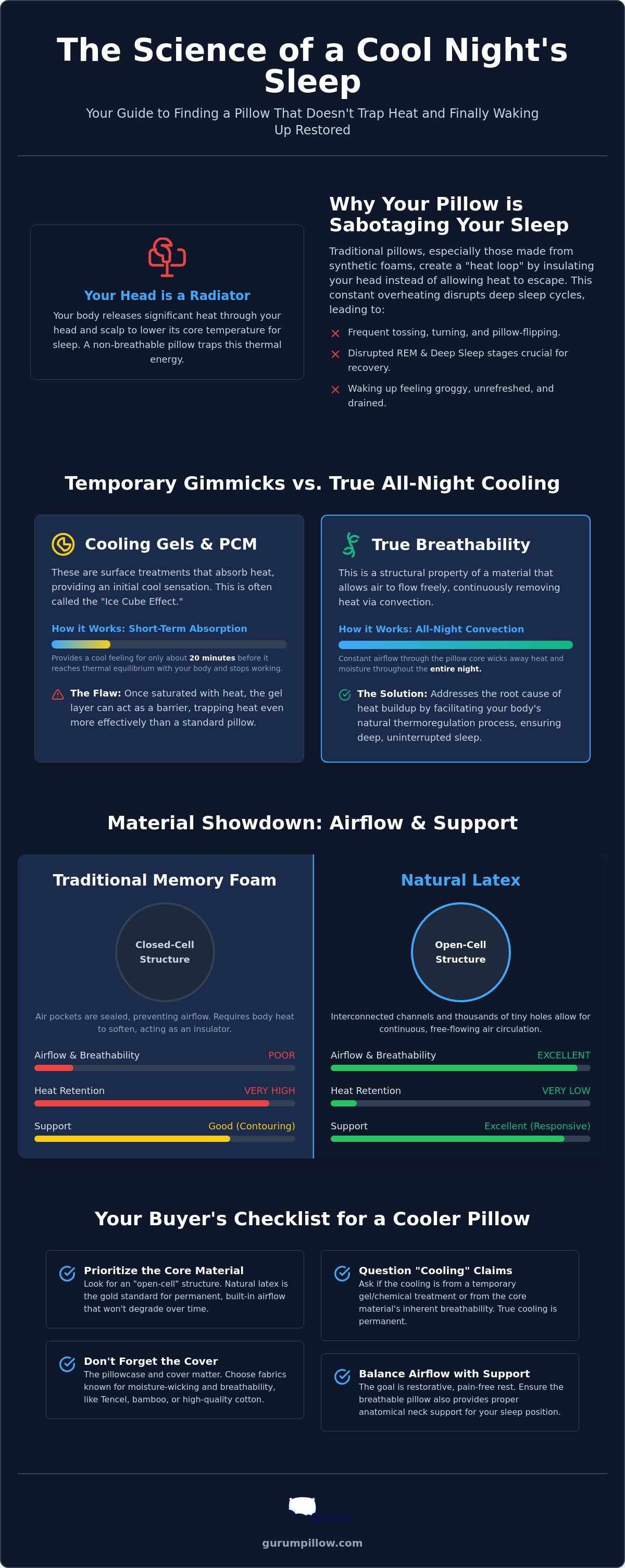
Your head is essentially your body's primary radiator. During the night, your system works hard to shed excess warmth through your scalp and face to lower your core temperature. If your pillow isn't designed to handle this thermal load, you'll find yourself in a cycle of constant overheating. Heat trapping is the technical inability of a material to dissipate this thermal energy. Instead of letting the warmth escape into the surrounding air, the material holds onto it. This creates a concentrated hot spot directly under your neck and head. For anyone committed to finding a pillow that doesn't trap heat, understanding this physiological process is the first step toward better rest.
When your pillow fails to breathe, it doesn't just feel uncomfortable. It creates a physical barrier to your body's natural cooling process. This thermal buildup forces your heart rate to stay slightly elevated as your body struggles to shed heat. You might find yourself waking up to flip the pillow or kicking off the covers in a desperate attempt to regulate. This isn't just a minor annoyance. It is a direct conflict between your bedding and your biology.
The Insulation Problem of Synthetic Foams
Traditional memory foam is often the biggest culprit in the search for a cool night. Most synthetic foams feature a closed-cell structure. This means the tiny air pockets within the foam are sealed off, which prevents air from moving through the pillow core. Memory foam actually requires your body heat to soften and contour to your shape. It acts as an insulator rather than a conductor. Your body heat gets stored in the material and then radiates back to your skin. This creates a "heat loop" that makes it nearly impossible for your body to cool down. You end up fighting against your own bedding all night long. Because the foam is dense and unyielding to airflow, the heat has nowhere to go but back toward you.
How Temperature Affects Your Sleep Quality
Your brain needs a specific environment to reach the deepest, most restorative stages of rest. Research shows that your body needs a 1-2 degree drop in core temperature to successfully transition into sleep. When your pillow stays hot, it triggers frequent micro-awakenings. You might not fully wake up, but you'll toss and turn as your body tries to find a cooler surface. Human thermoregulation is the body’s internal thermostat during rest, and a non-breathable pillow acts like a broken sensor in that system. This struggle disrupts your REM sleep and prevents you from reaching the deep sleep stages required for cognitive recovery and physical healing. Without that critical temperature drop, you'll likely wake up feeling groggy and unrefreshed, regardless of how many hours you spent in bed.
Cooling Gels vs. True Breathability: Which Actually Lasts?
Many people assume a cool-to-the-touch surface is the ultimate solution for a hot night. It's an easy mistake to make. When you're finding a pillow that doesn't trap heat, you're often drawn to that initial "chill" felt in the showroom. But there's a massive difference between a temporary sensation and long-term thermal regulation. One is a marketing feature; the other is a biological necessity for deep sleep.
Think of cooling gels like an ice cube in a glass of water. It feels cold at first because it's actively absorbing heat through conduction. However, once that ice cube melts, the water reaches room temperature. Cooling gels work the same way. They pull heat from your skin until the gel itself reaches thermal equilibrium with your body. Usually, this "Ice Cube Effect" lasts about 20 minutes. After that, the gel layer often becomes a heat-trapping barrier, making your pillow feel even warmer than a traditional one by midnight.
Phase Change Materials (PCM) are another popular choice in 2026. These fabrics absorb heat by changing from a solid to a liquid state at a microscopic level. While the science is fascinating, these materials have a limited "thermal battery." Once the material has fully transitioned, it can't absorb any more energy. It stops cooling. True relief doesn't come from absorbing heat; it comes from removing it through convection.
The Hidden Truth About Cooling Gels
Most cooling features are just thin surface treatments. They don't address the dense, heat-retaining core of the pillow. These chemical additives can also lead to off-gassing, which creates that unpleasant "synthetic" odor that disrupts your relaxation. It’s a chemical solution to what is essentially a mechanical problem. When you rely on gels, you're just delaying the inevitable heat buildup rather than preventing it. These features are often marketing gimmicks that fail to deliver on the promise of a full night of restorative rest.
The Mechanism of Natural Airflow
True breathability depends on open-cell architecture. This structure acts like a built-in ventilation system with thousands of tiny channels. Natural materials like latex provide this by design. They don't need chemical infusions to stay cool because the air simply moves through the core, carrying heat away from your head. This process is continuous. It doesn't "run out" like a gel or a PCM fabric. When paired with a moisture-wicking cover, you create a system that manages both temperature and humidity. If you're ready to move past temporary fixes, choosing a breathable natural latex pillow is a more reliable way to ensure your sleep remains uninterrupted and cool until morning.
Latex vs. Memory Foam: Comparing Airflow and Support
Choosing the right core material is the most critical step in finding a pillow that doesn't trap heat. While surface treatments might offer a few minutes of relief, the internal structure of your pillow dictates your comfort for the next eight hours. Most sleepers find themselves choosing between two dominant materials: synthetic memory foam and natural latex. One is designed to hold onto energy, while the other is engineered to release it.
The struggle with traditional pillows often comes down to a lack of structural ventilation. If the air can't move, the heat can't escape. This is why understanding the mechanical differences between these two materials is essential for anyone tired of waking up to a damp, hot pillow. It's the difference between sleeping on an insulator and sleeping on a ventilator.
Why Memory Foam Must Trap Heat to Work
Memory foam relies on a chemical process known as visco-elasticity. This material is specifically designed to be temperature-sensitive. It actually requires your body heat to soften and mold to your unique shape. Because it must absorb and retain that thermal energy to provide support, it becomes a literal heat reservoir by design. As the foam warms up and you sink deeper into it, the material creates a "cradle" around your head and neck. This snug fit further restricts airflow around your face and ears. Side sleepers typically suffer the most from this. The very mechanism that provides the famous "sinking" feeling is the same one that causes the material to overheat and disrupt your sleep cycles.
Natural Latex: The Open-Cell Advantage
Natural latex offers a refreshing alternative because it's an open-cell material by nature. Premium latex pillows feature a specific "pin-core" construction. This means the pillow is cast with thousands of tiny ventilation holes that allow air to circulate freely through the entire core. Unlike foam, latex doesn't need to "warm up" to support you. It's instantly responsive and bouncy. It provides excellent anatomical alignment without needing to trap your body heat to do its job. Latex is also naturally hypoallergenic and resistant to dust mites. It's a cleaner, cooler solution that stays fresh night after night.
Longevity is another area where these materials diverge. Synthetic foams tend to break down and lose their loft over time, which often leads to even more heat retention as the material becomes denser. Natural latex is incredibly durable and often maintains its breathable shape for 10 years or more. It’s a long-term investment in restorative rest. For a deeper dive into why this material is a top choice this year, explore our best latex pillow 2026 guide for more material insights.
Buyer’s Checklist for Finding a Non-Heat-Trapping Pillow
Understanding the physics of airflow is one thing; standing in a store or browsing online is another. When you're finding a pillow that doesn't trap heat, you need a strategy to filter through the noise of marketing claims. Most "cooling" labels focus on the first five minutes of sleep. You need a solution that maintains its thermal neutrality until your alarm goes off. Use these practical steps to verify a pillow's performance before you commit to a purchase.
- The Hand Press Test: Place your hand firmly on the pillow for at least 30 seconds. When you lift it, the surface should feel neutral, not warm. If the material retains a "ghost" of your body heat, it will likely cause overheating by midnight.
- Core Architecture: Look for specific mentions of "open-cell" or "ventilated" structures. Avoid solid, heavy foam blocks that lack visible air channels. A "solid" block is a red flag for insulation.
- The Cover Fabric: Prioritize natural fibers. If the cover feels like a thick, synthetic gym bag, it will block the core's ability to breathe.
Essential Material Standards
Your checklist should start with the core material. Always prioritize 100% natural latex over synthetic blends or hybrid foams. Blends often introduce petroleum-based additives that reduce the material's natural porosity. Verify the breathability of the pillow cover by checking for high-performance natural fibers like Tencel or organic cotton. These materials don't just feel soft; they actively move moisture away from your skin through capillary action. Avoid pillows with thick, non-removable polyester shells. These shells act as a thermal barrier, trapping heat against your scalp regardless of the technology inside the pillow core. If you can't remove the cover to see the core, it's likely hiding a closed-cell structure that won't stay cool.
Support Meets Airflow
It's a common mistake to sacrifice spinal alignment just to get a cool surface. A pillow that's too soft or "mushy" might seem breathable, but it can lead to chronic neck strain. You need an ergonomic shape that maintains the natural curve of your neck while allowing air to circulate. This is why many sleepers find relief with a cervical pillow design. These contours create natural gaps between the pillow and your jawline, reducing skin-to-fabric contact and promoting better convection. Finding a pillow that doesn't trap heat is as much about the physical shape as it is about the material.
The right height, or loft, is also a cooling factor. If your pillow is too low, your head sinks in deeply, increasing the surface area that traps heat. If it's too high, it creates tension that can raise your body temperature. A balanced loft keeps your airway open and your skin comfortable. If you're ready to stop the 3 AM pillow flip, you can explore our collection of breathable latex pillows to find a solution that balances anatomical support with a refreshingly cool environment.
Restorative Rest with Gurum: The Breathable Natural Latex Solution
After years of waking up to flip your pillow to the "cool side," you deserve a permanent solution. Restorative rest shouldn't be a struggle against your own bedding. When you're finding a pillow that doesn't trap heat, you're ultimately looking for a way to wake up feeling refreshed rather than sweaty and exhausted. The Gurum Premium Latex Pillow was designed to bridge the gap between clinical orthopedic support and the airy comfort of a high-performance sleep system.
Our 100% natural latex core ensures all-night temperature regulation by working with your body, not against it. It doesn't rely on temporary cooling gels or phase-change chemicals that eventually warm up. Instead, it uses the inherent properties of natural rubber to maintain a consistent, neutral temperature. We understand the frustration of investing in sleep products that promise relief but deliver disappointment. Our focus is on honest materials and proven physiological benefits that last for years.
Engineered for Airflow and Alignment
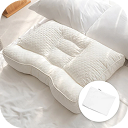
The secret to our design lies in the specific pin-hole ventilation system. These thousands of tiny channels act as a built-in exhaust for body heat. Every time you move, air is pushed through the core, creating a continuous cycle of fresh airflow. This means our latex doesn't require "flipping" to find a cool spot. The entire pillow stays at a comfortable temperature from the moment you lie down until your alarm goes off. To maximize these benefits, we recommend pairing the core with our Anti-Allergy Pillow Cover. This specialized fabric protects against irritants while allowing the natural latex to breathe freely. It ensures maximum hygiene without sacrificing the cooling effect.
A Solution Born from Real Experience
Gurum wasn't founded in a corporate boardroom. It was born from Ji H. Won’s personal mission to solve chronic neck pain and the sleep issues that follow. We know that physical discomfort and overheating often go hand-in-hand. When your body is in pain, your temperature rises; a hot pillow only makes the cycle worse. This is why our products emphasize the best latex pillow for neck pain features, combining ergonomic contours with thermal efficiency.
You don't have to settle for another night of interrupted sleep. By choosing a material that prioritizes natural convection, you're taking a decisive step toward better health. We offer free shipping across the USA to make your sleep upgrade completely risk-free. Experience the cool, supportive difference of a pillow designed for your biology. It's time to stop finding a pillow that doesn't trap heat and start actually sleeping on one. Experience the cool, supportive difference tonight and reclaim your rest.
Reclaim Your Rest with All-Night Airflow
You shouldn't have to choose between a cool surface and proper neck support. As we've explored, your head acts as a natural radiator that needs to shed heat for you to reach deep, restorative REM cycles. Moving away from heat-trapping synthetic foams toward open-cell materials like natural latex is the most effective way to ensure your body’s internal thermostat stays balanced. Finding a pillow that doesn't trap heat is the first step toward ending the cycle of night sweats and frustrating micro-awakenings.
Our mission is to provide a transformative sleep experience that addresses both anatomical health and sensory comfort. With 100% natural latex and a design specifically tailored for chronic neck pain relief, we offer a solution that stays cool without the need for chemical additives or temporary gels. You can Upgrade to the Breathable Premium Latex Pillow Today and enjoy free shipping across the USA. Restorative sleep is finally within your reach; it's time to wake up feeling refreshed, cool, and pain-free every single morning. You deserve the relief that comes with a truly perfected night of rest.
Common Questions About Breathable Sleep
Do cooling pillows actually stay cool all night?
Most pillows marketed as "cooling" only provide a temporary chill for about 20 minutes. If the pillow relies on gel infusions or Phase Change Materials, it eventually reaches your body temperature and stops absorbing heat. For all-night regulation, you need a material with open-cell architecture that allows air to move continuously through convection rather than just absorbing heat through conduction.
Is memory foam or latex better for hot sleepers?
Natural latex is significantly better for hot sleepers because it doesn't require body heat to contour to your shape. Memory foam is a closed-cell insulator that must trap thermal energy to soften and mold. In contrast, latex features a pin-core ventilation system that facilitates constant airflow. This makes it the superior choice when finding a pillow that doesn't trap heat.
What is the best pillow material for preventing night sweats?
100% natural latex is the most effective material for preventing night sweats due to its inherent breathability. It prevents the humidity buildup that often triggers sweating during the night. When you pair a breathable latex core with a Tencel or cotton cover, you create a sleep environment that manages both heat and moisture effectively, keeping your skin dry and comfortable.
How do I know if my pillow is trapping heat?
You can perform a simple hand press test by holding your palm firmly against the surface for 30 seconds. If the material feels warm or holds your body heat immediately after you lift your hand, it is acting as an insulator. Another clear sign is the "flip ritual." If you constantly wake up to find a cooler spot on the other side, your current pillow is failing to dissipate heat.
Can a pillow cover help with heat regulation?
A high-quality cover is essential, but it cannot fix a non-breathable core. Specialized fabrics like our Anti-Allergy Pillow Cover help by wicking away moisture and allowing air to reach the pillow's interior. However, if the core is made of dense, closed-cell foam, even the most advanced cover will eventually succumb to heat buildup. The cover and the core must work together as a system.
Why do I wake up with a hot head even with the AC on?
Ambient room temperature doesn't matter if your head is pressed against a heat-retaining material. Your pillow acts as an insulator, trapping your body heat directly against your skin. Even in a cold room, the lack of airflow under your head prevents your "natural radiator" from shedding heat. This leads to localized overheating that disrupts your sleep cycles regardless of the thermostat setting.
Are natural latex pillows breathable?
Yes, natural latex is one of the most breathable materials available for sleep. Its open-cell structure is naturally porous, allowing air to circulate through the core. Premium designs often include additional pin-core holes to enhance this effect. This ensures that heat is constantly moved away from your body rather than stored in the material, providing a consistently cool surface.
How often should I replace a cooling pillow?
Synthetic cooling pillows often lose their effectiveness and structural integrity within 2 to 3 years as the foam breaks down and becomes denser. Natural latex is much more durable. It can maintain its breathable, supportive shape for 10 years or more. This makes it a better long-term investment for anyone committed to finding a pillow that doesn't trap heat and maintaining a healthy sleep environment.