

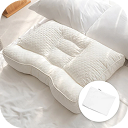
That cloud-like softness you crave in a down pillow might actually be the reason you wake up with a stiff neck every morning. It's a common struggle. You invest in luxury bedding only to find the pillow goes flat by midnight, leaving your spine at an awkward, painful angle. We understand the frustration of waking up with a cricked neck or dealing with allergies triggered by dust mites hidden in traditional feathers.
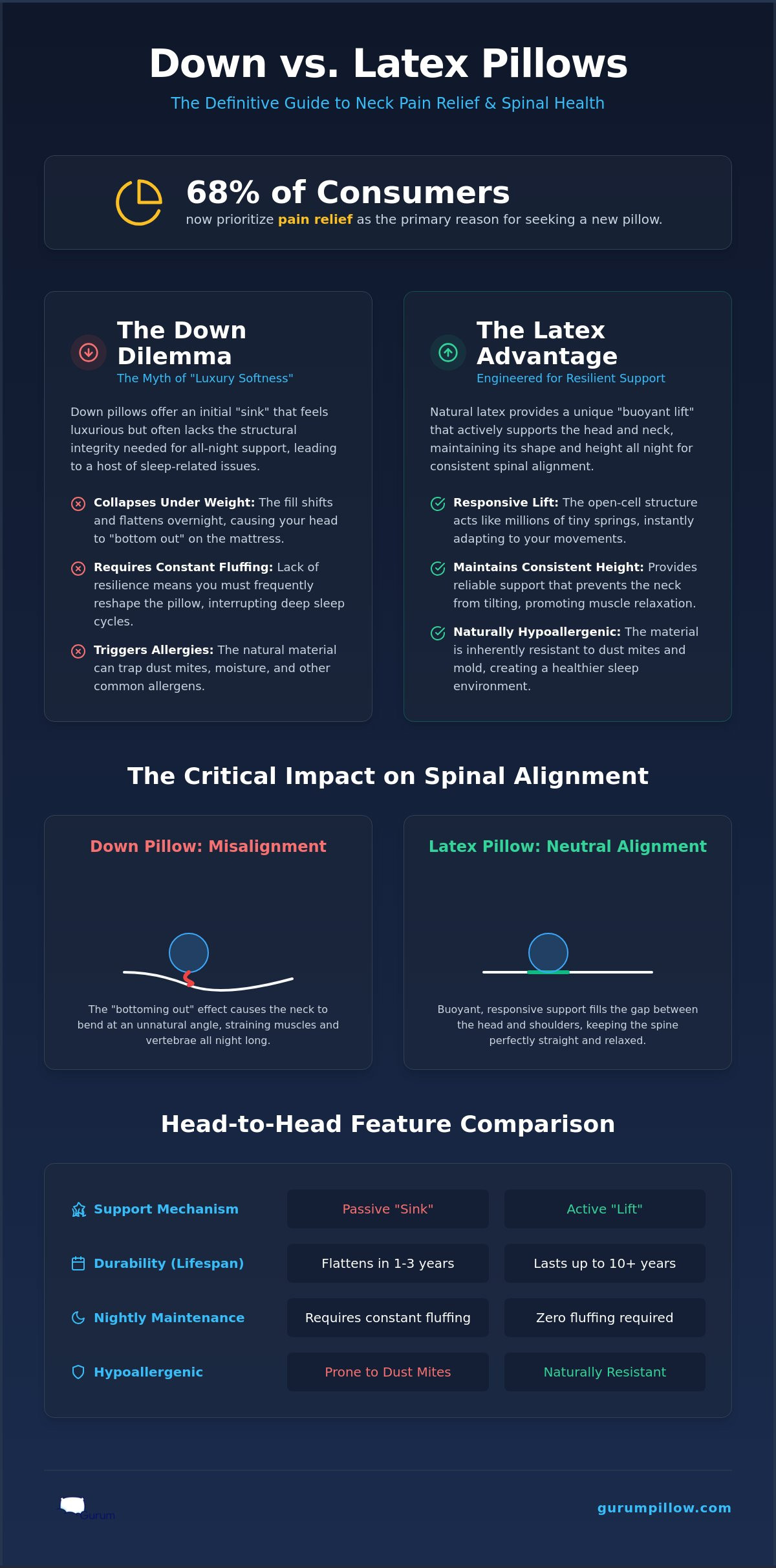
This down vs latex pillow comparison will help you look past the marketing fluff. Softness is not the same as support. While down offers a famous sink, it often lacks the resilient response needed to prevent structural collapse during the night. In this guide, you'll discover the critical differences between these materials so you can choose the support level your body actually needs for pain-free sleep. We will explore how different materials affect spinal alignment, temperature regulation, and why 68% of consumers now prioritize pain relief as their primary reason for seeking a new pillow.
Key Takeaways
- Understand the anatomical difference between the "sink" of feathers and the buoyant, resilient support of natural latex.
- Learn why "bottoming out" in a soft pillow causes chronic neck pain and how to maintain consistent height all night.
- Review this down vs latex pillow comparison to see why latex offers superior durability, lasting up to ten years without collapsing.
- Discover how natural rubber materials create a hypoallergenic sleep environment, protecting you from dust mites and environmental sensitivities.
- Identify the specific loft requirements your body needs to achieve neutral spinal alignment and wake up truly refreshed.
Down vs. Latex Pillows: The Fundamental Difference Between Sink and Support
Choosing a pillow is more than just a decor decision. It's an anatomical choice that dictates how your body recovers. To truly understand What is a Pillow? in the context of orthopedic health, you must look at the internal mechanics. Down and latex represent opposite ends of the sleep spectrum. One is designed to cradle you in passive softness. The other is engineered to actively push back. This down vs latex pillow comparison starts with a simple reality: your neck needs a surface that holds its shape, not one that yields to it.
The core conflict between these two materials is how they handle weight. Down is designed to collapse. It creates a "sink" that many associate with luxury. Latex is designed to resist. It creates a buoyant "lift" that keeps your spine in neutral alignment. Your choice determines whether your neck muscles can finally relax or if they must stay engaged all night to compensate for a lack of support.
The Anatomy of a Down Pillow
Down pillows utilize the soft under-plumage of ducks or geese. It's not the prickly feathers you might expect; it's the fluffy, quill-less clusters underneath. This material is prized for its "scrunchability." You can fold it, bunch it, and mold it into a specific shape. Manufacturers use "fill power" to measure this initial loft. A higher fill power means more air is trapped between the clusters, creating a cloud-like feel.
However, air is easily displaced. This leads to the reality of "loft loss." Three hours into your sleep cycle, that airy loft often vanishes. As you move in your sleep, the down shifts to the sides of the pillow. Your head sinks until it almost touches the mattress. This lack of structural integrity is why many people wake up fluffing their pillows in the middle of the night.
The Engineering of Natural Latex
Latex is different. It's harvested from the sap of rubber trees, which is then whipped into a foam and baked. This process creates an open-cell structure that acts like millions of microscopic springs. In any down vs latex pillow comparison, the most striking difference is this "responsiveness." While down is passive, latex is active. It moves when you move.
Whether the pillow is made through the Dunlop or Talalay process, the result is a consistent, buoyant foam. Responsiveness is the most important word in sleep ergonomics. It means the pillow fills the gap between your ear and the mattress instantly. It doesn't stay compressed. It doesn't require fluffing. It provides a reliable, "spring-like" effect that maintains its height from the moment you lie down until your alarm goes off. This consistency is what allows the delicate muscles in your neck and shoulders to truly let go.
The Down Pillow Dilemma: Why Luxury Softness Often Fails Your Neck
Down pillows are often marketed as the pinnacle of luxury. We've all seen the imagery of someone sinking into a cloud of white feathers, seemingly at peace. But for many, this luxury is a mirage. When you lie down, the down clusters compress immediately under the weight of your head. This creates the "Bottoming Out" effect. Your head sinks through the soft fill until it eventually rests on the hard mattress below. Your neck is left suspended in mid-air with zero structural support to bridge the gap.
In any down vs latex pillow comparison, the lack of integrity in feathers becomes clear for side sleepers. If you sleep on your side, you have a significant physical gap between your ear and your shoulder. Down simply cannot fill this space consistently. It shifts. It flattens. It forces your neck to tilt downward, straining the delicate cervical vertebrae. This constant struggle often leads to a cycle of fluffing the pillow throughout the night, which interrupts your deep sleep cycles and leaves you frustrated.
Spinal Misalignment and Morning Stiffness
Keeping your spine in a neutral position is vital for restorative rest. When a pillow goes flat, your neck spends eight hours at an unnatural angle. This sustained tension often manifests as morning stiffness or those nagging tension headaches that start at the base of the skull. A chiropractic perspective on pillow choice confirms that pillows that lose their loft quickly are a primary contributor to chronic neck issues. Throughout the night, gravity relentlessly pulls your head toward the mattress as the air escapes from between the down clusters. This results in a collapsed support system that fails precisely when your body needs to recover.
Allergy sufferers face an additional hurdle with traditional fills. Down and feathers are organic materials that naturally trap moisture and skin cells, creating a perfect breeding ground for dust mites. If you wake up with a stuffy nose or itchy eyes, your "luxury" pillow might be the culprit. Switching to a hypoallergenic option like our Premium Latex Pillow can provide an immediate breath of fresh air and a cleaner sleep environment.
The Hidden Cost of Frequent Replacement
Investing in feathers often leads to a cycle of high-maintenance care. Down pillows lose their resilience much faster than natural latex. Within a year or two, the clusters often break down or clump together, making the pillow lumpy and uneven. Given that 68% of consumers cite pain relief as their main reason for buying a new pillow, choosing a material that maintains its shape is essential. There are also significant hygiene concerns with animal-based fills that absorb oils and sweat over time. If you find yourself constantly folding your pillow in half to get enough height, it's time for a change. You might even recognize some of the 7 Signs Your Current Pillow is Causing Neck Pain in your own daily routine. A proper down vs latex pillow comparison reveals that while down feels good for the first five minutes, it rarely supports you through the last five hours of sleep.
The Latex Advantage: Why Resilient Support Wins for Spinal Health
If down is a cloud that eventually dissipates, natural latex is the solid ground that stays beneath you. The primary reason people switch to this material is the "instantaneous response." When you roll over or shift your weight, latex immediately bounces back to its original shape. It doesn't leave a permanent indentation or require you to wake up and punch it back into form. This creates a sense of buoyant weightlessness. You never feel "stuck" in a hole, a common frustration for those used to the passive sink of feathers.
Consistency is the hallmark of a high-quality sleep surface. This down vs latex pillow comparison reveals that while down is unpredictable, latex is reliable. It maintains the exact same loft from the moment you close your eyes until your alarm goes off. Since 54% of consumers consider temperature regulation a critical factor in their purchase, it's also worth noting that natural latex is the fastest-growing segment in the market for a reason. It solves the physical discomfort of collapse while addressing the sensory need for a cool, clean environment.
Cervical Spine Protection
Your cervical spine consists of seven delicate vertebrae that require neutral alignment to recover from daily stress. The buoyant nature of latex is uniquely suited for this task. It fills the structural gap between your shoulder and your ear without bottoming out. By providing a firm yet gentle lift, it reduces the pressure on your discs and nerves. If you've been struggling with morning stiffness, our Cervical Pillow Guide: How Ergonomic Support Heals Neck Pain at Night explains the science behind this alignment in deeper detail. Proper support ensures your muscles don't have to work overtime just to keep your head level while you sleep.
The "Breathable Foam" Secret
Unlike traditional foams or dense down clusters, natural latex features an open-cell structure. Most premium options are manufactured with "pin-core" holes. These small channels allow air to circulate freely through the pillow every time you move. This natural ventilation system prevents the buildup of body heat, keeping the surface at a neutral temperature. Thermoregulation is the physical process of maintaining a stable, comfortable body temperature by allowing excess heat to escape the sleep surface. This means you don't need chemical cooling gels or phase-change fabrics to stay comfortable.
Latex is also inherently hypoallergenic. It's naturally resistant to mold, mildew, and dust mites. This is a massive relief for anyone who has suffered through the sniffles caused by organic feather fills. By choosing a material that resists environmental triggers, you're creating a sanctuary for your respiratory system as well as your spine. It's a cleaner, cooler, and more supportive way to rest.
Head-to-Head Comparison: Down vs. Latex for Every Type of Sleeper
When you look at a down vs latex pillow comparison, the choice usually comes down to your primary sleep position and your tolerance for maintenance. Down is a high-maintenance material. It requires daily fluffing and frequent replacement. Latex is a "set it and forget it" solution. It stays the same shape for years without intervention. We know the frustration of waking up on a pillow that feels like a pancake. Here is how these two materials stack up across the categories that matter most for your recovery:
- Support Level: Down is low and passive. Latex is high and active.
- Durability: Down typically lasts one to three years before clumping. Latex maintains its structural integrity for five to ten years.
- Maintenance: Down requires daily manual adjustment to regain loft. Latex requires zero daily effort.
- Long-term Value: While initial costs vary, the cost-per-night for latex is significantly lower because you won't need to replace it for nearly a decade.
Which Should You Choose Based on Sleep Position?
Your sleep position dictates the specific loft your neck requires to stay neutral. Side sleepers have the greatest distance to fill between the shoulder and the ear. For this group, the firm, buoyant height of latex is non-negotiable. It prevents the head from tilting toward the mattress, which protects shoulder health and prevents nerve impingement. Back sleepers also benefit from the way latex cradles the skull while maintaining the natural cervical curve. It offers a consistent base that doesn't shift away as you settle into deep sleep.
Stomach sleepers are the rare exception where a collapsible material might be useful. This position requires the lowest possible loft to prevent the neck from arching backward. In this specific case, a very thin down pillow or a specialized low-profile latex option is preferred. However, if you are looking for a permanent solution to morning stiffness, you can shop our Premium Latex Pillow to find the exact height that suits your body frame.
The Longevity Factor
Latex is an eco-friendly choice because it keeps you out of the replacement cycle. You aren't sending a flattened, dust-filled pillow to the landfill every twelve months. Organic down is a natural material, but it degrades quickly. The clusters lose their ability to trap air and eventually become lumpy. Botanical latex is far more resilient. It resists the breakdown caused by body heat and moisture.
Choosing a durable material is a commitment to both your health and the environment. For a deeper dive into the top-rated options available today, read our Best Latex Pillow 2026: The Ultimate Guide to Pain-Free Sleep. This down vs latex pillow comparison makes it clear: if you want a pillow that supports you for a decade rather than a season, latex is the scientific winner.
Why Gurum’s Premium Latex Pillow is the Scientific Choice for Restorative Sleep
We didn't just build a pillow company; we solved a problem that kept us awake for years. Like many of you, our journey started with a closet full of expensive down pillows that promised luxury but delivered only headaches and stiff shoulders. This down vs latex pillow comparison has highlighted the structural failures of traditional fills, but knowing the science is only half the battle. You need a tool that translates that science into a better morning. We created the Gurum Premium Latex Pillow because we were tired of "bottoming out" and waking up feeling older than we actually are.
The sensory experience of our 100% natural latex is transformative. Imagine waking up and realizing you don't need to "crack" your neck to find relief. There is no morning stiffness to shake off. By combining the surface softness you want with the deep anatomical structure you need, we've created a sleep surface that respects your body's mechanics. It's the end of the "cricked" neck and the beginning of actual recovery.
Designed for Real-World Pain Relief
Our origin story is personal. Ji H. Won developed the Gurum prototype to solve her own chronic cervical discomfort after failing to find a market solution that actually worked. The result is a specific density that we call the "Goldilocks" of pillow firmness. It isn't rock-hard, nor is it a shapeless cloud. It provides a precise level of resistance that keeps your head level while allowing your ear and face to feel cushioned. To complete the experience, we also offer an Anti-Allergy Pillow Cover. This ensures your sleep environment is as clean as it is supportive, protecting you from the dust mites that often plague organic fills.
A Commitment to Quality and Health
We believe that restorative rest should be accessible and reliable. This is why we offer free shipping in the USA and focus entirely on long-term wellness rather than temporary comfort. Our customers frequently describe the feeling of our natural latex as "weightless support." It's a unique sensation where you feel the pillow pushing back just enough to take the pressure off your joints. When you look at a down vs latex pillow comparison through the lens of longevity, the choice becomes clear. You are investing in a decade of better mornings.
You've spent enough nights fighting with your pillow. It's time to let a scientifically designed surface do the work for you. Experience the relief of the Gurum Premium Latex Pillow today and finally give your neck the support it deserves.
Take the First Step Toward a Pain-Free Morning
Your journey to better sleep doesn't have to be a guessing game. This down vs latex pillow comparison has shown that while feathers offer a temporary luxury, they can't provide the structural integrity your cervical spine requires. You deserve a pillow that holds its shape as long as you do. By choosing resilient, botanical latex, you're investing in a surface that prevents the "bottoming out" effect and keeps your neck in perfect alignment all night long.
It's time to stop waking up with tension and start waking up refreshed. Our 100% natural, breathable latex is ergonomically designed to support your unique frame while keeping you cool and comfortable. With free shipping on qualifying US orders, there has never been a better time to prioritize your long-term health and wellness. Upgrade to the Gurum Premium Latex Pillow for Pain-Free Sleep and experience the weightless support you've been searching for. You're only one night away from the restorative rest you deserve.
Frequently Asked Questions
Is a latex pillow better than down for neck pain?
Yes, latex is generally superior for neck pain because it provides active, resilient support that maintains neutral spinal alignment. Unlike down, which collapses under weight, latex fills the gap between your shoulder and ear without flattening. This prevents the "bottoming out" effect that often leads to morning stiffness and tension headaches. It offers a reliable base that keeps your vertebrae supported all night.
Do latex pillows smell like rubber?
High quality natural latex has a very mild, slightly sweet scent when first unboxed, but it doesn't have a harsh chemical odor. This faint "new pillow" scent typically dissipates within a few days in a well-ventilated room. It's a much cleaner alternative to the musty, organic smell that aged down pillows often develop over time as they trap moisture and skin cells.
How long does a natural latex pillow last compared to down?
A natural latex pillow typically maintains its shape and support for five to ten years. In this down vs latex pillow comparison, durability is a major differentiator. Down pillows usually lose their loft and begin clumping within one to three years. Choosing latex means you won't have to deal with the frustration of a flattened pillow for nearly a decade.
Can I wash a latex pillow like I wash a down pillow?
No, you should never put a latex pillow core in a washing machine or dryer. The high heat and agitation will damage the delicate open-cell structure of the natural foam. Instead, you should wash the removable cover and spot-clean the latex itself with a damp cloth. For the ultimate clean sleep environment, we recommend using an Anti-Allergy Pillow Cover to protect the core.
Which is cooler to sleep on: down or latex?
Latex is significantly cooler to sleep on because of its breathable, open-cell structure. Most premium latex pillows feature pin-core holes that allow air to circulate freely, preventing heat buildup. Down clusters are designed to trap heat for insulation, which often leads to uncomfortable night sweats. Latex provides a neutral temperature through natural ventilation rather than chemical cooling gels.
Is latex a good choice for people with allergies?
Yes, natural latex is an excellent choice because it is inherently resistant to dust mites, mold, and mildew. Down and feathers are organic materials that naturally trap the allergens that trigger nighttime stuffiness. By switching to a hypoallergenic material, you create a much cleaner sanctuary for your respiratory system. This down vs latex pillow comparison confirms that latex is the healthier choice for sensitive sleepers.
Are latex pillows too firm for people used to down?
Latex feels different than down, but it isn't "hard"; it's buoyant. While down offers a passive sink, latex provides a weightless sensation that many people find more comfortable once they experience the relief of proper support. It offers the surface softness you want with the underlying structure your neck actually needs. Most people adjust to this superior support within just a few nights.
Why do down pillows go flat so quickly?
Down pillows go flat because they rely on air trapped between fluffy clusters to provide loft. When you rest your head on the pillow, that air is displaced and the feathers shift toward the edges. Gravity and the weight of your head eventually win, leaving you with a flattened surface. Latex resists this collapse because its solid, spring-like foam structure is engineered to push back.