

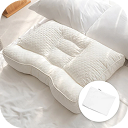
What if the reason you're waking up at 3 AM to fluff your pillow isn't because you're a restless sleeper, but because your pillow is fundamentally incapable of doing two jobs at once? You likely spend half the night fighting for comfort; switching from your side to your back only to find your support has vanished. It's exhausting to deal with neck stiffness and ear pain from materials that are either too soft or rock-hard. Finding the best pillow for side and back sleepers is about solving the biomechanical conflict between the 10 to 14 cm loft needed for your shoulders and the 7 to 9 cm required for the back of your head.
You deserve a sleep experience that adapts to you, not the other way around. This guide will show you how to achieve perfect spinal alignment in both positions so you can finally wake up without neck pain. We'll explore why natural latex is the superior choice for dynamic responsiveness, lasting up to 10 years while resisting the dust mites that trigger your morning sneezing. You're about to discover how the right materials and adjustable loft can end the cycle of constant repositioning for good.
Key Takeaways
- Understand the "Loft Paradox" and why a single, fixed height often fails to support you as you shift positions.
- Learn how to find the best pillow for side and back sleepers by matching pillow loft to your specific shoulder width.
- Discover why natural latex provides the responsive support needed to prevent the "Crater Effect" found in traditional foam.
- Identify the medium-firm density that keeps your spine aligned without the need for constant 3 AM pillow fluffing.
- Explore how ergonomic design stops transition friction so you can finally wake up without neck pain.
The Challenge of Finding the Best Pillow for Side and Back Sleepers
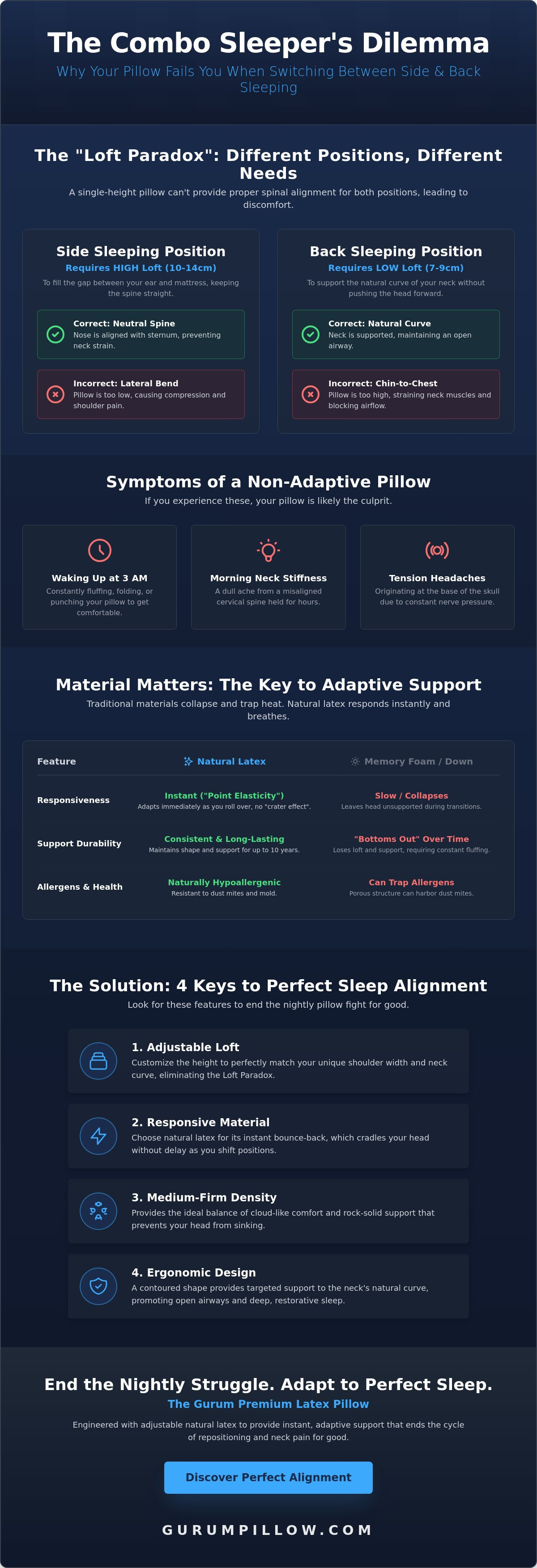
Most people aren't stationary sleepers. If you spend roughly 40% to 60% of your night rotating between your side and your back, you're a combo sleeper. This presents a unique biological hurdle known as the Loft Paradox. When you're on your side, you need a high loft, typically 10 to 14 cm, to fill the deep gap between your ear and the mattress. As soon as you roll onto your back, that same height becomes an enemy. It pushes your chin toward your chest; this tilts your head forward and strains the delicate muscles in your neck.
Finding the best pillow for side and back sleepers requires a solution that bridges this gap without manual intervention. Traditional down or poly-fill pillows fail here because they rely on trapped air. Once you rest your head, they collapse. They bottom out, leaving your spine unsupported by 2 AM. True orthopedic support isn't about sinking into a cloud. It's about maintaining a straight line from your head to your hips. Various Orthopedic pillow designs aim to solve this by providing structural integrity that doesn't flatten under weight.
Why Your Current Pillow Causes Morning Stiffness
If you wake up with a dull ache, your pillow has likely lost its shape. This bottoming out effect happens when the filling shifts, allowing your head to sink too close to the mattress. Your cervical spine then curves at an unnatural angle for six to eight hours. This misalignment creates constant pressure on your nerves and muscles. Cervical strain is the primary cause of tension headaches that start at the base of the skull. You don't need more fluffing. You need consistent support that stays put.
The Role of Spinal Alignment in Restorative Sleep
Restorative sleep happens when your body doesn't have to fight for comfort. For side sleepers, a neutral spine means your nose is aligned perfectly with your sternum. For back sleepers, it means your neck maintains its natural, subtle curve. Using a cervical pillow is essential for preserving this curve throughout the night. Proper alignment also keeps your airways open. This reduces the likelihood of snoring and ensures you're getting the oxygen levels your brain needs for deep sleep. Support where you need it. Comfort everywhere else.
The Biomechanics of Shifting Between Side and Back Positions
Rolling over shouldn't be a chore. When you shift from your side to your back, your head’s center of gravity moves. It travels from the temple and jaw area to the heavy occipital bone at the base of your skull. This movement requires a pillow that responds instantly to the change in weight distribution. Many people suffer from "transition friction." These are the micro-wakings that occur when you're forced to fluff, fold, or punch your pillow into a new shape at 3 AM. It breaks your deep sleep cycle and leaves you feeling exhausted.
The best pillow for side and back sleepers must possess high point elasticity. This technical term describes a material's ability to compress only under direct weight without affecting the surrounding area. According to long-term pillow testing, material resilience is the deciding factor for sleepers who change positions frequently. If a material is too slow to react, your head stays in a misaligned "crater" for several minutes after you turn. You need a surface that cradles your ear and jaw while on your side, then instantly adapts to support the base of your skull when you roll onto your back.
Side Sleeping: Filling the Shoulder Gap
Your shoulder width is the primary architect of your sleep posture. This width creates a significant gap between your head and the mattress that must be filled to keep your spine straight. If your pillow is too low, you'll likely resort to "shoulder scrunching." This is where you pull your shoulder forward or upward to compensate for the lack of height. It leads to impingement and morning stiffness. Maintaining this height is why the best pillow for neck support must be firm enough to resist compression throughout the entire night.
Back Sleeping: Supporting the Cervical Curve
When you roll onto your back, your needs change completely. You no longer need to bridge a shoulder gap; instead, you need to support the empty space under your neck. A pillow that is too high will push your head forward. This mimics the "tech neck" posture many of us struggle with during the day. A proper pillow for back sleeping provides a subtle "neutral dip" for the head while maintaining firm support under the cervical spine. This keeps your airway open and your muscles relaxed. If you're tired of fighting your current pillow, switching to a supportive and breathable latex core can eliminate the need for midnight adjustments.
Latex vs. Memory Foam: Which Material Supports Combo Sleepers?
Choosing between latex and memory foam isn't just about personal preference. It's about how the material behaves when you move. Memory foam is famous for its "contouring sink." It uses your body heat to soften and mold to your shape. While this feels cozy initially, it creates a significant problem for those who shift positions. This is known as the "Crater Effect." Because the foam is slow to react, it traps you in a molded depression. When you try to roll from your side to your back, you're essentially climbing out of a hole. This effort often triggers a micro-waking, ruining your sleep quality.
The best pillow for side and back sleepers needs to provide "Responsive Support" rather than a slow sink. Natural latex is the solution. Unlike memory foam, latex is buoyant. It doesn't rely on heat to adapt; it relies on its natural elasticity. It pushes back against the weight of your head. This makes the transition between positions feel effortless. You won't find yourself fighting against your bedding at 3 AM. Instead, the pillow moves with you, maintaining that critical spinal alignment we discussed earlier.
Durability is another area where these materials diverge. Traditional foam pillows often degrade within two to four years, losing their ability to support your neck. Natural latex maintains its structural integrity and "push-back" for five to ten years. It's a long-term investment in your orthopedic health. You're not just buying a pillow; you're securing a decade of pain-free mornings.
The "Instant Rebound" Advantage of Natural Latex
The secret to a seamless night is the rebound rate. This is the speed at which a material returns to its original shape after weight is removed. Latex has a nearly instantaneous rebound rate. As soon as you shift your weight, the material snaps back to its full height. This provides a sensory experience that is supportive, and comfortable (not rock-hard). It offers the firm foundation your neck needs without the stiff, unforgiving feel of high-density foam. It's the perfect balance for a body in motion.
Hypoallergenic and Breathable: Beyond Support
Comfort isn't just about loft; it's about the environment around your face. Natural latex features an open-cell structure. This design allows for constant airflow, preventing the heat buildup common with solid foam. You stay cool all night. Additionally, latex is inherently resistant to dust mites and mold. This is a game-changer if you often wake up sneezing or with a stuffy nose. For a deeper look at how these materials impact your health, check out our best latex pillow for neck pain guide. Investing in a material that naturally repels allergens ensures your sleep stays restorative for the long haul.
How to Choose the Right Loft and Firmness for Dual Positions
Loft refers to the thickness of your pillow. However, the most important metric for any sleeper is the "compressed loft." This is the actual height your head maintains after you settle into the material and the filling reacts to your weight. For someone seeking the best pillow for side and back sleepers, finding a medium-firm density is the key to success. This specific firmness level provides enough resistance to support your neck while on your side, but enough give to cradle your skull comfortably when you rotate to your back.
Your mattress also plays a silent role in this calculation. If you sleep on a plush, soft mattress, your torso sinks deeper into the bed. This reduces the distance between your ear and the mattress surface, meaning you require a lower loft pillow to stay aligned. Conversely, a firm mattress keeps your body on the surface. This necessitates a higher profile to fill the gap. If you ignore your mattress firmness, even the most expensive orthopedic pillow will feel "off."
The 2-Step Measurement for Perfect Loft
Finding your ideal height doesn't have to be a guessing game. You can find a baseline with a simple two-step process:
- Step 1: Stand sideways against a wall and measure the distance from the tip of your shoulder to the side of your neck.
- Step 2: Subtract 1 inch from this number to account for the natural sinkage of your shoulder into the mattress.
Once you have this measurement, lie on your back to verify. Your chin should remain in a neutral position, pointing straight at the ceiling. If your chin tilts toward your chest, the loft is too high. If your head tilts back toward the wall, the loft is too low. Both extremes lead to that familiar morning stiffness.
Identifying the "Goldilocks" Firmness
Firmness is about how the material pushes back against you. If a pillow is too soft, like traditional down or feather fills, your head sinks through until it essentially hits the mattress. This creates a sharp, painful angle in your neck. If it's too hard, it creates ear pressure and prevents your neck muscles from fully relaxing. The ideal sensation is the "buoyant" feel of premium latex. It floats the head rather than trapping it. You should feel supported, and comfortable (not rock-hard).
Before committing to a new sleep setup, use this 15-minute evaluation checklist. Do you feel any pressure on your jaw while on your side? Can you breathe easily without your chin being pushed down? Does the material return to its original shape the moment you move? If you're ready to stop the 3 AM struggle, you can find your perfect loft with our premium latex pillow. It's designed to provide the exact medium-firm support that combo sleepers need to wake up refreshed.
Why the Gurum Premium Latex Pillow is the 2026 Choice
The search for the best pillow for side and back sleepers often feels like a cycle of trial and error. You've likely tried the high-loft pillows that hurt your neck when you roll over, or the flat ones that leave your shoulders crushed. Gurum was born from this exact frustration. We understand the emotional toll of chronic neck pain and the exhaustion of broken sleep. Our ergonomic design is specifically engineered to handle the side-to-back transition without requiring you to wake up. By using a 100% natural latex core, we've created a surface that is supportive, and comfortable (not rock-hard). You won't find the chemical off-gassing common with synthetic foams here. Just pure, orthopedic support.
Our mission is simple: Wake Up Without Neck Pain. We believe restorative sleep is a necessity, not a luxury. Every purchase includes a breathable, anti-allergy cover. This ensures that while your spine is aligned, your skin stays cool and your airways remain clear of dust mites. It's a complete solution for anyone who has felt let down by traditional bedding. You don't have to settle for "good enough" when a perfected solution is available. We've taken the science of spinal alignment and combined it with the luxury of natural materials.
Engineered for the Modern Sleeper
We've spent years perfecting the specific density needed for combo sleepers. It's a precise balance. The core is high enough to bridge the shoulder gap but responsive enough to cradle the head instantly. This eliminates the "transition friction" that leads to morning stiffness. This isn't just for your bedroom, either. Our natural latex travel pillow provides this same level of orthopedic care when you're on the move. Join the thousands of Americans who have finally stopped the 3 AM pillow fluffing and started waking up refreshed. Consistent sleep is finally within your reach.
Risk-Free Sleep Improvement
We want to make your path to better sleep as easy as possible. That's why we offer free shipping in the USA on qualifying orders. We're confident in our solution because we've seen it transform the lives of our customers. Because natural latex lasts between 5 to 10 years, this is a one-time investment in your long-term health. You're not just buying another pillow; you're ending the search for good. It's time to stop compromising on your comfort and start investing in your wellness. Experience the Gurum difference and wake up refreshed tonight.
Wake Up Without Neck Pain Starting Tomorrow
Achieving deep, restorative sleep shouldn't feel like a nightly puzzle. You now know that the best pillow for side and back sleepers must offer a high rebound rate to eliminate transition friction. By choosing 100% natural latex, you're avoiding the "crater effect" of memory foam and securing up to 10 years of reliable orthopedic support. Our experts designed this solution specifically to solve the root causes of chronic neck pain by balancing the loft needs of both positions. It's about finding that buoyant, medium-firm feel that is supportive, and comfortable (not rock-hard).
Stop settling for traditional pillows that go flat or trap heat against your face. You've fought for comfort long enough; it's time for a material that moves with you. With free shipping in the USA, there’s no reason to wait for the physical and emotional relief you deserve. Shop the Premium Latex Pillow for Ultimate Support and rediscover what it means to feel truly rested. You’re one decision away from a pain-free morning and a more vibrant, energized life. Better sleep is finally within your reach.
Frequently Asked Questions
Is a firm or soft pillow better for side and back sleepers?
A medium-firm density is the superior choice for those who rotate positions throughout the night. Soft pillows, like down or poly-fill, often collapse under the head's weight, which is roughly 4.5 to 5.5 kilograms for the average adult. This loss of support leads to spinal misalignment. A medium-firm surface provides the necessary resistance to fill the shoulder gap while remaining comfortable enough for the back of the head.
What is the ideal pillow height (loft) for someone who sleeps in both positions?
Finding the best pillow for side and back sleepers requires balancing a 10 to 14 cm side loft with a 7 to 9 cm back loft. A compressed height of approximately 10 to 12 cm usually serves as the ideal compromise for most adults. This height prevents your chin from tilting toward your chest while on your back, yet stays high enough to keep your neck straight when you turn to your side.
Can one pillow really work for both side and back sleeping?
Yes, provided the material has high point elasticity to adapt instantly to your weight and movement. Traditional pillows fail because they require manual fluffing to change height every time you roll over. An ergonomic latex core responds to your movement without waking you up. It maintains a neutral spine regardless of your position, ensuring you wake up without neck pain.
How often should I replace my pillow if I have neck pain?
You should replace traditional memory foam or polyester pillows every 2 to 3 years to maintain orthopedic support. These materials degrade and soften over time, losing their ability to hold your head level. In contrast, 100% natural latex pillows are much more durable. They typically maintain their original shape and rebound rate for 5 to 10 years, making them a better long-term investment for your health.
Why does my ear hurt when I sleep on my side with a foam pillow?
Ear pain usually occurs when a pillow is too hard or lacks the ability to distribute pressure evenly across the side of your head. High-density foams can press against the delicate cartilage of the ear, causing significant discomfort by 2 AM. A material with a more buoyant feel, like natural latex, cradles the ear while supporting the jaw. This prevents the sharp pressure points that lead to tossing and turning.
Will a latex pillow feel too bouncy if I am used to memory foam?
It will feel more responsive than memory foam, but most users adapt to this change within 3 to 5 nights. Memory foam provides a sinking sensation that can make you feel trapped in one spot. Latex offers an instant rebound that makes rolling over feel effortless. It’s supportive and comfortable (not rock-hard), providing a floating sensation rather than the slow-molding feel of traditional foam.
What happens if my pillow is too high for back sleeping?
A pillow that is too high forces your head forward into a chin-to-chest position. This mimics the poor posture of "tech neck" and puts excessive strain on your cervical spine. Over 6 to 8 hours, this tension leads to morning stiffness and can even cause tension headaches. Your head should stay level with your mattress to keep your airways open and your neck muscles fully relaxed.
Are ergonomic pillows worth it for combo sleepers?
Ergonomic pillows are essential for combo sleepers because they are specifically engineered for the side-to-back transition. Finding the best pillow for side and back sleepers is about more than just softness; it’s about structural integrity. These pillows provide the specific contours needed to support the neck's natural curve while on the back and the shoulder's width while on the side, preventing micro-wakings.