

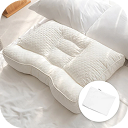
That cloud-like softness you feel when you first lay down is actually a "softness trap" that collapses the moment your neck needs support. While they feel luxurious at first touch, the reality of common problems with feather pillows often includes waking up with a stiff neck or a stuffy nose. Research shows that feather pillows are the most likely to be associated with waking cervical pain, impacting many of the 30% of adults who struggle with chronic neck discomfort.
We understand how frustrating it is to spend your night punching a flat pillow back into shape or dodging sharp, poking quills. You deserve a restorative rest that doesn't leave you reaching for painkillers by breakfast. This guide will uncover why your current pillow is failing your anatomy and how you can transition to a more supportive, hygienic sleep solution. We'll explore the seven critical reasons your sleep is suffering and reveal the path to a hypoallergenic, pain-free morning.
Key Takeaways
- Understand why the initial "cloud-like" comfort of feathers is actually a trap that leads to spinal misalignment.
- Identify the common problems with feather pillows, including how shifting fill leaves your neck unsupported throughout the night.
- Discover the hidden hygiene risks, from dust mite accumulation to musty odors, that impact your respiratory health.
- Learn about the "push-back" benefits of natural latex and how it maintains its shape to keep your neck in a neutral position.
- Find out how to reclaim restorative sleep by switching to a more hygienic and durable orthopedic solution.
The Softness Trap: Why Feather Pillows Fail Over Time
That first moment you sink your head into a fresh feather pillow feels like pure luxury. It's soft, inviting, and seemingly weightless. This is the "softness trap." The loft you see isn't actually structural support. It's mostly air trapped between loose feathers. As soon as you apply the weight of your head, that air escapes. The temporary comfort vanishes. You're left with a compressed layer of material that offers almost zero resistance against gravity.
Throughout history, Pillows have been crafted from various materials to bridge the gap between the head and the mattress. However, feathers lack the "memory" or buoyancy required for modern ergonomic health. Unlike solid core materials, feathers suffer from material fatigue. Every time you compress them, the delicate quills break down. They lose their natural spring. Over months of use, your once-plump pillow becomes a thin, clumpy shadow of its former self. This degradation is a primary reason why your sleep quality declines so sharply over time.
The Shifting Internal Fill Problem
The physics of loose fill is simple but devastating for your sleep. Feathers are independent particles. They move toward the path of least resistance. When your head rests in the center, the feathers migrate toward the edges. This creates a "hollow" center by the middle of the night. You'll likely find yourself waking up at 3:00 AM to punch and fluff the pillow back into a usable shape. It's an exhausting cycle that prevents deep, uninterrupted REM sleep.
Side sleepers feel this failure most acutely. To maintain a neutral spine, you need a consistent height to fill the space between your shoulder and your ear. When the feathers shift away, your head drops. Your neck tilts at an unnatural angle. This is one of the most frustrating problems with feather pillows. You're essentially sleeping on a shifting foundation that changes shape every time you move.
Quill Poking and Material Degradation
Traditional feather fills aren't just unstable; they can be physically irritating. Even with high-thread-count covers, those sharp quills eventually find a way through. There's nothing relaxing about a sharp poke to the cheek or scalp in the middle of the night. These quills act like tiny needles, slowly damaging the pillow casing from the inside out.
As these feathers break down, they create "feather dust." This fine particulate matter stays trapped inside the casing, accumulating with every move you make. This internal decay contributes significantly to the respiratory problems with feather pillows we see so often. You aren't just losing physical support. You're also losing the clean, hygienic environment necessary for restorative rest. Once the internal structure shatters into dust, no amount of fluffing will ever bring back the support your neck needs.
Chronic Neck Pain and the Lack of Structural Support
Cervical spinal alignment refers to the neutral position where your head, neck, and spine form a straight, unstrained line during sleep. Achieving this state is nearly impossible when your pillow's internal structure is constantly shifting. One of the primary problems with feather pillows is their complete lack of "push-back" force. For proper orthopedic health, a pillow must provide enough resistance to keep the weight of your head elevated. Feathers simply yield. They collapse under pressure until your head eventually bottoms out against the mattress.
This collapse is a major trigger for morning tension headaches. When your pillow flattens, your neck muscles must work throughout the night to stabilize your head. Instead of resting, your trapezius and levator scapulae muscles remain under constant strain. Chronic neck pain affects approximately 30% of adults at any given time, and researchers at The Asthma & Allergy Center have noted that while people often worry about dust mites and other indoor allergens, the physical failure of the pillow is often the most immediate cause of waking stiffness.
The Collapse of the Cervical Curve
Think of your neck as a delicate bridge that requires solid pillars. When feathers shift away from the center, that bridge drops. This sinking feeling is often mistaken for luxury, but it's actually anatomical failure. There is a vital difference between "cradling" and "sinking." Cradling occurs when a material contours to your shape while maintaining its structural height. Feathers only offer sinking. For anyone struggling with chronic pain, "soft" is often the enemy of support. You need a material that holds its shape, not one that vanishes under your weight.
Why Side and Back Sleepers Suffer Differently
Side sleepers require a consistent loft to fill the deep gap between the shoulder and the ear. Feathers fail here because they migrate toward the edges of the casing, leaving the neck to hang unsupported. Back sleepers face a different set of risks. Feathers often clump at the base of the skull, which can tilt the head forward into an unnatural "chin-to-chest" position. This misalignment puts immense pressure on the cervical discs. Using a dedicated ergonomic pillow ensures that your head stays at the correct height regardless of how much you move. If you're tired of waking up with a stiff neck, switching to a Premium Latex Pillow can provide the consistent, reliable support that feathers lack.
The Hidden Hygiene Risks: Allergies, Dust Mites, and Moisture
Your pillow should be a sanctuary for rest. For many, it's actually a biological "hotel" for unwanted guests. The loose, airy structure of feathers creates thousands of tiny pockets that are perfect for trapping shed skin cells and dust mites. Unlike solid core materials, feathers provide a deep, dark environment where allergens thrive. This is one of the most overlooked problems with feather pillows. You might think you're just a "morning person" with a stuffy nose. In reality, you're likely reacting to the ecosystem living inches from your face every night.
There's also the persistent issue of the "organic smell." Natural feathers contain residual oils that can develop a musty, earthy odor over time. This happens because feathers are incredibly effective at retaining moisture. Every night, your breath and sweat release humidity into the pillow. The feathers trap this moisture deep inside the casing. Without proper airflow, this dampness creates a breeding ground for bacteria. These trapped oils can eventually turn rancid, leaving you with a pillow that smells stale no matter how often you change the case.
Dust Mites and Respiratory Irritation
Do you wake up with puffy eyes or a scratchy throat? These are classic signs of respiratory irritation caused by your bedding. The shifting nature of feathers makes them a perfect breeding ground for mites. Every time you fluff or move the pillow, you release a cloud of fine "feather dust" and allergens into the air. This constant exposure leads to chronic morning congestion. In contrast, 100% natural latex is inherently antimicrobial and hypoallergenic. It doesn't offer the loose "pockets" that mites need to survive. This ensures a much cleaner sleep environment for those with sensitivities.
The Difficulty of Deep Cleaning
Cleaning a feather pillow is a logistical nightmare. Most manufacturers suggest washing only in emergencies. This is because detergent strips feathers of their natural oils. Without these oils, the feathers become brittle and snap, turning your support into sharp, useless dust. Even if you do wash them, the risk of internal mold is high. Feathers can take over six hours to dry completely in a machine. If even a tiny amount of moisture remains in the center of a clump, mold will grow. This creates a hygiene hazard that's almost impossible to detect until the smell becomes overwhelming. For a truly clean sleep, many find that a Premium Latex Pillow paired with an Anti-Allergy Pillow Cover offers a much safer, more manageable solution.
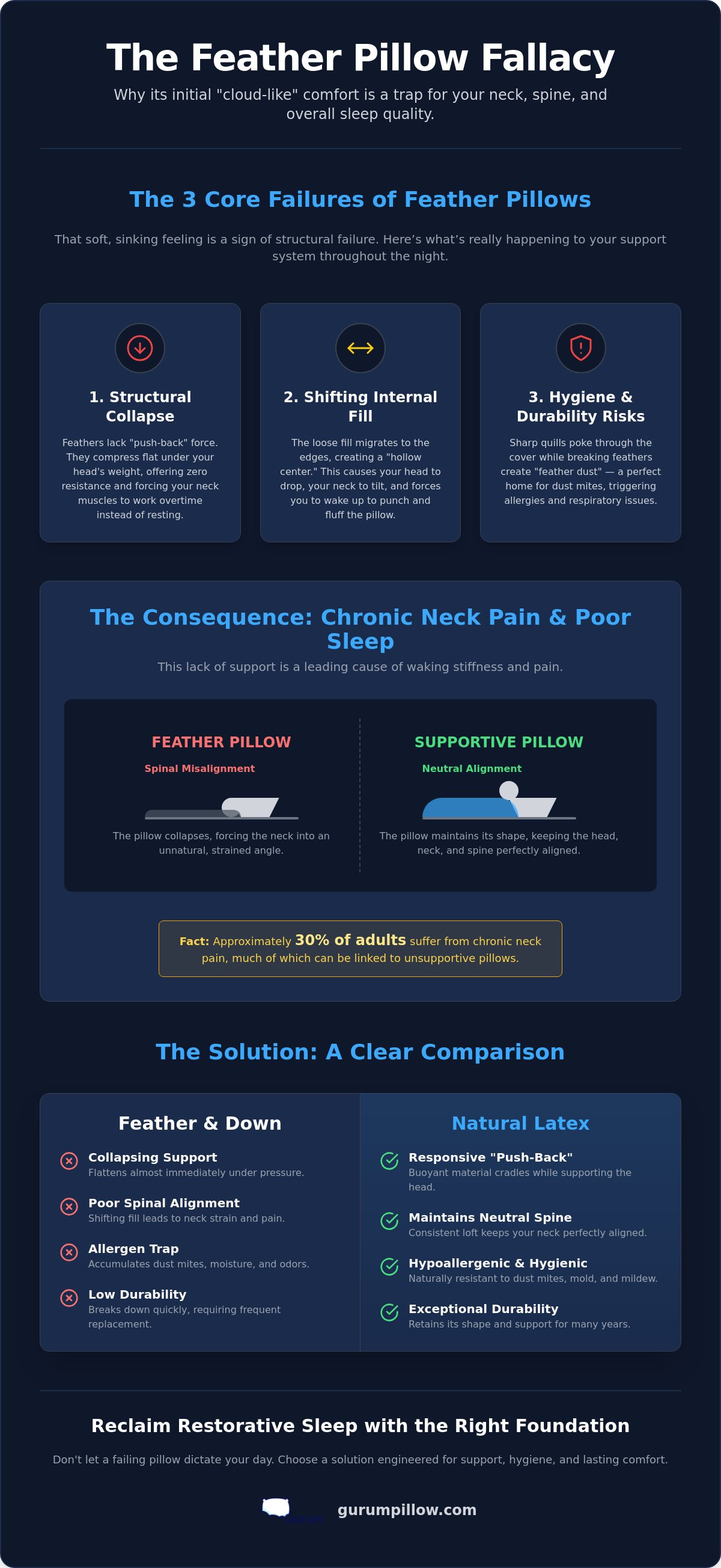
Latex vs. Feather: A Comparison of Long-Term Sleep Health
Choosing between latex and feather isn't just about preference; it's about the mechanical reality of how these materials interact with your body. One of the most persistent problems with feather pillows is their tendency to compress and stay compressed under the weight of your head. Latex, by contrast, is naturally buoyant. It provides an immediate "push-back" that supports your cervical spine without bottoming out. While feathers trap heat within their dense layers of down, natural latex features an open-cell structure. This allows air to circulate freely, keeping you cool even on warm nights.
Consistency vs. Chaos
Feathers are chaotic. They shift, clump, and require constant manual intervention to remain usable. Latex is consistent. It offers the exact same level of support from the first minute you lay down until the eighth hour when you wake up. This material possesses a high rebound factor, meaning it instantly adjusts to your movements without losing its shape. This is precisely why many users find latex pillows for side sleepers to be vastly superior to adjustable fill options. You don't have to fight your pillow to get comfortable; it simply works. This reliability is one of the many reasons why the structural problems with feather pillows eventually lead to chronic sleep disruption.
The Environmental and Health Impact
Sustainability matters for your home and the planet. Feather processing often involves intensive synthetic cleaning to remove animal odors and pathogens. Natural latex is harvested sustainably from rubber trees, making it a cleaner, more eco-friendly choice. It also avoids the chemical off-gassing common in synthetic foams. Natural latex is inherently hypoallergenic and resistant to mold, making it a far more hygienic choice than pillows made from animal byproducts. It is a professional-grade tool for your bedroom that respects both your health and the environment.
Think about the long-term investment in your rest. A high-quality latex pillow can maintain its structural integrity for up to 10 years. In that same decade, you might go through five or six feather pillows as they flatten and degrade. There is also the "set it and forget it" ease of a solid-core pillow. You never have to fluff it. You never have to shake it. It is ready for you every single night. If you are tired of the morning aches, switching to a Premium Latex Pillow provides the anatomical support you have been missing.
Reclaiming Your Rest with the Gurum Premium Latex Pillow
You have likely spent years trying to make feathers work. You have fluffed, folded, and replaced them, yet the morning stiffness remains. We understand that frustration. The Gurum Premium Latex Pillow was engineered as the definitive answer to the anatomical failures of traditional bedding. It solves the structural problems with feather pillows by replacing shifting, loose fill with a single, high-performance core. While feathers yield to the weight of your head until you are resting on the mattress, our 100% natural latex provides a constant, gentle lift. It maintains your alignment all night long.
This is a professional-grade tool for your bedroom. Because it is crafted from a solid piece of natural latex, there are no sharp quills to poke your skin and no clumps to navigate. The material is inherently resilient. It offers a sensory experience that balances luxury with medical-grade support. The design also addresses the heat retention issues common with down. Our latex features a breathable, open-cell structure that regulates temperature far more effectively than insulating feathers. You stay cool, supported, and undisturbed.
Why Gurum is the End of Your Pillow Search
We want you to experience the relief of waking up truly refreshed. This isn't just about a new pillow; it is about ending a history of sleep disappointment. Investing in a Gurum pillow means investing in years of pain-free mornings. Unlike feathers that degrade within months, our latex maintains its shape and buoyancy for a decade. To create the ultimate hygienic environment, you can pair your pillow with our anti-allergy pillow cover. This adds a final layer of protection against the environmental sensitivities that often accompany problems with feather pillows.
Making the Switch: What to Expect
When you transition from a collapsing feather pillow to a supportive latex one, there is often a brief adjustment period. Your neck muscles, which have been strained for years, finally get to relax. It might feel different at first because your head is finally being held in its correct anatomical position. You will quickly notice the absence of the "midnight fluffing" ritual. You won't have to fight your pillow to find a comfortable spot at 3:00 AM. It will be exactly where you left it, providing the same level of support as when you first laid down. Experience the difference of real support with Gurum Pillow.
Wake Up to a New Standard of Rest
Restorative sleep isn't a luxury. It is a necessity for your physical and emotional health. We have explored how the common problems with feather pillows, from structural collapse to hidden hygiene risks, prevent you from reaching deep, healing rest. You deserve a sleep environment that supports your cervical spine and respects your respiratory health. By moving away from the "softness trap," you are choosing a foundation that finally respects your anatomy.
The Gurum Premium Latex Pillow is the result of focused engineering. Designed by Ji H. Won specifically for chronic neck pain relief, this 100% natural latex solution provides the consistent buoyancy your body requires. It is durable, breathable, and ready to support you from the first minute to the eighth hour. We are proud to offer free shipping within the USA to help you start your journey toward better rest today.
Upgrade to the Gurum Premium Latex Pillow for Pain-Free Sleep
You have struggled with discomfort long enough. It's time to experience the relief of a truly supportive night. We're here to help you wake up feeling refreshed and ready for the day ahead.
Common Questions About Feather Pillows
Why does my feather pillow smell after a few months?
Feather pillows often develop a smell because their organic fibers trap moisture from your breath and sweat. This trapped humidity interacts with the residual oils on the feathers, which can eventually go rancid. Without the open-cell airflow of modern sleep solutions, this moisture creates a breeding ground for bacteria. This leads to a musty odor that regular washing doesn't easily eliminate.
Can feather pillows cause neck pain and headaches?
Yes, feather pillows frequently cause neck pain and headaches by failing to provide structural resistance. Because feathers shift away from the weight of your head, your neck loses its neutral cervical alignment. This constant dropping forces your neck and shoulder muscles to stay active all night. Research indicates that chronic neck pain affects approximately 30% of adults, with improper pillows being a major aggravating factor.
How often should I replace my feather pillow?
You should consider replacing your pillow every 6 to 24 months to ensure basic hygiene and support. Over time, the internal quills shatter and lose their natural spring, which is one of the most common problems with feather pillows. Some sources recommend replacing these pillows as often as every six months to maintain basic hygiene and prevent the accumulation of allergens.
Are feather pillows bad for people with allergies?
Yes, feather pillows can be a nightmare for people with environmental sensitivities. Their loose internal structure acts as a biological hotel for dust mites, skin cells, and mold. Additionally, as the feathers break down, they create a fine "feather dust" that stays trapped in the casing. This dust is a known respiratory irritant that can exacerbate common problems with feather pillows like morning congestion.
Why do the feathers in my pillow keep clumping together?
Feathers clump together when they are exposed to consistent moisture and physical pressure. Sweat and humidity cause the delicate fibers of the feathers to lose their ability to trap air. Once these air pockets vanish, the feathers stick together in dense, uncomfortable lumps. This clumping destroys the pillow's loft and makes it impossible to find a consistent, supportive position for your head.
Is there a way to stop feathers from poking through the pillowcase?
While a thick, high-thread-count protector can help, it is rarely a permanent solution. Sharp feather quills are remarkably persistent and will eventually work their way through even the tightest weaves. This leads to physical irritation against your face and scalp. The most reliable way to stop this poking is to transition to a quill-free, solid material like the natural latex used in a Premium Latex Pillow.
What is the best alternative to a feather pillow for side sleepers?
A natural latex pillow is the best alternative for side sleepers who need reliable support. Side sleeping requires a consistent height to fill the deep gap between the shoulder and the ear. Unlike feathers that shift and flatten, a Premium Latex Pillow provides a buoyant, solid core. This ensures your spine stays aligned without the need for constant fluffing or midnight adjustments.
Can you wash feather pillows in a standard washing machine?
You can use a standard machine, but it is a risky process that often ruins the pillow. Detergent strips the feathers of the natural oils they need to stay flexible and buoyant. If the feathers aren't dried perfectly for six or more hours, the damp core can develop internal mold. This makes washing a hygiene gamble that often leads to clumping and structural failure.