


Why are we still waking up with a stiff neck after spending money on "premium" memory foam wraps that promised the world? You've likely experienced the frustration of the "head-bob" or the uncomfortable heat buildup that comes with cheap, synthetic materials. It's exhausting to arrive at your dream destination feeling like you haven't slept in days because your pillow flattened into a useless pancake mid-flight. When you're searching for the best travel pillow for neck support, you're looking for more than a soft cushion; you're looking for anatomical relief.
We believe your neck deserves better than a temporary fix that loses its shape before you even land. Finding a reliable solution isn't about how small the product can fold; it's about the material science of "push-back" resilience. You deserve a pillow that mimics the restorative support of your home bed, even when you're stuck in a cramped middle seat.
In this guide, you'll discover why 100% natural latex is the secret to pain-free travel and how to choose a pillow that actually protects your cervical spine. We'll explore how to stay cool while sleeping upright and why switching from foam to latex is the most important upgrade for your 2026 travel kit.
Key Takeaways
- Learn why neutral spinal alignment is the only way to stop "head-bobbing" and how to identify pillows that prioritize cervical health over simple softness.
- Discover why natural latex's "push-back" resilience outperforms memory foam by staying cool and maintaining its shape throughout long-haul flights.
- Master specific seating strategies for the window and aisle to ensure you find the best travel pillow for neck support regardless of where you sit.
- Explore how the Gurum Travel Latex Pillow uses material science to bridge the gap between home-bed comfort and cabin necessity.
- Get practical tips on using compression straps to pack high-quality latex support without sacrificing valuable carry-on space.
Why Most Travel Pillows Fail Your Neck (And What to Look For)
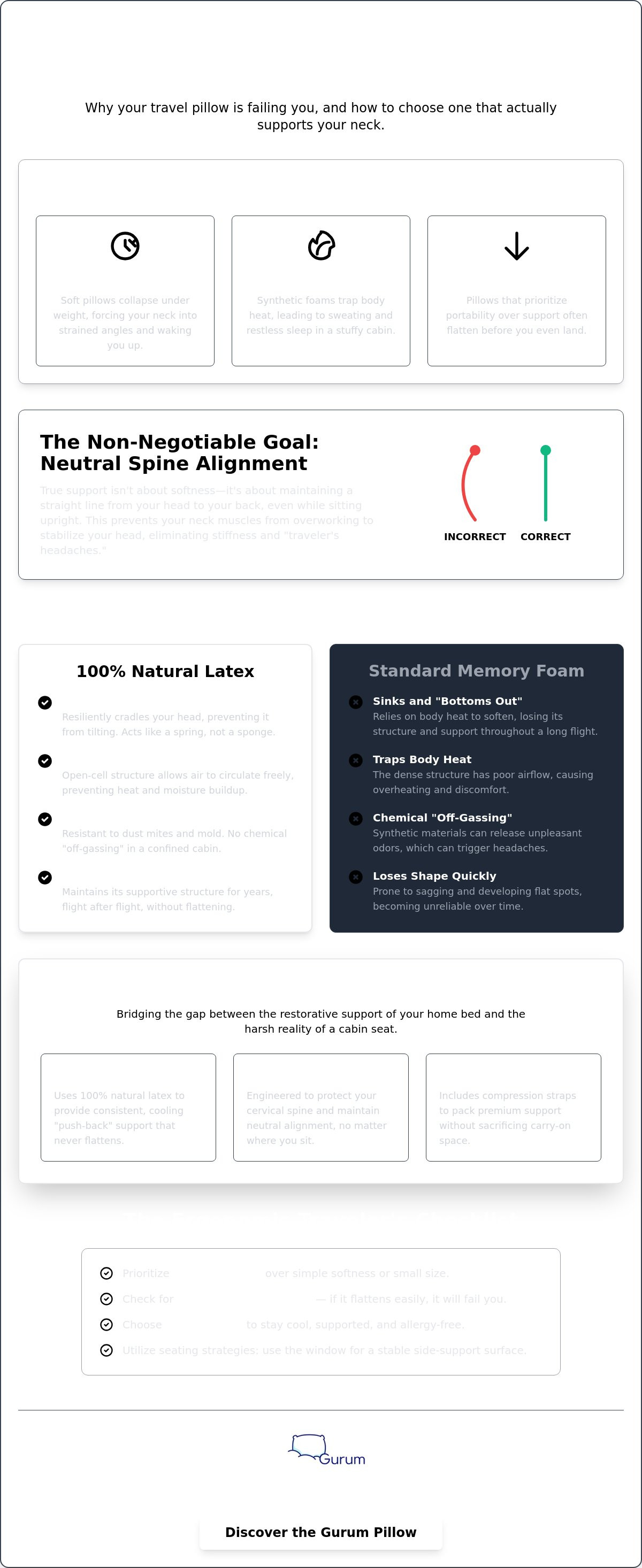
Most travelers make the mistake of choosing a pillow based on how soft it feels in the airport terminal. This approach almost always leads to the dreaded "head-bob" halfway through a flight. When your neck muscles relax during deep sleep, a soft pillow simply collapses under the weight. This lack of resistance forces your cervical spine into awkward, strained angles. Finding the best travel pillow for neck support requires looking past the initial plushness and focusing on structural integrity.
True neck support is defined by its ability to maintain a neutral spine. This means your head stays aligned with your back, even when you're sitting upright in a cramped cabin. Many Travel pillows fail because they prioritize being small over being functional. Inflatable options are particularly problematic. They lack the necessary contouring to cradle your neck and often create uncomfortable pressure points that restrict circulation. A one-size-fits-all wrap rarely works because it doesn't account for your specific neck length or shoulder width. This leaves a gap between your head and the headrest, which is exactly where the physical discomfort begins.
The Anatomy of Upright Sleep
When you sleep sitting up, gravity becomes a constant weight on your joints. Your cervical spine suffers when your head leans to the side without a firm, resilient boundary. This positioning forces your trapezius muscle to stay engaged as it tries to stabilize your skull, leading to deep-seated tension and "traveler's headache." Cervical alignment in travel means keeping your head centered over your shoulders without letting it tilt or drop forward. Without this balance, you'll wake up with stiffness that can ruin the first few days of your trip.
Portability vs. Support: The Great Trade-Off
The travel industry often pushes ultra-light materials that fold into tiny pouches. Unfortunately, these materials lack the "push-back" resilience needed for a twelve-hour flight. You need a material that doesn't soften as your body heat rises in the cabin. Using a familiar material like natural latex provides a psychological sense of security and physical consistency. Latex doesn't sag or flatten over time like cheap foam. To identify a high-quality pillow, check if it maintains its height under pressure. If it flattens easily between your hands, it won't support your head on a long-haul journey. Choosing a Travel Latex Pillow ensures that the material responds to your movements without losing its supportive core.
Latex vs. Memory Foam: The Battle for Cervical Alignment
Choosing between materials isn't just a matter of preference; it's a matter of physics. Most travelers reach for memory foam because it feels soft at first touch. However, memory foam is designed to sink. It relies on your body heat to soften the material so it can contour to your shape. This is a major flaw when you're looking for the best travel pillow for neck support. As the foam warms up during a long flight, it loses its ability to hold your head upright. You eventually "bottom out," leaving your cervical spine unsupported against the hard seat.
Natural latex offers a completely different experience. It's a high-resilience material that provides immediate "push-back" support. Instead of sinking, your head is cradled and held in a neutral position. This responsiveness is vital for preventing the sudden head-tilts that wake you up in pain. When comparing pillow materials, the structural difference is clear. Latex acts like a series of tiny springs, while foam acts like a slow-moving liquid. It doesn't require heat to activate its support, making it reliable from the moment you sit down.
Safety and air quality also matter in tight spaces. Synthetic foams often undergo "off-gassing," releasing a distinct chemical odor that can trigger sensitivities or headaches in a closed cabin. Natural latex is harvested from rubber trees, offering a cleaner and more breathable alternative. It's naturally hypoallergenic and resistant to dust mites, which is essential for frequent flyers. If you're tired of pillows that lose their support before you even reach your gate, investing in a Travel Latex Pillow provides the long-term resilience your neck needs.
Temperature Control in the Cabin
Heat retention is a common complaint for 41% of people who suffer from night sweats. In a crowded airplane cabin, memory foam acts as an insulator, trapping heat against your skin. This leads to the uncomfortable "neck sweat" that disrupts your rest. Natural latex features an open-cell structure that promotes constant airflow. It stays cool and dry, regardless of the cabin's temperature fluctuations. You can rest deeply without the distraction of overheating.
Long-Term Shape Retention
Durability is where the investment truly pays off. Memory foam travel pillows usually have a lifespan of only 2 to 4 years. They eventually lose their ability to bounce back, leading to permanent indents. Natural latex is far more durable, maintaining its shape for 5 to 10 years. It survives being crushed in a suitcase without losing its original loft. You won't have to replace it after a single season of heavy travel. It remains as supportive on your fiftieth trip as it was on your first.
Choosing Your Travel Companion: Support for Every Seat
Your seat assignment often feels like a game of chance, but your physical comfort shouldn't be. Whether you're leaning against a vibrating cabin wall or balancing in the open aisle, your support needs to adapt to the geometry of your surroundings. Most travelers assume a pillow is a universal tool. In reality, the best travel pillow for neck support is one that accounts for your specific seat and your unique anatomy. One critical factor is "loft," which refers to the height and thickness of the pillow. If you have broad shoulders, a thin, flimsy pillow leaves a significant gap. This gap causes your head to tilt at an extreme angle, overstretching the delicate muscles on one side of your neck. You need a pillow with enough height to fill the void between your ear and the headrest completely.
Middle seat survival requires a different approach. When you're pinned between two passengers, you have no surface to lean on. In this scenario, symmetry is your best friend. You need a resilient material that keeps your head centered. High-density support prevents you from slumping into your neighbor's space while keeping your spine neutral. By choosing a pillow that provides consistent resistance, you can maintain an upright posture that doesn't rely on external walls.
Ergonomics for the Aisle Sleeper
The aisle seat is the most challenging for rest because there's no leaning surface. Without support, your head tends to drop forward or slump sideways into the aisle. This creates "military neck" symptoms, where the natural curve of your spine is flattened or reversed. A high-density Travel Latex Pillow provides a stable "shelf" for your jaw. This prevents the chin-to-chest drop that restricts your airway and causes tension in the back of your neck. When you combine a slight seat recline with proper pillow placement, you create a stable cradle that mimics the support of a bed.
The Window Seat: Bridging the Gap
Window sleepers often wake up with a "kinked neck" because they lean directly against the hard, cold cabin wall. The wall is rarely at the right angle for your spine. You need to bridge that gap with a material that won't slip or compress under pressure. A Travel Latex Pillow stays firm even when the plane hits turbulence, ensuring your head doesn't bounce against the window. When you aren't sleeping, you can even use it as a lumbar support tool to protect your lower back from the poorly designed curves of airplane seats. This versatility ensures you arrive feeling refreshed, regardless of your row number.
The Ergonomic Traveler's Checklist: Packing Support Without the Bulk
Many travelers sacrifice their spine for suitcase space. They choose flat, inflatable options because they fit in a pocket. But a true solution doesn't have to be a burden. When searching for the best travel pillow for neck support, look for one that balances density with smart packing techniques. You can easily fit a solid latex pillow into a standard carry-on by using a simple compression strap. Tighten the strap to reduce the volume by up to 50%. Because natural latex is so resilient, it will bounce back to its original loft the moment you release the strap. It won't stay crushed or develop permanent creases like synthetic alternatives. This allows you to carry professional-grade support without losing half of your bag's capacity.
Don't wait until you're at 30,000 feet to test your gear. Use your pillow at home for a night or two before your departure. This familiarizes your neck muscles with the new support level. It also ensures you aren't surprised by the feel of the material while trying to rest in a stressful environment. Consistency is the key to avoiding travel-induced tension. If you're used to a specific level of "push-back" at home, your body will find it much easier to enter deep sleep during the flight. The built-in hoodie and side pocket for earplugs further enhance this sense of personal space in a crowded cabin.
Hygiene on the Go
Airplane cabins are high-traffic environments filled with hidden allergens. Natural latex is inherently antimicrobial and resistant to dust mites. This provides a clean foundation for your rest. To maximize hygiene, always use an Anti-Allergy Pillow Cover. These covers act as a barrier against skin irritants and are easy to remove for washing. Since 41% of people experience night sweats at least once a month, having a breathable, washable cover is a necessity for long-haul comfort. When cleaning the pillow itself, remember that natural latex should never be fully submerged. Simply spot clean the surface and let it air dry away from direct sunlight to preserve the integrity of the material.
Multi-Purpose Use Cases
Your support shouldn't end when you leave the plane. A high-quality travel pillow is a versatile tool for road trips and hotel stays. Most rental car seats lack proper lumbar support, leading to lower back fatigue. Place the pillow between the small of your back and the seat to maintain the natural inward curve of your lower spine during long drives. If your hotel pillows are too soft or lumpy, your own latex support ensures you wake up without a headache. It's an investment in your entire journey, not just the flight. Bringing your own pillow also provides a familiar texture, which helps reduce the anxiety of sleeping in a new place. Ready to upgrade your travel kit? Explore the Travel Latex Pillow for your next adventure.
Why the Gurum Travel Latex Pillow is a Frequent Flyer Essential
Rest shouldn't be a luxury reserved for your bedroom. We designed our Travel Latex Pillow to bridge the gap between your home sleep environment and the harsh reality of a long-haul flight. It's crafted from 100% natural latex to provide the same consistent, resilient support found in our full-sized Premium Latex Pillow. Most travelers are used to the disappointment of foam that sags or inflatable rings that offer zero stability. This is why we focused on material science to create the best travel pillow for neck support. Our design cradles the neck with surgical precision. It ensures your head stays exactly where it belongs, even during unexpected turbulence. You won't have to worry about the "head-bob" waking you up every twenty minutes.
Our customers recognize this commitment to quality. As of February 2026, the Gurum Premium Latex Pillow maintains a 4.92 out of 5 rating based on 346 verified reviews. We brought that same standard to our travel line. We understand the physical and emotional toll of arriving at your destination exhausted. By prioritizing anatomical health over mere portability, we've created a tool that transforms the way you move through the world. It's a professional-grade solution (that isn't too rigid for comfort) designed to make every seat feel like first class.
The Science of Gurum's Latex
The secret to our support lies in the unique balance of a "cloud-like" feel and unwavering structural integrity. While memory foam sinks and traps heat, our natural latex pushes back to maintain perfect spinal alignment. This is critical when you're sleeping in an upright position for hours. The open-cell structure also addresses the dry, recycled air of an airplane cabin. It's naturally breathable and hypoallergenic. This provides a clean, cool surface that resists dust mites and transit allergens. You can finally rest without the irritation or "neck sweat" caused by synthetic materials.
A Wellness Partner for Every Journey
Our mission, led by Ji H. Won, is to bring physical relief to travelers everywhere. We believe that restorative rest is a fundamental right, not a travel perk. Our community chooses latex because they're tired of the "permanent indent" and chemical smells of polyurethane alternatives. They want a pillow that lasts five to ten years, not one flight. We've included thoughtful features like a built-in hoodie and earplugs to help you reclaim your personal space in a crowded cabin. It's time to stop settling for temporary fixes and start investing in your long-term wellness. Experience the difference with the Gurum Travel Latex Pillow and arrive at your next destination feeling truly refreshed.
Reclaim Your Rest on Every Flight
The search for the best travel pillow for neck support isn't about finding the smallest accessory. It's about investing in the anatomical resilience of 100% natural latex. We've explored how traditional memory foam fails as it warms up, leaving your cervical spine unsupported. By prioritizing "push-back" support over simple softness, you can finally eliminate the head-bobbing that ruins deep sleep. You deserve to arrive at your destination feeling energized rather than recovering from a night of physical strain.
Choosing a wellness partner for your travels means selecting materials that are naturally hypoallergenic and breathable. Our Travel Latex Pillow provides a clean, cool surface that withstands the rigors of long-haul journeys. We even offer free shipping on qualifying US orders to help you start your journey right. Stop settling for temporary fixes that flatten before you land. It's time to treat your body with the same respect you give your travel plans.
Shop the Gurum Travel Latex Pillow for Pain-Free Travel
Your next adventure is waiting. We're here to make sure you're rested enough to enjoy every single moment of it.
Frequently Asked Questions
Is a latex travel pillow better than memory foam for neck pain?
Yes, latex is superior. It provides immediate "push-back" support that doesn't collapse as it warms up. Unlike memory foam, which sinks and loses its structural integrity during long flights, natural latex stays resilient. This consistent resistance is why many consider it the best travel pillow for neck support for preventing the deep-seated tension often associated with air travel.
How do I stop my head from falling forward when sleeping on a plane?
To stop the forward tilt, you need a high-density pillow that creates a stable "shelf" for your jaw. Most soft wraps fail. They compress too easily under the weight of your head. A Travel Latex Pillow maintains its loft and height, providing a firm boundary that keeps your chin from dropping toward your chest and restricting your airway.
Are latex travel pillows too heavy for carry-on luggage?
While natural latex is denser than foam, it remains light enough for standard carry-on requirements. The weight trade-off is worth it. You get the orthopedic benefit of consistent support. When you use a compression strap, you can significantly reduce the physical volume of the pillow. This makes it a manageable and essential addition to your gear without exceeding weight limits.
Can a travel pillow help with chronic neck pain or 'military neck'?
A properly designed pillow helps. It manages discomfort by maintaining neutral spinal alignment during upright sleep. For those with "military neck" or chronic stiffness, avoiding extreme angles is vital. The best travel pillow for neck support is one that fills the anatomical gap between your ear and shoulder, preventing further strain on your joints. This protection ensures you arrive without the flare-ups typical of long flights.
What is the best way to pack a latex travel pillow for a long flight?
The most efficient method is using a compression strap to roll the pillow into a compact shape. Because natural latex is highly resilient, it won't suffer from permanent creases or losing its shape when crushed. Simply release the strap once you reach your seat. The material will immediately bounce back to its original supportive loft, ready for your flight.
How do I choose the right size travel pillow for my neck?
Focus on the "loft" or height of the pillow relative to your shoulder width. Broad shoulders need a thicker pillow. This fills the space between your head and the seat or cabin wall. A pillow that is too thin will cause your neck to tilt, while one that is too high will push your head forward into an uncomfortable angle.
Are natural latex pillows hypoallergenic for sensitive travelers?
Yes, natural latex is inherently hypoallergenic. It resists dust mites, mold, and mildew. This makes it an ideal choice for sensitive travelers who struggle with recycled air. Pairing the pillow with an Anti-Allergy Pillow Cover provides an extra layer of protection. It shields your skin and respiratory system from allergens during transit through busy airports.
Can I use my travel pillow for lumbar support in a car or train?
Absolutely, it works. A Travel Latex Pillow is highly effective for lower back relief in rental cars or trains. Simply place the pillow in the small of your back. This maintains the natural inward curve of your lumbar spine. Its resilient material ensures it won't flatten under your weight, providing consistent comfort throughout your entire journey.