

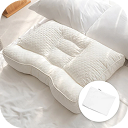
What if the "perfect" pillow you recently bought is actually the reason your neck feels like it's in a vice every morning? You've likely spent years searching for a solution to those stiff shoulders and the heat that trapped air creates in traditional foam. It's exhausting to invest in bedding that flattens into a pancake just when you've finally started to get comfortable. Understanding the talalay vs dunlop latex pillow differences is the first step toward reclaiming your rest.
We agree that your sleep shouldn't be a gamble. You deserve a surface that maintains its integrity for years while providing instant pressure relief for your cervical spine. This guide helps you decode the structural and sensory nuances between these two materials so you can choose the perfect support for your neck pain. We'll explore why Dunlop provides a firm architectural foundation while Talalay offers plush, breathable buoyancy. We will also touch on the latest 2026 certifications, including GOLS and the updated OEKO-TEX Standard 100, so you can rest easy knowing your sleep surface is as healthy as it is restorative. By the end, you'll know exactly which texture will transform your morning from a struggle into a refreshed start.
Key Takeaways
- Identify the manufacturing secrets that determine whether your pillow feels like a soft cloud or a sturdy, supportive foundation.
- Pinpoint the talalay vs dunlop latex pillow differences to match your specific sleeping position with the ideal level of density.
- Master the science of spinal alignment to finally eliminate morning stiffness and restore your natural cervical curve.
- Evaluate airflow and heat retention stats to find a naturally hypoallergenic surface that stays cool and breathable all night.
- Explore why a premium latex solution is the gold standard for those struggling with chronic physical discomfort and sensitive nerves.
Understanding the Latex Foundation: Why the Process Matters for Your Sleep
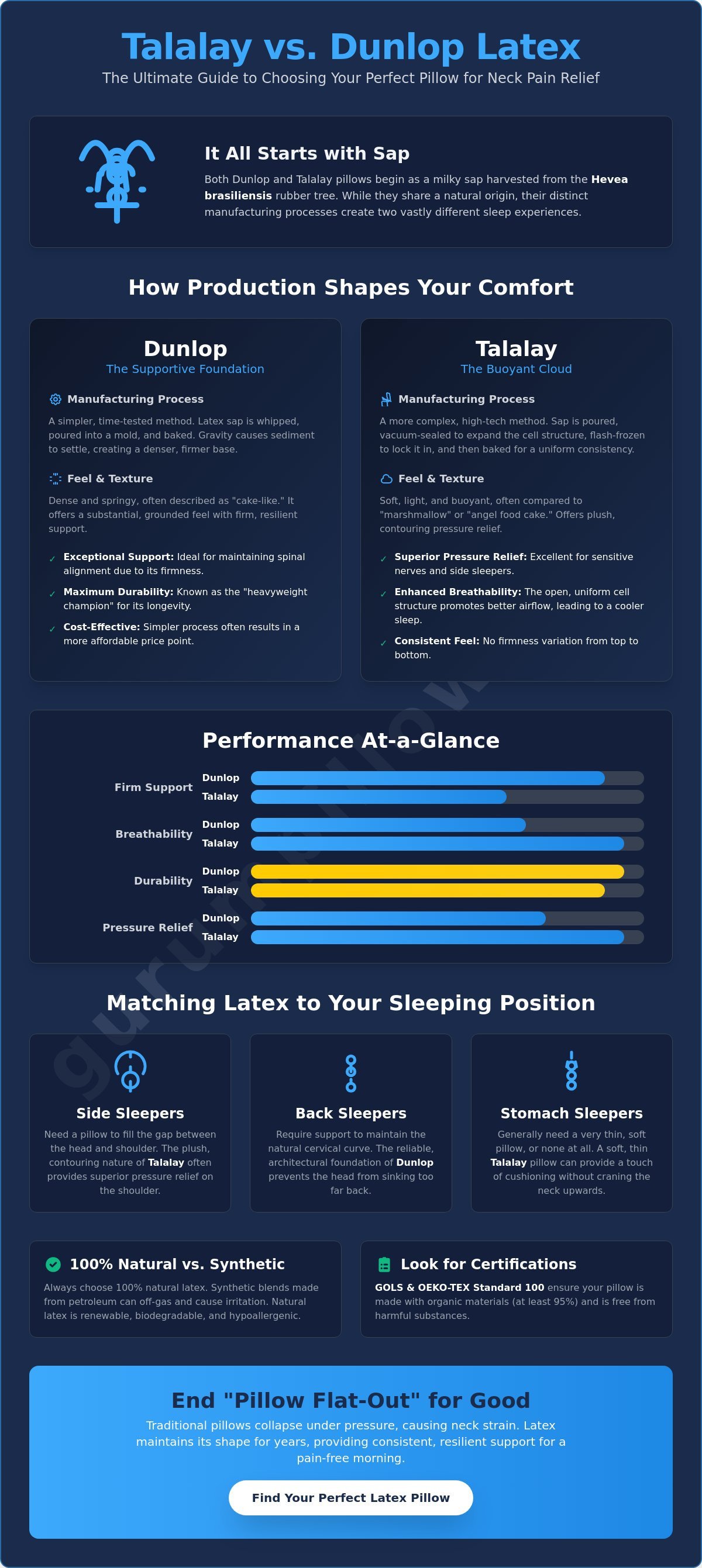
The journey to a pain-free morning starts with a milky sap harvested from the Hevea brasiliensis tree. This natural liquid is the foundation for both materials we are comparing today. While they share a botanical origin, the talalay vs dunlop latex pillow differences emerge during the manufacturing stage. Dunlop is the traditional method. It's a straightforward process that results in a dense, durable, and supportive foam. Talalay is the high-tech evolution of this craft. It involves a vacuum-sealed Talalay process where the latex is flash-frozen to create a perfectly uniform cell structure.
Why should you care about the "bouncy" nature of these materials? Most people are used to the sinking sensation of memory foam. Memory foam is designed to absorb energy and contour to your shape. The problem is that it often keeps sinking until you feel trapped. Latex offers an active response. It pushes back against the weight of your head. This buoyancy ensures you stay on top of the pillow rather than buried in it. This "lift" is the secret to maintaining a neutral spine and avoiding the heat traps common in synthetic foams.
The Problem with Traditional Pillows
Most traditional pillows have a structural shelf life that is shockingly short. Fiberfill and memory foam often collapse under the 10 to 12 pound weight of the human head. As the night goes on, the material loses its integrity. We call this "pillow flat-out." When your pillow flattens, your neck loses its natural curve and your muscles have to work overtime to compensate. This is a primary cause of morning neck stiffness and chronic shoulder tension. Latex is fundamentally different. It's incredibly resilient. It doesn't bottom out; it maintains its height and supportive shape for years, not just months.
Natural vs. Synthetic Latex
Your respiratory health is just as important as your spinal alignment. Many "latex" options on the market are actually synthetic blends made from petroleum-based chemicals. These can off-gas and cause irritation for sensitive sleepers. Choosing 100% natural latex is the only way to ensure a clean sleep environment. One of the key talalay vs dunlop latex pillow differences is that both can be produced naturally, but you must look for the GOLS (Global Organic Latex Standard) benchmark. This certification requires at least 95% certified organic raw latex. Natural latex is a biodegradable, renewable resource harvested from living trees.
The Science of Dunlop vs. Talalay: How Production Shapes Your Comfort
The way a pillow is manufactured determines how your neck feels at 3 AM. The talalay vs dunlop latex pillow differences start the moment the liquid sap enters the mold. Dunlop is the original, simpler method. It involves pouring the liquid into a mold, whipping it into a froth, and baking it. Because gravity is constant, the heavier particles naturally settle toward the bottom. This creates a dense, resilient structure. Talalay is more complex. It adds two critical steps: a vacuum seal and flash-freezing. These technical choices change everything about how the material responds to your weight.
The talalay vs dunlop latex pillow differences aren't just technical; they are sensory. Dunlop has a "cake-like" density that feels substantial and grounded. Talalay has a "marshmallow" feel that is light and buoyant. Understanding which one fits your physical needs is the key to ending chronic sleep discomfort.
Dunlop: The Heavyweight Champion of Support
Dunlop is often the first choice for sleepers who need a reliable architectural foundation. During the manufacturing process, the sediment settling creates a subtle gradient. One side of the pillow is naturally firmer than the other. This density is ideal for structural spinal support. It doesn't compress easily, ensuring your head stays in a neutral position throughout the night. It's also exceptionally durable. It's common for a high-quality Dunlop pillow to remain supportive for over a decade without crumbling or losing its loft. It is the gold standard for longevity and firm support.
Talalay: The Airy Cloud of Pressure Relief
Talalay is the solution for those who want a soft feel without the heat retention of memory foam. The vacuum step is the game-changer. By removing the air from the mold, the latex cells stretch and expand to fill every corner. This results in a uniform, open-cell structure. The flash-freezing step then locks these cells in place at -20 degrees Fahrenheit before baking. This prevents any particles from settling. The result is a pillow that feels like an airy cloud. It provides an "uplifting" sensation that cradles your head while staying remarkably cool. Because the cells are so open, airflow is significantly higher, offering superior thermoregulation for hot sleepers.
Finding the right balance between these two can be a challenge for anyone struggling with chronic stiffness. If you're ready for a solution that prioritizes your anatomical health, consider trying a Premium Latex Pillow designed for lasting relief.
Performance Breakdown: Density, Breathability, and Durability Compared
Choosing between these two materials requires a look at how they perform under the actual weight of your head. The talalay vs dunlop latex pillow differences are most visible when you compare their physical mass. On average, Dunlop is 2 to 3 times denser than Talalay. This density translates to a pillow that feels substantial and grounded. If you've ever been frustrated by a lightweight pillow that slides across the headboard while you sleep, Dunlop is your solution. It's significantly heavier and less prone to shifting during the night, providing a reliable anchor for your neck.
Response time is another area where latex outshines synthetic alternatives. Both types offer an "instant" return to shape the moment you move. You won't find the slow-sinking "crater" effect common in memory foam. However, Talalay has a noticeably higher "bounce" factor. It feels more energetic and springy. This elastic quality provides a sense of weightlessness that can be deeply soothing for sensitive nerves in the cervical spine.
Which Lasts Longer?
Durability is a major concern when you're investing in your health. Dunlop is the clear winner for resisting compression over time. Its dense structure makes it ideal for heavier sleepers who need consistent support that won't dip. Talalay is also durable, but it follows a "softening" curve. You might notice it feels slightly more plush over the first three years of use before it stabilizes. High-quality natural latex maintains 90% of its loft after five years of use. This longevity makes it a professional-grade tool for your home that outlasts fiberfill options by a wide margin.
The Temperature Regulation Factor
We know that "sleeping hot" is more than just an annoyance; it actively disrupts your REM cycles. When your body can't cool down, you spend more time tossing and turning. This is where the vacuum expansion of the Talalay process proves its value. By stretching the latex cells, it creates a structure that offers up to 4x more airflow than Dunlop. Both materials are naturally moisture-wicking and far superior to the heat-trapping nature of foam. Latex serves as the ultimate anti-sweat alternative. It keeps the surface of your skin cool and dry, allowing you to reach the deep, restorative sleep your body requires for healing.
Solving the Neck Pain Puzzle: Matching Latex Type to Your Sleeping Position
Waking up with a neck that feels frozen is more than a bad start to your day. It's often a sign of "Military Neck," a condition where the natural cervical lordosis, the healthy curve of your spine, is lost. To fix this, your body requires a specific push-back force that keeps your airway open and your vertebrae aligned. Understanding the talalay vs dunlop latex pillow differences is essential because your sleeping position dictates your anatomical needs. If you want to dive deeper into the mechanics of healing, check out our Cervical Pillow Guide.
The #1 goal for any neck pain sufferer is neutral spinal alignment. This means your head, neck, and back should form a straight, relaxed line. When your pillow is too soft or too firm for your position, your muscles stay "on" all night to protect your nerves. This leads to the familiar morning stiffness you're trying to escape. By leveraging the specific properties of different latex types, you can finally give those muscles permission to relax.
The Side Sleeper’s Dilemma
Side sleepers face a unique structural challenge. You must fill the significant gap between your ear and the tip of your shoulder. If your pillow collapses, your head tilts downward, overstretching the muscles on one side while compressing the nerves on the other. We recommend the denser support of Dunlop for this position. Its "cake-like" consistency provides the necessary height and stability to keep your head level. It won't bottom out under the weight of your skull, ensuring your spine stays straight until morning. For more tips on maintaining this posture, read our Best Pillow for Side Sleepers Guide.
Back Sleepers and the "Cradle" Effect
Back sleepers require a lower loft that still offers consistent contouring. If your pillow is too high, it pushes your chin toward your chest. This restricted posture can lead to snoring and interrupted breathing. Talalay is often the superior choice for back sleepers. It's designed to cradle the occipital bone, the base of your skull, without creating painful pressure points. This "cloud-like" response keeps your chin in a neutral position. It provides enough lift to support the neck's curve while allowing the head to settle comfortably. This balance is key to reaching the deep, restorative sleep cycles your body needs to repair damaged tissue.
Ready to stop the morning struggle? Experience the transformative relief of a Premium Latex Pillow designed to support your specific anatomy.
Why Gurum Pillow Chooses Premium Latex for Permanent Relief
Ji H. Won didn't start this brand to join a crowded market. He started it to solve a personal crisis. After years of struggling with chronic neck pain and disappointing "orthopedic" solutions, he realized that standard bedding was failing his anatomy. He discovered that the talalay vs dunlop latex pillow differences were the missing link in his own recovery. This realization led to the creation of the Premium Latex Pillow. It isn't just another bedding option; it's a gold standard for ergonomics designed by someone who has lived through your struggle.
We maintain a strict "no-filler" guarantee. Every pillow we produce is 100% natural, hypoallergenic, and naturally resistant to dust mites. This is vital for your respiratory health and long-term skin health. While many brands use synthetic blends that trap heat and harbor allergens, we prioritize a clean sleep environment. Our specialized anti-allergy cover adds a final layer of protection. It ensures your sleep surface remains breathable and hygienic, night after night.
Ergonomics on the Go: The Travel Factor
Spinal health shouldn't be a luxury you leave at home. Maintaining alignment during travel is crucial for preventing painful flare-ups caused by thin hotel pillows. We created the Travel Latex Pillow to bridge this gap. Because we utilize the dense, resilient durability of Dunlop latex, you can compress this pillow into your carry-on without fear. It will bounce back instantly to its original shape the moment you unpack. You get the same architectural support on a plane or in a hotel that you enjoy in your own bedroom. It's portable relief that doesn't compromise on density.
The Gurum Guarantee
We are dedicated to your long-term wellness. That's why we offer free shipping across the USA and a focused commitment to spinal health. Our "wake up refreshed" promise centers on the first 10 minutes of your morning. If you aren't waking up without that familiar stiffness, your pillow is failing you. We've mastered the talalay vs dunlop latex pillow differences to ensure our products provide the exact lift your cervical spine requires. It's time to stop managing pain and start preventing it.
Experience the difference with a Gurum Premium Latex Pillow today.
Claim Your First Pain-Free Morning
Waking up with a stiff neck doesn't have to be your normal. By mastering the talalay vs dunlop latex pillow differences, you've taken the first step toward reclaiming your rest. You now know that Dunlop provides the sturdy foundation side sleepers need, while Talalay offers the airy buoyancy that back sleepers crave. Both choices offer a resilience that traditional foams simply can't match. They lift your head rather than letting it sink, protecting your cervical spine all night long.
Our founder, Ji H. Won, spent years testing these materials to solve his own chronic discomfort. He created a solution that prioritizes your anatomy without using synthetic fillers or chemicals. Every Gurum pillow is 100% natural, hypoallergenic, and designed to maintain its shape for a decade. We believe that restorative sleep is a right, not a luxury. That's why we offer free shipping across the USA to help you start your journey toward wellness today.
End your neck pain tonight with the Gurum Premium Latex Pillow. You deserve to wake up feeling refreshed, aligned, and ready for the day ahead.
Frequently Asked Questions
Is Talalay or Dunlop latex softer for a pillow?
Talalay is the softer and more plush option. Its airy, open-cell structure creates a "marshmallow" feel that provides gentle contouring without high resistance. Dunlop is naturally denser and firmer. It feels more substantial and grounded, making it the preferred choice for those who want a solid, supportive foundation rather than a soft cushion.
Which latex type is better for people with neck pain?
The best choice depends on your specific anatomy and sleeping position. Dunlop is often recommended for side sleepers because its high density prevents the head from tilting, which helps maintain a neutral spine. Talalay is frequently better for back sleepers who need a softer cradle for the base of the skull. Both materials provide the "lift" necessary to prevent the muscle strain caused by collapsing foam.
Does Talalay latex smell worse than Dunlop?
Neither material has a harsh chemical odor, but both have a mild, natural scent when new. This scent is often described as similar to vanilla or sweet rubber. It is not the toxic off-gassing associated with synthetic foams. Because Talalay is more porous, any initial natural scent usually dissipates faster when left in a well-ventilated room for a few hours.
How long does a Talalay vs. Dunlop latex pillow last?
Both types are exceptionally durable and can last between 5 to 10 years with proper care. Dunlop typically has a slight edge in longevity because its dense structure is nearly indestructible. Talalay is also long-lasting but may experience a subtle softening over several years of nightly use. Both options far outlast traditional fiberfill pillows, which often flatten within months.
Is Talalay latex 100% natural or synthetic?
Talalay can be produced as 100% natural, synthetic, or a blend. You should always verify that your pillow is 100% natural to avoid petroleum-based fillers and harsh chemicals. Natural versions are harvested from the sap of rubber trees and are biodegradable. Look for GOLS or OEKO-TEX certifications to ensure your sleep surface is healthy and environmentally friendly.
Can I wash my latex pillow to keep it hypoallergenic?
You should never submerge a solid latex pillow in water or put it in a washing machine. Doing so can damage the delicate cellular structure and make the material difficult to dry, which could lead to mold. To keep your pillow hypoallergenic, use a washable Anti-Allergy Pillow Cover. This protects the latex from moisture, dust mites, and skin oils while keeping your sleep environment clean.
Why is Talalay latex more expensive than Dunlop?
The higher price is due to a more complex and energy-intensive manufacturing process. The Talalay method requires vacuum sealing and flash-freezing the latex before it is baked. This adds significant time and specialized equipment to the production line. When comparing talalay vs dunlop latex pillow differences, the cost reflects the advanced technology used to create a more consistent and airy texture.
Which latex is better for hot sleepers?
Talalay is the superior choice for those who struggle with night sweats. The vacuum expansion during its production creates an open-cell structure that allows for significantly more airflow than Dunlop. This prevents heat from becoming trapped against your skin. It helps regulate your body temperature throughout the night, ensuring you stay cool and comfortable through every sleep cycle.