

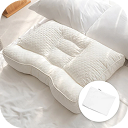
You finally treated yourself to a premium pillow, expecting the best rest of your life. Instead, you woke up with a dull headache and a sharp, chemical odor clinging to your sheets. It's a common story. That heavy memory foam pillow off-gassing smell is more than just a "new product" scent. It's the physical release of volatile organic compounds, or VOCs, used during manufacturing. You shouldn't have to choose between support and clear lungs.
We know how frustrating it is to feel regret over an expensive purchase, especially when it causes nasal irritation or keeps you awake. You deserve to feel confident that the air you breathe all night is safe. With standards like OEKO-TEX tightening chemical limits as of June 2026, understanding your bedding has never been more important. This article explains why these smells happen, how to speed up the clearing process, and the risks involved with synthetic materials. We'll also show you why switching to natural alternatives is the ultimate way to reclaim a neutral-smelling, chemical-free bedroom for a truly restorative sleep.
Key Takeaways
- Understand why that chemical odor is actually the release of petroleum-based VOCs used in synthetic foam production.
- Identify the symptoms of "New Pillow Syndrome" and how a pillow's micro-environment can trigger morning headaches or congestion.
- Learn five immediate, practical steps to neutralize a memory foam pillow off-gassing smell and speed up the clearing process.
- Discover why low-density synthetic materials can trap odors for months and how humidity might reactivate the scent.
- Explore why 100% natural latex is the ultimate breathable alternative for a hypoallergenic and chemical-free bedroom.
Understanding Memory Foam Pillow Off-Gassing: Why the Smell Happens
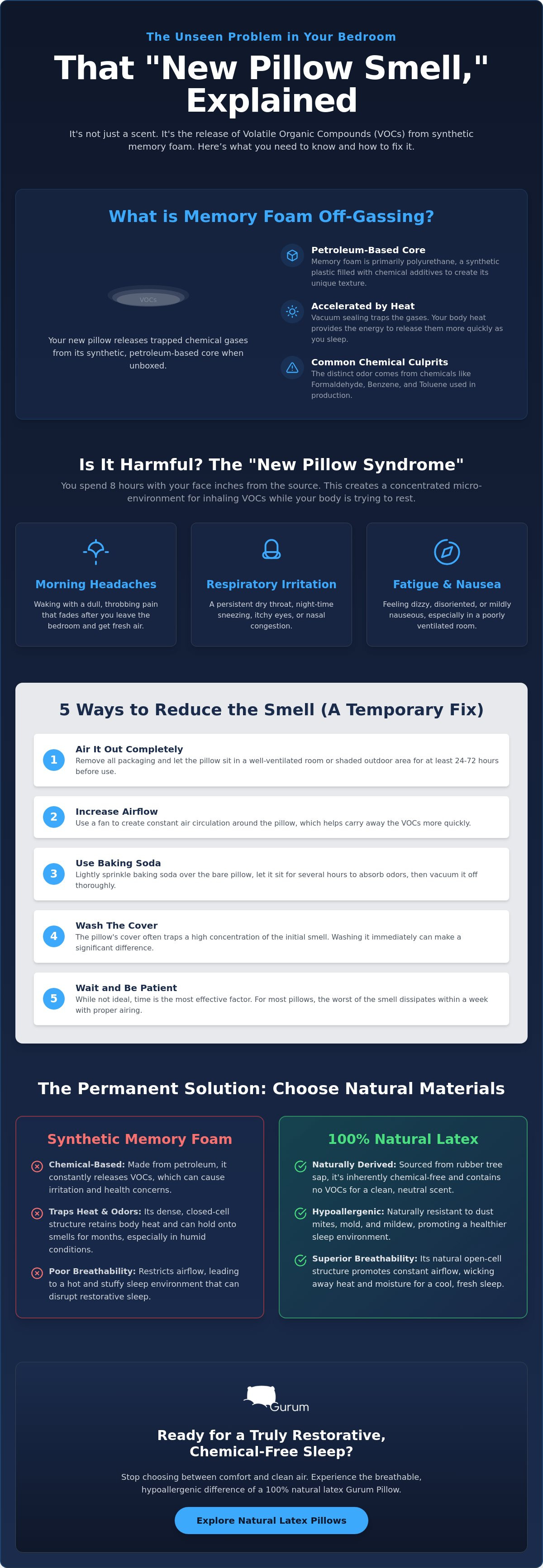
You unbox your new pillow with high hopes for a better night's sleep. Instead, you're greeted by a sharp, medicinal scent that fills the room. This experience is the memory foam pillow off-gassing smell. It isn't just a "new product" scent; it's a physical process where chemicals transition from a solid state into a gas. To understand why this happens, we have to look at how these pillows are made.
Memory foam is a synthetic material. It's a petroleum-based product primarily made from polyurethane. To give it that signature "slow-sink" feeling, manufacturers add a variety of chemical compounds. These substances are known as Volatile Organic Compounds, or VOCs. The term "volatile" refers to the fact that these chemicals have a low boiling point. They naturally want to escape the foam and enter the air at room temperature. This release is what we call off-gassing.
The process doesn't stop once you put a pillowcase on. In fact, your body heat can make it more noticeable. Your head acts like a gentle heating pad, warming the polyurethane throughout the night. This warmth provides the energy needed for these trapped gases to release more quickly. This is why many people find the smell becomes more intense after they've been lying on the pillow for an hour or two.
Common Chemicals Found in Memory Foam
The specific cocktail of chemicals varies by manufacturer, but a few common culprits usually contribute to the odor. Formaldehyde is sometimes present in adhesives or flame retardants. Methylene chloride is a solvent used during the foaming process to help the material expand. You might also encounter Benzene and Toluene. These are common VOCs that create that distinct, heavy, paint-like smell that can linger in your bedroom for days.
The Role of Vacuum Packaging
Most modern pillows arrive at your door compressed in tight, vacuum-sealed plastic. While this is efficient for shipping, it creates a chemical pressure cooker. Because the foam is squeezed tight, the gases produced during manufacturing have nowhere to go. They stay trapped within the foam cells during transit and storage.
The moment you break that seal, you get a concentrated "burst" of VOCs all at once. This initial surge is often the most overwhelming part of the experience. It's also worth noting that cheaper, low-density foams often use more chemical blowing agents to achieve their shape. This typically leads to a much stronger and more persistent initial odor compared to premium, higher-density options.
Is the Chemical Odor From Your Pillow Harmful to Your Health?
You spend roughly eight hours every night with your face pressed directly against your pillow. This creates a concentrated micro-environment where you inhale air from the foam's core. While a new sofa across the room might emit similar vapors, the proximity of your nose to the source changes the stakes. Dealing with a memory foam pillow off-gassing smell isn't just about a temporary nuisance; it's about the quality of the air entering your lungs while your body tries to recover.
Many people suffer from what experts call "New Pillow Syndrome." This manifests as persistent morning headaches or nasal congestion that seems to vanish once you leave the bedroom. For those with existing conditions, the impact is more acute. Sensitive individuals often report asthma flares or skin rashes after direct contact with synthetic foams. VOC sensitivity is a physiological reaction where the inhalation of chemical vapors triggers inflammation in the respiratory tract, often leading to immediate breathing discomfort or long-term airway hyper-responsiveness.
If you're tired of waking up congested, exploring a premium latex pillow made from natural materials can offer immediate relief. Choosing a breathable, botanical option removes the chemical load from your sleep environment entirely.
Immediate Symptoms of VOC Inhalation
The effects of Volatile Organic Compounds (VOCs) are usually most intense during the first 72 hours after unboxing. You might notice specific physical cues that your body is reacting to the memory foam pillow off-gassing smell:
- Morning Headaches: A dull, throbbing pain upon waking that dissipates after a few hours in fresh air.
- Respiratory Irritation: A dry throat, frequent sneezing, or itchy eyes that only occur during the night.
- Neurological Fatigue: Occasional dizziness or mild nausea, especially if your bedroom lacks proper cross-ventilation.
Long-Term Concerns and Certifications
As of June 2026, certification standards like OEKO-TEX have tightened limits on substances like Bisphenols and restricted chemicals like n-Hexane. However, it's vital to understand that "low VOC" does not mean "zero VOC." Even a CertiPUR-US certified foam, which must keep emissions below 0.5 parts per million, is still a petroleum-based product. These certifications ensure the foam is free from specific heavy metals and ozone depleters, but they don't eliminate the synthetic odor entirely.
This concern for indoor air quality should ideally extend to the very structure of your home. For readers planning renovations or building new spaces, using high-quality interior materials from Gyp Artisan can help ensure that walls and finishes contribute to a safe, low-VOC environment throughout the house.
The cumulative effect of sleeping on synthetic materials for years is still being studied. We do know that heat and humidity can keep these materials active. Over time, the structural breakdown of the foam can continue to release particulates into your "sleep zone." Transitioning to natural materials ensures you aren't just meeting a minimum safety standard, but actively choosing a cleaner, healthier way to rest. To complement a clean sleep environment, you can learn more about Herbalgrit.com and their guidance on establishing natural nightly rituals for deeper recovery.
5 Effective Ways to Reduce Memory Foam Off-Gassing at Home
Waiting for the scent to vanish on its own is a test of patience you don't need. While some manufacturers suggest a simple 48 hour wait, aggressive intervention is often necessary for sensitive sleepers. Taking immediate action can reduce the duration of the memory foam pillow off-gassing smell from weeks to just a few days. Proper ventilation stands as the most critical factor in dispersing airborne particulates and minimizing the health effects of VOCs. We recommend avoiding sleep on the pillow until the "sharp," medicinal edge of the scent has completely dissipated.
Step-by-Step Deodorizing Process
The "Sun Bath" Method: Place your pillow in direct sunlight for two to three hours. UV rays act as a natural catalyst to break down chemical bonds within the foam. The gentle heat helps the gases expand and escape faster than they would in a cool, dark bedroom. Just be sure to bring it in before evening dampness sets in.
Baking Soda Treatment: Sprinkle a generous layer of baking soda over the entire surface of the bare foam. Let it sit for at least two hours to allow the powder to absorb surface-level odors. Use a clean vacuum attachment to remove the powder. This is a safe way to neutralize smells without adding synthetic fragrances into the mix.
Vigorous Compression: Think of the foam as a sponge filled with stale, chemical air. Spend a few minutes manually compressing the pillow. This "pumping" action forces concentrated gases out of the internal cells. It allows fresh, ambient air to circulate into the core of the material.
Optimizing Your Bedroom Airflow
Removing the pillowcase is a vital first step. Even breathable cotton acts as a filter that traps gases against the foam. Keep the pillow completely bare during the airing process to ensure there's no barrier to evaporation. If the weather allows, place the pillow near an open window with a fan blowing air directly across it toward the outdoors.
For those in high-rise apartments or windowless rooms, an air purifier is essential. Look for models equipped with a HEPA filter and a significant amount of activated carbon. While HEPA filters trap dust, only activated carbon can "adsorb" and neutralize the chemical vapors that cause the memory foam pillow off-gassing smell. Creating a cross-ventilation path by opening doors and windows on opposite sides of the apartment will also help move the particulates out of your living space quickly.
Why Some Pillows Never Stop Off-Gassing: The Synthetic Trap
You followed every tip. You sunned the foam, used baking soda, and kept the windows open. Yet, weeks later, that medicinal scent still clings to your bedroom. This frustration is common because some synthetic materials are caught in a "synthetic trap" where the memory foam pillow off-gassing smell never truly disappears. While many guides claim the scent vanishes in days, the reality depends heavily on the density and quality of the foam you purchased.
Low-density memory foam is particularly prone to this persistent issue. These foams have a looser internal structure that, while soft, often harbors higher concentrations of unreacted chemical residues. Environmental factors can also play a role. High humidity can actually "reactivate" the smell months after you've unboxed the pillow. Moisture in the air interacts with the polyurethane, causing a secondary release of those trapped vapors. Persistent odor is a definitive sign that the material's internal chemical bonds are actively degrading and releasing particulates into your sleep environment.
Many sleepers also experience the "chemical ghost" effect. This happens when the VOCs saturate your pillowcase, protector, and even your hair or skin. You might think the pillow is still off-gassing, but the scent has actually migrated to your surrounding fabrics. If you find yourself washing your hair just to escape your pillow's scent, it's time to consider a permanent change. Ready to breathe easy again? Upgrade to a Premium Latex Pillow today and leave the synthetic odors behind.
Memory Foam vs. Natural Latex: A Structural Difference
The core of the problem lies in the cellular design. Memory foam is a closed-cell structure. It's designed to trap air to provide that slow-rebound sensation, but this also traps heat and chemicals. In contrast, natural latex is an open-cell, breathable material harvested directly from rubber trees. Because it's a botanical product, it doesn't require the same aggressive blowing agents or petroleum solvents used to manufacture synthetic foam. You can learn more about these differences in our guide on Latex vs. Memory Foam: Why Natural Support Wins.
The Hidden Cost of "Bargain" Pillows
Mass-produced, budget-friendly pillows often skip a critical step called the curing process. In high-end manufacturing, foam is allowed to rest in a temperature-controlled environment to let the majority of VOCs escape before packaging. Bargain brands often rush this to save money, sealing the foam in plastic while it's still "active." This leads to a much stronger initial memory foam pillow off-gassing smell and a faster rate of material breakdown. When a pillow smells strongly for months, it's usually losing its structural integrity, leading to the sagging and lack of support that caused your discomfort in the first place.
The Breathable Alternative: Why Natural Latex is the Solution
If you're tired of trying to neutralize a memory foam pillow off-gassing smell that won't quit, it's time to change the material, not just the ventilation. Natural latex is the botanical answer to synthetic frustration. Derived from the sap of the Hevea brasiliensis tree, 100% natural latex offers a clean, neutral scent profile. Some users describe it as slightly sweet or reminiscent of vanilla, but it never carries the sharp, medicinal bite of petroleum-based foams. You won't need to sunbathe this pillow or hide it in the garage for a week before it's safe to use.
Beyond the scent, natural materials provide a sanctuary for your respiratory system. They are inherently hypoallergenic. They naturally resist dust mites, mold, and mildew without the need for harsh chemical additives or synthetic flame retardants. Choosing this path means you aren't just masking an odor; you're removing the "chemical cloud" from your bedroom entirely. You can finally wake up without the nagging congestion or the "New Pillow Syndrome" headaches that synthetic alternatives often trigger. It's a transition from survival-based sleep to a refreshing, pain-free morning experience.
The memory foam pillow off-gassing smell is often a warning sign of a material that wasn't designed with long-term human health as the priority. By switching to a botanical core, you ensure that your sleep micro-environment remains pure. This is especially vital for children or those with chemical sensitivities who spend a third of their lives in close proximity to their bedding materials.
The Gurum Premium Latex Experience
Gurum Pillows are engineered for those who refuse to compromise on air quality or physical comfort. Our Premium Latex Pillow provides immediate pressure relief and consistent spinal alignment. Unlike memory foam, it doesn't rely on heat-reactive synthetic chemicals to contour to your shape. Instead, it uses the natural elasticity of rubber to support your neck and head. The result is a breathable, open-cell design that stays cool and fresh from the very first night. For those seeking targeted relief for physical discomfort, check out our guide on the Best Latex Pillow for Neck Pain: The 2026 Guide.
Investing in Long-Term Sleep Health
Choosing natural latex is a commitment to your long-term wellness. While synthetic foams often begin to sag, crumble, and lose their support within two years, a high-quality latex pillow can last up to 10 years. It maintains its shape, its density, and its freshness without the structural breakdown that causes recurring odors. This durability offers incredible value and, more importantly, total peace of mind. You’ll rest easy knowing exactly what you’re breathing in every night. It’s time to reclaim your rest and invest in a solution that supports your body and your health. Experience the difference of a chemical-free Gurum Pillow today.
Reclaim Your Right to Clean, Restorative Air
You've learned that the sharp scent from synthetic foam is more than a temporary nuisance; it's a byproduct of petroleum-based manufacturing. While temporary fixes like sunning or using baking soda can dull the edge of the odor, they don't change the chemical nature of the product. For many, a persistent memory foam pillow off-gassing smell is a sign that it's time to move beyond the synthetic trap and prioritize long-term respiratory health. You shouldn't have to compromise your air quality for the sake of support.
You deserve a sleep environment that feels as fresh as it is supportive. Our solutions are crafted from 100% Natural Latex, offering a breathable and hypoallergenic sanctuary for your head and neck. These pillows are designed by experts to provide chronic neck pain relief without the chemical baggage of traditional alternatives. It's time to wake up without congestion or headaches. Upgrade to a fresh, odor-free sleep with the Gurum Premium Latex Pillow and discover how transformative a botanical sleep surface can be. Your journey to pain-free, chemical-free rest starts tonight.
Frequently Asked Questions
How long does memory foam off-gassing usually last?
The most intense off-gassing occurs within the first 24 to 72 hours after you break the vacuum seal. While the sharpest odors typically dissipate within a week in a well-ventilated room, some low-density foams can linger for much longer. If the scent remains overwhelming after 14 days, the material may have trapped gases that are struggling to escape due to poor manufacturing quality.
Is it safe to sleep on a pillow that still smells like chemicals?
It's generally best to wait until the odor is no longer overwhelming before using the pillow. While the emissions in certified products are low, direct inhalation for eight hours can cause temporary respiratory irritation or morning headaches. If you have chemical sensitivities or asthma, sleeping on a pillow with a strong memory foam pillow off-gassing smell can trigger immediate physical discomfort or airway inflammation.
Can the off-gassing smell from a pillow make you sick?
Yes, exposure to concentrated VOCs can cause symptoms often called "New Pillow Syndrome." You might wake up with a dull headache, nausea, or a dry, scratchy throat. These symptoms usually vanish once you move into fresh air. If you notice persistent congestion or skin rashes, your body is likely reacting to the synthetic compounds and blowing agents used during the foam's production.
Do all memory foam pillows have a chemical odor?
Virtually all memory foam pillows have some level of odor because they are petroleum-based. Even pillows with CertiPUR-US certification, which limits VOC emissions to less than 0.5 parts per million, still release a synthetic scent. Higher-density, premium foams usually undergo a longer curing process before packaging. This helps reduce the initial intensity compared to budget alternatives that are often sealed while the foam is still "active."
Does an air purifier help with the new pillow smell?
An air purifier is very effective, provided it contains a substantial activated carbon filter. Standard HEPA filters are designed to trap physical particles like dust and dander, but they can't catch gaseous VOCs. The carbon layer "adsorbs" the chemical vapors, pulling the odor out of the air before you can breathe it in. For the best results, place the purifier directly next to the airing pillow.
What is the fastest way to get the smell out of a memory foam pillow?
The fastest way to clear the scent is a combination of direct sunlight and manual compression. Place the pillow in the sun for two hours to let UV rays break down chemical bonds. Periodically "pump" the pillow with your hands to force out trapped air from the internal cells. This active approach moves the memory foam pillow off-gassing smell out of the core much faster than passive airing alone.
Are there any foam pillows that don’t off-gas?
100% natural latex pillows are the primary choice for those seeking an odor-free experience. Because they are derived from rubber tree sap rather than petroleum, they don't release synthetic chemical vapors. While they have a mild, neutral scent often described as slightly sweet, they lack the sharp, medicinal odor that causes respiratory distress in synthetic alternatives. They offer the same support without the chemical baggage.
Can I wash a memory foam pillow to remove the smell?
You should never submerge a memory foam pillow in water or put it in a washing machine. Moisture can permanently damage the internal cell structure and lead to mold growth inside the closed-cell foam. Instead, use a dry method like sprinkling baking soda over the surface. Let it sit for several hours to draw out surface-level odors, then vacuum it away using a clean brush attachment.