

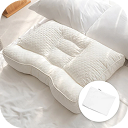
That memory foam pillow you bought to save your neck might actually be the reason you're waking up with a tension headache. It feels like a cloud for five minutes; however, sinking too deep often traps your cervical spine in a strained, unnatural curve for eight hours. This struggle makes the latex vs memory foam pillow for neck pain debate more than just a shopping choice. It's a search for relief. We know the routine. You wake up multiple times to adjust your loft, only to greet the morning with stiff shoulders that take hours to loosen.
It's a cycle of physical and emotional exhaustion. You've likely tried every "orthopedic" trend on the market, only to find they flatten out when you need them most. This guide settles the debate by focusing on the science of dynamic support. You'll learn how to achieve lasting spinal alignment that eliminates that morning "kink" in your neck once and for all. We'll explore why 2026 clinical reviews favor responsive, buoyant materials over sinking foams, helping you find a solution that stays supportive and breathable all night long.
Key Takeaways
- Understand why neutral spinal alignment is the essential foundation for eliminating morning stiffness and tension headaches.
- Compare the buoyancy of latex vs memory foam pillow for neck pain to see why "sinking" materials often lead to poor cervical support.
- Learn the 2026 checklist for measuring your ideal pillow loft based on your shoulder breadth and current mattress firmness.
- Discover how ergonomic contouring helps re-train the neck's natural curve to provide relief for chronic stiffness and "Military Neck."
- See how 100% natural latex offers the dynamic, lasting support required to maintain your alignment without the pillow flattening over time.
The Science of Neutral Alignment: Why Your Pillow is the Culprit
Morning stiffness isn't just a sign of getting older. It's a mechanical failure. Most people blame their stress or a busy schedule for those recurring neck kinks; however, the real culprit is usually hiding right under your head. Neutral spinal alignment is the foundation of pain-free sleep. It occurs when your vertebrae are stacked naturally without any muscular effort. When your pillow fails to maintain this line, your neck muscles stay "on" all night. They fight to protect your spine from awkward angles. This leads to repetitive micro-trauma. It's a slow-motion injury that happens while you're dreaming.
Understanding Cervical Lordosis
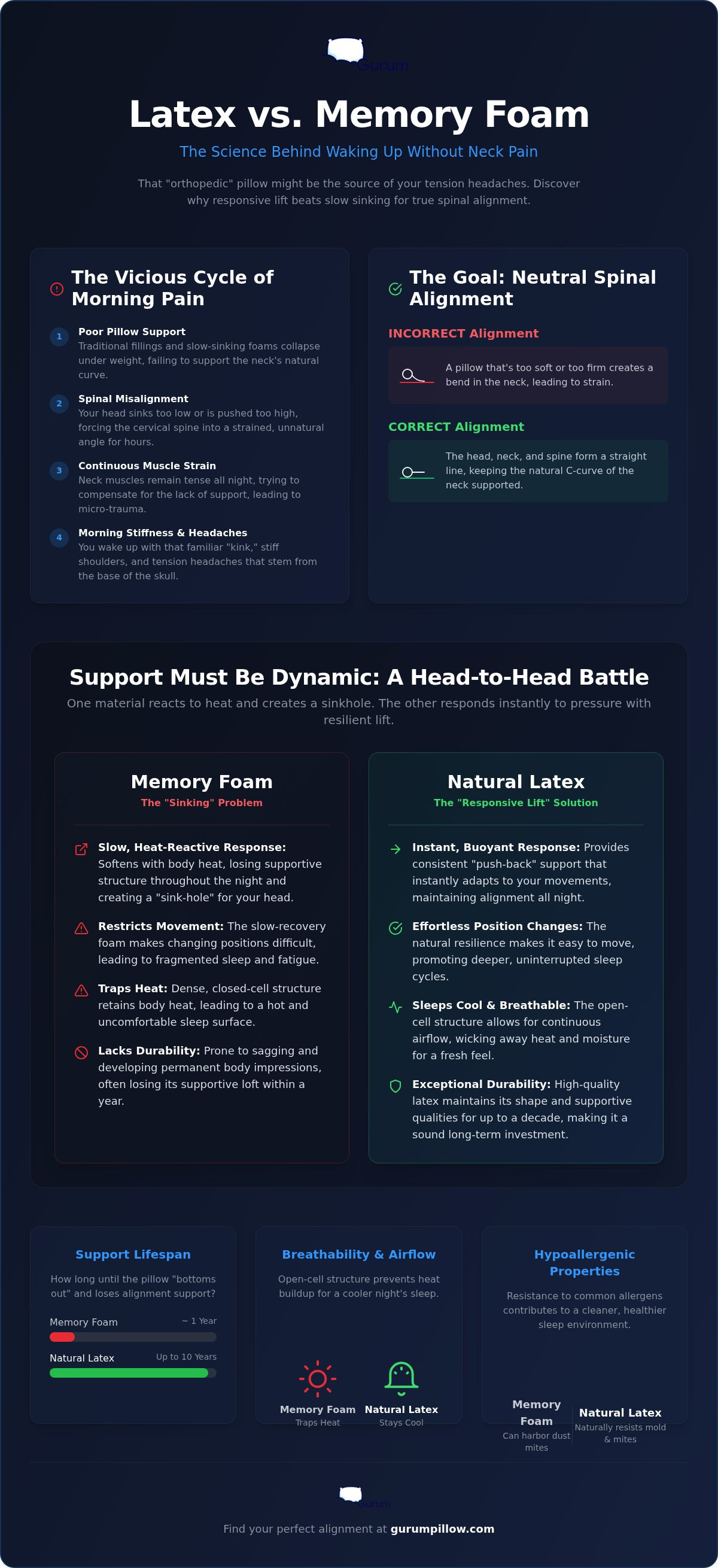
Your neck isn't meant to be straight. It has a natural, healthy C-curve known as cervical lordosis. This curve acts as a shock absorber for your head. It needs structural support, not just soft padding. During eight hours of sleep, gravity constantly pulls at your skull. Without a firm foundation, that natural curve flattens or reverses. This strain radiates upward into the base of the skull. It's the direct cause of those heavy tension headaches that take hours to fade. Many sleepers switch to orthopedic pillows to find relief, but the material inside determines if that support actually lasts until sunrise.
The Failure of Traditional Fillings
Traditional fluffy pillows are essentially "dead" support materials. Down, feathers, and polyester fibers feel luxurious when you first lie down. Then, they collapse. This is the "bottoming out" effect. As the air escapes the filling, your head sinks until it almost touches the mattress. This creates lateral flexion. Your neck bends sideways or backward into a strained, jagged angle. This collapse is why the latex vs memory foam pillow for neck pain debate is so important for your health. You don't need a pillow that simply cushions your head; you need one that provides a constant upward force. If you're choosing a latex vs memory foam pillow for neck pain, remember that alignment requires active resistance. You need a material that fills the gap between your ear and the mattress without losing its shape by 3:00 AM.
Latex vs. Memory Foam: Why Support Must Be Dynamic
Support is not a static state. It's an active process. When you toss and turn at night, your pillow needs to move with you. This is the core of the latex vs memory foam pillow for neck pain debate. One material waits for your body heat to react; the other responds instantly to your weight. This difference determines whether you wake up refreshed or in agony. For those struggling with chronic stiffness, the speed of that response is everything. You need a material that keeps up with your body's micro-adjustments throughout the night.
The Sink-Hole Problem in Memory Foam
Memory foam was originally designed for pressure relief, but it often fails at structural alignment. It's heat-reactive by nature. As your head warms the foam, the material softens and loses its integrity. You might start the night feeling supported, but by 2:00 AM, you're trapped in a "sink-hole." This is a major disadvantage for spinal health. Changing positions becomes a physical chore. You have to fight against the slow-recovery foam just to roll over. This struggle often wakes you up. It leads to fragmented sleep and morning fatigue. If the foam "remembers" a slumped position, your neck stays in that slump for hours, causing the very tension you're trying to avoid.
Natural Latex: The Resilient Alternative
Natural latex offers a completely different physical experience. It provides "lift" rather than "sink." This push-back force is vital for maintaining the crucial gap between your shoulder and ear. It keeps your head on a level plane with your spine. Unlike traditional foam, latex has an open-cell structure. It doesn't trap heat; it breathes. This thermoregulation keeps your sleep surface cool and consistent all night long. Latex is also naturally hypoallergenic. It resists dust mites and mold without the need for harsh chemicals or synthetic additives. It's a cleaner, more responsive way to rest.
Resilience is the hallmark of quality. While memory foam often sags and loses its loft within a year, high-quality latex stays bouncy for a decade. It's a long-term investment in your physical health. For those tired of the "bottoming out" effect, switching to a more responsive material is often life-changing. You can explore more about these benefits in our Best Latex Pillow 2026: The Ultimate Guide to Pain-Free Sleep. Finding the right balance of softness and strength is the final step toward a pain-free morning. If you're ready to stop the sinking, consider starting your journey with a natural support system designed for the human body.
Correcting Military Neck and Chronic Stiffness at Home
Modern life has a habit of pulling us forward. Between smartphones and laptop screens, the "Tech Neck" epidemic has become a silent thief of restorative sleep. This constant forward-leaning posture doesn't just strain your muscles; it physically reshapes your spine. Over time, the healthy C-curve of your neck begins to straighten into a condition known as Military Neck. When this happens, your body loses its natural ability to absorb shock and distribute weight. The result is a cycle of chronic stiffness and reduced range of motion that follows you from the bedroom to the office.
What is Military Neck?
Military Neck, or the loss of cervical lordosis, is more than just a stiff neck. It's a structural misalignment where the vertebrae in your neck lose their natural curvature. This straightening puts immense pressure on your nerves and spinal discs. You might experience sharp pains, numbness in your fingers, or a persistent dull ache at the base of your skull. A specialized pillow acts as a passive stretching tool during the night. It isn't just a place to rest your head. It's a corrective device that gently encourages your spine back into its proper shape while you're unconscious. This makes the latex vs memory foam pillow for neck pain comparison particularly important for those with Military Neck.
The Role of Ergonomic Contouring
A flat, traditional pillow is the enemy of a curved neck. It provides zero support for the hollow space behind your neck, leaving your muscles to do the heavy lifting all night. Ergonomic contouring solves this by providing a dedicated neck roll and a recessed center for your head. This "cradle effect" keeps your head centered and prevents the rolling that leads to morning kinks. When choosing between a latex vs memory foam pillow for neck pain, the material's ability to hold this contour is vital. Memory foam often loses its shape as it warms up, which can cause your neck to lose that corrective stretch halfway through the night.
Because natural latex is more resilient, it maintains the necessary height to support the cervical curve until the moment you wake up. It provides a consistent lift that memory foam simply can't match. If you're new to ergonomic support, be patient with yourself. There is usually a two-week adjustment period as your muscles unlearn years of poor posture. It might feel firm or "different" at first; however, that's the feeling of your spine returning to neutral. For a deeper look at how this works, check out our Cervical Pillow Guide: How Ergonomic Support Heals Neck Pain at Night. Your body didn't lose its curve in one day, and it won't get it back in one night. Consistency is the key to lasting relief.
The 2026 Checklist: Finding Your Perfect Loft and Firmness
Finding the right pillow isn't about following a general trend. It's about personal geometry. Most guides offer a one-size-fits-all recommendation; however, your shoulder width and mattress firmness are the real variables. A 2025 clinical review confirmed that no single material is universally superior for everyone. Instead, success depends on how well the pillow maintains your specific neutral alignment. When weighing the latex vs memory foam pillow for neck pain, you must first understand the physical gap you need to fill. If your pillow is too high, your neck flexes upward. Too low, and it drops toward the mattress. Both scenarios lead to the same result: a morning spent rubbing a sore neck.
Measuring Your Ideal Loft
Side sleepers make up a significant portion of the population. A July 2026 report noted that 63% of older adults managing chronic pain prefer sleeping on their sides. If you fall into this group, you need to measure your ear-to-shoulder gap. You can do this at home with the Wall Test. Stand sideways against a wall with your shoulder touching the surface. Have someone measure the distance from your ear to the wall. This measurement is your target loft. Back sleepers, conversely, require a lower profile with a reinforced roll to support the cervical curve. The best loft keeps your nose in line with your sternum. Avoid the common mistake of double-stacking cheap pillows. This creates an unstable, shifting foundation that forces your muscles to work throughout the night.
Your mattress also dictates your pillow height. If you sleep on a soft mattress, your shoulders sink deeper into the bed. This reduces the gap between your head and the surface, meaning you need a lower loft pillow. On a firm mattress, your body stays on top of the material. This requires a higher loft to keep your spine straight. This interaction is why many people struggle with the latex vs memory foam pillow for neck pain decision. They buy a pillow based on a review without considering their own bed. A responsive material like natural latex is often preferred because it doesn't compress further as the night goes on, unlike memory foam which can lose up to 25% of its height as it absorbs body heat.
Material Purity Matters
Not all latex is created equal. Many "latex" pillows on the market are actually synthetic blends or "shredded" foams that lack structural integrity. For true spinal support, 100% natural latex is the gold standard. It provides a consistent, buoyant lift that lasts for years. Protecting this investment is equally important for your respiratory and skin health. Using an Anti-Allergy Pillow Cover keeps your sleep environment free from dust mites and moisture buildup. This is especially vital for natural materials, as it preserves the open-cell structure that allows for breathability. When your pillow stays cool and clean, you move less. Less movement means fewer opportunities for your spine to fall out of alignment.
Ready to stop the guesswork and start waking up refreshed? You can find the ideal balance of height and resilience with our Premium Latex Pillow, designed specifically to maintain your cervical curve all night long.
Wake Up Refreshed: The Gurum Premium Latex Pillow Difference
Choosing between a latex vs memory foam pillow for neck pain often feels like a high-stakes gamble. You've likely spent years cycling through expensive foam options that promised relief but delivered only heat, sagging, and morning stiffness. We understand that frustration. At Gurum Pillow, we don't just sell bedding; we provide a perfected tool for anatomical restoration. Our approach is born from a deep understanding of the physical and emotional toll that chronic discomfort takes on your daily life. It’s time to stop settling for pillows that flatten out when you need them most.
Designed by a Sufferer, Perfected for You
Our founder, Ji H. Won, didn't start Gurum Pillow to join a crowded marketplace. He started it to solve his own chronic neck pain. After years of waking up with tension headaches and a "kink" in his neck, he realized that traditional pillows were part of the problem. He lived the same reality you do: adjusting the loft at 3:00 AM and hoping the next morning would be different. This personal struggle fueled a mission to end the cycle of poor rest. He focused on the science of lift rather than the marketing of "softness."
The resulting ergonomic design was tested to provide genuine cervical support for real-world sleepers. It isn't just about a shape; it's about the material's ability to resist gravity. The Gurum Premium Latex Pillow provides a quiet confidence. It doesn't rely on gimmicks or complex cooling gels that eventually fail. Instead, it relies on the inherent properties of 100% natural latex to keep your spine aligned. It’s a professional-grade tool for your home, designed by someone who knows exactly how much a good night’s sleep is worth.
Your Journey to Pain-Free Sleep Starts Here
When you invest in a Gurum Pillow product, you're investing in a long-term wellness partner. We use 100% natural latex because it is the most resilient material on the planet for sleep support. While the latex vs memory foam pillow for neck pain debate often focuses on initial feel, the real winner is the material that maintains its shape for a decade. Our pillows won't sag, dip, or lose their density after six months of use. They provide the same consistent "push-back" force on day 3,000 as they do on day one. This durability makes it the last pillow you'll ever need to buy.
We want your path to relief to be as smooth as possible. That’s why we offer free shipping within the USA on all orders. Whether you're at home with our Premium Latex Pillow or on the road with our Travel Latex Pillow, your alignment remains our priority. We also recommend our Anti-Allergy Pillow Cover to preserve the purity and breathability of your latex core. You deserve to wake up without the weight of yesterday's tension. Take the first step toward a transformative sleep experience today. You’ve struggled with the wrong support for long enough; it’s time to finally wake up refreshed and pain-free.
Take the Final Step Toward Pain-Free Mornings
Restorative sleep shouldn't feel like a luxury you can't reach. It's a fundamental part of your physical health and emotional well-being. Throughout this guide, we've explored how neutral alignment and dynamic lift are the only real solutions for chronic stiffness. The decision between a latex vs memory foam pillow for neck pain is ultimately about choosing a material that works with your body's geometry rather than against it. You need the buoyant, resilient support of natural latex to keep your cervical curve protected from the first hour of sleep to the last.
You've struggled with poor rest for long enough. It's time to invest in a solution that won't flatten or fail you. Our 100% Natural Latex pillows are specifically designed for cervical support, helping you wake up without the heavy burden of tension headaches or stiff shoulders. We're proud to offer free US shipping to help you start this journey toward recovery. Experience the relief of the Gurum Premium Latex Pillow and rediscover what it feels like to wake up truly refreshed. You deserve to start every day feeling your best.
Frequently Asked Questions
Can a pillow really fix chronic neck pain?
A high-quality pillow can significantly reduce chronic neck pain by maintaining neutral spinal alignment throughout the night. It isn't a medical cure-all; however, it removes the primary mechanical stressor that causes muscle strain. By supporting the natural cervical curve, it allows your muscles to fully relax and heal rather than fighting to protect your spine while you sleep.
How long does it take to get used to a cervical latex pillow?
Most sleepers require an adjustment period of 10 to 14 days when switching to an ergonomic latex pillow. Your neck muscles have likely spent years compensating for poor posture and flat pillows. As the new support gently re-trains your spine to its natural curve, you might feel a different kind of temporary soreness. This is a normal sign of your body returning to a healthy neutral state.
Is a firm or soft pillow better for neck pain?
A medium-firm pillow is generally superior for neck pain because it provides the necessary "push-back" to hold your head in line with your spine. Soft pillows often feel comfortable for the first few minutes but quickly collapse under the weight of your head. This collapse leads to lateral flexion and morning stiffness. You need structural integrity to keep your vertebrae stacked correctly.
How often should I replace my latex neck pain pillow?
You should replace a high-quality natural latex pillow every 5 to 10 years. This is a significant advantage in the latex vs memory foam pillow for neck pain debate. While memory foam often sags and loses its density within two years, 100% natural latex is incredibly resilient. It maintains its loft and support levels for a decade, making it a much more durable investment for your physical health.
What is the best pillow for side sleepers with neck and shoulder pain?
The best pillow for side sleepers is one with a higher loft that fills the entire gap between the ear and the shoulder. In the latex vs memory foam pillow for neck pain comparison, side sleepers benefit most from the buoyant lift of latex. It prevents the head from sinking too low. This stops the shoulder from collapsing inward and reduces the pressure that leads to rotator cuff discomfort.
Are latex pillows good for people with allergies?
Natural latex is an excellent choice for allergy sufferers because it is inherently resistant to dust mites, mold, and mildew. It doesn't require the harsh chemical treatments often found in synthetic foams. For maximum protection, pairing your pillow with an Anti-Allergy Pillow Cover ensures a clean, breathable sleep environment that won't irritate your respiratory system or skin.
What happens if my pillow is too high or too low?
If your pillow is too high, your neck is forced into a strained upward tilt; if it's too low, your head drops toward the mattress. Both extremes pull your vertebrae out of alignment. This misalignment causes constant muscle spasms and can even lead to nerve impingement. This is why you might wake up with "pins and needles" or numbness in your arms and fingers.
Why do I wake up with a stiff neck every morning?
Waking up with a stiff neck is usually a clear sign that your current pillow is "bottoming out" or failing to support your cervical curve. Stiffness occurs when your muscles spend the entire night working to protect your spinal cord from awkward angles. A responsive material prevents this muscle fatigue by doing the heavy lifting for you, allowing you to wake up without that familiar morning ache.