


The tightest compression roll might actually be the fastest way to ruin your next vacation. We've all been there, desperately trying to shave off every millimeter of luggage space only to arrive at 30,000 feet with a pillow that's lost its structural integrity. It's a frustrating trade-off between a manageable bag and the cervical support your neck craves during a long-haul flight. Waking up with a stiff neck isn't just an inconvenience; it's a physical tax on your travel experience that can linger for days.
You don't have to choose between a light carry-on and waking up refreshed. Learning how to pack a travel pillow correctly ensures you maintain professional-grade support without sacrificing precious real estate in your bag. We'll show you how to master the art of space-saving while preserving the lifespan of your pillow's internal structure. This guide previews the most effective folding methods, clarifies 2026 TSA regulations regarding gel-filled inserts, and highlights why materials like natural latex offer the resilient recovery you need after being tucked away in a suitcase.
Key Takeaways
- Protect your cervical spine by choosing strategic packing spots that maintain your pillow's vital structural integrity.
- Master how to pack a travel pillow using the "Burrito Roll" technique to save space while ensuring immediate support upon arrival.
- Understand why natural latex is the ideal travel material, offering quick recovery and consistent breathability that foam alternatives lack.
- Keep your sleep environment hygienic by using an anti-allergy pillow cover to shield against common airport contaminants.
Why Your Travel Pillow Deserves a Strategic Spot in Your Luggage
Your neck isn't designed for ten-hour flights in a cramped seat. When you prioritize luggage space over ergonomic support, your cervical spine pays the price. Most travelers treat their sleep support as a secondary concern; they often cram it into any available gap at the last minute. This leads to a common frustration: the collapsed pillow. A pillow that has lost its structural integrity provides no real benefit at 30,000 feet. It becomes a bulky accessory that fails to do its only job.
Airline pillows are notoriously inadequate. They are often thin, flimsy, and fail to maintain the necessary anatomical alignment for restorative rest. If you rely on these, you're essentially gambling with your physical comfort. Approximately 70% of frequent travelers report using neck support pillows during long journeys to avoid this exact issue. This is why understanding how to pack a travel pillow matters so much. It's about protecting your health; it's not just about organizing your bag. Travel pillows are specialized tools, and like any tool, they require proper handling to function effectively.
The Anatomy of Travel-Induced Neck Pain
Sleeping upright places immense strain on the neck muscles. Without proper support, your head tilts at awkward angles, stretching ligaments and compressing nerves. Your cervical spine requires a consistent, resilient surface to remain neutral. If you've packed your pillow so tightly that the material has deformed, it won't push back against the weight of your head. A collapsed support is often worse than having no pillow at all. It creates a false sense of security while your neck remains dangerously unsupported during transit.
Defining Your Packing Goals
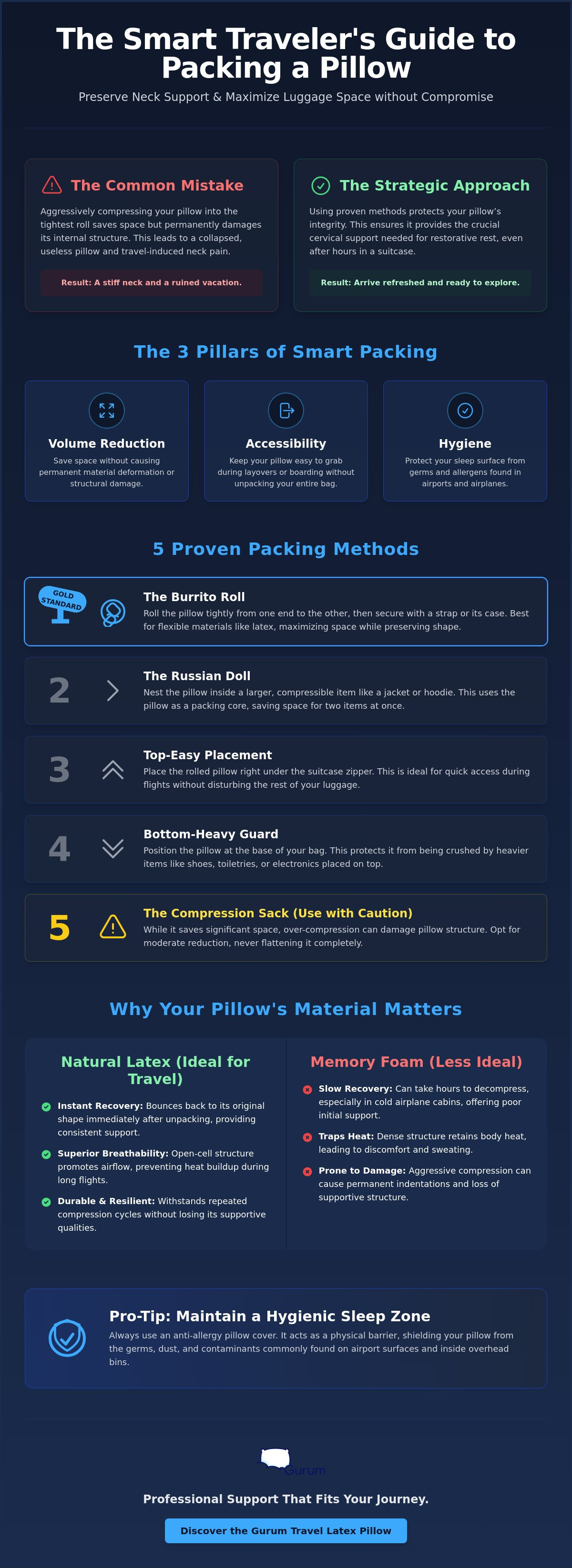
Successful packing balances three critical pillars. You need volume reduction. You want to save space without causing permanent material deformation. Second, consider accessibility. You don't want to dig through your entire suitcase during a short layover or while boarding. Finally, hygiene is paramount. Your pillow shouldn't touch the floor of a plane or the inside of a dirty overhead bin. Using an Anti-Allergy Pillow Cover ensures your sleep surface remains pristine and germ-free throughout your journey, regardless of where your bag is stored.
Strategic packing also extends the life of your gear. High-quality materials, like those found in a Travel Latex Pillow, are durable but still require intentional care. If you constantly crush your pillow into a tiny ball without a plan, you risk breaking down the internal structure over time. Learning how to pack a travel pillow correctly ensures that your investment provides the same level of comfort on your fiftieth trip as it did on your first. It's the difference between arriving at your destination exhausted and waking up ready to explore.
5 Proven Methods for Packing Your Travel Pillow Efficiently
Efficiency starts with technique. You don't need a larger bag; you need a better plan. Many travelers struggle with how to pack a travel pillow because they treat it as a solid object rather than a flexible tool. By using specific folding and placement strategies, you can reclaim significant luggage space while protecting the pillow's ergonomic shape. It's about working with the material, not against it.
The "Burrito Roll" is the gold standard for flexible materials. Start at one end and roll the pillow as tightly as possible, securing it with a built-in strap or its own travel case. This mimics the way professional campers pack sleeping bags. For those with limited interior room, the Russian Doll method works wonders. Nest your pillow inside a bulky jacket or hoodie before folding the garment. This uses the pillow as a structural core for your clothes, effectively saving space in two ways at once.
Where you place the item inside your suitcase changes your experience. A "Top-Easy" approach puts the pillow right under the zipper for immediate access. This is ideal for long flights with multiple legs. Conversely, a "Bottom-Heavy" strategy places the pillow at the very base of your bag. This protects the pillow from being crushed by heavier items like shoes or electronics. If you're looking for a solution designed for this level of portability, our Travel Latex Pillow offers the perfect balance of compressibility and support.
The Compression Sack Strategy
Compression is a double-edged sword. While it saves immense space, over-crushing can damage the internal structure of your support. Choose a sack that reduces volume moderately rather than trying to flatten it completely. When discussing Latex vs. Memory Foam, material resilience is key. Natural latex excels here; it bounces back almost instantly when released. If you use a vacuum bag, release the air slowly once you arrive. This prevents material shock, which occurs when fibers are forced to expand too rapidly after prolonged pressure.
External Carry Options
Sometimes the best way how to pack a travel pillow is to not put it inside the bag at all. Use a heavy-duty carabiner to clip the pillow's handle to your backpack strap. This keeps it within arm's reach and frees up internal volume for other essentials. If you use a rolling carry-on, try the "Handle Wrap" technique. Secure the pillow around the telescoping handle of your suitcase using its own snaps. To keep the surface clean while it's exposed to the cabin environment, always use an Anti-Allergy Pillow Cover. It acts as a protective shield against dust and airport grime.
Latex vs. Memory Foam: How Material Choice Changes Your Packing Strategy
Your choice of material dictates your success when deciding how to pack a travel pillow. Not all fills respond the same way to the pressure of a suitcase. While memory foam is a common market leader, accounting for roughly 48% of sales, its physical properties can create significant hurdles for the frequent traveler. Natural latex represents a smaller niche (about 15% of the market) but offers distinct advantages in durability and recovery that synthetic alternatives simply cannot match. Understanding these differences prevents you from arriving with a permanently deformed support.
The biggest risk with traditional foam is the "memory set." When you leave memory foam compressed for the duration of a long-haul flight, it often struggles to regain its original loft. This is especially true in cold environments. If your bag is stored in a chilly cargo hold or a drafty overhead bin, the foam can become stiff and unresponsive. In contrast, inflatable pillows are the undisputed kings of space-saving, yet they frequently fail to provide the anatomical alignment required for actual rest. They offer volume without the necessary density to cradle the cervical spine.
The Resilience of Natural Latex
Natural latex is the superior choice for those who prioritize both space and health. Its open-cell structure allows for constant airflow, which is vital for Maintaining Hygiene on the Road. This breathability prevents the buildup of moisture and heat even when the pillow is tucked into a tight corner of your luggage. Unlike synthetic materials, natural latex travel pillows don't lose their supportive "push-back" after being rolled. Latex resilience is its ability to return to its original shape instantly.
Memory Foam Limitations
Memory foam is highly sensitive to temperature and pressure. If you roll a foam pillow too tightly while it's cold, you risk "cracking" the internal structure, which leads to permanent support failure. It also requires a significant "breathing" period after unpacking. You might have to wait thirty minutes for the foam to warm up and expand before it's usable. Latex is often lighter than high-density memory foam, making it easier to stay under strict carry-on weight limits. When you're learning how to pack a travel pillow, choosing a resilient material like latex ensures your gear is ready to perform the moment you reach your seat.
Maintaining Hygiene and Support Integrity on the Road
Cleanliness is often the first casualty of a long journey. When you're focused on how to pack a travel pillow to save space, it's easy to overlook what that pillow is touching. Think about the standard TSA security bin. These plastic containers hold shoes, belts, and coins from thousands of travelers every day. Placing your sleep surface directly into one of these bins is a significant hygiene risk. Germs and bacteria can linger on these surfaces for hours. Your pillow shouldn't just be compact; it must remain a sterile sanctuary for your face and neck throughout the trip.
Moisture buildup is another hidden enemy of compressed travel gear. When you tightly roll a pillow, you trap any residual humidity or perspiration inside the material. If left in a dark suitcase for twelve hours or more, this can lead to unpleasant odors or even mold growth. Always ensure your pillow is completely dry before it goes into a compression sack or "burrito roll." If you've just finished a stressful dash through the terminal, give the material a few minutes to breathe before you commit to a tight pack. While natural latex is inherently more resistant to microbes than synthetic foam, it still requires proper airflow to stay fresh.
The Role of Anti-Allergy Covers
An extra layer of defense is essential in the unpredictable environment of an airplane cabin. High-quality anti-allergy pillow covers act as a sacrificial barrier during transit. They shield the core material from dust mites, dander, and liquid spills that are common in public spaces. Look for fabrics that are tightly woven yet breathable to ensure you don't overheat. These covers are easy to strip off and toss into a hot wash the moment you reach your hotel. This ensures that even if your bag was tossed around a dirty cargo hold, your actual sleep surface remains pristine. To protect your investment, consider adding an Anti-Allergy Pillow Cover to your travel kit.
Post-Travel Pillow Care
Your care routine shouldn't end when you land. Once you reach your destination, implement a "Fluff and Air" routine. Remove the pillow from its bag and shake it vigorously to help the fibers or latex cells expand to their full capacity. This restores the loft you need for proper cervical support. For spot cleaning, use a damp cloth with mild soap; avoid soaking the internal core as this can damage the material's structure. When you return home, store your pillow in a cool, dry place rather than leaving it compressed in your luggage. This simple habit prevents "musty" smells and ensures the material stays resilient for your next adventure. Knowing how to pack a travel pillow also means knowing how to unpack it with the respect your sleep deserves.
The Gurum Travel Latex Pillow: Professional Support That Fits Your Journey
You've mastered the technical side of how to pack a travel pillow to maximize your luggage space. Now, it's vital to ensure the pillow you're packing is actually worth the effort. Most travel accessories are designed for the suitcase first and the human body second. We've reversed that priority. Our Travel Latex Pillow bridges the gap between the restorative rest you get at home and the physical demands of long-haul transit. It's a professional-grade tool for your wellness journey.
Durability is the hallmark of a true travel investment. You shouldn't have to replace your gear every few trips because the material has "set" or lost its loft. Our 100% natural latex survives hundreds of packing cycles without losing its vital push-back. It's resilient. It's reliable. It's the silent partner in your travel routine that ensures you never have to settle for the flimsy alternatives provided by airlines. When you invest in quality, you're investing in your own recovery.
Engineered for the Cervical Spine
We scaled the specialized technology from the best latex pillow for neck pain specifically for the constraints of an airplane seat. Side sleepers and back sleepers both find immediate relief because the material adapts to your posture without delay. It doesn't require body heat to soften like synthetic foam does. This means you get consistent, cool support the moment you lean back in your seat. Gurum pillows maintain their precise anatomical shape over years of heavy travel thanks to the inherent structural memory of 100% natural latex.
Travel-Specific Features
Our design features compact sizing that doesn't compromise on the actual support surface area. You get the full benefit of a high-loft pillow in a form factor that fits into your carry-on with ease. For the sensitive traveler, the hypoallergenic properties of our latex provide a clean, irritant-free sleep environment. We understand the logistical stress of modern travel, so we've simplified the process by offering free shipping across the United States for all your travel essentials. This includes our Travel Latex Pillow and the protective Anti-Allergy Pillow Cover.
Stop settling for a stiff neck and a groggy arrival. When you master how to pack a travel pillow and pair that skill with the right material, your entire travel experience shifts. You arrive refreshed. You arrive pain-free. Most importantly, you arrive ready to perform at your best. Your journey deserves the same level of professional support that you expect in your own bedroom.
Arrive Ready for Your Next Adventure
Restorative sleep shouldn't be a luxury you leave behind at home. By mastering how to pack a travel pillow, you protect your cervical spine and ensure every journey begins with physical relief rather than a stiff neck. Success on the road depends on the balance of smart compression and material resilience. Choosing natural latex allows for instant recovery after hours of pressure, while a dedicated anti-allergy cover keeps your sleep surface pristine regardless of the environment. These small strategic shifts ensure your gear works for you, not against you.
You deserve a travel companion that understands the intricate science of rest. Our 100% Natural Latex support is designed by a neck pain specialist to provide professional-grade alignment in the most challenging seats. It's built to stay breathable and durable through years of transit. We also offer Free US Shipping to make your preparation even easier. Don't let another long-haul flight take a toll on your well-being.
Upgrade your journey with the Gurum Travel Latex Pillow and experience the transformative power of waking up refreshed. Your next destination is waiting, and you should arrive ready to enjoy every moment of it.
Frequently Asked Questions
Can I bring a full-sized pillow as a personal item on a plane?
Most major carriers, including Southwest Airlines, specify that a neck pillow does not count toward your carry-on or personal item limit. You can typically carry a full-sized pillow as an additional item, but it may be bulky to manage in a crowded cabin. If you are struggling with how to pack a travel pillow of a larger size, consider using a compression bag to fit it inside your suitcase instead of carrying it by hand.
Will compressing my memory foam travel pillow ruin it?
Leaving memory foam compressed for long periods can lead to permanent material deformation or "cracking," especially in cold cargo holds. Synthetic foam lacks the quick recovery of natural materials and often requires significant time to regain its shape after unpacking. If you must compress foam, try to release it as soon as you reach your destination to minimize structural damage.
How do I keep my travel pillow clean while it is attached to my bag?
Using an Anti-Allergy Pillow Cover is the most effective way to maintain hygiene during transit. This protective layer shields the pillow from germs in TSA bins and dust in the overhead compartment. If your pillow is clipped to the outside of your bag, ensure the cover is zipped tight and consider a water-resistant outer shell for extra protection against spills or rain.
What is the best way to pack a U-shaped neck pillow?
The most efficient method is the "Handle Wrap" technique, where you use the pillow's snaps to secure it around the telescoping handle of your rolling luggage. If you prefer to keep it inside your bag, use the "Burrito Roll" to reduce its volume. Knowing how to pack a travel pillow this way keeps it accessible for your flight while freeing up internal suitcase space for clothing.
Do compression bags actually work for latex pillows?
Compression bags are highly effective for natural latex due to its resilient, open-cell structure. Unlike synthetic foam, latex can be compressed to save space and will bounce back to its original loft almost instantly when the air is released. This makes it a superior choice for travelers who need to maximize luggage space without sacrificing the ergonomic support their neck requires.
How long can I leave my travel pillow compressed in my suitcase?
You should limit compression time to the duration of your transit, ideally no more than 24 hours. While high-quality materials like natural latex are durable, leaving any pillow tightly packed for weeks can eventually stress the internal fibers. Make it a habit to unpack and fluff your pillow as soon as you check into your hotel to ensure the material stays healthy and supportive.
Is an inflatable travel pillow better for saving space than a foam one?
Inflatable pillows are the leaders in volume reduction, but they often fail to provide necessary anatomical alignment. They lack the consistent density needed to cradle the cervical spine, which can lead to a stiff neck. A Travel Latex Pillow offers a better compromise; it compresses significantly for packing while providing professional-grade support that an air-filled bladder simply cannot match.
Does TSA allow pillows through security checkpoints?
TSA generally permits pillows through security, but there are specific rules for certain fills. As of January 2026, gel-filled neck pillows are reclassified as liquids and must follow the 3.4-ounce rule if the gel is non-removable. Always remember that the final decision rests with the individual TSA officer, so choose a solid-fill pillow like latex to avoid potential delays at the checkpoint.