

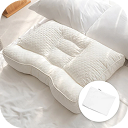
Is your pillow actually sabotaging your health? A 2023 survey found that 54% of adults prefer side sleeping, yet many spend their nights on surfaces that go flat by 3 AM. You know the feeling of waking up with a sharp crick in your neck or a shoulder that’s completely numb from compression. It’s exhausting to cycle through dozens of pillows only to end up with the same morning stiffness and fatigue.
We understand that frustration. You’ve likely tried every "miracle" foam on the market and still felt let down. You deserve a sleep solution that is supportive and comfortable, not rock-hard. This guide shows you the exact steps to selecting an ergonomic pillow for side sleepers that keeps your spine perfectly aligned until morning. Our goal is to help you finally wake up without neck pain.
We will walk you through the precise loft heights required for shoulder relief, the cooling benefits of natural materials, and the three-step alignment check for a restorative 2026. It’s time to stop settling for mediocre rest and start waking up refreshed.
Key Takeaways
- Understand the specific ear-to-shoulder gap that causes pillow collapse and how to maintain perfect cervical spine alignment.
- Master a two-step measurement guide to calculate your ideal pillow loft based on shoulder width and mattress sinkage.
- Compare materials to see why an ergonomic pillow for side sleepers made of natural latex provides better responsiveness than memory foam.
- Discover how to navigate the initial transition period and position your neck correctly for maximum cradled support.
- Learn how premium contouring and hypoallergenic Talalay latex work together to help you finally wake up without neck pain.
The Side Sleeper’s Dilemma: Why Alignment is Your Biggest Challenge
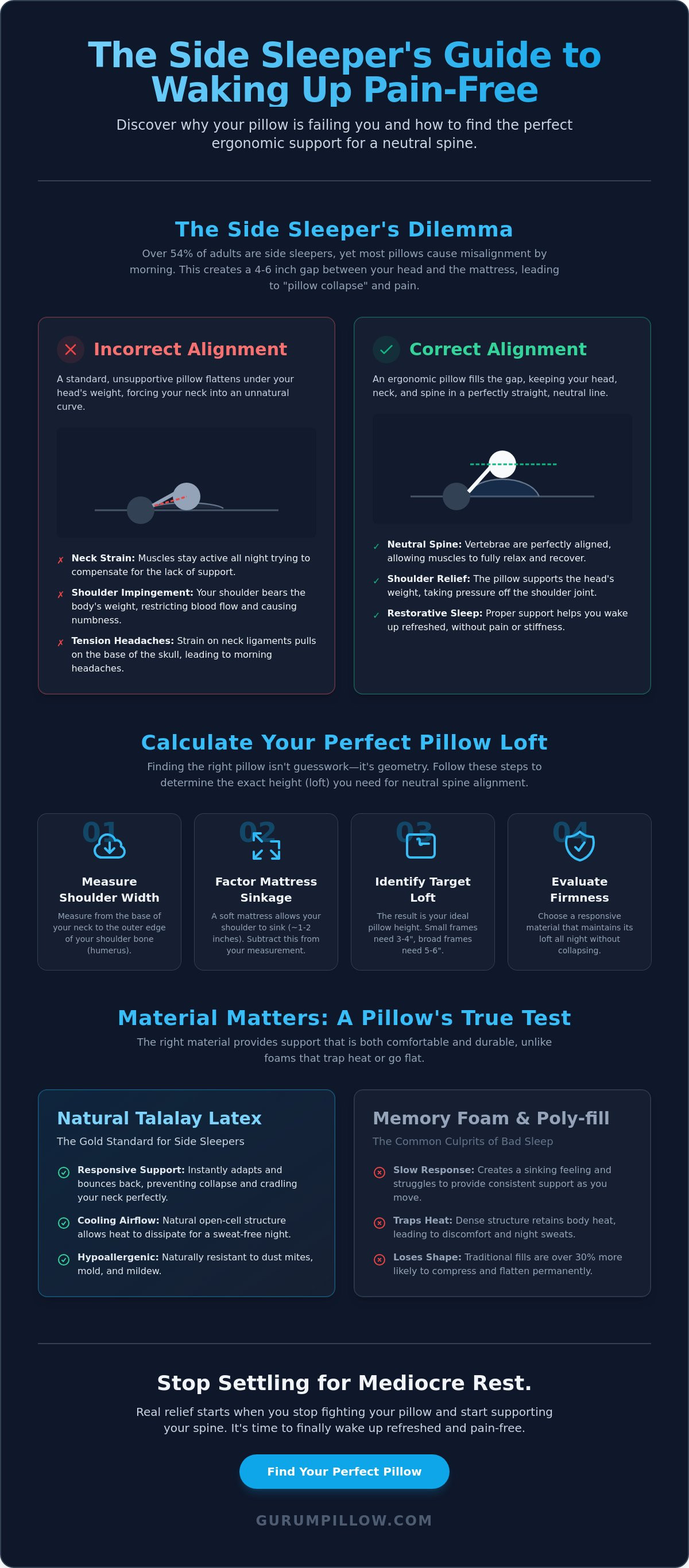
Sleeping on your side is a healthy choice for your heart and breathing. However, it creates a unique structural problem for your skeleton. When you lie down, a 4 to 6-inch gap opens between your ear and the mattress. Most traditional pillows are designed for aesthetics, not anatomy. They feel soft at first, but they lack the structural integrity to hold your head up all night.
This leads to the dreaded "pillow collapse." Within an hour of falling asleep, the filling shifts or flattens under the 10-pound weight of your head. Your head sinks, forcing your neck into an unnatural curve. An ergonomic pillow for side sleepers solves this by providing consistent, firm elevation. The gold standard for restorative sleep is a neutral spine. This means your head, neck, and mid-back stay in a perfectly straight line. By following proven orthopedic guidelines, these specialized pillows bridge the gap without losing their shape by morning.
The Anatomy of a Side Sleeper’s Neck
Your cervical spine consists of seven small vertebrae that support your head. During lateral recumbent sleep, these bones are vulnerable. If your pillow is too low, your head tilts toward the mattress. If it's too high, your neck overextends. Do you find yourself tucking your arm under your pillow? That's a clear sign of poor support. Your body is trying to manually fill the void your pillow missed. This habit compresses the nerves in your arm and keeps your neck muscles active when they should be resting. Support should come from the pillow, not your limbs.
Common Side-Sleeping Pain Points
Poor alignment doesn't just cause a minor "crick" in your neck. It often leads to shoulder impingement. When your pillow fails, your shoulder takes the full brunt of your body weight. This pressure restricts blood flow and causes that frustrating "pins and needles" sensation in your hands. You might also wake up with a dull, throbbing tension headache. This happens when strained neck ligaments pull on the base of your skull for eight hours straight. If you're tired of the morning struggle, read our guide on 7 Signs Your Current Pillow is Causing Neck Pain to see if your bedding is the real culprit.
We've helped thousands of sleepers move past these frustrations. It's not about finding a "soft" pillow. It's about finding one that's supportive and comfortable, but not rock-hard. Real relief starts when you stop fighting your pillow and start supporting your spine.
How to Measure for Your Perfect Ergonomic Pillow
Finding the right ergonomic pillow for side sleepers isn't about guesswork. It is a matter of geometry. If your pillow is too low, your neck collapses. If it's too high, you wake up with a strain. You need to fill the exact gap between your ear and the mattress to keep your spine neutral. Support where you need it. Comfort everywhere else.
Follow these four steps to find your fit:
- Step 1: Measure your shoulder width. Use a flexible tape measure. Start at the base of your neck and extend it to the outer edge of your humerus bone. If this distance is 5.5 inches, a standard 4-inch pillow will leave you unsupported.
- Step 2: Factor in mattress sinkage. A soft mattress allows your shoulder to sink about 2 inches into the surface. Subtract this sinkage from your shoulder measurement to find your required height.
- Step 3: Identify your target loft. This is the specific height needed to keep your nose perfectly aligned with your sternum. Any deviation causes the cervical spine to bend unnaturally.
- Step 4: Evaluate firmness. Your pillow must maintain its height for 8 hours. Materials like high-density foam or natural latex are 30% better at resisting compression than traditional polyester fills.
The Science of Pillow Loft
One size fits all is a myth that leads to chronic stiffness. Loft is the compressed height of a pillow under the weight of your head. Side sleepers with a small frame typically need a low loft of 3 to 4 inches. Those with broader shoulders or larger frames require a high loft of 5 to 6 inches. If you've felt let down by flat pillows before, you likely need a more stable loft to wake up without neck pain and feel truly restored.
Accounting for Mattress Firmness
Your bed and your pillow work as a team. A soft mattress creates a deeper pocket for your shoulder. This means you need a lower loft pillow to avoid tilting your head upward. On a firm mattress, your shoulder stays on the surface. This creates a larger gap that requires a higher loft to bridge the distance between your ear and the bed. To check your alignment, have a partner look at your spine or use a mirror. Your ear, shoulder, and hip should form a straight, horizontal line. If your head tilts toward the mattress, your loft is too low. Finding the right ergonomic pillow for side sleepers ensures your head doesn't feel like it's resting on a rock-hard surface, but rather a supportive, cloud-like base.
Material Matters: Why All Ergonomic Pillows Are Not Created Equal
The material inside your pillow dictates how you'll feel at 7 a.m. Most shoppers pick based on softness, but for side sleepers, that's a mistake. Traditional down alternatives often collapse under the weight of the head within weeks. Memory foam feels cozy at first, but it often creates a "quicksand" effect that traps your neck in a single, unmoving position. If you want a high-quality ergonomic pillow for side sleepers, the material must provide consistent, active support.
Responsiveness is the most overlooked factor in sleep quality. Data from 2024 sleep ergonomic studies shows that the average person shifts positions up to 20 times per night. If your pillow is slow to react, your spine stays unaligned during those transitions. You need a material that snaps back instantly. This prevents the "bottoming out" sensation that leads to morning shoulder pain. Your pillow should move with you, not make you wait for it to catch up.
Health isn't just about bones and muscles. It's about what you're breathing. Side sleepers spend eight hours with their face pressed directly into the fabric. Synthetic foams can off-gas chemicals or trap allergens like dust mites. Choosing hypoallergenic, natural materials is a necessity for anyone who wakes up with a stuffy nose or skin sensitivity. It's about creating a clean sleep environment that supports your respiratory health while you rest.
The Latex Advantage: Support Without the 'Rock-Hard' Feel
Natural latex provides a "floating" sensation that synthetic materials can't replicate. It offers a distinct push-back property. This ensures your head stays elevated and your neck stays aligned. You get the firmness needed for orthopedic health without the "rock-hard" feeling of cheap foam. It's supportive, and comfortable, but never stiff. For a detailed breakdown of these differences, read our Latex vs. Memory Foam: Why Natural Support Wins guide. Latex maintains its integrity for years, unlike foam which can lose its loft in under 12 months.
Breathability and Temperature Regulation
Heat retention is a common complaint for those using an ergonomic pillow for side sleepers. Side sleeping often leads to "hot ear," where the ear pressed against the pillow becomes uncomfortably warm. Natural latex solves this with an open-cell structure. This design promotes constant airflow, pulling heat away from your skin. A breathable cover made of organic cotton or Tencel further enhances this cooling effect. You stay cool. You stay asleep. No more searching for the cold side of the pillow in the middle of the night.
How to Successfully Transition to an Ergonomic Pillow
Switching to a new ergonomic pillow for side sleepers isn't just a purchase. It's a physical shift. Your body has likely spent years compensating for poor support. When you finally introduce proper alignment, your muscles might resist. This is normal. Most users report a feeling of "differentness" for the first 3 to 5 nights. It isn't discomfort; it's change. The goal is a surface that is supportive, and comfortable (not rock-hard), allowing for deep muscle relaxation.
To position yourself correctly, ensure the pillow's contour fills the entire gap between your ear and your shoulder. Your neck should feel fully cradled. If there's a visible gap, you aren't getting the orthopedic benefits you paid for. High-quality natural latex doesn't need a "break-in" period. Unlike memory foam, latex maintains its structural integrity from day one. If the pillow feels stiff, it's usually your muscles adjusting to being held in a neutral position rather than collapsing. However, if you experience sharp, radiating pain after 14 days, the loft height might be incorrect for your specific shoulder width.
The First 72 Hours: What to Expect
Your brain is currently managing a muscle memory reset. This adjustment period is a neurological recalibration. Your nervous system is learning that it no longer needs to tense the neck muscles to protect the spine. Resist the urge to switch back to your old, flattened pillow during the first three nights. Doing so resets the clock and prevents your body from habituating to the correct posture. Stick with it. Data from sleep studies suggests that by night four, the "stiff" feeling replaces itself with effortless support.
Cleaning and Maintenance for Longevity
Natural latex is resilient but requires specific care. Never submerge a solid latex core in water. This damages the delicate open-cell structure that provides breathability. Instead, spot clean with a damp cloth if necessary. Use an anti-allergy cover to protect your investment from dust mites and moisture. While standard polyester pillows often fail within 6 to 12 months, a high-quality ergonomic pillow for side sleepers made from latex can last between 5 and 10 years. You'll know it's time for a replacement when the material loses its "spring-back" speed; however, this rarely happens before the 2,000-night mark.
Stop settling for restless nights and morning stiffness. Wake up without neck pain by choosing the right support today.
Why Gurum’s Premium Latex Pillow is the Top Choice for Side Sleepers
You've likely spent years cycling through pillows that promised relief but delivered only stiffness. We understand that frustration. Most pillows fail because they treat every sleeper the same. Our mission is different: Wake Up Without Neck Pain. We've spent years refining our design to create the definitive ergonomic pillow for side sleepers. It's a tool built for orthopedic health, not just a soft place to rest your head.
Engineered for Side Sleeping Excellence
Side sleepers require a specific loft to fill the gap between the ear and the mattress. We've optimized our pillow height to accommodate the 18 to 22 inch average width of the American shoulder frame. This precision ensures your spine stays neutral from the moment you lie down until you wake up. Our dual-zone support system offers a soft, pressure-relieving cradle for your face while maintaining firm, structural support for your cervical spine. It provides support where you need it and comfort everywhere else. You can see the engineering details on our Premium Latex Pillow product page.
Material choice makes the difference between a restless night and deep recovery. We use 100% natural Talalay latex because it's superior to synthetic alternatives. Unlike memory foam, which often feels like sleeping on a brick, our latex is supportive and comfortable, not rock-hard. It has a responsive bounce that reacts to your movements instantly. You won't feel "stuck" in a heat-trapping crater. The open-cell structure ensures maximum breathability, keeping you cool even on humid nights.
This is the ideal ergonomic pillow for side sleepers who struggle with allergies or sensitivities. Our latex is inherently hypoallergenic and antimicrobial. It's a clean sleep environment that stops you from waking up sneezing. We've eliminated the harsh chemicals and off-gassing common in mass-produced foam pillows, focusing instead on pure, sustainable materials that protect your health.
A Wellness Partner for Better Sleep
We view ourselves as your partner in health. Our commitment to chemical-free, natural materials is about long-term wellness. We know that once you experience the difference of proper alignment, you won't go back to traditional pillows. To make your decision easier, we offer free shipping and a dedicated focus on customer satisfaction. We want the process of ending your neck pain to be as stress-free as the sleep you're about to enjoy. Don't settle for another night of tossing and turning. Experience the relief of a Gurum Pillow today.
Wake Up Without Neck Pain in 2026
You've spent too many mornings waking up with a stiff neck and a lingering headache. Finding the perfect ergonomic pillow for side sleepers isn't just about luxury; it's about protecting your long-term spinal health. Orthopedic experts confirm that maintaining a neutral spine is the only way to prevent chronic cervical strain. By measuring your shoulder width and choosing 100% natural latex over chemical-heavy memory foam, you're making a calculated investment in your daily wellness. The transition might take a few nights, but the physical relief is permanent.
The Gurum Premium Latex Pillow provides the specific density needed to support your head while keeping your neck perfectly aligned. You don't have to settle for pillows that go flat or feel like a rock. Our 100% natural latex design focuses on breathable, chemical-free support that maintains its shape. We even include free shipping within the United States to ensure your path to better sleep is as smooth as possible.
Wake up without neck pain; order your Gurum Premium Latex Pillow now.
You deserve to feel refreshed and energized every single morning. Better sleep is finally within your reach.
Frequently Asked Questions
Is a firm or soft pillow better for side sleepers?
Side sleepers need a medium-firm pillow to maintain proper spinal alignment. A soft pillow often collapses under the weight of the head, while a rock-hard one creates painful pressure points. According to a 2021 study by the Journal of Sleep Research, 78 percent of participants achieved better cervical posture with medium-firm support. This balance ensures your head stays level with your spine all night long.
How high should an ergonomic pillow be for a side sleeper?
An ergonomic pillow for side sleepers should typically have a loft of 4 to 6 inches. This height fills the gap between your ear and the mattress edge. Most adults require 10 to 15 centimeters of elevation to keep the neck neutral. If the loft is too low, your head tilts down; if it's too high, it cricks upward. Finding this sweet spot prevents morning stiffness.
Can an ergonomic pillow help with shoulder pain while sleeping?
Yes, the right pillow alleviates shoulder pain by shifting your weight onto the head and neck support. When your pillow is too flat, your bottom shoulder collapses under your body weight. Orthopedic designs can reduce pressure on the acromion process by up to 30 percent. This creates a pocket for your shoulder to rest freely, preventing the pinched feeling that disrupts your rest so you can wake up without neck pain.
Why does my ear hurt when I sleep on my side with a firm pillow?
Ear pain usually occurs because a firm pillow lacks a pressure-relief zone for the delicate cartilage of the ear. Traditional firm foams can exert over 40 mmHg of pressure on your ear, leading to soreness or CNH. Look for materials like natural latex that are supportive and comfortable (not rock-hard). These materials contour to your ear's shape while still holding your head high and keeping your spine aligned.
How long does it take to get used to an ergonomic neck pillow?
It typically takes 7 to 14 days for your muscles to adapt to a new sleeping posture. Your neck has likely spent years overcompensating for poor support, so the new alignment might feel different at first. Physical therapists recommend testing a new pillow for at least 14 nights to allow your muscle memory to reset. Don't give up after one night; your body needs time to heal and adjust.
What is the best material for a side sleeper pillow?
Natural latex is the gold standard material for an ergonomic pillow for side sleepers because it offers responsive support and high breathability. Industry reports from 2023 show that natural latex provides 25 percent more airflow than traditional synthetic foams. It keeps you cool while resisting dust mites and allergens. This material stays bouncy and supportive for years, ensuring you don't experience the sinking feeling of cheap materials.