

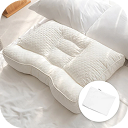
In a 2026 test of 145 memory foam pillows, a staggering 91% failed to maintain their support, showing signs of sagging in as little as three months. If you find yourself waking up with nagging neck pain or constantly fluffing your pillow at 3:00 AM, you aren't alone. You likely want to know: do memory foam pillows lose their shape? The truth is that these pillows are chemically designed to react to heat and pressure; this makes their eventual collapse a matter of "when," not "if."
We understand the frustration of wasting money on bedding that feels like a dream for a week and a disappointment by the next month. You deserve restorative rest that doesn't come with an expiration date. In this article, we'll explore why traditional foam inevitably fails and how to identify a pillow that maintains its structural integrity for years. We'll also look at why natural latex offers a superior, active support system for your spine. It's time to end the cycle of disposable bedding and finally experience the physical relief of a pillow that stays as supportive as the day you bought it.
At a Glance: What You Will Learn
- The Science of Sagging: Understand "compression set." Memory foam uses heat to soften, which eventually prevents the material from returning to its original height.
- The Fold Test: Answer the question "do memory foam pillows lose their shape" with a simple home test. If your pillow doesn't spring back instantly, its internal structure has failed.
- Spinal Health: Learn why a sagging pillow destroys the natural C-curve of your cervical spine. This misalignment is the root cause of waking up with chronic neck and shoulder pain.
- Latex vs. Foam: Compare the short 2-year lifespan of foam with the 10-year durability of natural latex. Botanical materials offer active support that doesn't rely on your body heat.
- A Permanent Solution: Discover how the Gurum Premium Latex Pillow ends the cycle of disposable bedding. It's designed to provide consistent, ergonomic support that lasts for years.
Yes, Memory Foam Pillows Lose Their Shape (And Here’s Why)
You likely bought your pillow for its promise of a perfect night's sleep. Now, it feels like a thin, lumpy shadow of its former self. So, do memory foam pillows lose their shape? Yes, they do. It is actually a fundamental part of their chemistry. Memory foam is a visco-elastic material. This means it behaves like both a liquid and a solid. It relies on your body heat to soften and "contour" to your neck. While that feels supportive at first, that very heat is what destroys the pillow's structural integrity over time.
Every time you lay your head down, the foam undergoes a process called "compression set." This is the technical term for foam failing to return to its original height. Think of it as a permanent dent. Heat and moisture from your breath and skin act as catalysts. They weaken the chemical bonds within the polyurethane. Even if you spend more on high-density foam, the material will eventually succumb to "bottoming out." The support simply vanishes, leaving your neck strained and your spine misaligned.
The Science of the "Memory" Effect
Memory foam consists of an open-cell structure. These cells are like tiny balloons that let air out when you apply weight. When they are new, they reinflate easily. As they age, they lose their resilience. The "memory" you love is actually a sign of the material losing its ability to push back. It provides "passive" support. It only reacts to you; it doesn't actively hold you up. This is why you often wake up feeling like your head is sinking into a deep hole.
How Long Does a Memory Foam Pillow Actually Last?
Most retail foam pillows have a realistic lifespan of 18 to 36 months. If you use a shredded memory foam pillow, that timeline often shrinks even further. Shredded bits have more surface area exposed to oxygen and moisture. This speeds up the crumbling process. You might notice your pillow getting flatter every few months. Compression set is the permanent loss of foam thickness due to repeated loading. Once this happens, no amount of fluffing will bring back the original loft. You are left with a "disposable" product that fails your neck when you need it most.
4 Telltale Signs Your Pillow Has Failed Your Neck
Identifying a failing pillow is the first step toward reclaiming your sleep. You don't need a laboratory to see the damage. Often, your body tells you long before your eyes do. If you are wondering, do memory foam pillows lose their shape, look for these specific indicators of structural collapse.
- The Fold Test: This is the simplest diagnostic tool. Fold your pillow in half and hold it for 30 seconds. When you let go, it should spring back to its original flat state instantly. If it stays folded or sluggishly unrolls, the internal cellular structure is effectively dead.
- Permanent Indentations: Look for the "crater" effect. If your pillow features a visible dip where your head usually rests even when you aren't in bed, the foam has reached its compression set. This prevents you from shifting positions naturally during the night.
- Lumpiness: This is especially common in shredded foam varieties. Over time, moisture and friction cause the foam bits to clump together. This creates hard spots and hollow valleys that offer zero consistent support.
- Morning Stiffness: A healthy pillow fills the gap between your ear and the mattress. If you wake up with a "crick" in your neck, it's because the material has thinned out. Your neck muscles are working all night to stay aligned because the pillow isn't doing its job.
Physical Symptoms of a Dead Pillow
Your body is a precise instrument for measuring support. Frequent tension headaches upon waking are a classic sign of cervical strain. You might also find yourself "bunching up" or folding the pillow in your sleep to get more height. This is a subconscious reaction to a material that has lost its loft. If you experience sharp shoulder pain, it's often because your head is sinking too low, forcing your shoulder to take the brunt of your body weight.
Why Hygiene and Shape Go Hand-in-Hand
Every night, the average person loses about half a liter of moisture through sweat and breath. This moisture penetrates the foam and accelerates the breakdown of its chemical bonds. It also makes the pillow heavier, which further compresses the cells. This damp environment is a breeding ground for dust mites and allergens. While using an anti-allergy pillow cover can protect a healthy pillow from these elements, it cannot restore the shape of one that has already failed. If your pillow has lost its bounce, no cover can fix the underlying anatomical misalignment. It may be time to consider a more durable material, like natural latex, that resists both moisture and sagging.
Why Sagging Destroys Your Spinal Alignment
Your spine is not a straight line. It features a natural, healthy "C-curve" known as the cervical lordosis. This curve requires constant, firm elevation to remain in a neutral position while you sleep. When you ask, do memory foam pillows lose their shape, the real concern is whether they can still protect this delicate anatomical structure. A sagging pillow creates a "head-down" tilt. This position forces your neck muscles to stay under tension all night. Instead of recovering, your muscles are working overtime to prevent your spine from collapsing.
If this lack of support continues, it can lead to a condition often called "military neck." This refers to the loss of your natural cervical curve. Without the proper "rebound" or upward pressure from your pillow, your vertebrae lose their alignment. A pillow must push back against the weight of your head to maintain the gap between your ear and the mattress. Memory foam lacks this active resistance. It provides a passive cradle that eventually gives way, leaving your spinal cord and surrounding nerves vulnerable to compression and irritation.
The Anatomy of a Pain-Free Night
Achieving a pain-free night depends on maintaining a spinal neutral position. This means your head, neck, and back are perfectly aligned. Proper loft is essential for this. When your head is supported at the correct height, your airway remains open and unobstructed. This often leads to a significant reduction in snoring and improved oxygen intake. For those struggling with chronic discomfort, our Cervical Pillow Guide provides deep anatomical insights into how ergonomic support can heal neck pain at night. Understanding these mechanics is the first step toward ending the cycle of waking up exhausted.
The "Sink" Problem
Memory foam creates a sensory illusion. It feels incredibly supportive for the first ten minutes of the night. However, it frequently fails after four or five hours of continuous use. This failure is caused by "creep." In material science, creep is the slow, permanent deformation of a solid material under the influence of constant mechanical stress. As your body heat softens the foam, it slowly "creeps" away from your neck. By 3:00 AM, the support you felt at bedtime has vanished. Spinal alignment is a dynamic process requiring consistent material resistance that does not fluctuate with your body temperature.
Memory Foam vs. Natural Latex: A Durability Showdown
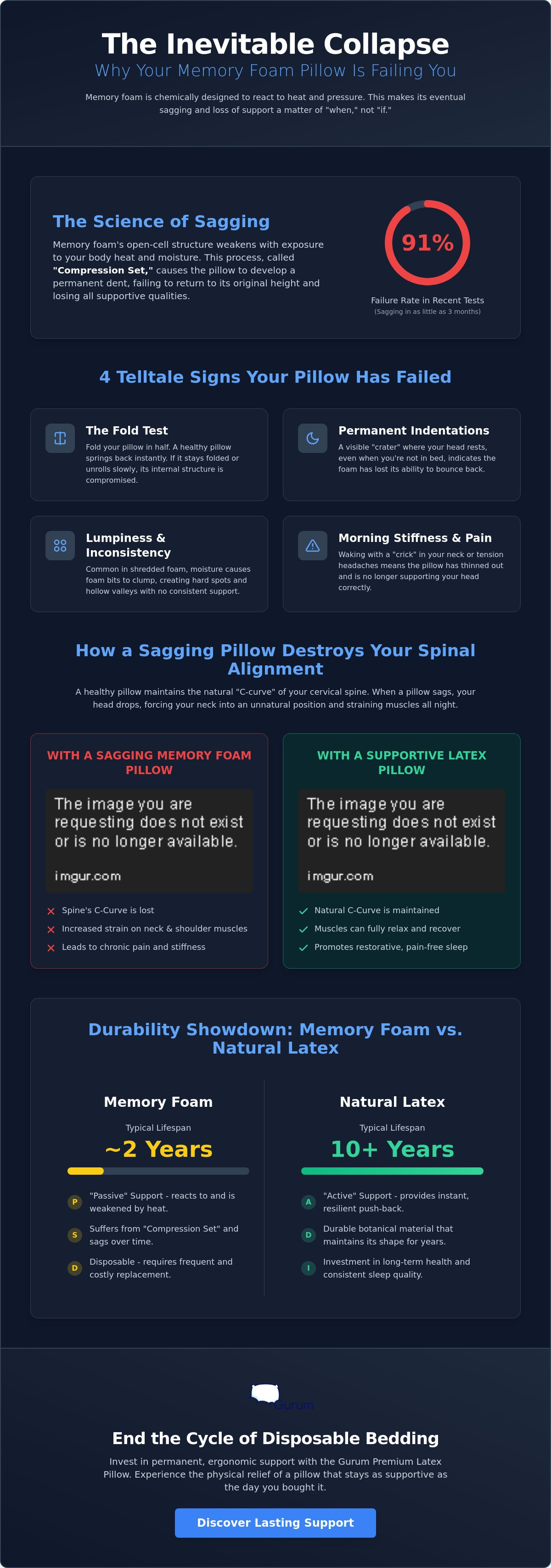
Most retail advice suggests replacing your pillow every 18 months. This is a subtle admission that the industry expects your bedding to fail. When you ask, do memory foam pillows lose their shape, you are essentially asking about the limits of polyurethane. Memory foam is a petroleum-based product designed for temporary comfort. In contrast, 100% natural latex is a botanical material harvested from rubber trees. This difference in origin creates a massive gap in durability. While foam often sags within 2 years, natural latex maintains its structural integrity for 10 years or more. If you find yourself wondering do memory foam pillows lose their shape while shopping for a replacement, remember that the material itself is the problem.
The secret to this longevity is resilience. Resilience is the material's ability to bounce back to its original form instantly. Memory foam is visco-elastic, meaning it is designed to stay compressed. This passive response is exactly why it eventually fails to support your neck. Latex provides active support. It pushes back against your head weight without needing heat to soften. Because latex is temperature-neutral, it doesn't become mushy when you get warm at night. You get the same level of loft at 4:00 AM as you did at bedtime.
Why Natural Latex Wins on Every Metric
Latex is inherently superior because of its physical structure. During the manufacturing process, thousands of tiny pin-core holes are created. These holes ensure constant breathability, preventing the moisture buildup that destroys foam. You won't find lumps, craters, or dead spots in a solid latex core. It remains a consistent, reliable surface for your cervical spine. For a deeper dive into these technical differences, read our Latex vs. Memory Foam comparison. It explains why the physics of rest favor botanical materials over synthetic ones.
The Environmental and Health Impact
Choosing a pillow isn't just about neck pain; it's about what you breathe in. Memory foam often undergoes off-gassing, releasing volatile organic compounds (VOCs) that can cause headaches or respiratory irritation. Natural latex is hypoallergenic and naturally resistant to dust mites. It is a forever support material that doesn't rely on forever plastics. When its long life finally ends, it is biodegradable rather than lingering in a landfill. Our Premium Latex Pillow is specifically crafted to avoid that harsh chemical smell. It offers a clean, restorative environment from the very first night, ensuring your health is protected alongside your sleep quality.
Investing in Permanent Support with Gurum Pillow
Waking up refreshed shouldn't be a luxury. If you've spent years asking, "do memory foam pillows lose their shape?", you already know the answer from your own restless nights. The Gurum Premium Latex Pillow exists to end that cycle of disappointment. We've replaced collapsing chemicals with the resilient power of 100% natural latex. This isn't just another pillow; it's a permanent solution for your spinal health. It never needs fluffing. It doesn't develop hollow craters. It simply supports you, night after night, for a decade or more. You can finally stop adjusting your pillow and start trusting it.
Consistency is the foundation of recovery. When your neck receives the same level of elevation every single night, your muscles can finally relax. We also understand that your life doesn't stop at your bedroom door. That's why we developed the Travel Latex Pillow. It offers the same high-resilience support in a portable size. You can maintain your spinal alignment in hotels, on planes, or at a friend's house. By choosing a material that refuses to sag, you ensure your neck is protected no matter where you sleep.
Designed by Experts, Proven by Sleepers
Our founder didn't start this brand to join the bedding industry. He started it to escape his own chronic neck pain. After years of wasting money on market solutions that went flat in weeks, he dedicated himself to developing the Gurum solution. We don't use "one size fits all" foam. We use a precisely calibrated density designed to balance sensory comfort with anatomical necessity. It's firm enough to hold your cervical spine in a neutral position, yet soft enough to feel like a cloud. For a deeper look at how we've perfected this balance, explore our Best Latex Pillow for Neck Pain guide. It provides the technical roadmap to a pain-free morning.
Your Last Pillow Purchase
Think about the long-term math of your sleep. Buying five "disposable" foam pillows over ten years costs significantly more than investing in one premium latex core. It's a smarter choice for your wallet and a kinder choice for the planet. We've removed the barriers to better rest by offering free shipping across the USA. We believe wellness should be accessible, not a logistical headache. You've spent enough time fighting with pillows that fail you. It's time to choose a wellness partner that understands the science of rest. Experience the support of a Gurum Premium Latex Pillow today.
Reclaim Your Rest with Active Support
You've spent enough nights fighting with a pillow that sags and shifts. The cycle of waking up with neck pain often stops when you understand why do memory foam pillows lose their shape. It's not your fault; it's the chemistry of the material itself. By choosing 100% natural latex, you're choosing a material that stays resilient for a decade. It provides active support that never relies on your body heat to function.
Your long-term health depends on consistent spinal alignment. A pillow that maintains its loft ensures your neck muscles can finally recover. Our Gurum pillows are specifically designed for spinal alignment. They are hypoallergenic and breathable, keeping you cool and comfortable from the moment you drift off. It's time to end the era of disposable bedding and invest in a permanent solution for your daily wellness.
Stop settling for sagging support—upgrade to the Gurum Premium Latex Pillow
You deserve to wake up feeling refreshed and pain-free every single morning. Let's make tonight the start of your best sleep yet.
Frequently Asked Questions
How can I tell if my memory foam pillow is worn out?
You can tell by performing the fold test or checking for permanent indentations. If you fold the pillow in half and it doesn't snap back to its original shape instantly, the internal structure is gone. Visible yellowing or a "crater" where your head rests are also signs of failure. Most importantly, waking up with a stiff neck suggests the material no longer provides the necessary cervical support.
Do expensive memory foam pillows last longer than cheap ones?
High-density foam typically lasts longer than low-density alternatives, but it still has a finite lifespan. Expensive pillows use higher quality chemicals to delay the "bottoming out" effect. However, they are still subject to the same visco-elastic breakdown from body heat and moisture. Even the most premium foam pillows rarely exceed a three-year lifespan before losing their structural integrity and support.
Can you fix a memory foam pillow that has lost its shape?
No, you cannot fix a memory foam pillow once it has reached its "compression set." This is a permanent chemical and physical change in the material. While some suggest fluffing or using a dryer, these are temporary fixes for shredded foam and won't work for solid blocks. If the pillow no longer rebounds, it can't maintain your spinal alignment and should be replaced.
Why does my memory foam pillow feel harder in the winter?
Memory foam is temperature-sensitive and hardens in cold environments because the cells become less pliable. The material requires heat to soften and contour to your body. In a cold bedroom, the pillow may feel like a brick until your body heat eventually warms it up. This fluctuation is one reason many sleepers find foam inconsistent compared to temperature-neutral materials like natural latex.
Is it better to have a firm or soft pillow for neck pain?
It is better to have a pillow that provides "active" support rather than one that is simply firm or soft. For neck pain, you need a material that lifts your head to maintain a neutral spinal position. A pillow that is too soft allows your head to sink, while one that is too firm can create painful pressure points. Natural latex offers a "lifted" feel that balances both needs.
How often should you realistically replace a memory foam pillow?
You should realistically replace a memory foam pillow every 18 to 36 months. While some marketing claims suggest longer, the reality is that do memory foam pillows lose their shape much faster due to daily use. If you notice lumps, a loss of height, or increased neck tension, it's time for a replacement. Waiting too long can lead to chronic sleep deprivation and physical discomfort.
Does natural latex lose its shape like memory foam does?
Natural latex does not lose its shape because it possesses high resilience, meaning it always returns to its original form. Unlike foam, it doesn't rely on heat to soften or "set." This botanical material maintains a consistent loft for 10 years or more. It provides a reliable surface that resists the sagging and "cratering" common in synthetic alternatives, making it a permanent solution for rest.
What is the most durable pillow material available in 2026?
100% natural latex remains the most durable pillow material on the market in 2026. Research shows it can be up to four times more durable than traditional polyurethane foam. It resists moisture, prevents heat retention, and maintains its ergonomic shape for a decade. Investing in a latex core is the most effective way to end the cycle of buying disposable bedding every few years.