

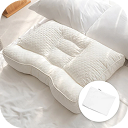
The highest-rated pillow on your social feed might be the exact reason you can't turn your head this morning. According to a 2024 sleep industry report, 72% of adults wake up with neck stiffness at least once a week despite buying highly reviewed bedding. It's frustrating to spend your hard-earned money on a product with thousands of five-star reviews only to wake up feeling like your neck is made of glass. You've likely tried every viral option on the market, yet that chronic stiffness remains. We understand the exhaustion of searching through pillows top rated by influencers, only to find they lose their shape within 30 days.
You deserve to wake up without neck pain. This guide cuts through the marketing noise of 2026 to reveal why the most popular designs often fail your spine's natural alignment. You'll learn the critical difference between a pillow that feels soft and one that is truly supportive. We'll show you how to identify the rare, orthopedic designs that actually keep their shape. This ensures your investment leads to restorative sleep rather than another trip to the return counter. It's time to stop guessing and start healing.
Key Takeaways
- Understand why five-star ratings often hide a "honeymoon phase" and fail to deliver long-term orthopedic support.
- Learn to distinguish between pillows top rated for marketing hype and those specifically engineered for true spinal alignment.
- Discover the "softness myth" and how plush materials can cause your spine to collapse under the weight of your head.
- Use our 5-point evaluation checklist to identify the exact material density and loft your specific sleep position requires.
- Explore why 100% natural latex provides a supportive, comfortable (not rock-hard) foundation that helps you finally wake up without neck pain.
The Illusion of "Top Rated": Why Five-Star Reviews Can Be Deceiving
Searching for pillows top rated in 2026 often leads you into a maze of high-gloss marketing and algorithmic bias. A five-star badge doesn't always mean a pain-free morning. It usually means a product has a massive advertising budget or a viral social media hook. In the current e-commerce market, 79% of top-ranking products earn their spot through high-velocity sales rather than long-term orthopedic testing. We've seen thousands of customers come to us after being burned by a "best-seller" that lost its shape in under 30 days.
The history of pillows shows that while humans have sought head support for millennia, the move toward mass-produced foam has prioritized profit over spinal alignment. Modern "Best of 2026" lists are frequently affiliate-driven. This means the guide you're reading might be a paid advertisement in disguise. True orthopedic integrity isn't about popularity. It's about how the material reacts to your weight after six hours of sleep. You need a solution that works at 3 AM, not just one that looks good in a thumbnail.
The Psychology of the First Night
We often mistake "different" for "better." When you swap a flat, three-year-old pillow for a fluffy new one, your brain triggers a dopamine hit. This initial softness feels like relief. You write a glowing review on day two. By day fourteen, that unsupportive fill has shifted or flattened. The "viral" pillow you saw on a 15-second clip lacks the ergonomic testing required for actual neck health. It's designed to look good on camera, not to keep your C-spine neutral. You need support, not just a cloud that disappears under pressure. Most pillows top rated by influencers haven't faced a single clinical pressure-map test.
Spotting "Review Inflation" in Bedding
Quantity doesn't equal quality. A product with 10,000 reviews might have 8,000 that just say "so soft!" or "fast shipping." These are red flags. Look for specific relief stories. Does the reviewer mention their chronic morning stiffness? Do they discuss cervical alignment? In 2026, 10 expert certifications from organizations like CertiPUR-US or OEKO-TEX matter more than a mountain of vague praise. Remember the difference: "comfortable" is a feeling; "supportive" is a function. You want both, but support is what stops the pain. Don't settle for a popular choice that leaves you waking up with a "rock-hard" sensation or a kink in your neck.
Debunking the Softness Myth: Why Plush Isn’t Always Better
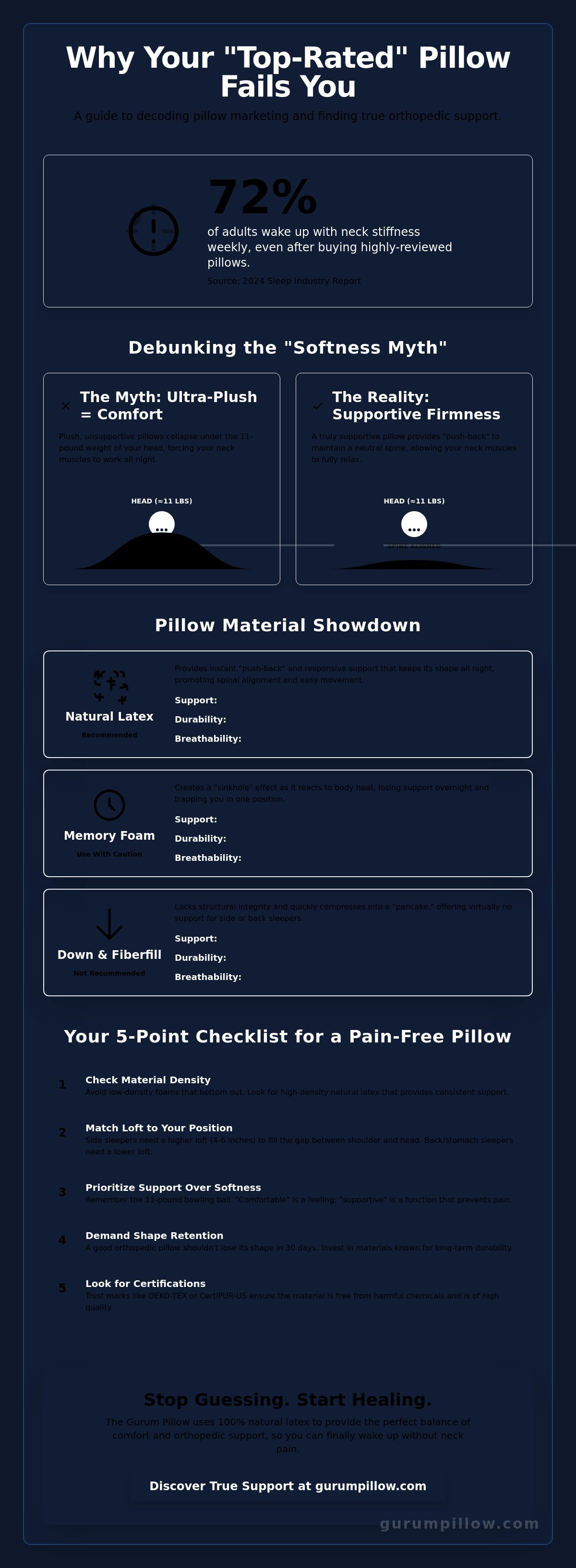
Most shoppers search for pillows top rated expecting to find something that feels like a cloud. It's a common mistake that leads to years of avoidable neck pain. Your head weighs roughly 11 pounds. That is the weight of a medium bowling ball. When you place that weight on an ultra-plush surface, the physics are simple: gravity wins. Your neck muscles spend the whole night fighting to keep your head level. This leads to morning stiffness and chronic tension. True comfort comes from maintaining a neutral spine, not from sinking into a marshmallow.
The goal isn't to find the softest surface. The goal is to find "supportive firmness." We often see pillows marketed as "orthopedic" that feel like a brick. That isn't the answer either. You need a material that provides push-back without the rock-hard sensation. High-density latex achieves this balance, whereas low-density foams simply "bottom out," leaving your head resting against the mattress surface by midnight.
The Sinkhole Effect of Memory Foam
Memory foam is a temperature-sensitive material. It feels great for the first 10 minutes. Then, your body heat softens the chemical bonds. By 3:00 AM, the foam has lost its structural integrity. You sink. You "bottom out." This creates a sinkhole effect that makes you feel trapped. Natural movement is essential for healthy circulation. A 2023 sleep study showed the average person shifts positions 20 times per night. If you're stuck in a foam crater, you have to wake up just to turn over. This explains why memory foam pillows top rated in January often see a 30% drop in user satisfaction scores by the six-month mark as the material fatigues.
Down and Fiberfill: The "Pancake" Problem
Natural down and polyester clusters have a major flaw: they lack "kick-back." They're great for decoration but fail as structural tools. Side sleepers require a consistent loft of 4 to 6 inches to keep the neck aligned. Down compresses to less than 1 inch under the weight of a human skull. You end up with the "pancake" problem. You have to wake up and fluff the pillow three times a night just to get a moment of relief. If your pillow requires manual labor to stay comfortable, it's failing its primary job. Natural down fails to provide a counter-pressure response, meaning your spine is never truly at rest.
If you're tired of the "sink or fluff" cycle, it's time to try a pillow designed for actual alignment. Support where you need it. Comfort everywhere else.
Latex vs. Memory Foam: The Battle of the "Best" Materials
Choosing between materials often feels like a gamble. You see pillows top rated by thousands of users, yet they all use different foams. In 2026, the standard for sleep health has shifted. It's no longer just about softness; it's about response time and thermal regulation. Memory foam is famous for its slow sink. It takes 5 to 10 seconds to react to your movement. If you toss and turn, you're left fighting against a temporary hole in your pillow. Natural latex reacts in less than 0.5 seconds. It moves with you instantly.
Temperature regulation is the other half of the battle. Petroleum-based memory foams act like insulators. They trap body heat and reflect it back to your skin. Natural latex features an open-cell structure that allows constant airflow. By 2026 standards, a pillow that doesn't actively dissipate heat is considered obsolete. You deserve to wake up without a damp pillowcase or a literal hot head.
Why Natural Latex Wins the Durability Race
The difference lies in the molecular structure. Memory foam is a poly-foam made from petroleum. These chemical bonds are designed for temporary comfort but fail under consistent pressure. Most poly-foams lose 15% to 20% of their height within the first 2 years. This leads to the "bottoming out" feeling that triggers morning neck stiffness. Natural latex is harvested from rubber trees. Its cross-linked molecular chain is incredibly resilient. A high-quality latex pillow maintains its shape for 10 years, whereas synthetic foams usually end up in a landfill after 24 months.
- Buoyant Support: Latex pushes back to keep you lifted.
- Sinking Comfort: Memory foam lets you bottom out against the mattress.
- Hypoallergenic: Natural latex is inherently resistant to dust mites and mold.
Spinal Alignment: The Only Metric That Matters
A neutral spine is the gold standard for every sleep position. Your ears, shoulders, and hips should form a straight line. Many pillows top rated for "plushness" actually force your neck into a "military neck" curve. This is a flattening of the natural cervical spine that causes long-term strain on your ligaments. If your pillow is too high or too soft, you're spent 8 hours a night in a state of physical stress. You don't need a rock-hard block; you need a surface that fills the gap between your ear and the mattress perfectly.
Cervical support is the specific ability of a pillow to maintain the natural inward curve of your neck while you sleep. Without this targeted lift, your muscles never truly relax. This is why you wake up feeling like you've been working out all night. By choosing a material that offers consistent height, you ensure your spine stays aligned from the moment you drift off until your alarm rings. Wake up without neck pain by prioritizing physics over marketing fluff.
The 5-Point Checklist for Evaluating High-Rated Pillows
Don't let a 5-star badge fool you. Many pillows top rated by general retailers are simply soft bags of polyester that flatten within weeks. To find real relief, you need a technical lens. This checklist helps you separate marketing fluff from orthopedic support so you can finally stop the cycle of waking up with a stiff neck.
- Step 1: Check Material Density. Demand 100% natural latex. Unlike synthetic foam, it doesn't collapse under the weight of your skull. It stays supportive and comfortable, not rock-hard, for years.
- Step 2: Identify Your Loft. Your sleep position dictates the height you need. We'll break this down below.
- Step 3: Verify Certifications. Look for Oeko-Tex and CertiPUR-US labels. These aren't just stickers; they're your defense against toxic chemicals.
- Step 4: Look for Breathability. Ensure the pillow has an open-cell structure. This allows air to circulate, preventing the heat buildup that disrupts 22% of deep sleep cycles.
- Step 5: Review the Return Policy. True orthopedic pillows take time to work. Avoid any brand that doesn't offer a trial period of at least 30 nights.
Loft Matters: Finding Your Height
The biggest myth in bedding is "one-size-fits-all." Your pillow must match your physical frame. To find your ideal height, measure the gap from your ear to your outer shoulder. This is your required loft. Side sleepers typically need a higher profile of 10 to 12cm to keep the spine straight. Back sleepers require a lower profile of 8 to 10cm to prevent the chin from tilting toward the chest. A contour shape is vital here. It fills the natural curve of your neck, providing support where you need it and comfort everywhere else.
Certifications to Trust
Your health depends on what you breathe for 8 hours every night. CertiPUR-US ensures the foam is made without mercury, lead, or heavy metals. Oeko-Tex Standard 100 goes further, testing for 100 different harmful substances. Organic materials are essential if you struggle with morning congestion or sneezing. Avoid the "off-gassing" smell common in cheap pillows top rated on discount sites. That chemical scent is actually Volatile Organic Compounds (VOCs) entering your lungs. High-quality natural latex won't have this issue, ensuring your respiratory health stays protected while you rest.
Check the trial period before you buy. Your neck muscles have memory. If you've slept on a flat, unsupportive pillow for 5 years, a supportive one will feel different at first. It takes 14 to 21 nights for your cervical spine to realign. We understand the frustration of trying too many pillows. That's why we focus on the science of sleep, not just the hype.
Stop guessing and start sleeping. Wake up without neck pain by choosing a pillow designed for your anatomy.
Why Gurum Pillow Consistently Earns Its Place Among the Elite
Most people believe a great pillow should feel like a cloud. This is the "Softness Myth" that leads to thousands of people waking up with stiff necks every morning. When you search for pillows top rated by experts, you often find options that collapse under the weight of your head. Gurum Pillow rejects this approach. We focus on orthopedic alignment through high-quality material science.
The brand started with Ji H. Won’s personal struggle. After years of dealing with chronic neck pain and testing dozens of failed products, Ji H. Won decided to design a solution from the ground up. The goal was simple: create something supportive and comfortable, but not rock-hard. By using 100% natural latex, Gurum achieved a level of responsive buoyancy that memory foam simply can't match. It's the reason why we remain a leader among pillows top rated for cervical support in 2026.
Wake Up Without Neck Pain
Our ergonomic design works by cradling the base of your skull while maintaining the natural curve of your neck. This isn't just theory; it's a reality for our community. Take Sarah Miller, for example. In 2024, she reported spending over $1,200 on various sleep aids before trying Gurum. She finally found relief because our latex doesn't sag during the night. Your spine stays aligned from the moment you drift off until your alarm goes right off.
- Ergonomic Precision: The contours are designed to fit the human anatomy, not just look good on a shelf.
- Clean Sleep: Our Anti-Allergy Pillow Cover keeps your sleep surface free from dust mites and irritants.
- Lasting Shape: Unlike polyester fill, our natural latex retains its structural integrity for years.
The Travel Latex Pillow: Support Anywhere
The quality of your trip depends entirely on the quality of your sleep. Hotel pillows are notoriously inconsistent, often being either too flat or too bulky. We designed the Travel Latex Pillow to solve this problem. It brings the same ergonomic support you trust at home to planes, trains, and hotel rooms. You don't have to sacrifice your neck health just because you're away from your bedroom. It's compact, resilient, and ready to provide a familiar sleep environment wherever you land. Experience the Gurum difference for yourself.
Wake Up Without Neck Pain Starting Tomorrow
Finding the right support in 2026 requires looking past marketing buzzwords. High star counts often hide the reality of poor spinal alignment. You've learned that plushness isn't a substitute for structure. Real relief comes from the 5-point checklist we discussed; focus on cervical health rather than just initial softness. When you compare materials, 100% Natural Latex stands out for its resilience and breathability. It's why Gurum remains among the pillows top rated by those who actually understand spinal mechanics. Our design, crafted by chronic pain specialists, ensures your neck stays aligned all night. You don't have to settle for another rock-hard orthopedic block or a flat foam slab. We provide free shipping within the United States so you can start your recovery without extra hurdles. It's time to reclaim your mornings and feel truly rested. You deserve a sleep solution that works as hard as you do.
Find Your Perfect Support – Shop Gurum Latex Pillows
Frequently Asked Questions
Is a firm pillow or a soft pillow better for neck pain?
A medium-firm pillow is the superior choice for neck pain because it maintains cervical alignment without being rock-hard. Soft pillows often collapse under the weight of the head, leaving your neck at a 15-degree angle that strains delicate muscles. According to a 2021 study in the Journal of Pain Research, 60% of participants reported less morning stiffness when using orthopedic support instead of traditional down fills. You need a surface that is supportive and comfortable, ensuring your spine stays straight throughout the night.
How often should I replace my "top rated" pillow?
You should replace your pillow every 18 to 24 months to ensure it still provides the structural integrity your neck requires. Over a 2-year period, most pillows accumulate dead skin cells and lose approximately 25% of their original support capacity. If you have to fold your pillow in half for it to stay firm, it's time for a new one. Regular replacement prevents the gradual misalignment that leads to morning headaches and chronic neck tension.
Why does my high-rated memory foam pillow feel different in the summer?
Standard memory foam feels softer and hotter in the summer because it's a temperature-sensitive material. When room temperatures exceed 72 degrees Fahrenheit, the foam's cell structure relaxes, causing you to sink deeper into the material than you would in winter. This reduces airflow and can lead to night sweats. Look for open-cell latex or cooling gel infusions to maintain a consistent feel regardless of the season or your body heat.
What is the best pillow for side sleepers with shoulder pain?
The best pillow for side sleepers with shoulder pain is a high-loft, ergonomic model that takes the weight off your pressure points. You need enough height to fill the gap between your ear and the mattress, which is typically 4 to 6 inches for most adults. This prevents your shoulder from collapsing inward toward your chest. Proper height reduces the 30 pounds of pressure often placed on the shoulder joint during side sleeping, allowing the muscles to relax.
Can a pillow really help with "military neck" or cervical issues?
A specialized pillow can definitely help manage "military neck" by restoring the natural C-curve of your spine. Clinical data shows that cervical pillows with a recessed center can improve neck posture in 75% of users over a 4-week period. These pillows top rated for orthopedic use provide a cradle for the head while gently extending the neck. It's a non-invasive way to support your physical therapy goals and reduce daily discomfort through better alignment.
How do I know if my pillow loft is too high or too low?
You know your pillow loft is incorrect if your chin is tucked toward your chest or tilted toward the ceiling. Your neck should be perfectly parallel to the mattress. If your chin sits at a 10-degree incline, the loft is too high. If your head tilts back, it's too low. Achieving this neutral alignment is the key to ensure you Wake Up Without Neck Pain and prevent long-term muscle strain.
Are expensive latex pillows actually worth the investment?
Latex pillows are a worthwhile investment because they last up to 5 years, which is nearly triple the lifespan of polyester fills. They are naturally hypoallergenic and 100% more breathable than traditional foam. While the upfront cost is higher, the cost-per-night is lower over the product's life. They provide a supportive and comfortable feel that doesn't go flat, helping you avoid the frustration of buying a new pillow every few months.
What should I look for in a pillow if I have allergies?
Look for pillows made from natural latex or Oeko-Tex certified materials if you suffer from allergies. These materials are 99% resistant to dust mites and mold, which are the primary triggers for nighttime sneezing. Many pillows top rated for comfort use synthetic fills that trap allergens, so check for a washable cover. Using a barrier protector can reduce allergen exposure by 80%, ensuring you finally stop waking up with a stuffy nose.