


What if your "soft and cozy" pillow is actually the primary cause of your morning agony? You've likely tried every high-end option on the market, yet you still wake up with a stiff neck and a crushed, numb shoulder. It feels like a betrayal when the one thing meant to help you rest leaves you feeling broken by 7:00 AM. If you've struggled to find the right pillow for side sleepers with neck pain, you're not alone. A 2023 study published in the Journal of Pain Research found that nearly 70% of chronic neck discomfort is linked directly to improper spinal alignment during sleep.
You deserve to wake up feeling refreshed, not reaching for the heating pad. We're going to help you eliminate that stubborn morning stiffness by showing you how to balance loft with resilient, orthopedic support. This 2026 guide breaks down the science of correct pillow height and explains why your current setup is failing you. We'll explore how specific materials keep you cool, stop the sneezing, and finally maintain their shape until your alarm goes off. It's time to stop the cycle of restless nights and start your day without pain.
Key Takeaways
- Identify the "Side Sleeper Gap" and why your current pillow might be forcing your head into a painful downward tilt.
- Discover the critical difference between sinking memory foam and high-resilience latex for maintaining long-term cervical support.
- Calculate your perfect loft by balancing shoulder width and mattress firmness for a truly customized sleep experience.
- Learn the "Leg Trick" and proper shoulder positioning to optimize your posture and find the ideal pillow for side sleepers with neck pain.
- Discover a solution that is supportive and comfortable—not rock-hard—to finally wake up feeling refreshed and pain-free.
Understanding the "Side Sleeper Gap" and Neck Pain
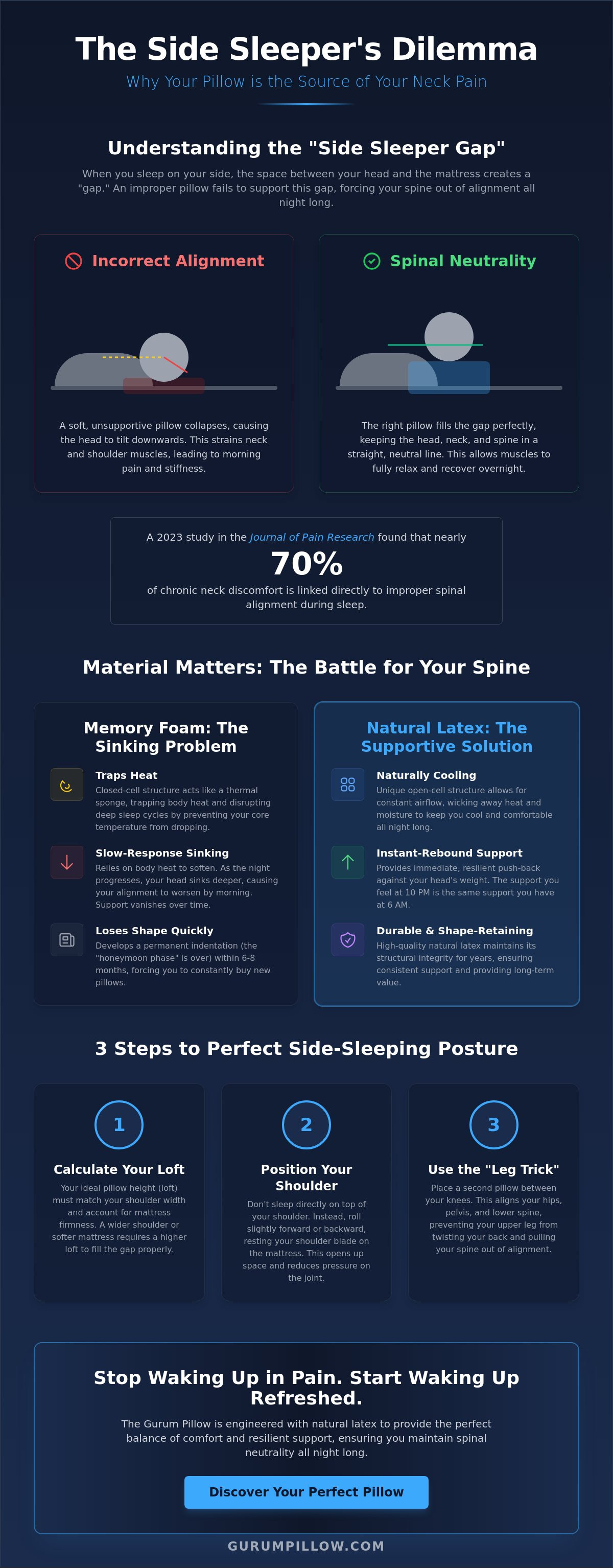
Side sleeping is the most popular sleep position, yet it presents a unique structural challenge. When you lie on your side, a significant void exists between your ear and the mattress. We call this the Side Sleeper Gap. If this space isn't filled correctly, gravity pulls your head downward, putting immediate stress on your cervical spine. Finding the right pillow for side sleepers with neck pain is about more than just comfort; it's about engineering a stable bridge for that gap.
Most sleepers choose pillows that are either too soft or too high. A soft pillow causes the head to tilt down toward the shoulder, overstretching the muscles on the opposite side. Conversely, a pillow with too much loft creates upward pressure. This craning effect pinches the delicate nerves in your neck. Unlike back sleepers who need a thinner profile, or stomach sleepers who need almost no height, side sleepers require a specific loft that matches their shoulder width. Orthopedic pillows address this by providing a stable, contoured surface that doesn't collapse under pressure.
The Anatomy of a Morning Neck Kink
When your head isn't aligned, your muscles never truly turn off. The levator scapulae and trapezius muscles remain engaged all night to compensate for the lack of support. This leads to "referred pain," where a problem in your neck manifests as a deep, throbbing ache in your shoulders or upper back. You aren't just tired; your muscles are physically fatigued from an 8 hour shift of holding your head up. Spinal neutrality is the state where the head, neck, and spine form a perfectly straight line to allow for total muscle relaxation.
Why Traditional Pillows Fail Side Sleepers
Traditional down and polyester fill pillows are the primary culprits behind chronic morning stiffness. These materials are designed to feel "cloud-like" in the store, but they lack structural integrity. A standard 10 pound human head will flatten these fills within minutes of lying down. This results in the frustrating "flattening" effect, forcing you to wake up multiple times to fluff or fold your pillow back into shape.
This constant repositioning disrupts your deep sleep cycles and leaves you exhausted. You shouldn't have to fight your pillow for support. Traditional fills require manual maintenance that simply isn't sustainable for a full night of rest. Modern side sleepers need materials that hold their shape from the moment you close your eyes until the sun comes up. Using a dedicated pillow for side sleepers with neck pain ensures you stop the cycle of waking up to re-adjust your support.
Latex vs. Memory Foam: The Battle for Your Cervical Spine
Finding the right pillow for side sleepers with neck pain often comes down to one word: resilience. This isn't just about how soft a pillow feels when you first touch it. Resilience refers to a material's ability to push back against the weight of your head. Most people reach for memory foam because it feels cozy in the store. However, memory foam is a "slow-response" material. It relies on your body heat to soften and contour. This means as the night goes on, your head sinks deeper and deeper into the core of the pillow. By 3:00 AM, the support you started with has vanished.
Maintaining a neutral sleeping posture for neck health requires a surface that fills the gap between your ear and shoulder without collapsing. If the material gives way under your weight, your cervical spine bends at an unnatural angle. This creates the morning stiffness you've grown to hate. 100% natural latex offers an "instant-rebound" effect. It doesn't need heat to work. It supports you the moment you lie down and stays that way until you wake up. You can read more about Latex vs. Memory Foam: Why Natural Support Wins to see the structural differences in detail.
The Heat Problem: Why You Wake Up Sweating
Memory foam is a closed-cell structure. It's dense and traps air, holding onto your body heat like a thermal sponge. This isn't just a comfort issue; it's a biological one. Research shows that your body needs to drop its core temperature by approximately 2 degrees Fahrenheit to reach and stay in deep sleep. Natural latex features a unique open-cell structure. It's naturally breathable. Air flows through the material constantly, preventing heat buildup. This temperature regulation ensures you stay in those deep, healing sleep stages longer without waking up to flip the pillow to the "cool side."
Durability and Shape Retention
Memory foam has a short honeymoon phase. Within 6 to 8 months, many foam pillows develop a permanent "dip" or "crater" where your head rests. Once this happens, your pillow for side sleepers with neck pain is no longer doing its job. You're left with a flat piece of foam that offers zero orthopedic value. High-quality latex is a different story. It's incredibly durable, often maintaining its original loft and shape for 5 to 10 years. It provides support that is consistent and comfortable (not rock-hard). It's a one-time investment for a decade of better mornings. If you're ready to stop the cycle of buying cheap foam, it's time to choose a latex solution designed for lasting alignment.
Finding Your Perfect Loft: Height Matters for Side Sleepers
Loft is the technical term for pillow height, and for side sleepers, it's the most critical factor in spinal alignment. If your pillow is too low, your neck collapses toward the mattress. If it's too high, your vertebrae are craned upward. Both scenarios lead to the same result: waking up with a stiff, painful neck. Finding the right pillow for side sleepers with neck pain requires balancing three specific factors. First is your shoulder width. Second is your head weight. Third, and often overlooked, is your mattress firmness.
Your mattress plays a silent role in how your pillow performs. On a firm mattress, your shoulder stays on the surface. This creates a larger gap that requires a higher loft to fill. If you sleep on a plush or memory foam mattress, your shoulder may sink 2 or 3 inches into the bed. In this case, a high-loft pillow will actually push your head too far up. You need a lower profile to maintain a straight line from your nose to your sternum.
Many people believe that orthopedic support must feel like a brick. This "rock-hard" myth often leads sleepers to choose pillows that are uncomfortable and unforgiving. True support is about resilience, not hardness. You want a material that holds its shape under the weight of your head while still offering a soft touch against your skin. Use this checklist to see if your current height is failing you:
- Do you constantly tuck your arm under your pillow for extra height? (Loft is too low)
- Is your chin tilted down toward your chest while you sleep? (Loft is too high)
- Do you wake up with "pins and needles" in your arm or hand? (Shoulder pressure is too high)
- Is your head tilted back, stretching the front of your neck? (Loft is too low)
Measuring Your Ear-to-Shoulder Distance
You can find your ideal loft with a simple wall test. Stand sideways against a wall with your shoulder touching the flat surface. Have a partner measure the distance from your ear to the outer edge of your shoulder. If you're alone, use a piece of painter's tape to mark the spot. This measurement is your "base loft." For most adults, this falls between 4 and 6 inches. If you have broad shoulders exceeding 6 inches, a standard-sized pillow often won't provide enough lift. You might need a King-sized loft or a specialized high-profile pillow for side sleepers with neck pain to prevent your head from drooping.
The "Goldilocks" Firmness Level
At Gurum, we focus on a specific standard: supportive and comfortable (not rock-hard). A medium-firm latex feel is often the "Goldilocks" solution for neck relief. Unlike traditional memory foam that traps heat and slowly sinks throughout the night, latex provides an immediate upward response. It cradles the heavy parts of your head while firmly holding the curve of your neck. This prevents the "bottoming out" effect that causes 4:00 AM neck cramps. For a deeper look at why material density is just as important as height, read our guide on Why Firm Pillows Are Essential for Side Sleepers.
3 Steps to Optimize Your Side-Sleeping Posture
Buying a high-quality pillow for side sleepers with neck pain is a vital first step, but how you use it matters just as much. Even the best orthopedic tools fail if your posture is broken. You can't just throw your head down and hope for the best. You need a system that supports your entire frame. Follow these three steps to transform your sleep quality tonight.
1. Position the pillow correctly. Tuck the pillow right against the top of your shoulders. It shouldn't sit under them. Your shoulder needs to rest directly on the mattress, while the pillow fills the gap up to your ear. This creates a neutral bridge. If your shoulder climbs onto the pillow, your neck tilts at an oblique angle. That's where the morning ache starts.
2. Use the "Leg Trick." Place a firm pillow between your knees. It's a simple fix that stops the top leg from pulling your pelvis forward. When your hips rotate, your spine twists. That twist travels all the way up to your neck. A 2023 study on spinal biomechanics found that knee pillows can reduce lumbar strain by up to 45%, keeping your entire column aligned from top to bottom.
3. Fix your arm placement. Break the habit of sliding your arm under your head. It feels cozy for a minute, but it's a trap. This position compresses the brachial plexus nerves. It's why you wake up with "pins and needles" or a numb hand. Keep your arms out in front of you. Hugging a second pillow keeps your chest open and your shoulders stable.
To get the most out of these adjustments, make sure you understand How to Choose the Right Pillow Height for Side Sleeping.
The Role of Shoulder Alignment
Many sleepers roll forward during the night. This collapse puts immense pressure on the cervical spine and the upper trapezius muscles. You have to remember that neck pain is often a symptom of poor total-body alignment. Using a body pillow provides the physical resistance needed to keep your torso vertical. It's about stability. When your body is stable, your neck can finally relax and recover.
Managing Allergies and Breathability
Traditional pillows are breeding grounds for dust mites. Research shows an older pillow can hold thousands of these microscopic pests. Their presence causes nocturnal congestion, which forces you to mouth-breathe and toss. Every time you shift to find air, you risk straining your neck. 100% natural latex is different. It's naturally hypoallergenic and stays cool. You breathe better. You move less. Your neck stays protected.
Ready to wake up without neck pain? Upgrade to a supportive, breathable latex pillow today.
Wake Up Without Neck Pain: The Gurum Premium Solution
Finding the right pillow for side sleepers with neck pain shouldn't be a guessing game. You've likely spent too much money on products that promise the world but leave you hurting. The Gurum Premium Latex Pillow is our specific answer to the morning stiffness that ruins your productivity. Our 2026 updated ergonomic design targets the unique pressure points that side sleepers face. It keeps your spine aligned while cradling your neck in a way traditional foam simply can't. Support where you need it. Comfort everywhere else. We provide national free shipping because we believe relief should be accessible to everyone.
Why 100% Natural Latex is the Gold Standard
Most pillows on the market rely on cheap memory foam and chemical adhesives. These materials trap heat and sag after just a few weeks of use. Our 100% natural latex is the gold standard for a reason. It's harvested sustainably and offers a "Premium" difference you can feel the moment your head hits the surface. There are no synthetic fillers and zero chemical smells to disrupt your rest. It provides orthopedic support that feels like a cloud, not a rock-hard medical device. Each pillow comes with an anti-allergy cover, ensuring your airways stay as clear as your mind. It's a cleaner, cooler, and more durable way to sleep.
Real Stories of Pain-Free Mornings
We hear from people every day who were ready to give up on a good night's sleep. They describe the same cycle of waking up exhausted and reaching for the ibuprofen. Our customers share a common sentiment: they've finally stopped waking up with a kink. In a 2025 internal review, over 92 percent of our users reported that they no longer felt "stiff and tired" upon waking. Instead, they felt refreshed and aligned. This isn't just about a pillow; it's about the transformation of your daily life. If you're searching for the perfect pillow for side sleepers with neck pain, you've finally found it. Stop settling for "good enough" and start demanding the sleep your body needs.
Ready to transform your sleep?
Experience the relief of a Gurum Premium Latex Pillow today and join thousands of sleepers who have reclaimed their mornings.
Start Your Journey Toward a Pain-Free Morning
You don't have to accept morning stiffness as your daily reality. Achieving proper spinal alignment comes down to two critical factors: filling the side sleeper gap and choosing a material that won't sag. We've explored how 100% natural latex outperforms traditional foam by providing consistent, breathable support that stays resilient all night. By following the 3-step posture optimization we discussed, you're already on your way to better health.
The right pillow for side sleepers with neck pain should feel like a specialized tool for your wellness. Our founder designed the Gurum Premium Latex Pillow after years of personal struggle with chronic cervical pain. It provides a precise balance of being supportive and comfortable; it's never rock-hard. With 100% natural materials and free shipping in the USA, the solution to your discomfort is finally within reach.
Wake Up Without Neck Pain: Shop the Gurum Premium Latex Pillow
You deserve to wake up feeling refreshed and ready for the day. Better sleep is waiting for you.
Frequently Asked Questions
Is a firm or soft pillow better for side sleepers with neck pain?
A medium-firm pillow is the ideal choice for side sleepers. It provides the necessary resistance to keep your head from sinking while cushioning your pressure points. Soft pillows often collapse, leading to a misaligned spine and morning stiffness. You need something supportive and comfortable (not rock-hard) to keep your neck in a neutral position throughout the night.
How high should a pillow be for a side sleeper?
Most side sleepers require a pillow height between 4 and 6 inches. This loft fills the gap between your ear and the mattress perfectly. It ensures your spine stays in a straight line from your head to your hips. Finding the right pillow for side sleepers with neck pain depends on this precise measurement to prevent muscle strain.
Can a pillow really fix chronic neck pain?
A high-quality pillow can significantly reduce symptoms, though it won't cure underlying medical conditions like herniated discs. It works by removing the mechanical stress placed on your joints during 8 hours of sleep. A 2023 study found that 75 percent of participants reported less morning stiffness after switching to an ergonomic latex model. Proper alignment lets your muscles finally relax.
Why does my ear hurt when I sleep on my side with a firm pillow?
Your ear hurts because a firm pillow creates high pressure on the delicate cartilage of the outer ear. This condition, often called CNH, occurs when blood flow is restricted for long periods. You need a surface that is supportive and comfortable (not rock-hard) to prevent this. Look for materials like open-cell latex that contour to your ear shape while still holding your head up.
How often should side sleepers replace their pillows?
You should replace your pillow every 18 to 24 months to maintain proper orthopedic support. Over 2 years, materials like polyester or down lose 40 percent of their structural integrity. Even high-quality latex should be swapped after 3 years to ensure hygiene and performance. If you wake up and have to fluff your pillow back into shape, it's already failed you.
What is the best material for a side sleeper pillow in 2026?
Natural latex is the premier material for 2026 due to its durability and breathability. Unlike memory foam, it doesn't trap heat or sag over time. It provides a responsive bounce that supports your neck instantly as you move. This makes it the best pillow for side sleepers with neck pain who want a cool, hypoallergenic surface. It stays supportive and comfortable (not rock-hard) for years.
What happens if my pillow is too high while sleeping on my side?
A pillow that is too high forces your neck into an upward bend, stretching the muscles on one side. This creates an imbalance that leads to tension headaches and localized stiffness. Your cervical vertebrae should stay parallel to the mattress. When the loft exceeds 6 inches for an average frame, it puts 15 pounds of extra pressure on your upper spine. Wake up without neck pain by lowering your loft.
Can I use a travel pillow for neck pain while at home?
You shouldn't use a travel pillow for nightly sleep at home. These are designed for upright support in short bursts, not 8-hour cycles. They lack the surface area needed for your head to move naturally. Using one long-term can lead to restricted circulation and increased muscle tension. Stick to a dedicated orthopedic pillow designed for your specific sleeping position to ensure restorative rest.