

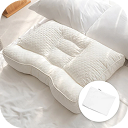
Why does your pillow feel like it's failing you halfway through the night? You likely start the evening on a plush cloud, but by 3 AM, you're awake and fighting with your bedding. Waking up with shoulder impingement or chronic neck tension is a clear sign that your support has collapsed. It's exhausting to spend your nights fluffing a pillow that simply won't hold its shape. We understand the frustration of searching for a solution that actually works. This struggle is exactly why latex pillows are better for side sleepers who require unwavering structural integrity. Unlike memory foam that sags under the weight of your head, natural latex provides the lift needed for neutral spinal alignment.
You're about to discover how to eliminate morning neck and shoulder pain by choosing a pillow that maintains its height all night long. We'll show you how to achieve a restorative, cooler sleep without the worry of chemical off-gassing. This guide breaks down the science of spinal health and explains why the latest 2026 safety standards are the key to waking up refreshed. It's time to stop settling for temporary comfort and start investing in a permanent solution for your rest.
Key Takeaways
- Understand why the physical gap between your head and the mattress causes cervical strain and how to bridge it effectively.
- Learn why latex pillows are better for side sleepers because they provide consistent, uplifting support that refuses to flatten overnight.
- Use our measurement guide to identify your ideal loft of 5 to 7 inches for perfect, neutral spinal alignment.
- Discover how a 100% natural latex core regulates temperature and maintains its shape for years without shifting.
- Explore how the Gurum Premium Latex Pillow uses ergonomic design to target and eliminate chronic side-sleeper neck pain.
The Side Sleeper’s Dilemma: Why Your Neck and Shoulders Hurt
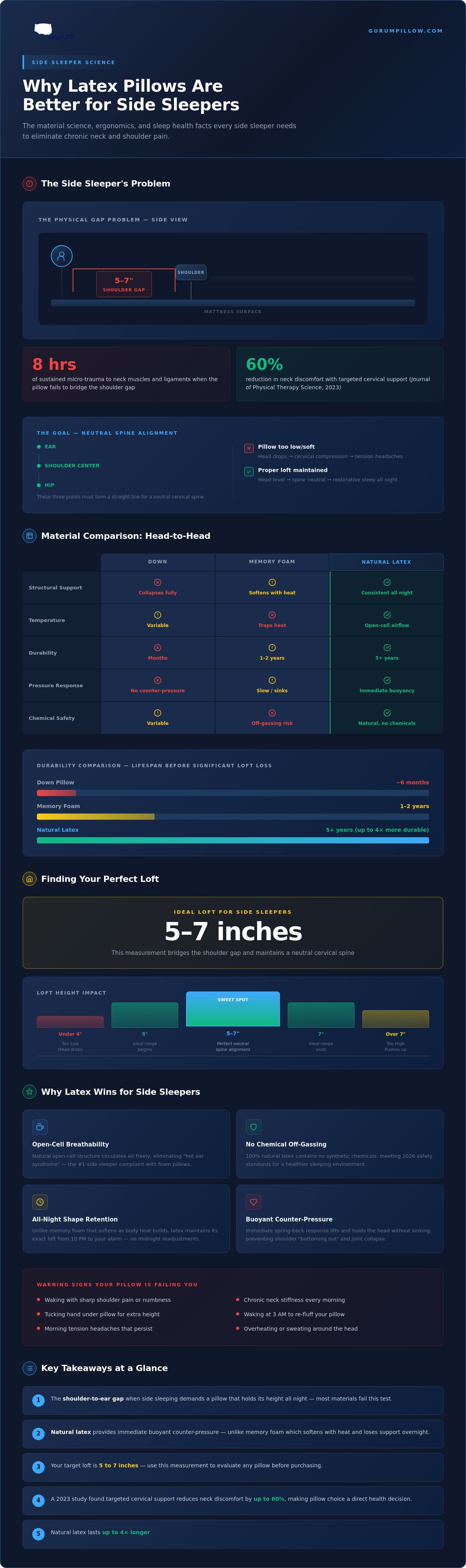
Side sleeping is the most popular sleep position, yet it is arguably the most demanding on your bedding. When you lie on your side, you create the largest physical gap between your head and the mattress. This void, roughly the width of your shoulder, must be filled perfectly to maintain health. Most pillows fail this simple mechanical task. They start the night with promise but flatten within hours, leaving your head to tilt downward at an unnatural angle. This collapse puts immediate, sustained strain on your cervical spine.
If you wake up with sharp shoulder pain, you are likely "bottoming out." This happens when a pillow is too soft to support the weight of your head, forcing your shoulder to collapse inward to compensate. The result is not just a bad night of sleep. It is eight hours of micro-trauma to your neck muscles and ligaments. Over time, this repetitive stress leads to the chronic stiffness and morning headaches that many people mistakenly attribute to aging or stress.
The Anatomy of a Neutral Spine
A healthy sleep posture requires a neutral spine. This means your body should form a relatively straight line from your ear, through the center of your shoulder, and down to your hip. When your pillow is too low or too soft, your head drops. To find relief, you might subconsciously tuck your chin toward your chest or shove a hand under the pillow. These are survival instincts for your spine. A 2023 study in the Journal of Physical Therapy Science found that using a pillow with targeted cervical support can reduce neck discomfort by as much as 60%. Without this support, the delicate vertebrae in your neck are compressed, often leading to tension headaches that linger long after you've had your morning coffee.
Why Traditional Down and Memory Foam Fail
When exploring various pillow materials, it becomes clear that many popular options are ill-suited for side sleepers. Down pillows, while luxurious, lack the "push-back" or counter-pressure needed to bridge the shoulder-to-ear gap. They compress almost entirely under the weight of a human head. Memory foam presents a different problem. It is highly temperature-sensitive. As your body heat warms the foam, it softens significantly throughout the night. What felt supportive at 10 PM often feels like a sinking pit by midnight.
This lack of consistent height is exactly why latex pillows are better for side sleepers. Natural latex provides an immediate, buoyant response that doesn't rely on heat to contour. It maintains its structural integrity from the moment you lie down until your alarm goes off. By refusing to sag or shift, latex ensures that your spine remains in that coveted neutral line, preventing the midnight misalignment that causes morning misery.
Material Science: Why Latex Outperforms Foam for Side Sleepers
The difference between a restless night and deep recovery often comes down to how a material reacts to your weight. Memory foam is a slow-motion material. It relies on your body heat to soften and "melt" into a shape. This is a fundamental flaw for someone on their side. By the time the foam has contoured to your neck, it has often lost the strength to hold your head up. This resilience is exactly why latex pillows are better for side sleepers. Latex provides an immediate, buoyant response. It pushes back against the weight of your head with consistent, uplifting counter-pressure that doesn't sag as the night goes on.
Temperature regulation is another area where synthetics struggle. Traditional foam acts as an insulator, trapping heat against your skin. This leads to "hot ear syndrome," a common complaint for side sleepers who have significant surface area contact with their pillow. Natural latex features an open-cell structure that allows air to circulate freely. It acts like a natural ventilation system, wicking away moisture and excess heat. Healthline's guide to the best pillow for side sleepers frequently notes that material breathability is a top priority for uninterrupted rest.
Durability is the final pillar of latex's superiority. While polyester and low-density foams lose their loft within months, high-quality natural latex is built for longevity. Research indicates that natural latex can be up to four times more durable than traditional foam, often maintaining its original height for five years or more. It is a long-term investment in your physical health.
Solid Core vs. Shredded Fill
Many brands market shredded fill as "customizable," but for a side sleeper, it is often a liability. As you move during the night, those individual pieces of foam or latex migrate toward the edges of the pillow. This creates a hollow spot right where you need support. You wake up with your head resting inches lower than it was at bedtime. A solid core provides a predictable, stable surface. Maintaining a consistent height across the entire sleeping area is non-negotiable for keeping your spine aligned.
Eco-Friendly and Hypoallergenic Benefits
Since your face is pressed against your pillow for eight hours, material purity matters. Petroleum-based synthetic foams often release volatile organic compounds, known as off-gassing. This chemical scent is more than just an annoyance; it can irritate sensitive airways. Natural latex is inherently resistant to dust mites, mold, and mildew. It provides a hypoallergenic environment without the need for harsh chemical treatments. If you are looking for a cleaner sleep experience, the Premium Latex Pillow offers a scent-free, 100% natural alternative that meets the strictest safety standards of 2026. This is another reason why latex pillows are better for side sleepers who prioritize both health and comfort.
Finding Your Perfect Loft: The Side Sleeper’s Measurement Guide
"Loft" is a technical term for a simple but vital concept. It is the uncompressed height of your pillow. For side sleepers, this measurement represents the difference between a restful night and a morning spent massaging a stiff neck. Most people in this position require a loft of 5 to 7 inches to achieve a neutral spine. If your pillow is too low, your head tilts toward the mattress. If it's too high, your neck overstretches. Both scenarios lead to muscle strain and disrupted sleep.
Consistency is the primary goal. This is a major reason why latex pillows are better for side sleepers. While a down pillow might start at 6 inches, it quickly compresses to 2 inches once you lay your head down. Natural latex is resilient. It stays at the height you bought it for. If you are a larger individual, density becomes just as important as height. You need a denser latex core to provide enough counter-pressure to prevent your head from bottoming out against the mattress surface.
How to Measure Your Shoulder-to-Ear Gap
Finding your specific number doesn't require professional tools. You can do it at home with a ruler and a wall. Follow these three steps to find your baseline:
- Step 1: Stand with your side against a wall. Mimic your usual side-sleeping posture, keeping your shoulders square and relaxed.
- Step 2: Have someone measure the distance from the wall to your ear. This represents the basic physical gap your pillow needs to fill.
- Step 3: Add one inch to this measurement. This extra inch accounts for the natural compression of your shoulder into the mattress.
Adjusting for Mattress Firmness
Your mattress and pillow work as a team. They are not independent variables. If you sleep on a very soft mattress, your shoulder will sink deep into the comfort layers. This reduces the distance between your ear and the bed, meaning you might need a slightly lower loft. Conversely, a firm mattress keeps your shoulder high. This leaves a massive gap that your pillow must bridge. In this setup, you will likely need a loft closer to the 7-inch mark.
Natural latex offers a reliable middle ground for most sleepers. It is adaptable enough to work with various sleep surfaces while providing the structural integrity needed for long-term health. Understanding these variables is why latex pillows are better for side sleepers who have struggled with "one-size-fits-all" foam alternatives. You aren't just buying a cushion; you're engineering a specific alignment for your unique body.
Beyond Support: Breathability and Longevity in 2026
Thermal regulation is a critical component of restorative rest that many sleepers overlook. If you sleep on your side, you have more surface area contact with your pillow than back or stomach sleepers. Your face and ear are pressed firmly against the material for hours. This creates a heat trap in traditional synthetic foams, leading to restless tossing and turning. Natural latex solves this by molecularly wicking away moisture and heat. It doesn't just feel cool for the first ten minutes. It maintains a stable temperature throughout the entire night.
This consistent thermal environment is another reason why latex pillows are better for side sleepers. When your body doesn't have to work to shed excess heat, you can remain in deep, uninterrupted REM cycles longer. Most people focus only on firmness, but the ability to breathe is what prevents the 3 AM wake-up call caused by a "hot ear." It's a functional benefit that directly impacts your cognitive recovery and morning energy levels.
The Cool Side of the Pillow Every Minute
The secret to this cooling effect lies in the manufacturing process. Most high-quality latex pillows feature pincore holes. These are small, vertical channels created during the molding process. They facilitate constant, passive airflow every time you move. Many competitors try to solve the heat problem with cooling gels or phase-change covers. These are often temporary fixes that eventually reach their heat capacity. Choosing a naturally breathable material is a superior strategy because the cooling is inherent to the material itself, not a chemical additive that wears off over time.
Investing in 5+ Years of Sleep
We often think of pillows as disposable items, but this mindset is both expensive and bad for the planet. A "Value Per Night" calculation reveals that a premium pillow is a much smarter long-term investment. While a cheap polyester or low-grade foam pillow might sag within six months, natural latex is famous for its resistance to permanent indentations. It bounces back to its original shape every single morning. This durability ensures that the perfect loft you measured for your shoulder-to-ear gap stays consistent for years.
Choosing durable, natural products is the most sustainable way to sleep. By selecting a material that lasts five years or more, you significantly reduce the amount of synthetic waste heading to landfills. To protect your investment and your skin health, consider pairing your pillow with an Anti-Allergy Pillow Cover. This secondary defense keeps your sleeping surface pristine while the 100% natural core of the Premium Latex Pillow provides the structural integrity your spine deserves. It is a complete system designed for those who are tired of the "buy and replace" cycle of traditional bedding.
The Gurum Premium Latex Pillow: Engineered for Side Sleeper Relief
The science of sleep posture is clear. You need height that doesn't quit. The Premium Latex Pillow was built specifically to address the structural failures of traditional bedding. By using a solid 100% natural latex core, this pillow ensures your loft never shifts or migrates during the night. It provides a stable, ergonomic foundation that cradles your head while actively supporting the delicate curve of your neck. This is the practical application of why latex pillows are better for side sleepers. You get the lift of a firm support system with the surface comfort of a luxury cloud.
Most pillows on the market are designed for the average person, but side sleepers aren't average. They have specific anatomical needs that require a high level of resilience. Our solid core design eliminates the "hollow spots" that occur with shredded fill or down. It stays consistent. It stays supportive. This unwavering integrity is the key to waking up without the shoulder impingement or neck stiffness that has likely plagued your mornings for years.
From Chronic Pain to Restorative Rest
The most effective solutions are often born from personal necessity. Ji H. Won, the founder of Gurum, spent years battling chronic neck pain and the exhaustion that follows a poor night's rest. Traditional market solutions were either too soft to provide alignment or too rigid to be comfortable. This search for the perfect ergonomic balance led to the development of a pillow designed by a sufferer, for sufferers. When you choose our product, you are benefiting from a design philosophy that prioritizes anatomical health over generic mass-production. For a deeper look at managing discomfort, read our Best Latex Pillow for Neck Pain: The 2026 Guide to Pain-Free Sleep.
The Gurum Difference: Resilience Meets Comfort
Finding the right density is a delicate science. If a pillow is too hard, it creates pressure points. If it's too soft, your spine collapses. The Gurum difference lies in a specific density that provides "active resilience." It yields just enough to prevent ear pain while maintaining the 5 to 7 inches of loft required for side-sleeping health. We focus on premium quality because we know that your health depends on it. This commitment includes free shipping across the USA, ensuring that professional-grade sleep is accessible to everyone.
This resilience is a primary reason why latex pillows are better for side sleepers who are tired of the "sinking feeling" of memory foam. You won't find any chemical off-gassing here. Instead, you'll find a clean, hypoallergenic core. For the ultimate restorative setup, we recommend adding our Anti-Allergy Pillow Cover. It provides a secondary defense for your skin and respiratory health, creating a pristine environment for your recovery. You can learn more about perfecting your sleep setup in our Best Pillow for Side Sleepers: The 2026 Guide to Spinal Alignment. It's time to stop fighting with your pillow and start waking up refreshed.
Step Into a Future of Pain-Free Mornings
You shouldn't have to fight your pillow every night. Achieving neutral spinal alignment is the foundation of restorative sleep. By measuring your specific shoulder-to-ear gap and choosing a material that resists sagging, you can finally put an end to chronic neck tension. This fundamental shift in support is why latex pillows are better for side sleepers who refuse to settle for subpar rest. Your body needs consistent, uplifting counter-pressure to truly recover from the day's physical stress.
It's time to reclaim your nights. Our solution features 100% Natural Latex and is specifically Designed for Spinal Alignment. We even offer Free USA Shipping to make your transition to better sleep as seamless as possible. Experience the difference with the Gurum Premium Latex Pillow and start your journey toward waking up pain-free. You've struggled with disappointment and discomfort long enough. It's finally time to wake up feeling refreshed and ready for your day.
Frequently Asked Questions
Is a firm or soft pillow better for side sleepers?
Medium-firm support is the ideal choice for side sleepers. A pillow that's too soft will collapse under your head's weight, while one that's too firm can cause ear discomfort. Natural latex offers a unique balance by providing a soft surface with a supportive core. This ensures your head stays elevated without creating painful pressure points on your face or ears throughout the night.
How high should a pillow be for a side sleeper?
Most side sleepers require a loft between 5 and 7 inches. The goal is to fill the entire gap between your ear and the mattress surface. if you have broader shoulders, you'll likely need a higher loft to keep your neck straight. Using a pillow that's too low forces your head to tilt down, which is a primary cause of morning stiffness and cervical strain.
What is the best pillow material for side sleepers with neck pain?
Natural latex is widely considered the best material for neck pain relief. This is a key reason why latex pillows are better for side sleepers compared to memory foam or down. Latex provides instant recovery and doesn't sag over time. It holds your cervical spine in a neutral position all night, preventing the micro-trauma that leads to chronic tension and headaches.
Can a pillow help with shoulder pain while side sleeping?
A high-quality pillow is essential for managing shoulder impingement. When your pillow lacks sufficient loft, your head drops and your shoulder collapses inward to bridge the gap. This puts immense pressure on the rotator cuff and joint. A supportive latex core maintains the necessary height to keep your weight off your shoulder, allowing the joint to rest in a neutral, pain-free position.
How often should side sleepers replace their pillows?
While traditional polyester or low-density foam pillows often need replacement every 18 months, natural latex is far more durable. High-quality latex can maintain its original loft and support for five years or more. You should consider a replacement if you notice permanent indentations, yellowing, or if you find yourself waking up with new neck tension that wasn't there before.
Why does my arm go numb when I sleep on my side?
Numbness is usually caused by nerve compression in the shoulder area. If your pillow is too thin, the weight of your head compresses the brachial plexus, which is the network of nerves in your shoulder. This leads to that "pins and needles" sensation. Upgrading to a more resilient material with the correct height helps lift your head and relieves the pressure on these delicate nerves.
Are latex pillows good for side sleepers who run hot?
Latex is an excellent choice for anyone who struggles with night sweats or overheating. Its open-cell structure and pincore ventilation holes allow for constant, passive airflow. This breathability is another reason why latex pillows are better for side sleepers who have significant contact with their pillow surface. It wicks away heat naturally without the need for temporary cooling gels or chemicals.
What is the difference between Talalay and Dunlop latex for side sleepers?
The primary difference lies in density and feel. Dunlop latex is generally denser and more supportive, making it a favorite for those who need firm neck alignment. Talalay latex undergoes an extra flash-freeze step, resulting in a lighter, airier feel. Most side sleepers benefit from the consistent, uplifting support of a denser core that won't bottom out or sag during the night.