

You fall asleep feeling comfortable, but you wake up at 3:00 AM with a sharp, familiar ache in your neck. You rolled from your back to your side, and suddenly, your pillow feels like a flat pancake. Finding the best pillow for back sleepers with neck pain shouldn't feel like an impossible task. Most people spend their nights wrestling with fluff and foam, trying to find a height that works for two different positions at once.
We know the cycle well. You need loft to support your shoulders while side sleeping, but you need a gentle cradle for your neck when you're on your back. It's a physical and emotional drain to start every morning with a cricked neck or numb shoulders. You've likely tried every "miracle" solution on the market, only to end up back at square one with chronic cervical pressure.
This guide promises a different path to restorative rest. You'll discover how to achieve perfect spinal alignment in every position with the ultimate guide to side-to-back sleep support. We'll explore why 100% natural latex offers the instant response you need and how the right ergonomic design can finally give you deep, uninterrupted sleep. It's time to stop fighting your pillow and start waking up refreshed.
Key Takeaways
- Learn why standard pillows fail combo sleepers during position transitions and how to bridge the "support gap."
- Identify the specific anatomical needs for neutral spinal alignment, including the best pillow for back sleepers with neck pain.
- Compare the buoyant response of natural latex against memory foam to ensure consistent cervical support all night.
- Master the simple two-step process to calculate your perfect pillow loft based on shoulder width and mattress firmness.
- Discover how ergonomic contouring provides a professional-grade solution for restless sleepers without the need for constant fluffing.
The Challenge of the Combo Sleeper: Why One Position Isn’t Enough
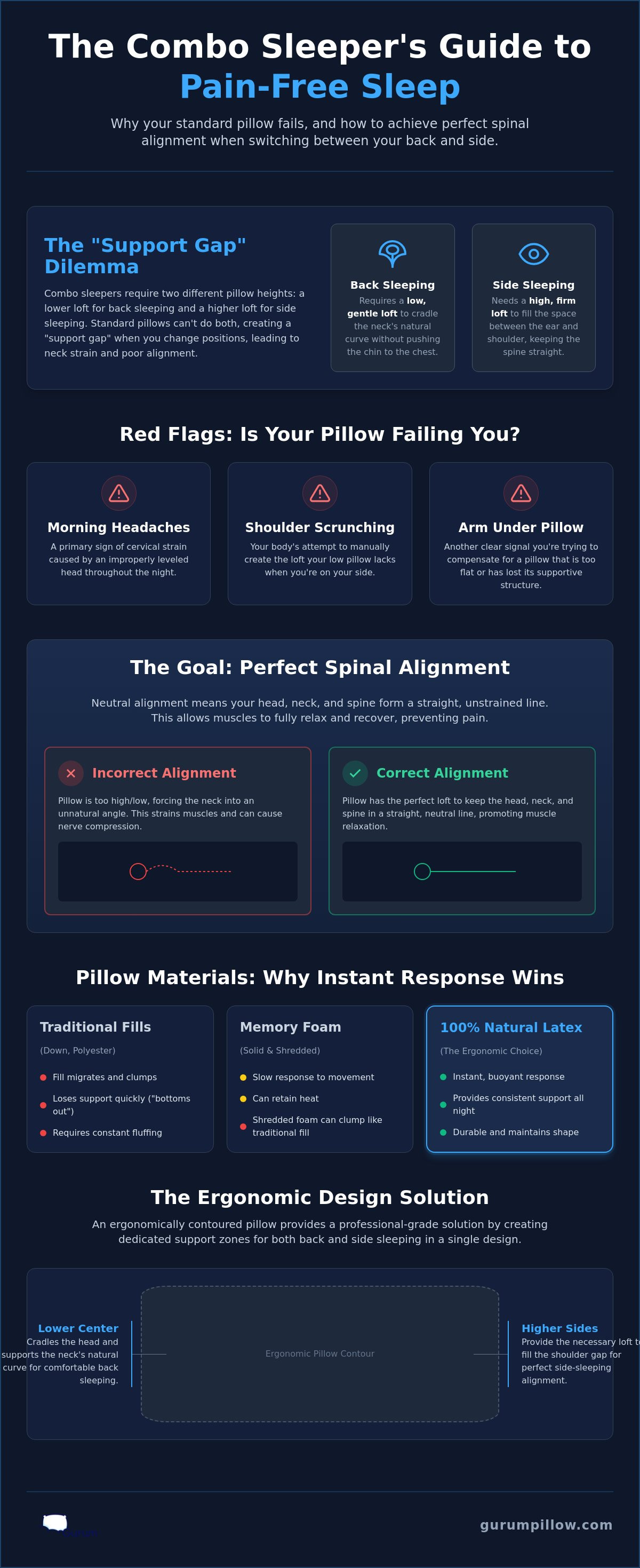
A combo sleeper is someone who spends significant time on both their side and back throughout the night. You aren't just a "side sleeper" or a "back sleeper." You're both. You likely start on your back but wake up on your side; or perhaps you flip-flop in a search for comfort. This movement creates a unique anatomical challenge. While back sleeping requires a lower loft to keep the chin from tucking, side sleeping demands a higher profile to fill the gap between the ear and the shoulder point.
Most standard pillows create a "Support Gap." They are either too firm for the back or too soft for the side. When you roll over, the pillow doesn't adjust with you. It stays static, leaving your neck hanging or your head propped at an awkward angle. This inconsistency prevents your neck muscles from ever fully relaxing. Instead of recovering, your body stays in a state of low-level tension all night. The emotional toll is real. Fragmented sleep leads to morning irritability and a lack of focus. You aren't just tired; you're physically drained from the constant manual pillow adjusting. Searching for the best pillow for back sleepers with neck pain isn't just about luxury. It's about reclaiming your mornings and your health.
The Physics of Tossing and Turning
Every time you shift weight, the internal structure of your pillow reacts. Traditional fills like down or polyester are notorious for "migrating." As you move, the fill slides away from the point of pressure, leaving you bottoming out on the mattress. These micro-awakenings rip you out of deep, restorative sleep stages. In 2026, sleep technology focuses on instant recovery. Unlike shredded foam that clumps or feathers that flatten, natural latex offers a buoyant response. It ensures the support is exactly where you need it the moment you roll over.
Recognizing the Signs of Poor Alignment
Your body sends clear signals when your support is failing. Morning headaches are a primary red flag, often stemming from cervical strain when the head isn't properly leveled. If you find yourself "shoulder scrunching" or tucking your arm under your head, your pillow is likely too low for side sleeping. You're manually trying to create the loft your bedding lacks. Many people confuse surface softness with actual relief. Orthopedic pillows are specifically engineered to provide deep structural integrity rather than just a soft touch. When you're looking for the best pillow for back sleepers with neck pain, remember that alignment is the only cure for chronic cervical pressure.
Anatomical Alignment: What Your Neck Needs in Every Position
Spinal alignment isn't just a wellness buzzword; it's the foundation of pain-free mornings. It means maintaining a neutral posture where your head, neck, and spine form a straight, unstrained line. When you're on your side, your pillow must fill the anatomical bridge between your ear and your outer shoulder. If that gap isn't filled, your head drops toward the mattress. Your neck muscles then strain to hold it up all night. Conversely, back sleeping requires the pillow to cradle the natural C-curve of your cervical spine. If the pillow is too high, it flattens that curve, pushing your head forward into an unnatural tilt. This is why the best pillow for back sleepers with neck pain must be versatile enough to handle both heights.
This creates a significant mechanical dilemma. How can one object perform two different jobs? A pillow that's high enough for your side is usually too tall for your back. This conflict is why finding the best pillow for back sleepers with neck pain feels like a constant compromise. You're often forced to choose which position to prioritize, leaving the other to suffer. The transition between these positions is where most pillows fail. They lack the dynamic response needed to shift from filling a large gap to cradling a delicate curve in seconds. Without this adaptability, your body stays in a state of physical stress until the sun comes up.
The Cervical Curve Explained
The cervical spine acts as a shock absorber for your head, preventing nerve compression and muscle fatigue through its natural curvature. The hollow at the back of your neck requires firm yet flexible support to maintain this shape. Without it, you risk developing "military neck," a condition where the curve flattens completely. This lack of structural support is a primary reason people seek out ways to alleviate neck pain through better bedding choices.
Shoulder Pressure and Side Sleeping
Pillow loft is the secret to keeping your spine straight from a side-view perspective. If the fill collapses, your shoulder takes the full weight of your torso, often leading to that "pins and needles" sensation. This numbness is a distress signal from compressed nerves. Long-term orthopedic health depends on a material that won't bottom out under the weight of your head. For those who need consistent support that adapts as they move, the Premium Latex Pillow provides the structural integrity needed to protect your shoulders and spine simultaneously. Proper alignment isn't just about comfort today; it's about preventing chronic pain years down the line.
Latex vs. Memory Foam: Why Consistency Wins for Side-to-Back Sleepers
Choosing between latex and memory foam is a matter of physics. Most people think memory foam is the gold standard for comfort. It isn't. Memory foam is designed to sink and trap. It uses your body heat to soften, creating a deep indentation that contours to your shape. While this feels cozy at first, it's a nightmare for combo sleepers. You're effectively sleeping in a hole. Natural latex offers a buoyant push-back instead. It supports your weight instantly without requiring heat to activate. This makes it the best pillow for back sleepers with neck pain who need to roll over without a struggle.
Shredded fills, such as down or foam, also present a major problem. They suffer from migration. As you shift during the night, the fill travels to the edges of the pillow. You wake up with your head on the mattress and the support bunched up under your ears. Solid-core natural latex maintains its structural integrity. It provides the same level of support at 4:00 AM as it did when you first laid down. This consistency is vital for maintaining spinal alignment through every position change.
Durability is another stark divider. High-quality natural latex maintains its shape and resilience for five years or more. Synthetic foams often begin to sag or lose their density within 24 months. You shouldn't have to replace your sleep solution every other year. Latex is also significantly more breathable. It prevents the hot pillow syndrome that triggers tossing and turning, allowing you to stay in deep sleep stages longer.
The Memory Foam Vortex
Turning over in memory foam requires physical effort. You have to climb out of the indentation you've created. This exertion leads to micro-awakenings that ruin your sleep quality. Additionally, foam is a heat sponge. As the material warms up, it loses its density. A pillow that felt firm at bedtime can feel collapsed by dawn. Synthetic foams also carry concerns regarding off-gassing. They often release chemical odors that can irritate sensitive sleepers or those with environmental sensitivities.
The Responsive Support of 100% Natural Latex
Natural latex features an open-cell structure. This design allows for constant airflow. It keeps your sleep environment cool and dry throughout the night. It's also naturally hypoallergenic. It resists dust mites and mold without the need for harsh chemical treatments. For a deeper look at why this material is the professional-grade choice, read our guide on the best latex pillow for neck pain. It's a cleaner and more reliable way for back sleepers with neck pain to achieve restorative rest.
Finding Your Perfect Loft: A Guide for Dual-Position Comfort
Loft is the technical term for pillow height. For a combination sleeper, loft is a moving target. You need a specific height to keep your head level while on your side, but that same height might strain your neck when you roll onto your back. Finding the best pillow for back sleepers with neck pain requires a balance between these two extremes. It isn't about finding a "medium" height that is mediocre for both; it's about finding a design that adapts to your unique frame.
To find your ideal fit, follow these four strategic steps:
- Step 1: Measure your shoulder width. This determines the maximum height you need to fill the gap while side sleeping.
- Step 2: Evaluate your mattress. A softer mattress allows your shoulders to sink deeper, meaning you actually need a lower pillow loft.
- Step 3: Test for the Neutral Gaze. While lying on your back, your eyes should point straight at the ceiling. If you're looking at your knees or the wall behind you, your chin is tilted and your spine is strained.
- Step 4: Verify core density. A solid core is essential. Unlike adjustable shredded pillows that shift under weight, a solid core ensures the height remains consistent all night long.
The best pillow for back sleepers with neck pain should feel like it was custom-molded for your body. If the pillow is too high, it creates tension at the base of the skull. If it's too low, it causes the shoulder to collapse. You're looking for a material that provides a "floating" sensation, where the weight of your head is evenly distributed across the surface.
Measuring for Success
You can measure your required loft at home with a simple wall test. Stand sideways against a wall and have someone measure the distance from your ear to the outer point of your shoulder. This measurement is your baseline. However, your body weight also plays a role. Heavier sleepers compress materials more than lighter sleepers. You are looking for the "Goldilocks zone." This is the height that keeps your neck neutral on your back without leaving your head hanging when you roll to your side. It is a precise anatomical requirement that generic pillows rarely meet.
Adapting to Ergonomic Support
Switching to a specialized cervical pillow often involves a transition period. During the first seven days, your muscles might feel slightly different as they unlearn years of poor posture. Muscle memory is powerful. If you've spent years on a flat or overly soft pillow, your body might initially resist proper alignment. This isn't a sign of failure; it's a sign of correction. To optimize this process, ensure your room is cool and your mattress is supportive. Breaking in a high-quality latex pillow is faster than foam because the material doesn't need to "soften" to work. It simply needs your body to accept the new, healthier baseline.
Ready to stop guessing and start sleeping? View the Premium Latex Pillow and find the specific support your cervical spine has been missing.
The Gurum Premium Latex Pillow: Designed for the Restless Sleeper
Ji H. Won didn't set out to build a bedding company. He set out to stop the pain. Like many of you, he spent years waking up with a cricked neck and a sense of physical exhaustion. He tried every "miracle" foam and adjustable fill on the market, but each one failed to provide consistent support. This personal struggle with chronic cervical pressure led to the unique Gurum design. It's a solution born from real-world frustration and a deep understanding of anatomical health. We don't just sell pillows; we provide the professional-grade tool you need to reclaim your mornings.
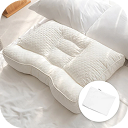
The Premium Latex Pillow is specifically engineered for the side-to-back transition. Most pillows require you to wake up and "fluff" them when you change positions. The Gurum design removes that burden. Its ergonomic contouring caters to your movements without any manual adjustment. By using 100% natural latex, we've created a foundation that provides instant response. It's the best pillow for back sleepers with neck pain because it maintains the cervical curve while offering the necessary loft for your shoulders. You get the structural integrity of a solid core with the sensory satisfaction of a soft touch.
A clean sleep environment is just as vital as proper alignment. The Anti-Allergy Pillow Cover is an essential part of the Gurum promise. It acts as a breathable sanctuary, keeping your sleep surface free from dust mites and environmental irritants. When paired with the naturally hypoallergenic properties of latex, it ensures your recovery isn't interrupted by sensitivities or heat retention. It's about creating a holistic space for restorative rest.
Engineered for Real Life
Sleep shouldn't be a sweaty or uncomfortable experience. Our pillows feature a hole-punched design that facilitates maximum airflow and temperature regulation. This keeps you cool throughout the night, preventing the tossing and turning caused by overheating. The Medium-Firm density provides immediate comfort without the risk of bottoming out. Your head stays supported, and your spine stays neutral. We provide national shipping across the USA, allowing you to upgrade your sleep setup with ease and confidence today.
A Transformation in Sleep Quality
The journey from waking up in pain to experiencing deep, restorative rest is transformative. It changes your mood, your focus, and your overall quality of life. You've likely spent years disappointed by market solutions that didn't live up to the hype. Trust your neck to the best pillow for side sleepers and back sleepers who refuse to compromise on health. For those who travel, our Travel Latex Pillow ensures you maintain perfect alignment even when you're away from home. It's time to stop settling for "good enough" and start experiencing the relief you deserve.
Reclaim Your Mornings with Restorative Rest
Achieving perfect spinal alignment shouldn't be a nightly struggle. We've explored how 100% natural latex provides the instant response combo sleepers need to move without waking. Neutral posture is the foundation of recovery. By measuring your loft and choosing a design that cradles the cervical curve, you finally end the cycle of chronic tension. Finding the best pillow for back sleepers with neck pain is more than a purchase. It's a commitment to your long-term physical and emotional health.
Our flagship solution was designed by a neck pain sufferer for neck pain sufferers. It offers the professional-grade support your body has been missing. Stop settling for fragmented sleep. Start waking up refreshed. With free shipping in the USA on qualifying orders, it's easy to upgrade your sleep setup today.
Experience pain-free sleep with the Gurum Premium Latex Pillow
You deserve to wake up without a cricked neck or numb shoulders. Take the first step toward a pain-free life. Your body will thank you every morning.
Frequently Asked Questions
Is a firm or soft pillow better for side and back sleepers?
A medium-firm pillow is usually the best choice for dual-position sleepers. Soft pillows often collapse under the head's weight, leading to spinal misalignment. Extremely firm pillows can create painful pressure points on the ears or the base of the skull. You need a material that offers immediate comfort but maintains its structural integrity. This precise balance ensures your neck stays supported whether you are resting on your back or your side.
How high should a pillow be for someone who sleeps on both their side and back?
The ideal height, or loft, depends on your shoulder width and mattress firmness. Side sleepers generally need a higher profile to fill the gap between the ear and shoulder. Back sleepers require a lower cradle to prevent the chin from tucking toward the chest. Finding the best pillow for back sleepers with neck pain involves choosing a design that accommodates both heights through ergonomic contouring rather than a flat, uniform surface.
Can one pillow really work for both sleeping positions without adjustment?
Yes, a specifically designed ergonomic pillow can support both positions seamlessly. You don't have to wake up and fluff your pillow every time you roll over. High-quality natural latex provides the instant response needed for these transitions. Because it doesn't "sink and trap" like foam, it maintains its height and shape automatically. This allows you to move freely while keeping your spine in a neutral, pain-free position all night long.
Why does my neck hurt more when I switch from my back to my side?
This pain usually stems from the "Support Gap." When you roll to your side, your head needs more elevation to stay level with your spine. If your pillow is too low, your head drops toward the mattress and strains the muscles on the opposite side of your neck. This lack of support is a primary reason people search for the best pillow for back sleepers with neck pain. Proper alignment requires a pillow that fills that anatomical bridge.
How long does a natural latex pillow last compared to memory foam?
A 100% natural latex pillow typically maintains its shape and support for five years or more. In contrast, many synthetic memory foam pillows begin to sag or lose their density within 24 months. Latex is a highly resilient material that resists permanent indentations. This durability makes it a professional-grade investment for your home wellness. You won't have to worry about your support collapsing just as you've finally found relief from chronic pain.
What is the best pillow material for avoiding night sweats and tossing?
Natural latex is the superior material for temperature regulation and breathability. Its open-cell structure allows for constant airflow, which prevents the heat trap common in synthetic foams. When your head stays cool, your body is less likely to toss and turn in search of a comfortable spot. Combining this material with a breathable cover creates a clean sleep sanctuary. This helps you stay in deep, restorative sleep stages for longer periods.
Do I need a special pillow for military neck or chronic cervical pain?
Yes, chronic cervical issues often require a pillow that specifically cradles the natural C-curve of the spine. Standard pillows often flatten this curve, which can worsen conditions like military neck. An ergonomic or orthopedic design provides firm yet flexible support in the hollow of the neck. This prevents muscle fatigue and nerve compression. It's a necessary tool for anyone struggling with long-term discomfort who needs to maintain a healthy, neutral posture while they sleep.
Can an ergonomic pillow help with shoulder pain while side sleeping?
An ergonomic pillow helps by relieving the pressure on your shoulder joint. When a pillow is too low, your shoulder takes the full weight of your torso, often leading to numbness or sharp pain. A pillow with the correct loft keeps your spine straight and lifts the weight off your shoulder. This prevents the "pins and needles" sensation. It allows you to rest on your side comfortably without the need to constantly shift positions throughout the night.