

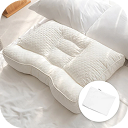
Why does your neck feel like it's been in a vice the moment you open your eyes? If you're a side sleeper, you've likely spent years "fluffing" dead pillows or sinking into memory foam that traps heat. Searching for the best latex pillow for side sleepers is often the final step for those tired of waking up with compressed shoulders and chronic stiffness. We understand the frustration of investing in your sleep only to wake up feeling physically drained. You're ready for a solution that actually works.
The truth is that most pillows fail to bridge the structural void between your ear and the mattress. High-rebound natural latex provides the consistent lift needed for neutral spinal alignment. This solves the "Side Sleeper Gap" once and for all. It offers a restorative rest without the constant need for manual adjustment. You can finally wake up refreshed, pain-free, and ready for the day. It's about moving beyond temporary comfort toward long-term anatomical health.
This 2026 guide breaks down the science of high-rebound support and breathable open-cell structures. We'll explore GOLS-certified materials and the latest ergonomic designs that regulate temperature while you rest. You'll discover how to choose a durable pillow that maintains its shape for years, transforming your sleep from a nightly struggle into a true recovery session.
Key Takeaways
- Identify the Side Sleeper Gap and learn why this specific structural void is the root cause of your chronic morning neck stiffness.
- Discover why the best latex pillow for side sleepers relies on high-rebound support to lift your head into alignment rather than sinking like traditional foam.
- Master the precise method for measuring your ideal loft by calculating the distance between your shoulder tip and ear.
- Understand how 100% natural latex offers a breathable, durable solution that eliminates overheating and prevents your pillow from going flat.
Understanding the Side Sleeper Gap and Neck Strain
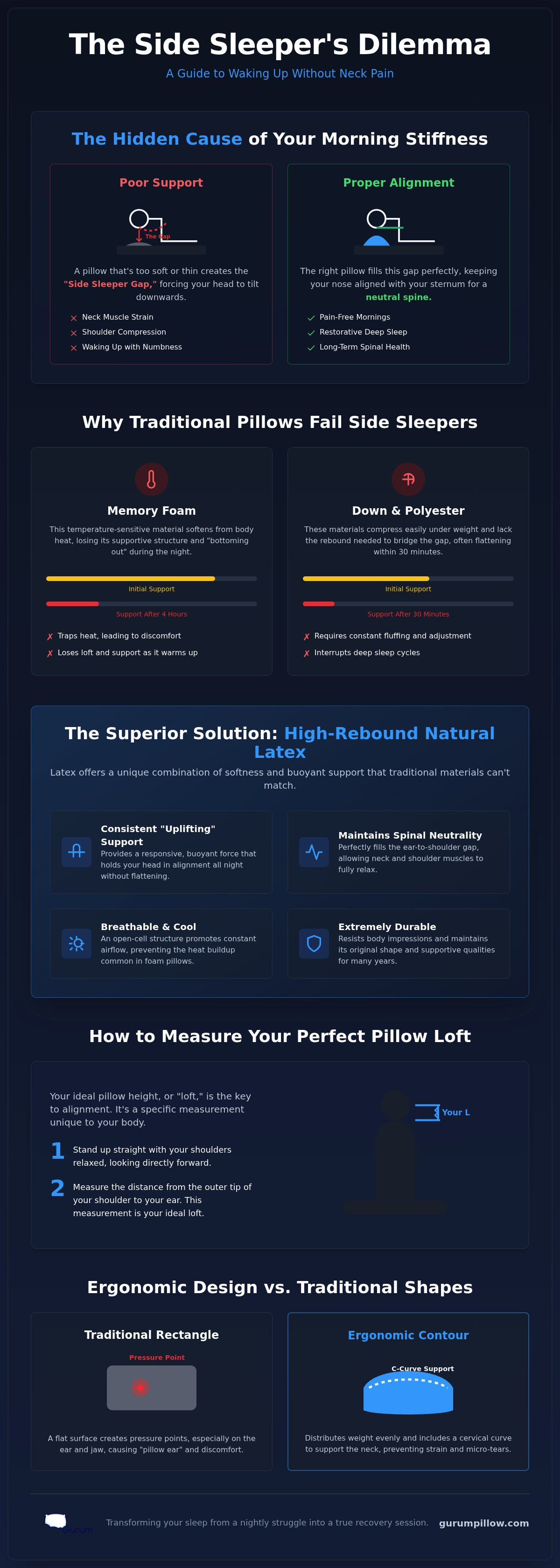
Most people sleep on their sides, yet this popular position is the most demanding on your cervical spine. When you lie on your side, you create a structural void known as the "Side Sleeper Gap." This is the vertical space between your ear and the mattress surface. It's a distance that must be perfectly filled to keep your head level. While the history and types of pillows reveal a long evolution of sleep aids, side sleepers still face this unique anatomical challenge every single night.
When this gap isn't filled by the best latex pillow for side sleepers, gravity takes over. Your head tilts downward toward the mattress. This creates a constant, low-grade stretch on the top-side neck muscles while compressing the vertebrae on the bottom side. You don't just feel this in your neck. Shoulder compression occurs when a pillow is too thin. This forces your shoulder to collapse inward to compensate for the lack of height. It leads to that familiar pins-and-needles numbness that wakes you up at 2:00 AM.
The Ear-to-Shoulder Alignment Rule
Restorative sleep depends on a simple geometric rule: your nose must stay in line with your sternum. This prevents vertebral rotation, which is a common cause of morning stiffness. When your head is properly supported, your neck muscles can finally go "off duty." A neutral spine allows the nervous system to recover during deep sleep cycles. Without this alignment, your brain remains semi-active as it tries to protect your spine from awkward angles. You can explore why spinal alignment is the key to pain-free sleep to understand the neurological benefits of maintaining proper loft throughout the night.
Why Traditional Pillows Fail Side Sleepers
Traditional materials are often the silent culprits behind chronic pain. Down and polyester pillows might feel soft at first, but they typically flatten within 30 minutes of sleep. They lose the "lift" required to bridge the Side Sleeper Gap. This leads to the "toss and turn" cycle where you're forced to fluff a dead pillow just to get comfortable again. This constant movement interrupts your REM sleep and prevents true recovery.
Memory foam has its own set of failures for side sleepers. It's a temperature-sensitive material that softens as it absorbs your body heat. As the night progresses, the foam "bottoms out." It loses the high-rebound support needed to keep your head elevated. By the time the sun comes up, you're sleeping on a compressed slab that offers no anatomical benefit. Finding the best latex pillow for side sleepers means choosing a material that stays consistent from the moment you lie down until the moment you wake up.
Anatomy of an Ergonomic Pillow for Side Sleepers
An ergonomic pillow isn't just a soft place to rest your head. It's a therapeutic tool engineered to match human curves. For those on their side, this means the pillow must act as a bridge. Finding the best latex pillow for side sleepers starts with understanding that your support needs a firmer core to maintain head height throughout the night. Without this structural integrity, the weight of your head eventually wins. You wake up with that familiar, nagging ache.
Consistent height is more critical for nerve health than surface plushness. While a "cloud-like" feel is tempting, it often masks a lack of support. Your nerves require a stable environment to avoid compression. A well-designed pillow allows your shoulder to tuck naturally under the edge without bunching. This prevents the material from pushing against your face or throat. It ensures the pillow works for your anatomy, not against it.
The Role of Cervical Support
Proper cervical support maintains the natural C-curve of your neck even when you're on your side. This isn't just about comfort. It's about medical necessity. According to expert advice on pillows and neck pain, the right support can significantly reduce morning discomfort. In this context, a cervical pillow is a device that ensures spinal neutrality by filling the space under the neck. This specific alignment prevents micro-tears in the levator scapulae muscles, which are often the source of "stiff neck" symptoms.
Contouring vs. Traditional Shapes
Traditional rectangular pillows have a major flaw for side sleepers. They push back unevenly. This creates concentrated pressure points on the ear and jaw. Have you ever woken up with a sore ear? That's "pillow ear." It's caused by the flat surface of a standard pillow resisting the weight of your head. It's an unnecessary frustration that interrupts your rest.
Ergonomic contours solve this by distributing weight across a larger surface area. The best latex pillow for side sleepers uses these shapes to cradle the head while supporting the neck. This design reduces jaw tension and promotes better circulation. It's the difference between fighting your pillow and resting with it. If you're tired of the struggle, exploring a Premium Latex Pillow might be the restorative shift your body deserves.
Latex vs. Memory Foam: Why High-Rebound Wins
Many sleepers believe memory foam is the gold standard for pressure relief. It's often marketed as "cloud-like" or "cradling." But for a side sleeper, a cloud that collapses is a physical liability. Memory foam is a slow-response material. It "traps" you in a single position as it conforms to your shape. In contrast, natural latex is a high-rebound material. It doesn't just cradle your head; it actively lifts it into alignment. This resilient lift is exactly why many experts consider it the foundation of the best latex pillow for side sleepers. It ensures your spine remains neutral even as you shift throughout the night.
Durability is another area where these materials diverge sharply. A high-quality latex pillow is a "buy it for life" investment for your sleep health. It maintains its original loft and shape for 5 to 10 years. Compare this to traditional memory foam, which often begins to sag or lose its "memory" within 1 to 3 years. When you choose latex, you're opting for a material that is naturally hypoallergenic and inherently resistant to dust mites. It's a cleaner, more durable solution for a restorative bedroom environment.
The Sinking Problem of Memory Foam
Memory foam is a thermo-reactive material. This means it responds to your body heat by softening. While this feels pleasant for the first twenty minutes, it creates a "quicksand" effect. As the night progresses and the foam warms up, your head sinks deeper. Side sleepers often wake up in pain because their pillow "gave up" at 3:00 AM. When researching how to choose a pillow for neck pain, medical experts emphasize the importance of consistent support. Latex provides this. It offers 100% consistent support from the first hour of sleep to the eighth. It doesn't soften with heat, so your alignment stays locked in place.
Breathability and Temperature Regulation
A cool head is a biological requirement for entering deep, restorative sleep. Your core temperature must drop slightly to signal to your brain that it's time for recovery. Memory foam often thwarts this process. It acts as an insulator, trapping and reflecting your body heat back toward your face. This leads to the "hot pillow" syndrome that causes tossing and turning.
Latex solves this through its physical structure. It features an open-cell design that allows for constant passive airflow. This breathability ensures that heat is whisked away rather than stored. By combining this cooling effect with the best latex pillow for side sleepers, you create an environment where your body can focus on healing rather than cooling itself down. It's a simple change that leads to a transformative difference in how you feel when the alarm goes off.
How to Select Your Perfect Loft and Firmness
Selecting the right pillow shouldn't be a guessing game. It's a calculated decision based on your unique anatomy. Most retailers suggest a "high loft" for all side sleepers, but this generic advice often leads to more pain. You need a customized approach. Finding the best latex pillow for side sleepers requires looking at four specific factors: your shoulder width, mattress firmness, body weight, and spinal neutrality. It's about precision, not just plushness.
Start by measuring the distance from the tip of your shoulder to your ear. This measurement is your baseline Side Sleeper Gap. However, this number doesn't exist in a vacuum. You must adjust for your mattress. If you sleep on a soft bed, your torso sinks deeper into the surface. This narrows the gap and requires a lower loft. Conversely, a firm mattress keeps you on top of the bed. This requires a higher loft to prevent your head from tilting downward. Your weight also plays a significant role. Heavier sleepers compress the mattress more than lighter individuals, which changes the "effective height" of the pillow.
Shoulder Width and Pillow Height
Broad-shouldered sleepers need a higher loft to fill the larger Side Sleeper Gap. Without it, the head drops and overstretches the neck muscles. Petite sleepers should be careful. A loft that is too high pushes the head upward, straining the upper cervical spine. The goal is a perfectly horizontal line from the base of your skull to your tailbone. This ensures your nervous system can fully relax without fighting gravity all night.
Testing for Neutral Alignment at Home
You can perform a "Neutral Spine Test" at home with a partner or a mirror. Lie on your side in your usual position. Check if your chin is tucked too close to your chest. Your neck should feel weightless. There should be no tension in your traps or upper shoulders. If you feel a "pull" on either side, your alignment is off. Check our best latex pillow guide for a visual alignment checklist to ensure you're getting it right.
Achieving this balance is the only way to stop the cycle of morning stiffness. If you're ready to stop guessing and start healing, you can choose your Premium Latex Pillow today. It's the definitive tool for maintaining that perfect, horizontal line all night long.
The Gurum Solution: Engineering Your Best Sleep Ever
Finding the best latex pillow for side sleepers shouldn't feel like a never ending quest. We know you've likely spent hundreds on foam slabs and down clusters that promised the world but left you with a stiff neck. The Gurum Premium Latex Pillow is the answer to that specific frustration. It's engineered for side-sleeping biomechanics, ensuring your head stays lifted and your spine stays neutral. You can finally stop the nightly battle with your bedding and start resting.
Ji H. Won designed this solution after years of struggling with the same chronic neck stiffness you feel every morning. It's a product born from personal necessity and scientific rigor. By using 100% natural latex, we've created a chemical-free environment that supports your body's natural recovery process. This isn't just about soft materials. It's about a professional-grade tool for your home. It provides the high-rebound support required to bridge the Side Sleeper Gap effectively.
Why Our Premium Latex Pillow is Different
Most pillows require constant fluffing to maintain their shape. Ours doesn't. Natural latex has a unique molecular structure that resists compression. It never goes flat, even after years of nightly use. The ergonomic shape specifically cradles your head while providing the firm cervical lift discussed in previous sections. Because it maintains its integrity for 5 to 10 years, it's widely considered the best latex pillow for neck pain available in 2026.
Support on the Go with the Travel Latex Pillow
Consistency is the secret to pain-free living. You shouldn't have to sacrifice your spinal health just because you're in a hotel or on a long flight. Our Travel Latex Pillow maintains the same ergonomic integrity as the full-sized version in a compact, portable form. It's the perfect companion for anyone who refuses to compromise on rest while away from home. If you're planning a trip, read our guide to choosing a natural latex travel pillow to see how to pack for better sleep.
To complete your sleep system, we recommend pairing your pillow with our Anti-Allergy Pillow Cover. It protects your respiratory health by creating a barrier against environmental irritants that often hide in traditional bedding. Between the breathable open-cell structure of the latex and this protective cover, you're investing in a restorative experience that lasts. You deserve to wake up feeling refreshed. You deserve a solution that actually works for your body.
Take Control of Your Morning Recovery
You don't have to accept chronic neck stiffness as a natural part of waking up. We've explored how the Side Sleeper Gap creates anatomical strain and why high-rebound support is the only permanent solution for neutral alignment. By selecting the best latex pillow for side sleepers, you're choosing a material that stays consistent from the first hour to the eighth. No more fluffing dead pillows in the middle of the night. No more waking up to compressed shoulders and numbness.
The transition to restorative rest starts with the right tools. Our pillows are crafted from 100% natural latex and designed specifically for long-term spinal health. We even offer free shipping in the USA on qualifying orders to make your recovery journey easier. You've spent enough nights fighting for comfort. It's time to let your pillow do the work for you.
End your neck pain tonight with the Gurum Premium Latex Pillow
Better sleep isn't just a luxury; it's a biological necessity for a healthy life. Take this step toward a pain-free morning and rediscover what it feels like to wake up truly refreshed. You're ready for the transformative rest you deserve.
Frequently Asked Questions
What is the best pillow loft for side sleepers?
The ideal loft for side sleepers typically ranges between 4 and 6 inches. You need enough height to fill the gap between your ear and the mattress surface. If you have broad shoulders or sleep on a firm mattress, aim for the higher end of that range. Petite sleepers on softer beds usually require a lower loft. The goal is to keep your nose perfectly aligned with your sternum.
Can an ergonomic pillow fix shoulder pain for side sleepers?
An ergonomic pillow can significantly reduce shoulder pain by preventing your weight from collapsing onto your bottom arm. When the best latex pillow for side sleepers provides proper head height, it creates space for your shoulder to rest naturally. This reduces compression on the rotator cuff and prevents that "pins and needles" sensation. It effectively shifts the burden of support from your joints to the pillow core.
How long does a natural latex pillow last compared to memory foam?
Natural latex pillows typically maintain their supportive properties for 5 to 10 years. In contrast, traditional memory foam often begins to sag or lose its shape within 1 to 3 years. Latex is a high-rebound material that resists permanent indentations or softening from body heat. This durability makes it a superior long-term investment for your sleep health. You won't need to replace it nearly as often.
Are latex pillows good for side sleepers with allergies?
Yes, natural latex is an excellent choice for side sleepers with environmental sensitivities. It is inherently resistant to dust mites, mold, and mildew without the use of harsh chemical additives. The open-cell structure also promotes constant airflow, which prevents the moisture buildup that allergens thrive on. Pairing your pillow with an Anti-Allergy Pillow Cover provides an extra layer of respiratory protection for a cleaner sleep environment.
Why does my ear hurt when I sleep on my side?
Ear pain often occurs when a traditional flat pillow creates concentrated pressure points on the cartilage. This is common with pillows that are too firm or lack ergonomic contouring. The flat surface resists the weight of your head rather than cradling it. An ergonomic latex design distributes this weight across a larger surface area. This relieves the direct pressure on your ear and prevents morning soreness or skin irritation.
How do I know if my pillow is too high or too low?
You can identify height issues by checking your neck angle in a mirror while lying down. If your pillow is too high, your head will tilt upward, causing strain on the top side of your neck. If it's too low, your head will drop toward the mattress, overstretching the opposite side. Your chin should not be tucked toward your chest. A neutral spine should look like a straight, horizontal line.
Is a firm or soft pillow better for side sleeping?
Side sleepers generally benefit most from a medium-firm pillow. While a soft pillow feels inviting, it rarely provides the consistent lift needed to bridge the Side Sleeper Gap. You need a material with enough push-back to keep your head elevated throughout the night. Finding the best latex pillow for side sleepers means looking for this balance. It feels soft to the touch but provides the firm underlying support required for alignment.
Does a side sleeper pillow help with snoring or sleep apnea?
A side sleeper pillow can help reduce snoring by maintaining an open airway through proper alignment. When your head and neck are supported, your throat tissues are less likely to collapse and vibrate. While it is not a cure for clinical sleep apnea, side sleeping is often recommended by doctors to keep the tongue from blocking the airway. Proper loft ensures you stay comfortably in this beneficial position all night long.