


Did you know that 21% of travelers have had an entire trip ruined by neck or back pain? It's a frustrating reality for one in three Americans who experience physical discomfort while flying. You've likely spent hours shifting your weight and trying to find a position that doesn't leave your neck feeling locked in a vise. We understand that chronic stiffness and post-flight headaches aren't just minor annoyances. They're real barriers to enjoying your destination. Learning how to avoid neck pain on a plane is about more than just comfort. It's about protecting your anatomical health in a cabin environment designed for safety rather than your spine's natural curve.
We're here to help you reclaim your rest. Discover the anatomical secrets to arriving refreshed and pain-free with our comprehensive guide to airplane ergonomics. We'll explore the latest 2026 travel regulations, including new TSA rules on gel inserts and how to navigate the shift toward vertical seating on budget carriers. From choosing the right portable support to simple movement strategies, this guide provides five expert tips to help you sleep soundly. You'll learn exactly how to land without a single "crick" in your neck.
Key Takeaways
- Understand why standard economy seats force your spine into a damaging "C-shape" and how to counteract this design flaw.
- Learn why traditional memory foam often fails in hot cabins and why resilient, natural materials offer superior cervical support.
- Discover five practical steps on how to avoid neck pain on a plane, from dynamic stretching to optimizing your seat's lumbar-neck connection.
- Master post-flight recovery techniques like spinal decompression and targeted temperature therapy to reset your body after landing.
- Explore how a high-quality Travel Latex Pillow provides the consistent, breathable support needed for restorative rest at 30,000 feet.
The Anatomy of the "Airplane Ache": Why Seats Cause Neck Pain
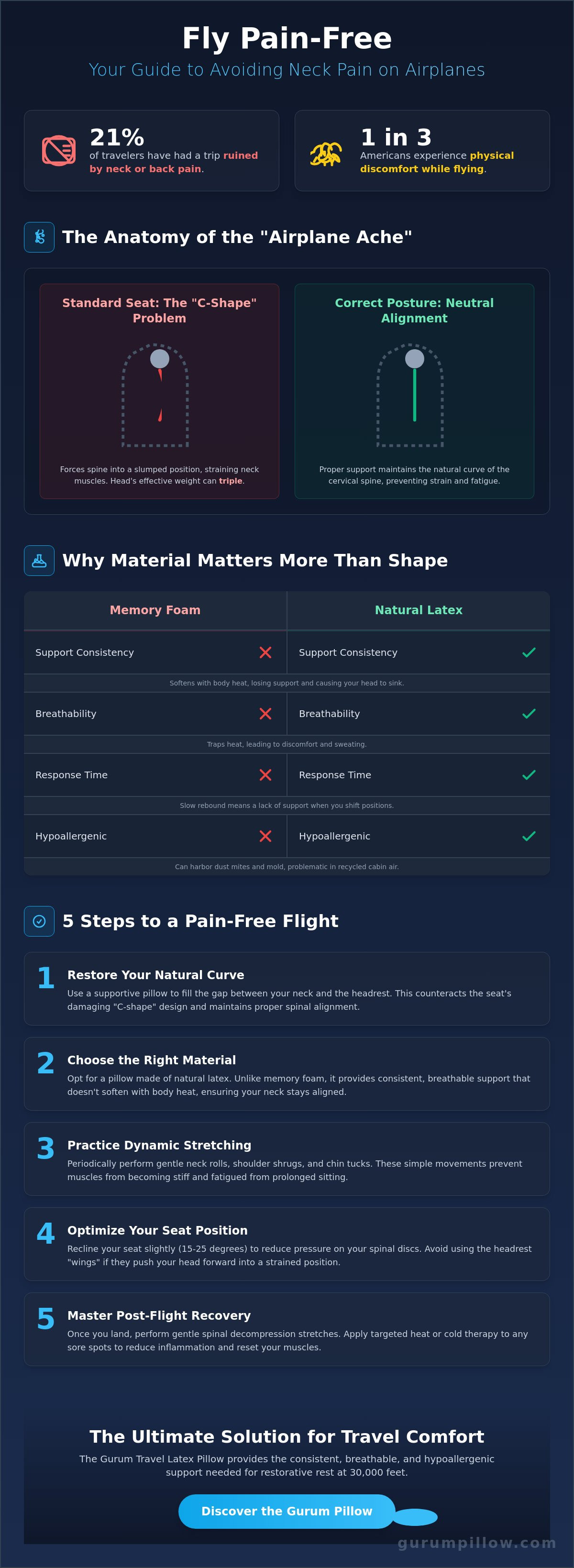
The design of a standard economy seat is a marvel of safety engineering, but it’s a disaster for your spine. Most seats feature a curved backrest that forces your body into a slumped "C-shape." This posture collapses your lower back and rounds your shoulders, leaving your neck to bear the brunt of the misalignment. When you understand the mechanics of this position, you can finally begin to learn The Anatomy of 'Airplane Ache' and why it feels so persistent after landing. It's the primary reason why knowing how to avoid neck pain on a plane is essential for any frequent traveler.
The problem is exacerbated by a total lack of lateral support. Without a stable surface to rest against, your head eventually bobs as you drift off. This sudden, jerky movement jars the cervical spine. This area is already vulnerable to the constant, low-level vibrations of the aircraft engines. These micro-vibrations cause muscles to fatigue much faster than they would on solid ground. It turns a simple six-hour flight into a marathon of physical stress for your connective tissues.
The Cervical Spine Under Pressure
In a neutral position, your head weighs about 10 to 12 pounds. It's a heavy load for your neck to carry. However, when the seat forces your head into a forward tilt, that effective weight can double or even triple. This creates immense strain on the levator scapulae and trapezius muscles. These muscles work overtime to keep your head from falling. Combined with the dry cabin air and dehydration, your muscle fibers become less elastic. This makes stiffness almost inevitable. You aren't just tired; your muscles are physically exhausted from the fight against gravity.
The Flaw in Standard Headrests
Airplane headrests often feature adjustable "wings" meant to provide support. In reality, these often push the skull forward, deepening the Forward Head Posture (FHP). This "one-size-fits-all" approach fails because ergonomics are deeply personal. True cervical alignment occurs only when your vertebrae stack vertically in a neutral state. To truly master how to avoid neck pain on a plane, you must find ways to fill the gap between your neck and the seat. You need to restore the natural curve that the chair is trying to flatten. Without a portable solution to counteract this mechanical flaw, your neck remains in a state of constant tension.
Choosing Your Support: Why Material Matters More Than Shape
Most travelers pick a pillow based on its aesthetic or how small it folds. They often ignore the most critical factor: the material inside. If you want to know how to avoid neck pain on a plane, you have to look beyond the standard "U-shape." The material determines whether your cervical spine stays aligned or collapses under the weight of your head during a long flight. Choosing the wrong support can turn a quick nap into a week of physical therapy.
Memory foam is the most common choice, but it's often the most problematic in a flight environment. It's a notorious heat trap. In a cramped, poorly ventilated airplane cabin, memory foam absorbs your body heat and softens significantly. As it loses its structural integrity, your head begins to sink. This leads to the very misalignment you were trying to avoid. You end up with your chin tucked toward your chest, which places immense strain on the posterior neck muscles.
Latex vs. Memory Foam for Travel
Natural latex is the superior alternative for frequent fliers. It offers a buoyant support that doesn't rely on heat to conform to your body. It stays consistent and resilient regardless of the cabin temperature. Because latex has an "instant rebound," it provides constant support even when you shift positions. The open-cell structure of the material also ensures high breathability. This keeps you cool and prevents the "sweaty neck" feeling that often wakes travelers up. For those seeking the gold standard in comfort, a natural latex travel pillow is the most effective tool for maintaining neutral alignment at 30,000 feet.
Hypoallergenic properties are another reason to choose your materials carefully. Travel gear stays in close contact with your skin and respiratory system for hours. Natural latex is inherently resistant to dust mites and mold, which is vital when you're breathing recycled cabin air. This focus on purity and health makes your eventual Post-Flight Recovery much easier. You won't just arrive without a "crick" in your neck; you'll arrive feeling clean and refreshed.
The Inflatable Trap
Inflatable pillows are popular for their portability, but they lack the density required for true orthopedic support. An air-filled cushion is essentially a balloon. It lacks the complex cell structure needed to dampen vibrations. This creates a "bouncing" effect. Every time the aircraft experiences minor turbulence or engine vibration, your head micro-bounces against the pillow. These tiny, repetitive movements cause micro-strains in the delicate muscles of your neck. You might save space in your carry-on, but you'll likely pay for it with a tension headache upon arrival.
Investing in a high-quality support system is the best way to ensure you actually enjoy your destination. Our Travel Latex Pillow was designed to solve these specific ergonomic failures, providing the density of a home pillow in a travel-ready size.
5 Steps to Avoid Neck Pain on a Plane
Understanding the anatomy of your discomfort is the first step. Now, you need a proactive strategy to maintain your health during the flight. These five steps combine anatomical science with practical cabin reality. They offer a clear roadmap for how to avoid neck pain on a plane, regardless of your seat assignment.
- Step 1: Prime Your Muscles. Begin with pre-flight hydration. Dehydrated muscles are prone to cramping and stiffness. Perform dynamic neck stretches, like gentle side-to-side tilts, to increase blood flow to the cervical area before boarding.
- Step 2: Optimize Your Seat. If possible, choose airlines like Japan Airlines or ANA, which offer a 34-inch seat pitch. Avoid the "standing-only" seats appearing on some budget flights in 2026. Use a small jacket or towel to support your lumbar curve. This stabilizes your base and prevents the "C-shape" collapse.
- Step 3: Secure 360-Degree Stability. Don't just place your pillow; secure it. It should act as a soft brace that prevents your head from tilting beyond its natural range of motion.
- Step 4: Follow the 90-90-90 Rule. Keep your hips, knees, and ankles at 90-degree angles. Use your carry-on bag as a footrest if your feet don't touch the floor. This alignment reduces the pull on your upper back and neck.
- Step 5: Move Every 90 Minutes. Set a timer. Get up and walk the aisle to reset your systemic circulation and prevent static muscle loading.
The Correct Way to Wear a Travel Pillow
Most travelers leave the gap of their pillow at the front. This is often a mistake. If you find your head falling forward, rotate the pillow 180 degrees. This provides a "shelf" for your chin to rest on, preventing the sudden "head bob" that jars the spine. Proper travel pillow placement should eliminate the space between your neck and the seat, not push your head away from it. By filling this void, you allow your muscles to fully relax without losing cervical alignment. It's a simple rotation that changes your entire sleep quality.
In-Flight Ergonomic Exercises
You don't need much space to stay limber. Try "Chin Tucks" to reset your posture. Gently draw your chin straight back, as if making a double chin, to align your ears over your shoulders. This movement decompresses the upper vertebrae. Follow this with a "Seated Cat-Cow." Place your hands on your knees. Inhale as you arch your back slightly and look up. Exhale as you round your spine. These micro-movements counteract the rigidity of long-haul travel. Simple shoulder rolls can also release tension in the trapezius before it radiates into a headache. We recommend walking the cabin every 90 minutes to keep your circulation moving. This holistic approach is the most effective way to manage how to avoid neck pain on a plane.
Post-Flight Recovery: Resetting Your Spine After Landing
Your journey doesn't end when the wheels touch the tarmac. The compression your spine endured during the flight requires immediate attention. While you've learned how to avoid neck pain on a plane during transit, the post-flight window is when you prevent temporary stiffness from becoming chronic. Decompressing the vertebrae is essential. It allows the discs to rehydrate and the muscles to release the "guarded" state they adopted in that cramped cabin.
Knowing when to use temperature is key. If you feel a sharp, localized sting, reach for a cold pack. It reduces inflammation from those micro-vibrations discussed in earlier sections. For a general, heavy ache in the trapezius, use heat. A warm shower or a heat pad increases blood flow and coaxes tight fibers back to their resting length. This simple distinction can be the difference between a productive trip and a weekend spent in bed.
The Hotel Room Spinal Reset
Most travelers head straight for the hotel bed, but the floor is actually your best friend. Laying flat on a hard surface for 10 minutes without a pillow allows gravity to do the work of decompression. Try the "Wall Slide" stretch. Stand against a flat wall and slowly raise your arms while keeping your elbows and wrists in contact with the surface. It opens the chest and counteracts the rounded shoulders caused by the seat's "C-shape." For stubborn knots, use a tennis ball. Place it between your shoulder blade and the wall, leaning in to apply pressure to plane-stiffened traps. This self-myofascial release breaks up adhesions that stretches alone can't reach.
The Role of Your Home Pillow
Your first night back is the most critical for long-term recovery. This is when your body attempts to repair the structural stress of travel. If you return to a sagging or unsupportive surface, you reinforce the poor alignment from the plane. Consistency is the secret to a pain-free life. Using the best latex pillow for neck pain ensures your cervical spine stays neutral while you recover from the trip. It provides the same buoyant, breathable support you need at 30,000 feet, but in a size designed for your nightly ritual.
Ensure your recovery is complete by resting on our Premium Latex Pillow for targeted, anatomical support.
The Gurum Solution: Why Our Travel Latex Pillow is Different
We've explored the mechanical flaws of airplane seats and the shortcomings of traditional materials. Now, we offer a definitive answer. Our Travel Latex Pillow is the portable counterpart to our Premium Latex Pillow. It's designed for those who refuse to compromise on their health just because they're 30,000 feet in the air. This isn't just another travel accessory. It's a professional-grade tool for restorative rest. When you're looking for how to avoid neck pain on a plane, the solution lies in the resilience of 100% natural latex.
Unlike memory foam, which we've noted softens and loses its structure in warm cabins, natural latex maintains its integrity. It never goes flat. It won't lose its shape halfway through a long-haul flight. The "Small but Mighty" design ensures it fits easily into your carry-on luggage without taking up excessive space. It's dense enough to provide real orthopedic support but light enough for the modern traveler. The core is inherently breathable and hypoallergenic, protecting you from the environmental sensitivities often found in public transit.
Eronomics on the Go
The specific contouring of our travel version mimics a professional cervical pillow. It fills the void between your neck and the headrest, providing the stable, neutral alignment your spine craves. This is the "Relatable Expert" approved support that prevents your head from dropping or bobbing. We also include an Anti-Allergy Pillow Cover. It ensures a clean, soft sleep environment anywhere in the world. You won't have to worry about the dust or allergens that often hide in airplane upholstery or standard cabin gear.
From Plane to Hotel
The versatility of our travel version extends far beyond the aircraft cabin. Most hotel pillows are either too soft or too high, leading to the "Forward Head Posture" we've worked so hard to avoid. Our Travel Latex Pillow is the perfect size to layer on top of a hotel pillow or use on its own. It provides consistent support from the moment you board until you wake up at your destination. It's a durable, one-time investment for a lifetime of pain-free travel. You don't have to settle for "good enough" rest when you're away from home. Experience the difference with our Travel Latex Pillow and change the way you arrive.
Arrive Refreshed and Ready to Explore
You've learned that your anatomy doesn't have to be at the mercy of poor airline seat design. By mastering the "90-90-90" rule and committing to a post-flight floor reset, you've taken the first steps toward pain-free travel. Knowing how to avoid neck pain on a plane is truly about maintaining that neutral cervical alignment we've discussed. It's about filling the gap between your spine and the seat with resilient materials that actually support your weight through every engine vibration.
Don't let your next trip be defined by stiffness or lingering headaches. Our Travel Latex Pillow is crafted from 100% natural latex and was ergonomically designed by experts to provide the buoyant support that memory foam simply can't match. We're committed to your comfort, which is why we offer free shipping on qualifying US orders. It's time to invest in a solution that works as hard as you do to find rest.
Shop the Gurum Travel Latex Pillow for your next flight
You deserve to land feeling as vibrant as your destination. We're here to help you wake up refreshed, aligned, and ready for your next adventure. Safe travels and restorative rest are finally within your reach.
Frequently Asked Questions
Is it better to sleep with or without a travel pillow on a plane?
It's much better to sleep with a pillow, provided it offers genuine anatomical support. Sleeping without one allows your head to tilt beyond its natural range of motion. This places immense strain on the cervical ligaments and muscles. A well-designed pillow fills the void between your neck and the seat. This is a primary strategy for how to avoid neck pain on a plane. It allows your body to relax into a neutral, healthy position.
How do I stop my head from falling forward when I sleep on a plane?
You can prevent this by rotating your pillow 180 degrees so the bulk of the support is under your chin. Most travelers leave the gap in the front, which provides no resistance when your head drops. Closing that gap creates a soft brace for your jaw. It stabilizes your posture and prevents the sudden, painful waking caused by a falling head. It's a simple fix for a common travel frustration.
Why does my neck hurt even when I use a U-shaped travel pillow?
Many U-shaped pillows are made from low-density materials like polyester fill or cheap foam. These materials flatten under the weight of your head, offering only the illusion of support. If the pillow is too thin at the back, it can actually push your head forward into a "C-shape." You need a high-density, resilient material that maintains its structural integrity. This ensures your vertebrae stay stacked vertically throughout the entire flight.
Can a plane seat actually cause permanent neck damage?
A single flight typically won't cause permanent damage, but chronic misalignment is a serious concern. Repeatedly forcing your spine into "Forward Head Posture" (FHP) increases the load on your discs and joints. This can lead to long-term stiffness or accelerated disc degeneration. Protecting your cervical alignment during travel isn't just about comfort for the day. It's about preserving your spinal health for years to come.
What is the best material for a travel neck pillow?
Natural latex is the most effective material for travel pillows. It offers a unique combination of breathability and buoyant support. Unlike memory foam, it doesn't rely on body heat to mold to your shape. This means it stays firm and supportive even in fluctuating cabin temperatures. It's also inherently hypoallergenic. This is a crucial feature when you're resting your face against a surface for several hours in a public space.
Should I use a lumbar support pillow alongside a neck pillow on a flight?
Supporting your lower back is essential for neck health. The spine functions as a single unit. When your lumbar curve flattens against a standard seat, your neck naturally rounds forward to maintain balance. This creates a chain reaction of tension. Using a lumbar support helps you sit taller and keeps your shoulders back. This makes it much easier to keep your head in a neutral, pain-free position during the flight.
How can I stretch my neck in a cramped economy seat?
Micro-movements are your best tool in tight quarters. Try "Chin Tucks" by drawing your head straight back as if making a double chin. This resets the cervical spine. You can also do isometric neck presses. Gently push your head against your hand or the headrest for five seconds. These exercises engage the stabilizing muscles without disturbing your neighbors. They are vital for anyone wondering how to avoid neck pain on a plane.
Does the window seat really help with neck pain?
The window seat offers a wall to lean on, but it requires caution. The cabin wall is often cold and vibrates with the engine. This can cause your neck muscles to spasm or stiffen. If you use the wall, always place a dense, supportive pillow like a Travel Latex Pillow between your head and the surface. This dampens the vibration and ensures your neck isn't bent at an extreme angle while you sleep.